A mic stand is the most boring piece of gear you own. Nobody geeks out over one. That is, until yours sags mid-take, or a leg gives out and drops a pricey condenser onto a hardwood floor. Then it becomes the most important thing in the room.
So let's talk about the ones worth your money. Five boom stands, honest takes on each, matched to different needs and budgets. No fluff, no filler. Here's the list.
TABLE OF CONTENTS
What to look for in a boom mic stand
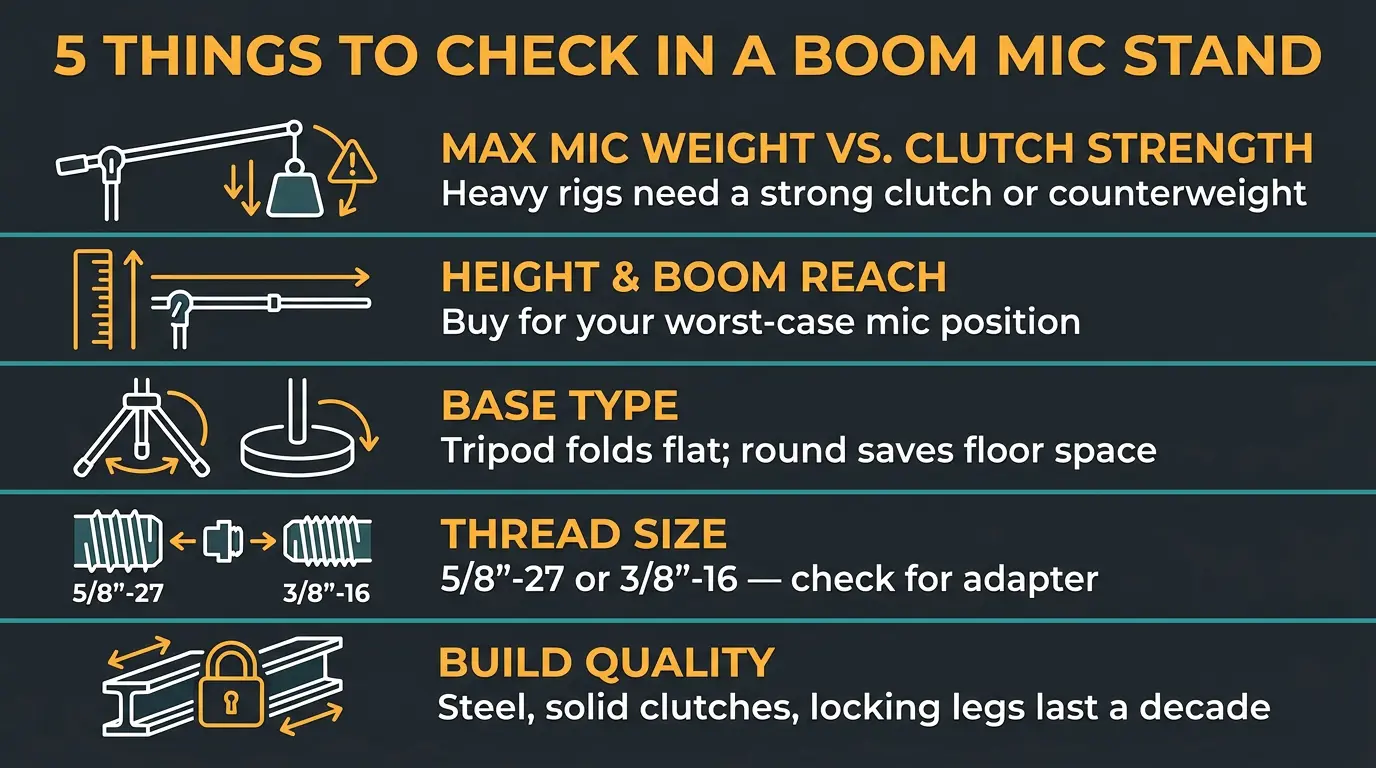
Most of the differences between stands come down to a handful of things. Get these right and you won't think about your stand again, which is exactly the point.
- Max mic weight vs. clutch strength. A heavy condenser in a shock mount puts real load on the boom. If the clutch can't hold it, the arm creeps downward during your session. Heavy rigs want a strong clutch or a counterweight.
- Height and boom reach. Vocals at a desk need way less reach than a drum overhead. Figure out your worst-case position and buy for that.
- Base type. Tripod bases fold flat and travel well. Round bases take up less floor space but are heavier and less stable with a long boom extended.
- Thread size. Mic clips use either 5/8"-27 or 3/8"-16. Most good stands include an adapter, but check before you order so you're not stuck.
- Build quality. Steel where it matters, decent clutches, and legs that lock. This is the difference between a stand that lasts a decade and one you replace next year.
All right, cool. Let's give it a listen to the picks.
On-Stage MS7701B Mic Stand

#1
Best Overall
On-Stage MS7701B Mic Stand
This is the stand I'd hand to most people without a second thought. The On-Stage MS7701B is a Euro boom that adjusts from 37 to 64 inches, with a fixed 31-inch boom, a tripod base, and a twist-action clutch that holds where you set it. The legs fold, the whole thing is composite steel and plastic, and it weighs around 5.2 pounds. Setup is quick and it stays put.
It's stable for what it is, and it works just as well in the studio as it does on stage. The honest knock is the fixed boom — it doesn't telescope, so you get less flexibility than some others here when you're wrestling with an awkward position. Stock can also be intermittent at some retailers, so if you see one in stock, grab it. If you want the manufacturer's full rundown, On-Stage has a breakdown of the Euro Boom line worth a look. For the money, this is the one that fits the most situations.
Pros
- Genuinely stable tripod base for studio or live use
- Fast, no-fuss setup with a reliable twist clutch
- Folds down small for transport
- Lightweight at around 5.2 pounds
Cons
- Fixed 31-inch boom, no telescoping
- Stock can be spotty at some retailers
K&M 21090 Mic Stand

#2
Top Pick
K&M 21090 Mic Stand
If you want a stand that outlives your interface, your monitors, and possibly you, the K&M 21090 is it. Made in Germany, it has a telescoping boom from 17.1 to 29.3 inches, a height range of 35.4 to 63.2 inches, a 5/8-inch thread, and it comes in black or chrome. Everything on it feels deliberate.
The real story here is longevity. K&M backs it with a 5-year warranty and keeps replacement parts available for 10 years, so when something eventually wears, you fix it instead of tossing it. That's rare. The honest trade-off is that it costs more than the others on this list, and the boom reach is fairly modest. If you gig hard or just hate replacing gear, this is the buy-it-once pick.
Pros
- German build quality that holds up for years
- 5-year warranty and 10-year parts availability
- Telescoping boom for finer positioning
- Black or chrome finish options
Cons
- Priced above the rest of the field
- Boom reach is modest compared to bigger stands
Gator Frameworks Tripod Mic Stand
#3
Top Pick
Gator Frameworks Tripod Mic Stand
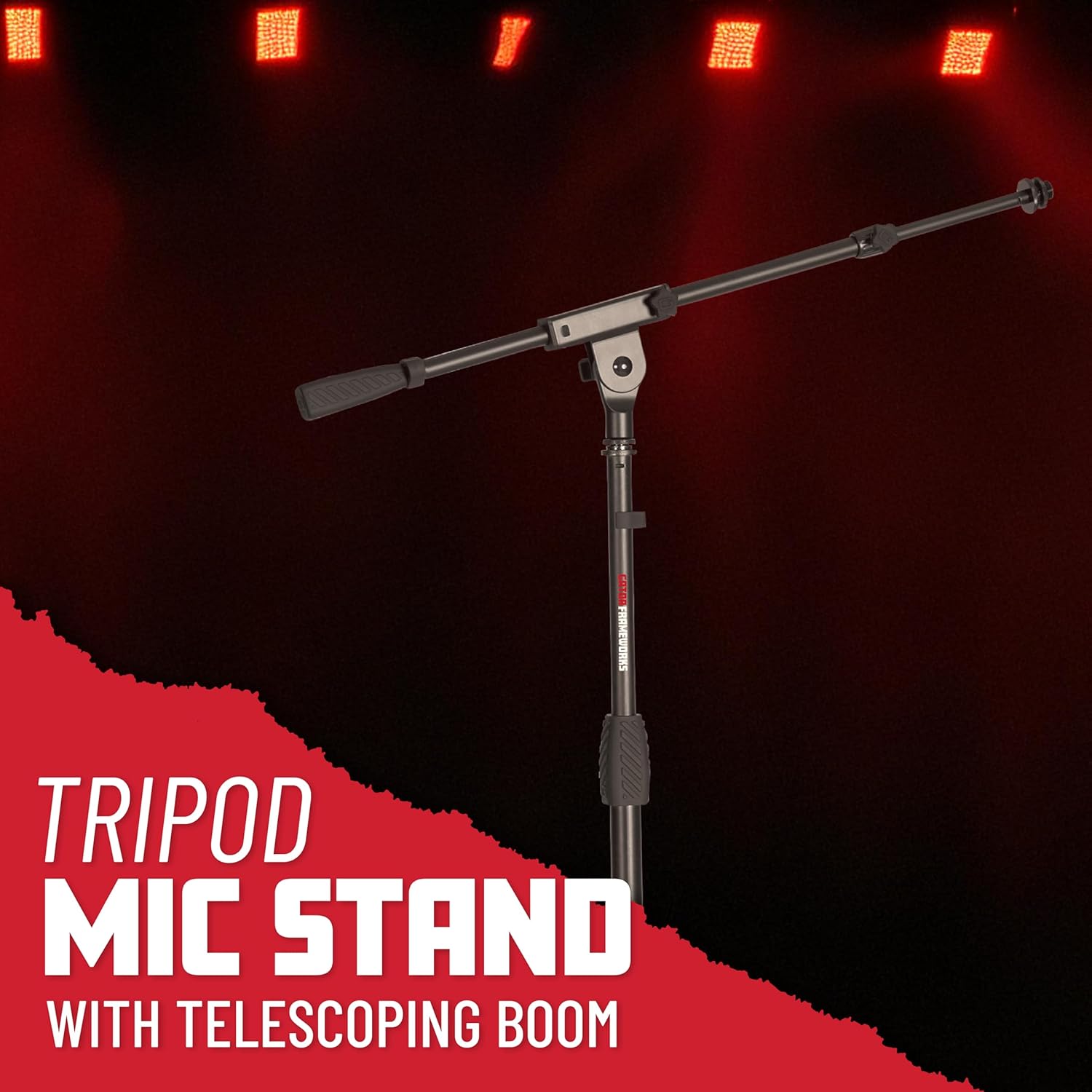
When you need to get a mic somewhere weird, the Gator Frameworks GFW-MIC-2020 is the reach champion. Height adjusts from 6 all the way to 99 inches, the boom telescopes, and it rides on a folding tripod base. It's steel, weighs about 5 pounds, and includes both 5/8"-27 and 3/8"-16 threads so it fits US and Euro clips.
The little touches are nice — removable red safety trim on the feet and built-in cable clips. Now, the honest part: reviews on this one are split. The friction clutch won't hold a very heavy mic, and some folks report connector wear under heavy gigging. So if you're hanging a big condenser in a shock mount, plan on a counterweight. For overheads and general-purpose positioning, it's a workhorse.
Pros
- Enormous 6 to 99 inch height range
- Telescoping boom for tough positions
- Both 5/8 and 3/8 threads included
- Cable clips and removable safety trim on the feet
Cons
- Friction clutch struggles with heavy mics — plan a counterweight
- Some reports of connector wear under heavy use
CAHAYA Tripod Microphone Stand
#4
Top Pick
CAHAYA Tripod Microphone Stand
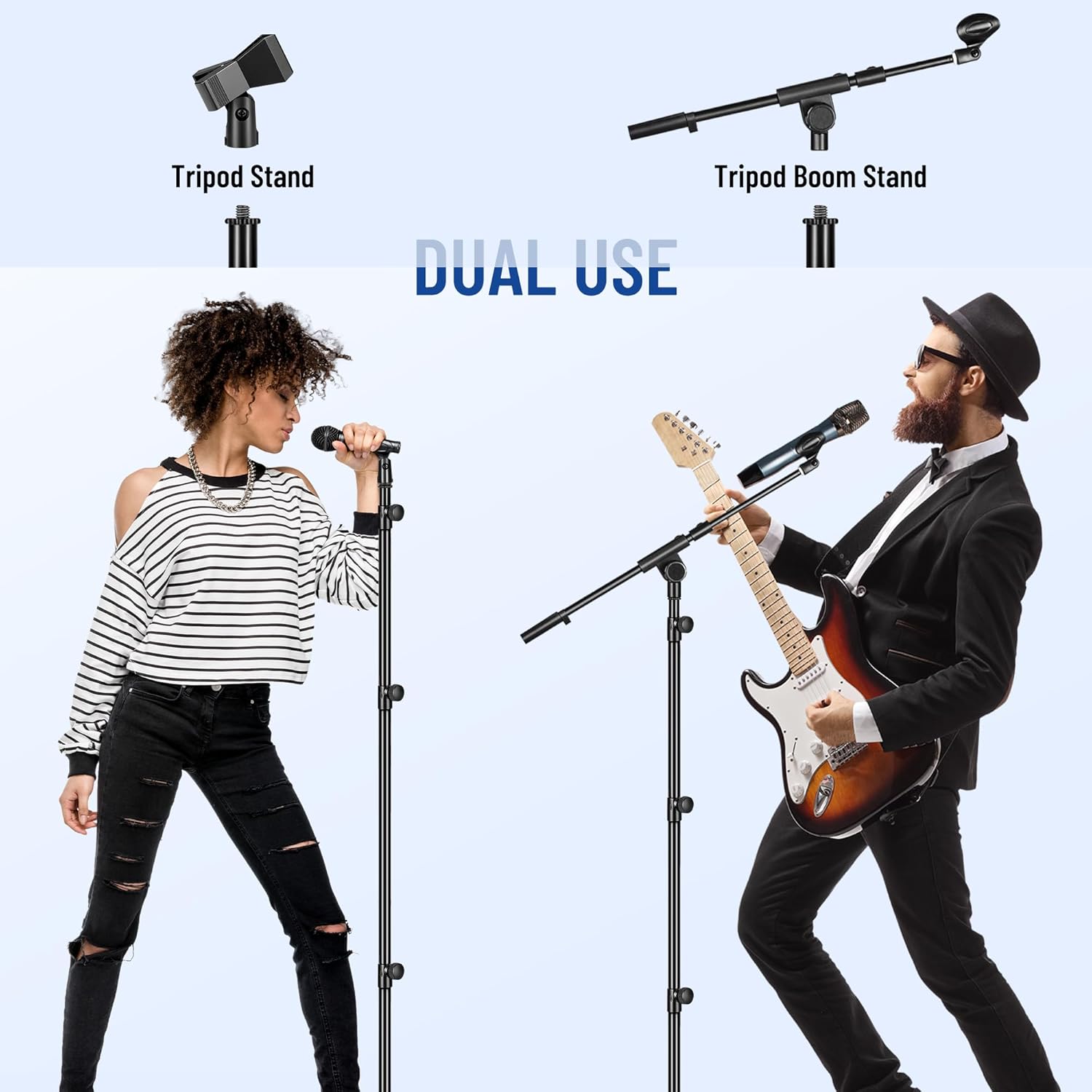
For home recording and streaming, the CAHAYA tripod does the job without drama. Height runs from 25.2 to 62.2 inches, the boom extends 16.9 to 30.1 inches, and it rotates a full 360 degrees via the adjustment knobs. It ships with a carry bag and two clips — a barrel style and a clothespin style — and plays nice with the usual suspects like the Shure SM58, Samson Q2U, and HyperX QuadCast.
It's solid value for dynamic mics and podcast setups. The one caveat worth flagging: CAHAYA sells a bunch of near-identical models under different SKUs, so make sure you confirm the exact listing before you buy. This isn't the stand for a heavy condenser rig, but for a desk mic or a spoken-word setup, it's plenty.
Pros
- Comes with carry bag and two clip styles
- 360-degree boom rotation via knobs
- Works with common dynamic and USB mics
- Easy to set up for streaming and podcasting
Cons
- Not built for heavy condensers or shock-mount rigs
- Many similar SKUs — confirm the exact listing
Amazon Basics Boom Microphone Stand

#5
Top Pick
Amazon Basics Boom Microphone Stand
If you just need to get a mic in the air and you're keeping it simple, the Amazon Basics boom stand does that. It goes up to 85.75 inches, has a 21-inch base width, and folds flat to work as a straight stand if you don't need the boom. Steel build, includes a 3/8-to-5/8 adapter and a clip-on cable holder.
Here's the caveat you can't skip: max mic weight is about 2 pounds. That rules out heavy condensers and most shock-mount setups. Push past that and you're asking for a sag or a spill. Like the CAHAYA, there are several near-identical variants floating around, so verify the link. For dynamics, light mics, and getting started, it's a fine way in.
Pros
- Tall reach up to 85.75 inches
- Folds flat to double as a straight stand
- Includes thread adapter and cable holder
- Simple, no-frills entry point
Cons
- Only rated for about 2 pounds — no heavy condensers
- Multiple near-identical variants to sort through
| Model | Max Height | Boom Reach | Best For |
|---|---|---|---|
| On-Stage MS7701B | 64 in | Fixed 31 in | All-round studio and live use |
| K&M 21090 | 63.2 in | 17.1–29.3 in (telescoping) | Buy-it-once durability |
| Gator Frameworks GFW-MIC-2020 | 99 in | Telescoping | Reach and awkward positions |
| CAHAYA Tripod | 62.2 in | 16.9–30.1 in | Home recording and streaming |
| Amazon Basics Boom | 85.75 in | Folds flat | Light mics on a tight budget |
Frequently Asked Questions (FAQs)
What's the difference between a boom stand and a straight stand?
A boom stand has a horizontal arm that extends off the top, so you can position the mic away from the base. A straight stand goes straight up with the mic clip on top. Booms are more flexible for overheads, instruments, and awkward angles. Straight stands are simpler and take up less room.
Can these stands hold heavy condenser mics?
Some can, some can't. Heavier condensers in shock mounts put a lot of leverage on the boom, and lighter stands like the Amazon Basics (rated around 2 pounds) will sag or tip. For heavy mics, use a sturdy stand like the K&M, keep the boom shorter, and add a counterweight if the clutch can't hold it.
What thread size do mic clips use?
Mic clips use either 5/8"-27 (common in the US) or 3/8"-16 (common in Europe). Most quality stands include an adapter to convert between the two, and some, like the Gator, have both threads built in. Make sure you check which one your clip needs before ordering.
Is a tripod base or round base better for a boom stand?
It depends on your space. Tripod bases fold flat, travel well, and stay stable with a long boom extended, which is why most boom stands use them. Round bases take up less floor space and slide under desks easily, but they can tip if the boom reaches out too far with a heavy mic.
Do I need a separate shock mount or pop filter?
Usually, yes — most stands ship with a basic clip, not a shock mount or pop filter. A shock mount isolates the mic from stand vibration and footsteps, and a pop filter tames plosives on vocals. Just remember a shock mount adds weight, so factor that into your stand's max load.
Final Thoughts
Any of these five will get a mic where you need it. The On-Stage is the one I'd point most people to first, the K&M is the one you buy once and forget about, and the Gator is there when you need serious reach. The CAHAYA and Amazon Basics are honest entry points, as long as you respect their weight limits.
Match the stand to the mic and the job, and don't overthink it — a good stand is one you never think about again. And once your recording space is sorted, it's worth keeping the rest of it tidy too, whether that's a proper recording desk or a rack to keep your gear organized. Make sure you buy for your worst-case setup, not your best-case one.
Some of the links within this article are affiliate links. These links are from various companies such as Amazon. This means if you click on any of these links and purchase the item or service, I will receive an affiliate commission. This is at no cost to you and the money gets invested back into Audio Sorcerer LLC.