The robot-gargling era is over. Modern AI vocals sound smooth, clean, and honestly a little uncanny. In April 2026, Deezer reported that roughly 44% of the tracks uploaded to its platform every day are AI-generated — about 75,000 songs daily. Suno's V5.5 and Udio's best generations are good enough that a two-second gut check doesn't cut it anymore.
But here's the engineer's paradox: the smoothness itself is the clue. Real voices are messy in specific, repeatable ways, and models still smooth over that mess. The tells didn't disappear — they got subtler. This post trains your ear on four buckets of them, plus the signal-level stuff you can actually measure. Let's give it a listen.
TABLE OF CONTENTS
Breath is the biggest giveaway
Real singers breathe in response to the music. A long phrase forces a big inhale. A quiet emotional line gets a soft one. A breath right before a huge note isn't just air — it's anticipation, and you can hear the singer bracing for it.
AI handles this two ways, and both are tells. Either the breaths are gone entirely, or they get dropped in mechanically at metronomic intervals — same volume, same duration, like a metronome that occasionally inhales. That creates the uncanny-valley effect where a vocal sounds technically flawless but emotionally disconnected.
The missing breath stands out most in long phrases, where a real singer would obviously need to grab air. Make sure you listen on headphones and pay attention to the space between lines, not the lines themselves. That's where the human lives.
Consonants and sibilance: crisp vowels, blurry edges
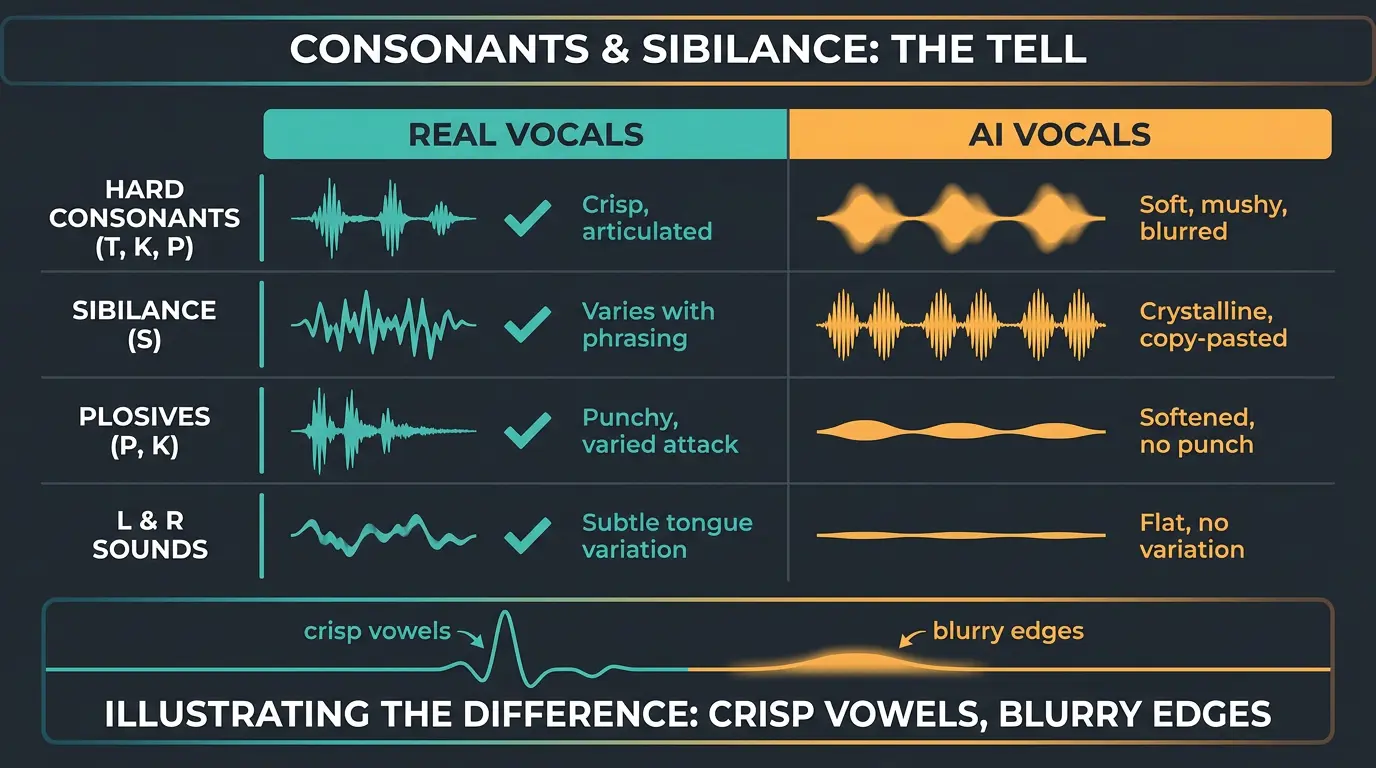
Here's the classic pattern once you know it. The vowels sound crystal clear, but the hard consonants — t, k, s, p — come out soft, mushy, or blurred. The voice glides between words instead of actually articulating them.
Sibilance is its own tell. Real S sounds vary with mouth position, energy, and phrasing. AI sibilance often sounds crystalline and copy-pasted, where every S hits with the same harshness and duration. Plosives get softened too, which robs the vocal of punch — real singers attack their Ps and Ks with different intensity every time. L and R sounds also lack that subtle tongue-position variation you'd hear in real speech.
Worth noting: AI is inconsistent in both directions. Sometimes it over-sharpens these sounds, sometimes it over-softens them. Either way, the movement doesn't match how a real mouth actually works. If this level of detail interests you, our breakdown of vocoder vs talkbox tools covers how machines have always struggled to fake a human voice.
Micro-timing, pitch, and vibrato: too perfect to be human
Humans don't sit on the grid. Real vocals land 5 to 30ms off it in natural patterns — rushing the excited phrases, dragging the emotional ones. AI phrases land almost exactly on the grid, and that precision reads as slightly wrong.
The pitch paradox is similar. AI vocals are often dead-on in tune, and paradoxically that's what tips you off. The pitch is right, but the expressive drift isn't there. Here's a checkable one: on any sustained note over about 1.5 seconds, Suno and Udio tend to produce a subtle fluttery pitch modulation humans don't do. Sometimes it sounds like auto-tune gone slightly wrong, sometimes like a whisper of phase interference. The vibrato jitter is a hair too even, because a model reconstructs it with a faint periodicity a real diaphragm never has.
How vibrato behaves on a sustained note
This one you can verify with a spectrogram. Human vibrato loses amplitude over a long sustained note because the diaphragm fatigues — you run out of steam and the wobble gets shallower. In a spectrogram, that shows up as decreasing peak amplitude in the 5-7 Hz band.
AI often does the opposite. It holds the vibrato depth perfectly constant for the whole note, or it cuts off abruptly at the end. On a spectrogram that reads as a flat or stepped curve instead of a natural decay. If you've got a track you're unsure about, pull it up and watch what the vibrato does as the note ages. The machine gives itself away by not getting tired.
Emotional arc: the macro tell across a whole performance
Step back from the details and listen to the whole take. A real vocal performance has shape — it builds, it pulls back, it lands. The singer leans into the meaning of the lyric, pushing and pulling against the beat to make you feel something.
AI tends to deliver every phrase at roughly the same emotional volume. Even a genuinely well-written topline starts to feel monotonous over four minutes because nothing rises or falls. It's eerily correct and strangely uninvested at the same time.
This is also why rap and spoken word still sound synthetic — those styles live entirely on human push-and-pull timing — and why songs over about five minutes lose coherence. The model can nail a phrase. It can't yet perform an arc.
Under the hood: the signal-level tells
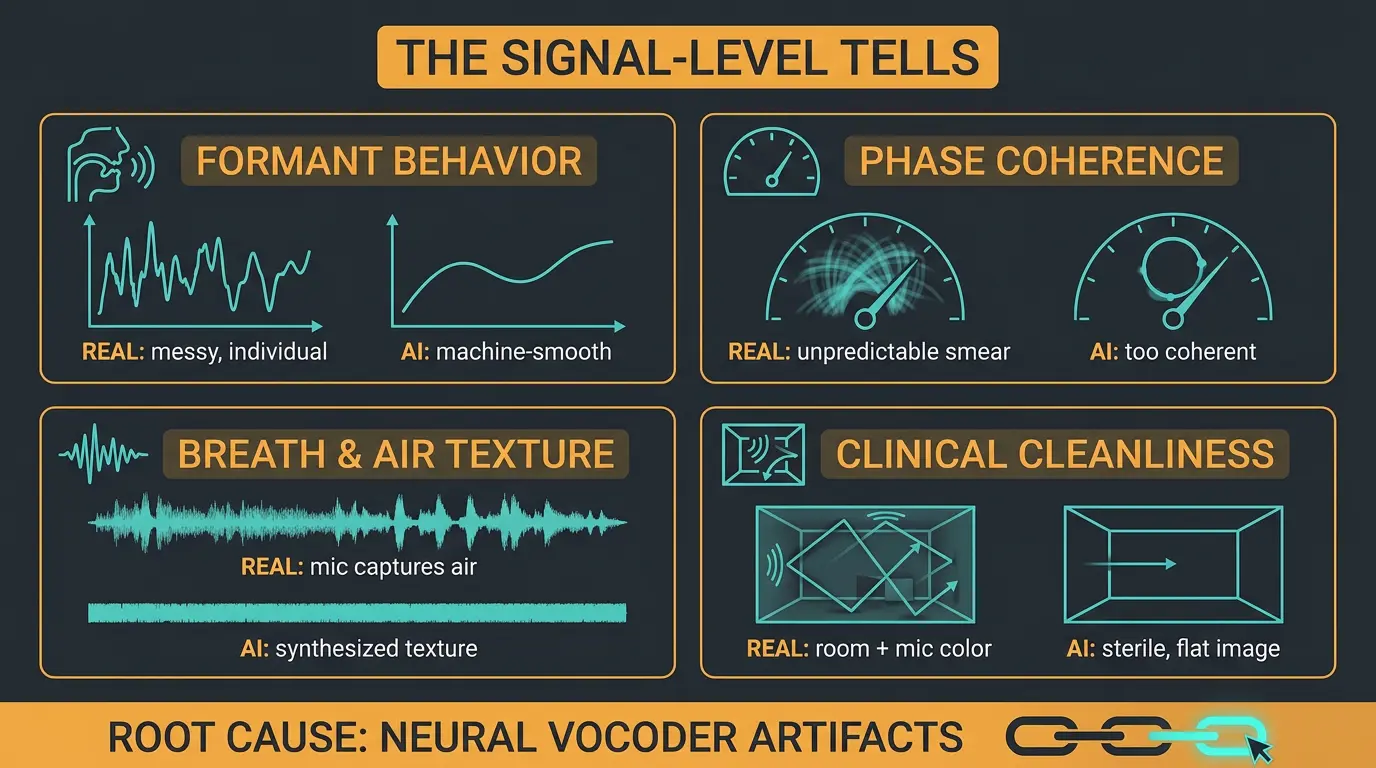
For the engineers, there are tells you can measure even when your ears aren't sure. A few worth checking:
- Formant behavior. Real vocal tracts move their resonances in messy, individual ways. Generated formants sit and glide with a machine-smooth regularity, and vowels sometimes shift timbre mid-sustain in a way a real mouth wouldn't.
- Phase coherence. The harmonics of a sung note carry phase relationships that real recordings smear unpredictably. Generated vocals are often too coherent, or too uniformly smeared — inaudible, but easy to spot on a meter.
- Breath and air texture. The noise floor of a real breath is a mic capturing air. AI breath noise has a synthesized texture that's statistically different from a real capture.
The root cause of most of this is neural vocoder artifacts. Most AI singing runs through a neural vocoder as its final synthesis step — something real audio never touches — and that step leaves cues behind. You'll also hear clinical cleanliness: real recordings carry room reflections and mic coloration, while AI vocals tend toward sterile reverb and a flat spatial image. If you want to hear how real space stacks up, our piece on the different types of reverb is a good reference point.
The tells at a glance
- Breath that's missing entirely or dropped in at mechanical, metronomic intervals with identical volume and duration.
- Crisp vowels but blurry, softened consonants, plus sibilance that sounds crystalline and copy-pasted.
- Micro-timing that lands almost exactly on the grid instead of pushing and dragging like a human would.
- A subtle flutter on sustained notes over about 1.5 seconds, with vibrato that stays too even and doesn't decay.
- A flat emotional arc — every phrase at the same intensity, so a great topline feels monotonous over four minutes.
Why you can't just trust your ears
Here's the counterintuitive part. Automated detectors outperform human listeners, and it's not close. Depending on the conditions, people correctly identify fakes somewhere in the 48% to 72% range — closer to a coin flip on the harder material.
A large 2026 study found something even stranger: humans aren't getting better at hearing artifacts, they're just getting more skeptical of all audio. Accuracy on fake samples barely moved, but accuracy on real samples dropped from 72.7% to 64.1% — people are increasingly labeling genuine recordings as fake. So more suspicion, not more skill.
And detectors aren't a verdict either. No detector is 100% accurate, and accuracy drops sharply on compressed or phone audio, which is most of what actually gets shared. If you want to go deeper, the overview of AI content detection is worth a read. Bottom line: use these tells as a screening habit, not gospel.
Frequently Asked Questions (FAQs)
Can you tell AI vocals from real ones just by ear?
Sometimes, but not reliably. Studies show people correctly spot AI vocals only about 48% to 72% of the time depending on conditions. A trained ear listening for breath, consonants, and emotional arc does better than that, but no honest engineer will claim they catch every one.
What's the single most reliable tell for AI vocals?
Breathing is the strongest giveaway. Real singers breathe irregularly, based on phrase length and emotion, with a big inhale before a big note. AI either skips breaths entirely or drops them in at mechanical, identical intervals. Listen to the space between the lines, not the lines.
Do AI vocal detectors actually work?
Yes, and they beat human listeners — but they're not a verdict. No detector is 100% accurate, and accuracy drops sharply on compressed or phone audio, which is most real-world listening. Treat a detector result as one data point in the ai vs human vocals question, not a final ruling.
Why do AI vocals sound emotionally flat?
Because they lack dynamic shape. A real performance builds, pulls back, and lands, with the singer leaning into the lyric's meaning. AI delivers nearly every phrase at the same intensity, so even a strong topline feels monotonous over a few minutes. It's technically correct but strangely uninvested.
Are AI vocals good enough to fool a professional engineer now?
On short, well-produced sections, yes — the best Suno and Udio generations can fool anyone briefly. Over a full performance it gets harder, since the tells stack up: mechanical breath, blurry consonants, on-the-grid timing, and flat emotion. So can you tell AI vocals? Often, but not always, and not fast.
Final Thoughts
The tools got good. That's not something to panic about — it's something to listen for. Once you know where the seams are, you start hearing them: the breath that never comes, the consonants that glide instead of hit, the vibrato that never gets tired. None of these is a magic bullet on its own, but together they add up fast.
Use them as a screening habit, lean on a detector when the stakes are high, and stay a little humble about all of it. The technology moves, the tells shift, and the honest answer is that your ears are one tool among several. Keep training them anyway — they're still the best one you carry around for free.
Some of the links within this article are affiliate links. These links are from various companies such as Amazon. This means if you click on any of these links and purchase the item or service, I will receive an affiliate commission. This is at no cost to you and the money gets invested back into Audio Sorcerer LLC.