A pick is probably the cheapest piece of gear you own, and it shapes your tone and feel more than most beginners expect. Material changes the attack. Thickness changes the response. Grip changes whether the thing stays in your hand at all.
There's no single right answer here. The best pick for a folk strummer isn't the best pick for someone playing fast lead lines, and that's fine. It comes down to how you play and what feels good in your fingers.
So here are five picks that cover a wide range of playing styles, what each one actually does, and which one I'd reach for first.
TABLE OF CONTENTS
How to choose a guitar pick
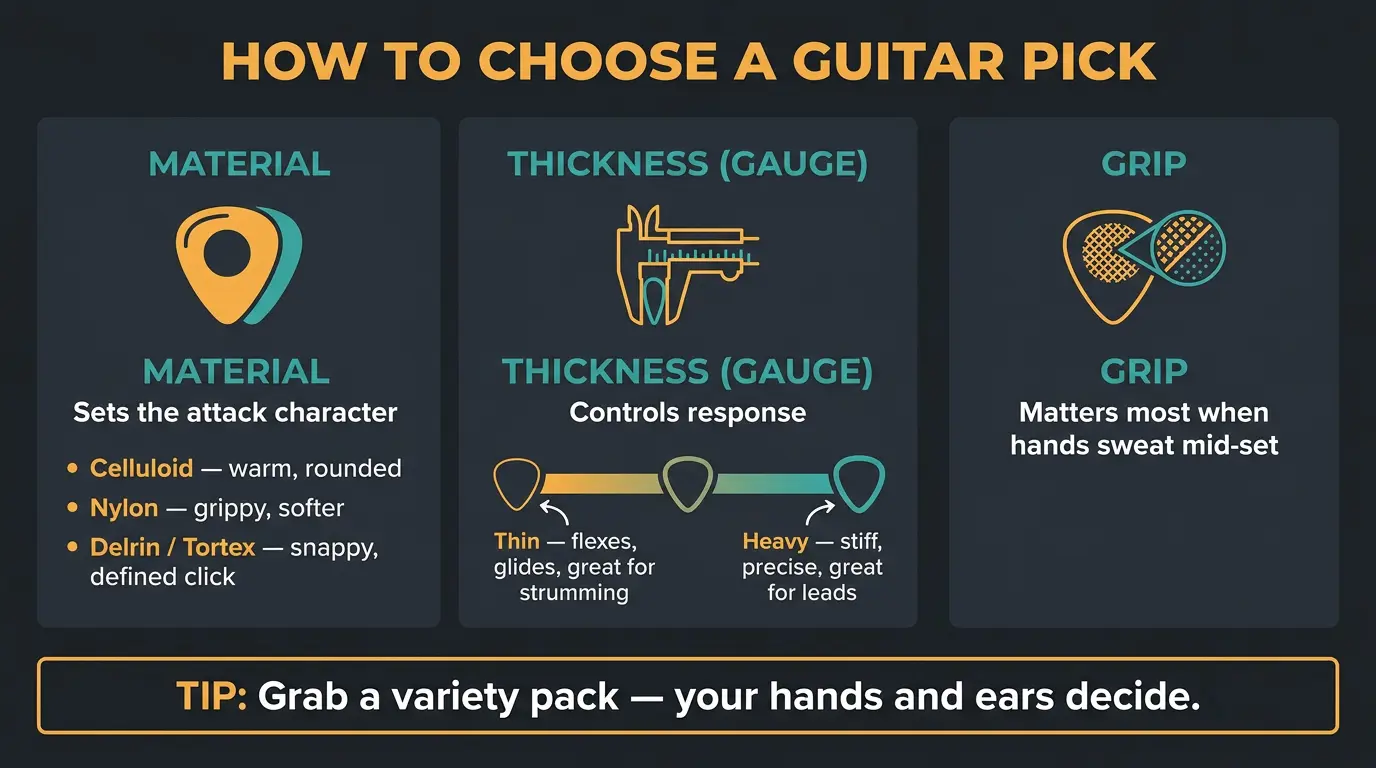
Three things actually matter with a pick: material, thickness, and grip. Material sets the character of the attack. Celluloid is warm and rounded. Nylon is grippy and a little softer. Delrin and Tortex are snappy with a defined click.
Thickness, or gauge, is about response. Thin picks flex and glide across the strings, so they're great for strumming. Heavy picks don't flex, which gives you precision and control for lead playing and single notes. Grip texture is the last piece, and it matters a lot more once your hands start sweating mid-set.
Honestly, the best move is to grab a variety pack and see what feels right in your hand and sounds right to your ears. It's the same idea we cover in our guide to guitar string gauges — the numbers only tell you so much, and your hands tell you the rest. If you want a deeper roundup for comparison, the folks at MusicRadar have a solid rundown of plectrums for acoustic, electric, and bass.
Fender Premium Guitar Picks

#1
Best Overall
Fender Premium Guitar Picks
This is the classic 351 shape in celluloid, and it's the default guitar pick for a reason. You get a warm, rounded tone, broad shoulders that make it easy to grip, and a rounded point that cuts down on string noise. It's the shape most players picture when they think "guitar pick."
A scenario where this shines: acoustic strumming and general electric playing where you want a traditional feel under your fingers. It's available in thin, medium, and heavy, so you can dial in the flex you like. Celluloid has been the cornerstone of Fender's pick lineup for decades, and it still does the job.
The one honest catch is that celluloid is smooth. If your hands get sweaty, this pick can slip, and there's no grip texture to save you. But as an all-arounder that feels familiar and sounds warm, it's hard to beat. Best overall because it's the most versatile choice on this list.
Pros
- Warm, rounded celluloid tone
- Traditional 351 shape feels familiar to almost everyone
- Rounded point reduces string noise
- Available in thin, medium, and heavy
Cons
- Smooth surface can slip with sweaty hands
- No grip texture at all
Jim Dunlop 449P.73 Max-Grip Guitar Pick

#2
Runner-up
Jim Dunlop 449P.73 Max-Grip Guitar Pick
This is a nylon standard pick with a molded coarse-grid gripping surface, engineered specifically to be non-slip. The .73mm gauge is the sweet spot most players land on, and it's part of a range that runs from .60mm up to 1.5mm, so there's something for every style.
A scenario where this is useful: speed picking and hard strumming, the times when a pick tends to twist and creep in your fingers. The grip genuinely works. You can dig in hard and the pick stays put, which is exactly what you want when you're moving fast and can't afford to lose control.
It's also durable and holds up over time. With that being said, the textured grid feel isn't for everyone. Some players love it, some find it a little rough under the thumb. If slipping is your problem, though, this solves it better than almost anything.
Pros
- Non-slip coarse-grid grip actually works
- Wide gauge range from .60mm to 1.5mm
- Durable nylon that holds up
- .73mm sweet spot suits a lot of players
Cons
- Textured grid feel isn't for everyone
Dunlop Tortex Standard Picks

#3
Top Pick
Dunlop Tortex Standard Picks
The Tortex is Dunlop's flagship pick, made since 1981 as a replacement for tortoiseshell, and it's still made at Dunlop HQ in Benicia, California. It's color-coded by gauge from around .50mm up, so you can spot the thickness at a glance. Slightly matte feel, balanced tone, and it wears down slowly.
A scenario where this is useful: players who want one reliable pick for everything, electric or acoustic. There's a reason the Tortex is the industry standard. It just feels great in the hand and doesn't get slippery the way a glossy pick can.
Quick note so nobody grabs the wrong thing: the Tortex Flow is a separate bevelled-edge variant, not this one. If you want the classic, look for the Standard. Honestly, if you handed me one pick and told me to play a whole gig on it, this is what I'd want.
Pros
- Industry-standard feel and balanced tone
- Matte surface grips well without added texture
- Color-coded gauges make sorting easy
- Wears down slowly, made in the USA
Cons
- Easy to confuse with the separate Tortex Flow variant
D’Addario DuraGrip Guitar Picks

#4
Top Pick
D’Addario DuraGrip Guitar Picks
The DuraGrip is made from Duralin, which brings out a bright "click" when it hits the string. It has a stamped grip design, solid durability, seven gauge options, and it comes in Wide, Jazz, Sharp, and Standard shapes. That shape variety is genuinely useful if you're picky about how the point sits.
A scenario where this is useful: acoustic, electric, or bass players who want grip plus a defined attack, and who want to experiment with different shapes to find their fit. The grip does its job and the pick has a lively, articulate response.
The brighter click won't suit everyone. If you're chasing warmth, this isn't the pick for you. But the combination of grip, durability, and shape options makes it a strong all-rounder that works across a lot of instruments.
Pros
- Bright, articulate click with good attack
- Four shapes: Wide, Jazz, Sharp, and Standard
- Stamped grip design for control
- Works well for acoustic, electric, and bass
Cons
- Brighter tone won't suit players chasing warmth
Ernie Ball Everlast Guitar Picks

#5
Lowest Price
Ernie Ball Everlast Guitar Picks
Everlast picks use Ernie Ball's patented Everlast technology, made from Delrin thermoplastic resin. That means they're ultra-strong yet flexible, and they won't warp, bend, or break easily. The range spans from .48mm all the way up to 2.0mm, and they come in bright colors that make them easy to find when you inevitably drop one.
A scenario where this is useful: someone who chews through picks fast and wants something that lasts. Players often describe these as brighter and snappier than Tortex, so there's a real difference in character.
Great value in terms of how tough they are and how many gauges you get to choose from. The tone leans bright, so it's a matter of taste versus the warmer celluloid options up top. Let's give it a listen before you commit if you can — the snappier attack is easy to hear.
Pros
- Extremely durable Delrin construction
- Huge gauge range from .48mm to 2.0mm
- Bright, snappy attack
- Vibrant colors are easy to spot
Cons
- Bright tone is a matter of taste versus warmer picks
Fender Offset Picks

#6
Top Pick
Fender Offset Picks
Fender took the offset guitar look and put it on a pick, and the asymmetrical shape is the whole pitch here. The idea is more surface area to grip, a sculpted thumb imprint for control, and two different edges that give you a bit of tonal variety. It's a medium gauge at 0.83mm, though a few players find it stiffer than a typical medium, and the thumb imprint favors right-handed folks. Fender calls it the most versatile pick ever, which is a lot of pick to live up to, so try one and let your hands decide.
Pros
- Offset shape gives you plenty of grip and control
- Two usable edges for a little tonal variety
- Durable polycarbonate, made in the USA
Cons
- Thumb imprint favors right-handed players
- Runs stiff for a medium, and launched in only one gauge
| Pick | Material | Gauges | Best for |
|---|---|---|---|
| Fender Premium | Celluloid | Thin / medium / heavy | Warm strumming and all-around play |
| Jim Dunlop Max-Grip | Nylon | .60mm–1.5mm | Speed picking and hard strumming |
| Dunlop Tortex Standard | Tortex | ~.50mm and up | One reliable pick for everything |
| D'Addario DuraGrip | Duralin | Seven gauges | Bright attack with grip and shape options |
| Ernie Ball Everlast | Delrin | .48mm–2.0mm | Durability and a snappy tone |
| Fender Offset Picks | Polycarbonate | 0.83mm | Contoured thumb imprint for comfortable grip |
Frequently Asked Questions (FAQs)
Does pick material actually change your tone?
Yes, pick material genuinely changes your tone. Celluloid sounds warm and rounded, nylon is a little softer and grippy, and Delrin or Tortex give you a brighter, snappier click. It's subtle compared to changing pickups or strings, but it's real. Trust your ears here.
What thickness guitar pick should a beginner start with?
Beginners usually do best starting with a medium pick, somewhere around .70mm to .73mm. It's flexible enough for comfortable strumming but stiff enough to pick single notes with some control. Once you know what you play most, you can go thinner or heavier from there.
What's the difference between thin and heavy guitar picks?
Thin picks flex and glide across the strings, which makes them great for strumming chords. Heavy picks don't flex, so they give you more precision and control for lead lines and single notes. Most players end up owning both and switching depending on the song.
Why do some guitar picks have grip texture?
Picks have grip texture to keep them from slipping and twisting in your fingers, especially when your hands get sweaty or you're playing fast. Smooth picks like celluloid look and feel classic but can slide around. If losing your pick mid-solo is a problem, a textured grip fixes it.
How often should you replace a worn guitar pick?
Replace a pick once the point gets noticeably rounded, rough, or starts scratching the strings, which usually means the attack has gone soft. Tougher materials like Delrin and Tortex last a good while. Make sure you keep a few spares around, because a worn pick sneaks up on you.
Final Thoughts
If you want one pick to cover the most ground, the Fender Premium celluloid is where I'd start. It's warm, familiar, and does a little of everything. If you play fast or your hands sweat, the Dunlop Max-Grip solves that, and the Tortex Standard is the safe pick you'll never regret owning.
Really though, picks are the one place where experimenting costs you almost nothing. Grab a handful across a couple materials and gauges, play the same riff on each, and let your hands tell you the truth. Less is more — you don't need twenty picks, just the two or three that feel right.
Some of the links within this article are affiliate links. These links are from various companies such as Amazon. This means if you click on any of these links and purchase the item or service, I will receive an affiliate commission. This is at no cost to you and the money gets invested back into Audio Sorcerer LLC.