A tuner is the least glamorous piece of gear you own. It's also the one that matters most, because nothing you play sounds good if the guitar isn't in tune. Simple as that.
Most people overthink this purchase. The good news is a good tuner really only comes down to three things: how accurate it is (measured in cents), how easy it is to read the display, and what form it takes — a clip-on you grab and go, or a pedal that lives on your board.
We picked five tuners that actually hold up, and we covered a range on purpose. There's something here for the pedalboard person and something for the bedroom player. Here's what each one does, who it's for, and which one we'd grab first.
TABLE OF CONTENTS
How we picked these tuners
Three things carry the most weight for us. First, tuning accuracy in cents — a cent is a hundredth of a semitone, so the smaller the number, the tighter the tuning. A strobe tuner gets you down to fractions of a cent, where a standard needle display sits closer to plus or minus one cent.
Second, display visibility. A tuner that's crystal clear at your desk can be useless on a dark, loud stage, so we care about brightness and readability where it counts.
Third, format. Clip-ons are grab-and-go and live in your case. Pedals live on the board and mute your signal so you can tune silently between songs.
Here's the honest part, and it fits our whole less is more philosophy: most players don't need 0.1-cent accuracy. But when you do need it, it's nice to have.
TC Electronic Polytune Clip-On Tuner
#1
Best Overall
TC Electronic Polytune Clip-On Tuner
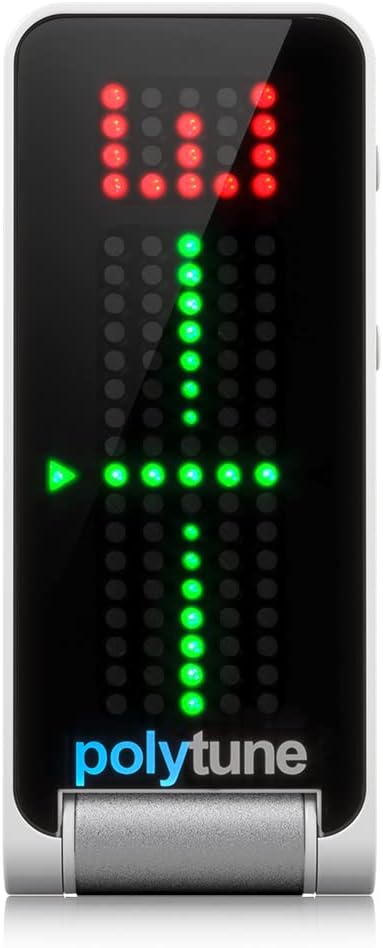
The Polytune Clip takes the top spot because it does three things well in one little clip-on body. It's got a polyphonic mode that tunes all six strings at once — strum once, and it shows you every string at a glance. It's got a standard chromatic mode. And it's got a strobe mode good down to plus or minus 0.02 cents.
A scenario where this shines: you finish a song, you've got about four seconds before the next one, and you strum once. The polyphonic view tells you exactly which string drifted without making you check each one individually. That's genuinely useful.
It's the most versatile clip-on we've used. With that being said, we'll be straight with you — some players report that the newer units feel a little less solid than older ones, particularly the switches. It's anecdotal, not a dealbreaker, but if you can handle one in a shop first, do it. Still our overall pick.
Pros
- Polyphonic mode tunes all six strings in one strum
- Strobe mode accurate to plus or minus 0.02 cents
- Three modes (polyphonic, chromatic, strobe) in a clip-on
- Fast between-song checks on stage
Cons
- Some reports of build quality feeling less solid on newer units
- More features than a casual player needs
Boss TU-3 Chromatic Tuner

#2
Runner-up
Boss TU-3 Chromatic Tuner
The TU-3 is the industry-standard pedal tuner, and it earned that reputation. It's got chromatic and guitar/bass-specific modes, a 21-segment LED display, and a High Brightness setting that stays readable in direct sunlight. Accuracy is plus or minus one cent — not strobe-level, but honestly fine for the vast majority of gigs.
Here's how it works in real life: it lives on your pedalboard, you step on it, it kills your signal so you can tune silently, and it doubles as a mute switch when you need to swap a cable or just kill the noise. If you're setting up a board, it pairs naturally with the rest of your rig — worth a look at our guide to the best guitar pedalboards if you're building one out.
Boss already offers a couple of variants worth knowing about. The TU-3S is an always-on version with no footswitch and the same display, and the TU-3W is the Waza Craft take. But the standard TU-3 is built like a tank, and that's really the point.
Pros
- Industry-standard reliability and build
- High Brightness mode readable in direct sunlight
- Mutes your signal for silent tuning
- Variants available (TU-3S, TU-3W) for different needs
Cons
- Plus or minus one cent isn't strobe-level accuracy
- Takes up pedalboard space a clip-on doesn't
Peterson StroboStomp Mini Guitar Tuner

#3
Top Pick
Peterson StroboStomp Mini Guitar Tuner
This is the accuracy monster shrunk down to fit a crowded board. A strobe tuner reads pitch by comparing it against a spinning reference, which is what gets you Peterson's 0.1-cent accuracy — the same engine as the larger StroboStomp HD, packed into a mini pedal.
The standout feature, and the one we actually love, is capo and downtuning transposition. You tell it how many semitones you've dropped or where the capo sits, and it still shows you standard EADGBE. No translating note names in your head. If you capo and detune constantly, that's a small thing that saves real headaches.
A scenario where this earns its keep: studio tracking, where you want everything dead-on so the parts stack cleanly. MusicRadar was firmly on board too — you can read their full StroboStomp Mini review for the deep dive. If accuracy is your priority, this is the one to buy.
Pros
- 0.1-cent strobe accuracy in a mini footprint
- Capo/downtuning transposition shows standard note names
- Same Peterson engine as the larger StroboStomp HD
- Ideal for studio tracking and detuned players
Cons
- Strobe display takes a moment to get used to
- More accuracy than casual players strictly need
Snark ST-8 Chromatic Tuner
#4
Top Pick
Snark ST-8 Chromatic Tuner
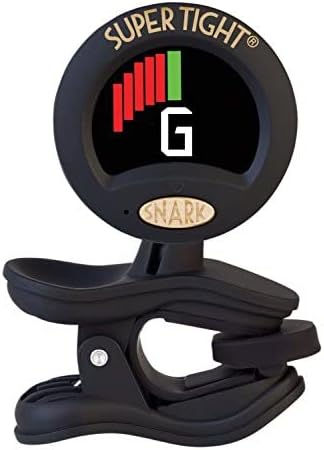
The Snark ST-8 is the friendly clip-on that shows up in just about every acoustic player's case. If you assumed it was battery-only, there's now a rechargeable "RE" version, so that's one less thing to think about.
The current model has a redesigned processing chip and pitch calibration, a brighter display, a 360-degree swivel head so you can read it from any angle, and a grippy clip that actually stays put. Nothing fancy — it just works.
A scenario where this is perfect: acoustic guitar, banjo, mandolin, anything with a headstock, tuned fast at a jam or on the couch. It pairs naturally with an acoustic in your lap, and if you're still getting comfortable, our guide on how to tune a guitar walks through the basics. It's not the most precise tuner here, but it's genuinely easy and reliable, and that counts for a lot.
Pros
- Now available in a rechargeable version
- 360-degree swivel head reads from any angle
- Grippy clip stays put
- Great for acoustic, banjo, and mandolin
Cons
- Not the most precise option in this roundup
- Better suited to casual use than critical studio work
Fender FT-1 Professional Guitar Tuner
#5
Lowest Price
Fender FT-1 Professional Guitar Tuner
Quick note on the name first: Fender now lists this as the "FT-1 Pro" on their own site, while a lot of retailers still show "FT-1 Professional." Same tuner, don't let it confuse you.
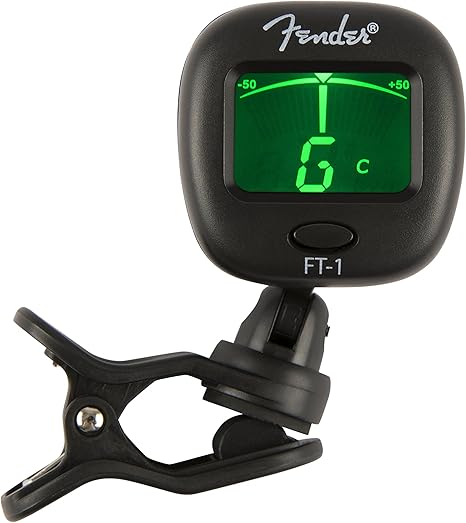
It's a full-range chromatic clip-on with A4 calibration and A440 accuracy to plus or minus one cent, with guitar, bass, ukulele, violin, and chromatic modes across a B0 to B7 range. So it covers a lot of instruments without any fuss.
The touches that matter for playing out: a vibration sensor that helps it track pitch in a noisy room, an LCD needle with a backlight that turns green when you're in tune, and a dual-hinge design so it mounts on either side of the headstock. A scenario where it wins — dark stage, loud room, and you just need to glance down and see "in tune." It punches above its class for what you get.
Pros
- Vibration sensor helps in noisy rooms
- Backlight turns green when in tune
- Dual-hinge mounts on either side of the headstock
- Guitar, bass, ukulele, violin, and chromatic modes
Cons
- Plus or minus one cent, not strobe-level accuracy
- Naming (FT-1 Pro vs Professional) can cause confusion
Korg Pitchblack X Pro

#6
Top Pick
Korg Pitchblack X Pro
The Pitchblack X Pro is Korg's flagship rackmount tuner, and it earns the "flagship" tag where it counts: ±0.1 cent accuracy in Strobe mode, four display modes, and a genuinely readable multicolor display with a handy "just-right" blink when you land on pitch. What makes it worth a look over a basic tuner is the whole-rig thinking — true bypass plus an Ultra Buffer to keep your tone clean over long cable runs, front and rear I/O for board integration, and a built-in cable checker that'll save you a headache at soundcheck. Make sure you know which model you're buying, though: this is the rack Pro with Focus mode, not the pedal Pitchblack X with Mirror mode. If you're running a rack rig or a big board and you want an always-on tuner that's precise and easy to read, this is a strong pick.
Pros
- Extremely accurate at ±0.1 cents in Strobe mode
- Bright, highly readable display with five color options and a just-right indicator
- Ultra Buffer keeps tone clean over long cables, with true bypass available too
- Built-in cable checker and flexible front/rear I/O for board integration
Cons
- One owner reported plastic chassis and rack ears, so check build quality hands-on
- Easy to confuse with the pedal Pitchblack X and older Pitchblack Pro models
| Model | Type | Accuracy | Best For |
|---|---|---|---|
| TC Electronic Polytune Clip | Clip-on | ±0.02 cents (strobe) / polyphonic | Best all-rounder |
| Boss TU-3 | Pedal | ±1 cent | Pedalboard standard |
| Peterson StroboStomp Mini | Strobe pedal | 0.1 cent | Max accuracy in a mini |
| Snark ST-8 | Clip-on | General accuracy | Easy everyday acoustic use |
| Fender FT-1 | Clip-on | ±1 cent (A440) | Stage use on a budget of space |
| Korg Pitchblack X Pro | Rack Mounted | ±1 cent (A440) | Stage and studio |
Frequently Asked Questions (FAQs)
What do 'cents' mean for tuning accuracy, and how precise do I actually need?
A cent is one hundredth of a semitone, so a tuner rated to plus or minus one cent is already tight enough for most playing. Strobe tuners get down to fractions of a cent, which matters most in the studio or for perfectionists. Live players rarely notice the difference.
Should I get a clip-on or a pedal tuner?
Get a clip-on if you want grab-and-go tuning for practice, jams, or acoustic gigs, and a pedal tuner if you play electric through a board and want to mute your signal to tune silently between songs. Plenty of players own both — a clip-on in the case and a pedal on the board.
What is a strobe tuner and is it worth it?
A strobe tuner reads pitch against a spinning visual reference, which is what gives it accuracy down to around 0.1 cents. It's worth it if you track in the studio, set intonation, or detune often. For casual playing, a standard clip-on is plenty and easier to read fast.
Do I need a polyphonic tuner?
No, you don't need one, but polyphonic tuning is genuinely handy — you strum all six strings once and see which ones drifted at a glance. It shines for quick between-song checks on stage. For deliberate string-by-string tuning at home, a standard mode works just fine.
Can a clip-on tuner work in a loud room or on a bright stage?
Yes. Clip-ons read vibration through the headstock rather than sound, so they handle loud rooms well, and many now have bright or backlit displays for dark or sunlit stages. The Fender FT-1's vibration sensor and the Snark ST-8's brighter display are both built with exactly that in mind.
Final Thoughts
If you want one tuner that covers the most ground, the TC Electronic Polytune Clip is our pick — polyphonic, chromatic, and strobe modes in a clip-on that lives in your case. If accuracy is your whole reason for buying, the Peterson StroboStomp Mini is the one. And if you play electric through a board, the Boss TU-3 is the standard for a reason.
Whatever you land on, don't overthink it. A tuner just needs to be accurate enough for what you do and easy to read when you're actually playing. Get one that fits your rig, keep it handy, and make sure you use it. Your ears — and everyone listening — will thank you.
Some of the links within this article are affiliate links. These links are from various companies such as Amazon. This means if you click on any of these links and purchase the item or service, I will receive an affiliate commission. This is at no cost to you and the money gets invested back into Audio Sorcerer LLC.