A 360 deal is a record contract where the label takes a cut of more than just your music. Touring, merch, publishing, endorsements, brand deals — the whole circle of your income. That's where the name comes from.
Here's the thing most articles get wrong: a 360 deal isn't some rare, exotic trap anymore. It's the default structure for major-label signings. If you sign with a major today, you're almost certainly signing a 360.
And the terms have actually shifted in artists' favor over the last few years, which means the old horror-story framing needs an update. Let's walk through what a 360 deal really is, how the splits work, and the fine print that decides whether it helps you or buries you.
TABLE OF CONTENTS
What a 360 deal actually is
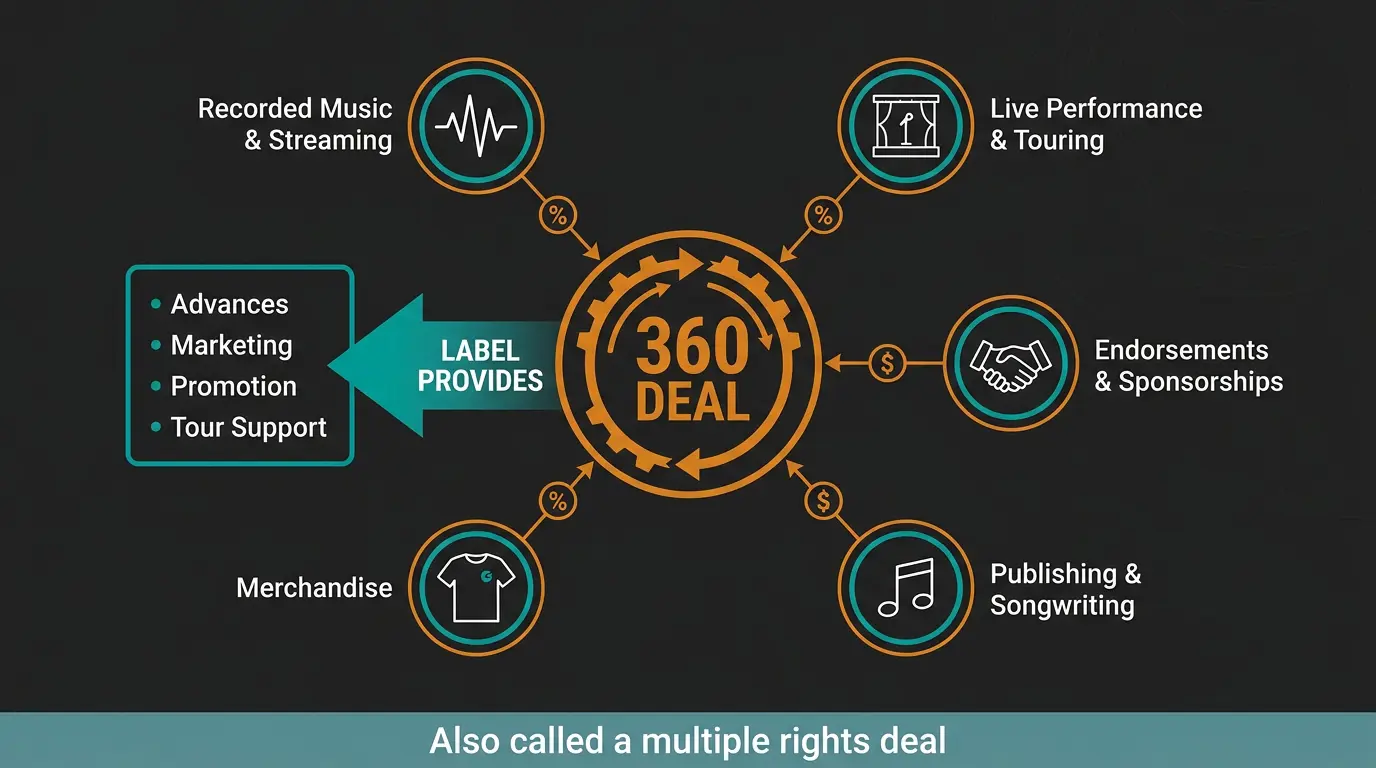
In a 360 deal, the label puts money and muscle behind you — advances, marketing, promotion, tour support — and in exchange takes a percentage of an increased number of your revenue streams, not just your recordings.
The streams commonly on the table include:
- Recorded music and streaming
- Live performance and touring
- Merchandise
- Endorsement and sponsorship deals
- Publishing and songwriting royalties
You'll also hear it called a multiple rights deal or multi-rights deal. Same thing, less catchy.
These showed up in the early 2000s when recorded-music revenue fell off a cliff and the old profit margins vanished. Labels needed new income, so they reached into money that used to be the artist's alone — shows, sponsorships, merch. That's the whole origin story.
Why 360 deals became the default
Streaming shrank what labels earn from recordings. At the same time, breaking an artist got more expensive, not less. Labels needed new revenue, and artists needed bigger marketing budgets. The 360 deal solved both problems at once — for the label, anyway.
So this became the standard contract for major-label signings. It's not one "type" of deal you might get offered. It's the baseline.
You'll still hear people talk about "active" versus "passive" 360 deals, and that distinction does matter for how the splits land — more on that in a second. But the real story now isn't which of two boxes you fit into. It's how much of the deal you can customize.
How the revenue splits work
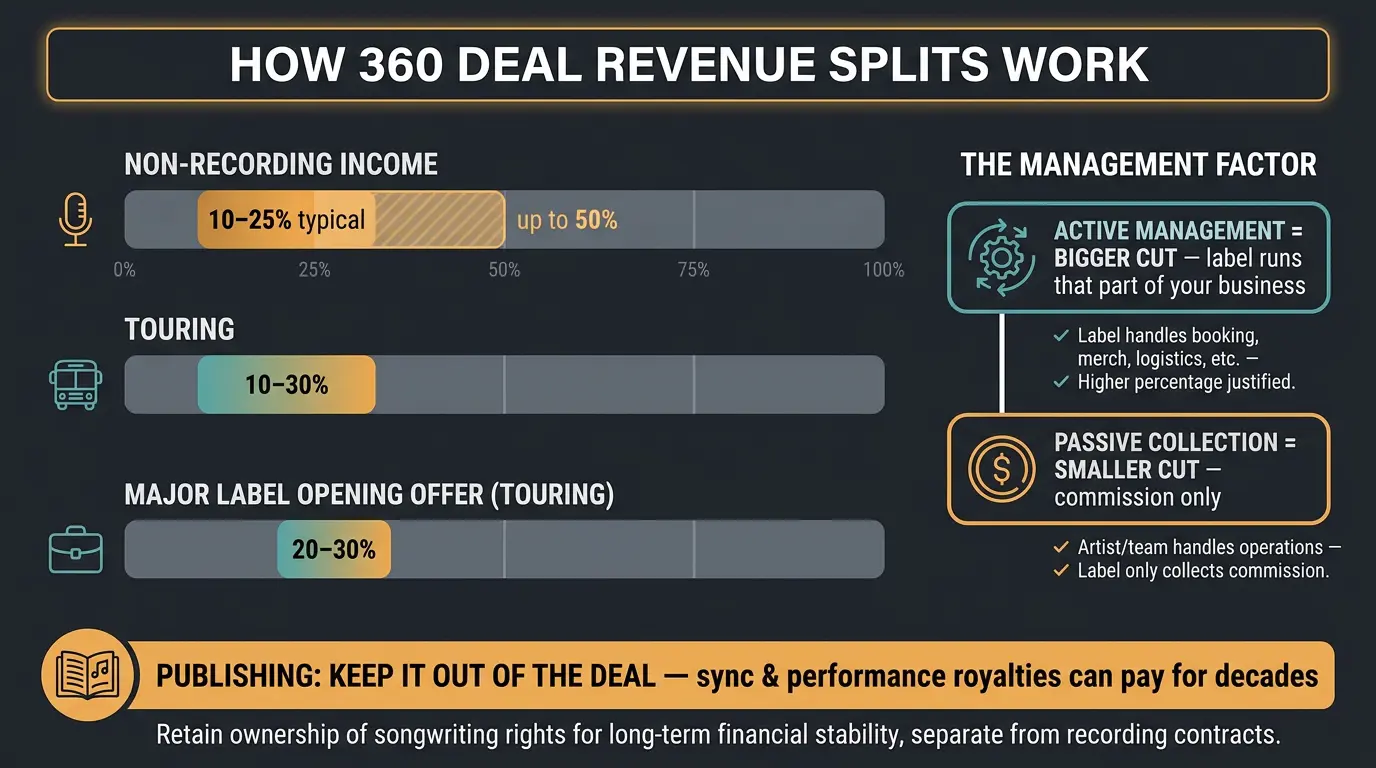
No magic here. The split mostly comes down to who's doing the labor.
Across non-recording income, labels often take somewhere in the 10–25% range, though the wider band runs from 10% all the way up to 50% depending on the specific stream. Touring usually sits around 10–30%. An indie artist signing with a major will commonly see opening offers of 20–30% on touring.
The percentage climbs when the label is actively managing or administering a right — because they're actually running that part of your business. It drops when they're passive and just collecting a commission on money you're generating yourself. That's the logic behind the whole thing: more work, bigger cut.
Publishing is its own conversation, and one you should treat carefully. Your songwriting royalties tie into sync licensing income and public performance royalties that can pay you for decades. We'll come back to why you want those out of the deal entirely.
The terms are shifting toward artists
This is the part the old horror stories miss. The terms have softened.
A label that once took 20% of everything might now take just 5–10%, and only above a revenue threshold — say, $500,000. Below that line, you keep it all. That single change makes a huge difference for a developing artist.
You're also seeing more flexible structures. "360-lite" or à la carte deals, where you pick and choose which streams the label touches. "180" and "270" deals, where the artist keeps whole chunks of their business — maybe the label gets a slice of merch but you keep 100% of touring, or you handle your own brand deals and only give up the music side.
Why the change? Leverage. Social media and direct-to-fan tools mean you don't need a label as badly as you used to. Labels would rather carve out a few streams than lose a signing entirely. Think of it as a menu now, not a fixed prix-fixe meal you have to eat whole.
The fine print that decides everything

The split percentage gets all the attention. The fine print is what actually decides whether you make money.
Cross-collateralization and recoupment. This is the big one. In most 360 deals, you don't see a dime of profit until the label recoups its entire investment across every venture. So you can sell out a tour, generate real touring income, and still see nothing — because the album's still in the red and your tour money is paying it off.
The fix is siloed recoupment: recording costs recoup from recording revenue, tour support recoups from touring, marketing recoups from merch. Full siloing is rare, so realistically you're pushing for partial siloing. At minimum, keep publishing out of the recoupment pool completely.
A few more things to watch:
- Ownership grabs. Some deals hand the label your masters, your publishing, even the rights to your own name. Read every ownership clause.
- Net vs. gross on touring. A percentage of gross is brutal — touring costs are enormous. Tie the cut to net, and cap it.
- Term length. Usually 3–7 years with options. Negotiate a clear end date on every single stream, especially the non-music ones.
With that being said, none of this is unbeatable. It's just stuff you have to catch before you sign. For a broader overview of how these structures evolved, the 360 deal entry on Wikipedia is a solid starting point.
Non-negotiables before you sign
- Carve out publishing entirely — mechanical, performance, and sync royalties should be out of the split AND out of the recoupment pool. It's your most valuable long-term income.
- Push for siloed recoupment so one part of your career can't get buried paying off another. Partial siloing is a realistic win.
- Tie any touring cut to net, not gross, and put a hard cap on it. Gross-based touring splits can wreck you.
- Get clear, written end dates on every revenue stream, and bring experienced music counsel before you sign anything.
Is a 360 deal worth it?
A 360 deal isn't automatically a rip-off. But most of them are built to favor the label, so you have to go in clear-eyed.
For an early-career artist, the real upside is access. Capital, tour support, PR teams, playlist pitching, professional marketing — that infrastructure costs serious money you probably don't have. A good 360 deal buys you all of it at once.
For an established artist with an existing audience, the math can flip. If you're already selling out rooms and moving merch, giving a label a cut of all that may leave you earning less than you would on your own.
The value is in the negotiation, not the structure. And there are other roads: self-releasing and staying fully independent, a traditional record deal that only touches your recordings, distribution or licensing partnerships, or an upstream deal where indie success pulls major-label interest to you. Weigh them honestly against what a 360 is really offering.
Frequently Asked Questions (FAQs)
What does 360 mean in a 360 deal?
The 360 refers to the full circle of an artist's income — the label takes a cut of every revenue stream, not just recordings. That means touring, merch, publishing, endorsements, and sponsorships can all be on the table. It's the opposite of a traditional deal, which only covers your music.
Are 360 deals bad for artists?
Not automatically, but most are structured to favor the label. A 360 deal can be a real advantage for a developing artist who needs capital and infrastructure. The danger is in the fine print — recoupment, ownership clauses, and gross-based touring splits — which is why experienced counsel matters so much.
What's the difference between a 360 deal and a traditional record deal?
A traditional record deal only covers your recorded music, so the label earns from records and streaming and nothing else. A 360 deal covers multiple income streams — touring, merch, publishing, endorsements. In exchange, a 360 usually comes with bigger advances and more marketing support.
Should publishing be included in a 360 deal?
No — push to keep publishing out of a 360 deal entirely. Your songwriting royalties are the most valuable long-term income you have, often paying out for decades. Demand an explicit carve-out that excludes mechanical, performance, and sync royalties from both the split and the recoupment pool.
What are 180 and 270 deals?
180 and 270 deals are scaled-down versions of a 360 where you keep whole chunks of your business. Instead of the label owning the full circle, you might give up merch but keep 100% of touring, or hand over the music side and control your own brand deals. They reflect the industry moving toward customized, à la carte contracts.
Final Thoughts
A 360 deal is neither the villain some people make it out to be nor the golden ticket a label's A&R rep will pitch you. It's a tool, and like any tool, the outcome depends on how it's used. The structure isn't the problem — the terms are.
Make sure you read every clause, protect your publishing, and get a real music attorney in the room before you sign. The artists who come out ahead aren't the ones who avoid 360 deals. They're the ones who negotiate them.
Some of the links within this article are affiliate links. These links are from various companies such as Amazon. This means if you click on any of these links and purchase the item or service, I will receive an affiliate commission. This is at no cost to you and the money gets invested back into Audio Sorcerer LLC.