A great live vocal mic does three things well: it shrugs off abuse, it fights feedback, and it flatters the voice without a fuss. That's the whole job. The rest is taste.
All five picks here are dynamic handhelds built for the stage, so they're tough, they reject what they should, and they sound good night after night. There's no single right answer, though. The best mic depends on your voice and your room, so think of this as a shortlist, not a ranking carved in stone. Let's get into it.
TABLE OF CONTENTS
What makes a good live vocal mic
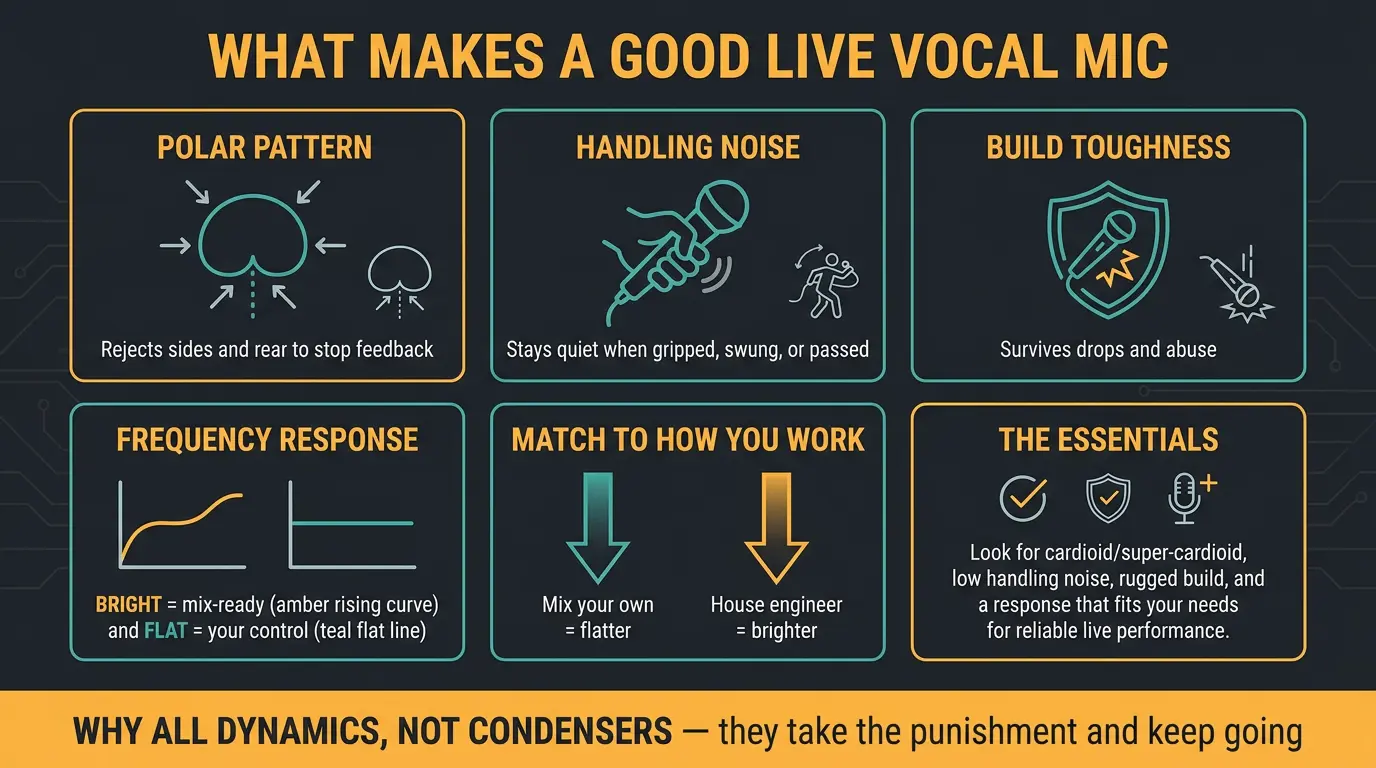
A few things actually matter on stage, and the spec sheet only tells part of the story.
- Polar pattern. Cardioid and super-cardioid mics reject sound coming from the sides and rear, which is how you keep monitors and wedges from feeding back into the capsule.
- Handling noise. Singers move. A good live mic stays quiet when you grip it, swing it, or pass it around.
- Build toughness. It's going to get dropped. Plan accordingly.
- Frequency response. Brighter mics show up more mix-ready and need less help at the console. Flatter mics leave you room to shape things yourself.
Make sure you match the mic to how you work — if you mix your own shows, a flatter response gives you control, but if you're handing a mic to a busy house engineer, a brighter voicing does some of that work for you. And that's exactly why all five picks here are dynamics, not condensers. They take the punishment and keep going.
Shure SM58 Vocal Microphone

#1
Best Overall
Shure SM58 Vocal Microphone
The SM58 has been in production since 1966, and in 2026 it hit its 60th anniversary still as the standard against which every other live vocal mic gets measured. That kind of run isn't an accident.
It earns Best Overall because it's dependable in a way nothing else on this list can quite match. It's bulletproof. It's consistent from one unit to the next. And it sounds good on almost any voice, in almost any venue, from a tiny club to an arena. It uses a cardioid pattern with a built-in pop filter that tames plosives and a little stage spit, so it's ready to go the second you plug it in.
Here's the honest part. The SM58 is not the most detailed or the brightest mic here. The Telefunken has more air, the V7 has more sparkle. The 58 is the reliable one — a touch of a midrange bump, a controlled top end, nothing flashy. That's the point. It does the job and never surprises you in a bad way.
One quick SKU note so you order the right thing. The standard cable-free version is the SM58-LC (the LC means "less cable"). There's also a switched variant, the SM58S, with an on/off switch on the body, plus a USB bundle if you want one. For most singers, the plain LC is what you want. If you want the deep history, the Shure SM58 Wikipedia page is a fun rabbit hole.
Pros
- Legendary reliability and tank-like build
- Consistent, flattering sound on nearly any voice
- Built-in pop filter handles plosives and moisture
- Works everywhere, from clubs to arenas
- Easy to find parts, accessories, and replacements
Cons
- Not the most detailed or bright mic on this list
- Voicing is safe rather than exciting
Sennheiser E 945 Vocal Microphone

#2
Runner-up
Sennheiser E 945 Vocal Microphone
The e 945 is a super-cardioid dynamic from Sennheiser's e900 series, and it's the mic I reach for when the stage is loud and feedback is a genuine fight. That tighter pattern rejects more off-axis sound than a standard cardioid, which buys you headroom before things start ringing.
Tonally, it splits the difference nicely — warm in the body, but with real presence up top so it cuts through a dense mix. If you sing over a wall of guitars and the SM58 feels like it's getting buried, the e 945 is the kind of mic that pokes its head right back out. Vocals sit forward without you having to shove the fader.
The honest catch is technique. A super-cardioid pattern is narrower, so if you drift off-axis or cup the mic, you'll lose level and the tone changes. Singers with steady mic technique love it. Singers who wander all over the capsule sometimes do better with the more forgiving 58.
Pair it with solid monitoring and that tight pattern really shines — it plays nicely with a good in-ear monitor setup when you're trying to keep stage volume under control. With that being said, it's a workhorse on wedges too. Build quality is what you'd expect from Sennheiser, which is to say it'll outlast a lot of tours.
Pros
- Tight super-cardioid pattern fights feedback well
- Warm body with strong presence that cuts through
- Sennheiser build quality made for the road
- Great for loud, dense stages
Cons
- Narrow pattern demands consistent mic technique
- Less forgiving than a standard cardioid if you wander
Telefunken M80 Vocal Microphone

#3
Top Pick
Telefunken M80 Vocal Microphone
The M80 is the one for singers who want their dynamic mic to sound a little more like a condenser. It's hand-assembled in the USA, built rugged for the road, and it delivers a level of detail and air you don't usually get from a stage dynamic.
A scenario where that matters: you've got a singer with a breathy, nuanced voice and the SM58 makes them sound a touch dull and closed-in. The M80 opens that up. There's an honest sense of top-end clarity that translates beautifully on the right voice, which is why it's just as welcome in the studio as it is on stage.
It comes with family options too. The M81 is a less-bright voicing of the same idea, the M82 is a large-diaphragm dynamic, and Telefunken's Custom Shop offers a pile of colors and finishes plus low-profile and wireless packages. So you can dial in the look and the voicing.
Now the honest part, and it's the same thing that makes it great. That detailed top end is fantastic on some voices and too much on others. A bright, sibilant singer can end up fighting it. Less is more here — if the M80 sounds harsh, the M81 voicing or a different mic entirely might serve that singer better. Try before you commit if you can.
Pros
- Condenser-like detail and air in a dynamic
- Hand-assembled, road-ready build
- Doubles beautifully as a studio mic
- Family options (M81, M82) and Custom Shop finishes
Cons
- Bright top end can be too much for some voices
- Not the most neutral choice for sibilant singers
Rode M1 Vocal Microphone

#4
Top Pick
Rode M1 Vocal Microphone
The M1 is RØDE's no-drama live dynamic, and it's a genuine workhorse for bands and bars. It pairs a high-power neodymium capsule with a tightly controlled cardioid pattern, so you get good output and solid spill rejection. The standout, though, is how quiet it is in the hand — the internal design knocks down handling noise about as well as anything in this class.
That makes it a great pick for singers who grip and move the mic a lot, or for a band passing one mic around for backups. It's warm, it's clear, and it just gets out of the way. If you're outfitting a stage on a sensible setup and need several reliable mics, the M1 is an easy one to stock up on.
One SKU note so you don't get confused. There's an M1-S with an integrated on/off switch and a locking screw, aimed at presenters and anyone who needs to mute at the body. It's a separate SKU, not a newer or better model — same mic, just with a switch. Grab it only if you actually want that switch.
Honest take: the M1 is warm and clean, but it isn't as detailed up top as the Telefunken or the V7. If you want air and sparkle, this isn't the one. If you want a dependable, quiet, great-sounding mic that doesn't draw attention to itself, it nails it.
Pros
- Exceptionally low handling noise
- Warm, clear tone that sits well in a mix
- Tight cardioid pattern for good feedback control
- Great value as a stock-up-the-stage workhorse
Cons
- Less top-end detail than the Telefunken or V7
- M1-S switched version is a separate SKU, easy to mix up
SE Electronics V7 Vocal Microphone

#5
Lowest Price
SE Electronics V7 Vocal Microphone
The V7 is the one that punches way above its weight. It's a super-cardioid dynamic with an aluminum voice coil and an all-metal build, and it delivers strong feedback rejection with a bright, crisp character that holds its own against mics that cost a lot more.
If you want a mic that shows up mix-ready and cuts through without much help at the console, the V7 is right in that pocket. The super-cardioid pattern keeps the bleed down, and the top end has a sparkle that flatters a lot of modern voices. It's a legitimately great-sounding mic, not just a great-value one.
sE has grown the V7 into a whole family — color variants, a V7 Switch, wireless capsules, and a 25th Anniversary edition — so there's a version for most rigs. The core V7 is the one to start with. And it's not just a home-studio darling either: it's turned up in the hands of high-profile performers like FINNEAS and Mk.gee, which tells you it can hang at the top level.
Honest take: it's bright and crisp, and that's mostly a feature. On a voice that's already edgy or sibilant, that brightness can stack up, so it's the same caveat as the Telefunken — try it on the actual singer. For a lot of people, though, this is the most you'll get for what you put in.
Pros
- Bright, mix-ready tone that cuts through
- All-metal build with aluminum voice coil
- Strong feedback rejection from the super-cardioid pattern
- Outstanding value and a broad family of variants
Cons
- Brightness can be too much on already-edgy voices
- Not the choice if you want a warmer, flatter sound
| Model | Polar Pattern | Best For |
|---|---|---|
| Shure SM58 | Cardioid | Do-it-all reliability in any venue |
| Sennheiser e 945 | Super-cardioid | Loud stages where feedback is a fight |
| Telefunken M80 | Super-cardioid | Detailed studio-meets-stage tone |
| Rode M1 | Cardioid | Quiet, dependable budget workhorse |
| sE Electronics V7 | Super-cardioid | Most value, bright and mix-ready |
A newer option to keep an eye on

If you want something fresher than the classics, the Shure Nexadyne is worth watching. It was announced in April 2024 in two handheld flavors — the 8/S super-cardioid and the 8/C cardioid — and it's aimed squarely at the SM58 and Beta 58 crowd.
The interesting part is the tech. Shure's Revonic design uses two matched transducers instead of one, which it leans on to maximize the frequencies you want and crush handling noise and mechanical rumble. Reviewers have been genuinely positive, praising a bright, mix-ready tone and excellent noise and handling rejection.
The honest caveat, straight from those same reviews: that pronounced treble lift suits some voices better than others. So it's one to try before you commit, not a guaranteed upgrade over the picks above. Call it a strong new contender to keep on your radar.
Frequently Asked Questions (FAQs)
What's the difference between cardioid and super-cardioid for live use?
A cardioid mic rejects sound from directly behind it, while a super-cardioid rejects more from the sides but picks up a little from the rear. For live use, super-cardioid gives tighter feedback control on loud stages, but it demands steadier mic technique since the pickup angle is narrower.
Why use a dynamic mic instead of a condenser on stage?
Dynamic mics are the go-to for live vocals because they're tougher, handle loud sources without distorting, and reject more of the stage around them. Condensers are more sensitive and detailed, which sounds great in a quiet studio but invites feedback and bleed in a loud, chaotic live room.
Does a more expensive mic always sound better?
No, a pricier mic doesn't automatically sound better — it just sounds different, and "better" depends on your voice and your room. The V7 holds its own against mics that cost far more, and plenty of pros tour on an SM58. Match the voicing to the singer, not the price tag.
Can these live mics be used in the studio too?
Yes, all five work in the studio, and the Telefunken M80 and sE V7 are especially at home there thanks to their detailed top end. Dynamics are great for loud sources and rooms that aren't acoustically perfect, so they're a smart, forgiving choice for home recording too.
How do I reduce feedback with mic choice and technique?
Pick a super-cardioid mic, point its dead spot at your monitors, and keep the mic close to your mouth so you can run lower gain. Feedback comes from gain plus open pattern plus distance, so tight technique and smart placement do as much as the mic itself. Less is more on the gain knob.
Final Thoughts
If you only remember one thing, make it this: there's no universally best mic, just the best one for your voice and your stage. The SM58 is the safe, do-anything default and it's earned that spot. From there, the e 945 buys you feedback control, the M80 and V7 buy you detail, and the M1 buys you a quiet, dependable workhorse.
Borrow before you buy if you can, and trust your ears over the spec sheet. And once the mic's sorted, the rest of your stage matters too — good stage monitors and a solid digital mixing board do as much for your sound as the capsule in your hand. Now go sing into something.
Some of the links within this article are affiliate links. These links are from various companies such as Amazon. This means if you click on any of these links and purchase the item or service, I will receive an affiliate commission. This is at no cost to you and the money gets invested back into Audio Sorcerer LLC.