A chord progression is the harmonic backbone of a song. It's what shapes the emotional arc, the push and pull between tension and resolution, the whole mood of a tune. And here's the part that surprises a lot of people: most of the songs you love are built on a tiny handful of progressions.
That's not a limitation. It's a feature. The richness doesn't come from the chords themselves — it comes from the melody, the rhythm, the lyrics, the arrangement, and the small variations that turn a familiar pattern into something that sounds like you.
One quick thing before we get into the list. I'm using Roman numerals throughout. Uppercase means a major chord, lowercase means minor, and the number tells you which scale degree it's built on. The beauty of this system is that it's key-independent — the same numerals work in any key, so you can transpose anything here to whatever fits your voice. All right, let's get into it.
TABLE OF CONTENTS
Why the same progressions keep coming back
Common progressions are common for a simple reason: they sounded good when songwriters used them in the past, so the writers who came after knew they'd sound good too. It's not laziness. It's standing on the shoulders of every great song that came before you.
If you're just starting out, don't feel like reaching for a familiar progression is cheating. Some of the best songs ever written use the same four chords as a thousand others. What makes them great is everything happening on top.
And because we're using Roman numerals, none of this is locked to a single key. Learn the shape once, and you can drop it into any key that suits the song. If you want to go deeper on how those numerals connect to the scale, our guide to music scale degrees breaks it down.
I-V-vi-IV: the four-chord pop progression
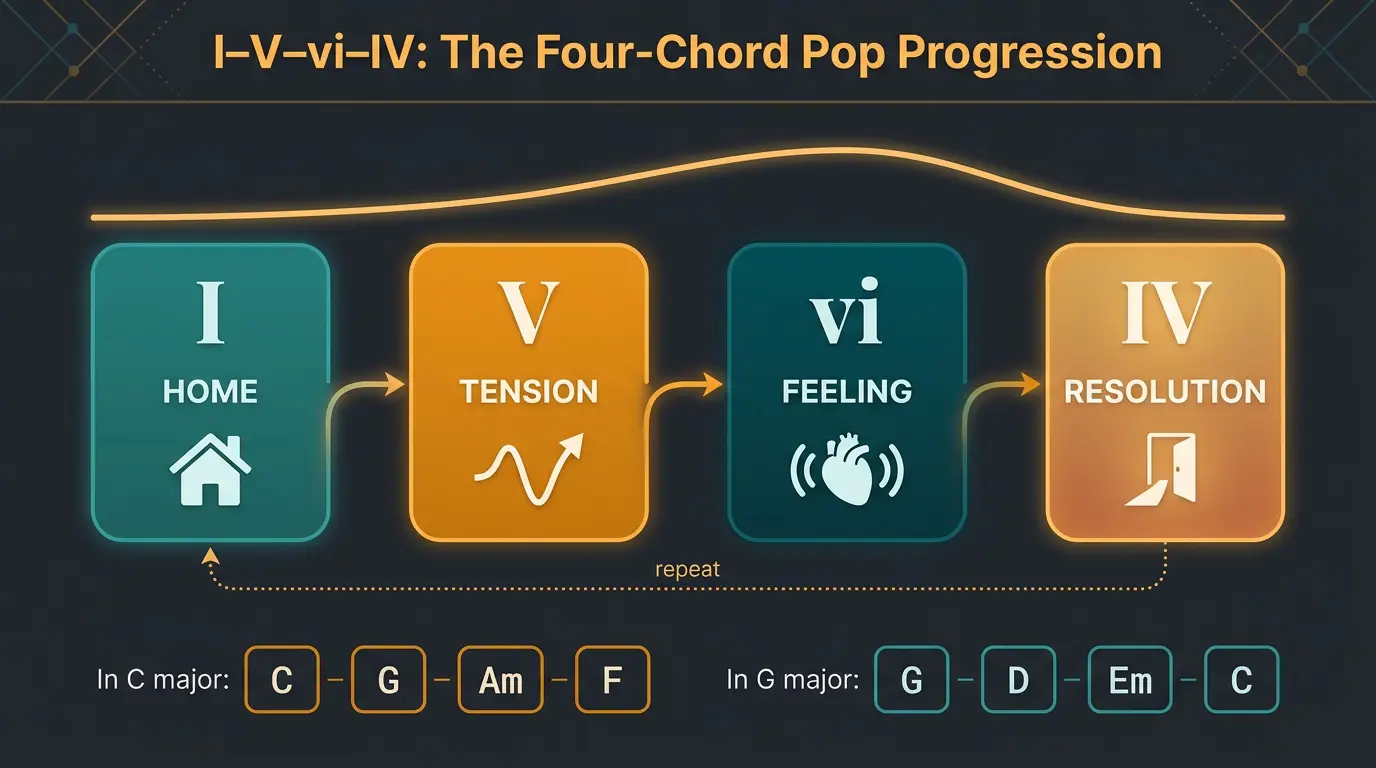
This is the big one — sometimes called the Axis progression, and probably the most common chord progression in modern pop and rock. In C major it's C–G–Am–F. In G major it's G–D–Em–C.
Listen to the emotional arc and you'll hear why it works. You start at home on the I, move to a little tension on the V, sink into the depth of the relative minor on the vi, then land softly on the IV. Home, tension, feeling, resolution — over and over.
The list of songs built on it is long: "Let It Be" by The Beatles, "With or Without You" by U2, "I'm Yours" by Jason Mraz, "Don't Stop Believin'" by Journey, "Counting Stars" by OneRepublic, "Poker Face" by Lady Gaga. If you want the cleanest example, put on "With or Without You" — the loop runs uninterrupted through the whole song, spelled out right there in the bassline.
You've probably seen the Axis of Awesome "Four Chords" medley, where they cram dozens of songs into this one progression. It's a fun bit, but it's a little overstated. Some of those songs only touch the progression briefly, and they transposed everything into one key to make it line up. The point isn't that there's some magic trick fooling everybody. It's just that these happen to be the most popular four chords in pop music, and there aren't that many orders to play them in. For more reading on this, Berklee's piece on common chord progressions and how to make them your own is worth a look.
Same four chords, different starting point
Here's a thing that confuses people early on. A lot of "different" progressions are really just the Axis loop started in a different spot.
Start on the vi and you get vi–IV–I–V. Start on the IV and you get the "Call Me Maybe" shape — in G, that's C–G–D–Em. The chorus of Rihanna's "Umbrella" uses the same rotation. Same four chords, different launch point. Once you see it, you can't unsee it.
I-IV-V: the three-chord foundation
If the four-chord loop is the most popular, I–IV–V is the most foundational. It's arguably the most iconic progression in all of Western music, and it's the easiest one to master. In C, it's C–F–G.
The function is clean. The tonic (I) sets the key and the tone. The subdominant (IV) adds movement and a bit of tension. The dominant (V) pulls you right back home. Three chords, and the whole story is told.
It shows up everywhere — blues, rock, country, pop. Think "Wild Thing" by The Troggs, "Louie Louie" by The Kingsmen, "La Bamba" by Ritchie Valens, the chorus of "Like a Rolling Stone" by Bob Dylan, and the verse of "Blitzkrieg Bop" by the Ramones. Three chords have carried a lot of great songs.
12-bar blues: a form built on I-IV-V
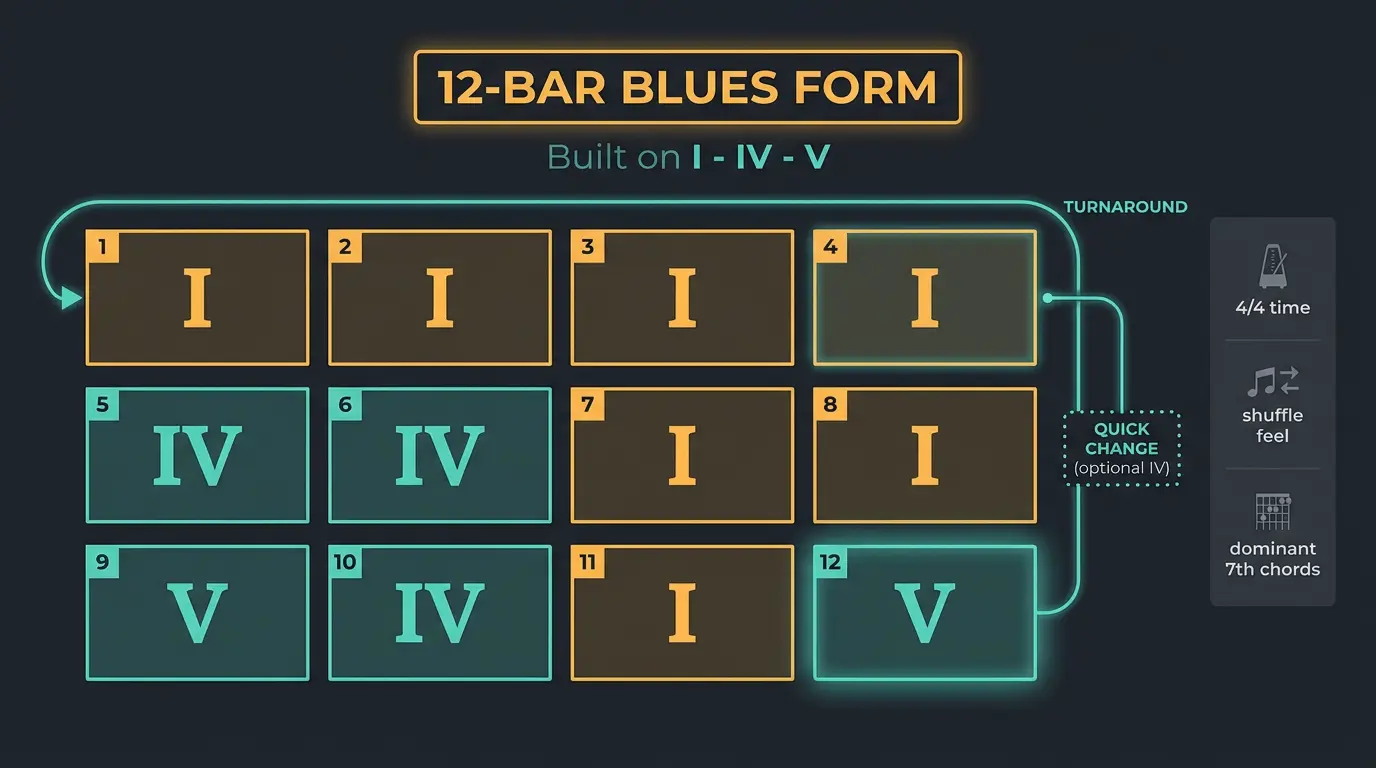
This one's a little different. The 12-bar blues isn't just a chord sequence — it's a 12-measure form. It uses those same I, IV, and V chords, but the magic is in how they're laid out over time.
The standard layout goes like this: four bars of the I chord, two bars of the IV, two bars back on the I, then V for one bar, IV for one bar, I for one bar, and V for one bar to wrap up. It's usually in 4/4 with a shuffle feel, and those chords are often played as dominant 7ths to get that gritty blues color.
That last bar matters. If the song's ending, bar 12 stays on the I. If you're going around again, you switch to the V — that's the turnaround, and it's what pulls you back to the top. There's also a common variation called the quick change, where you hit the IV in the second bar before returning to the I, just to keep those opening four bars from sitting still.
And it's not only for blues. Thousands of pop, rock, and jazz tunes use this form. "Johnny B. Goode" by Chuck Berry, "Hound Dog" by Elvis, "Rock Around the Clock" by Bill Haley, and James Brown's "I Got You (I Feel Good)" all live on it.
ii-V-I: the jazz cadence
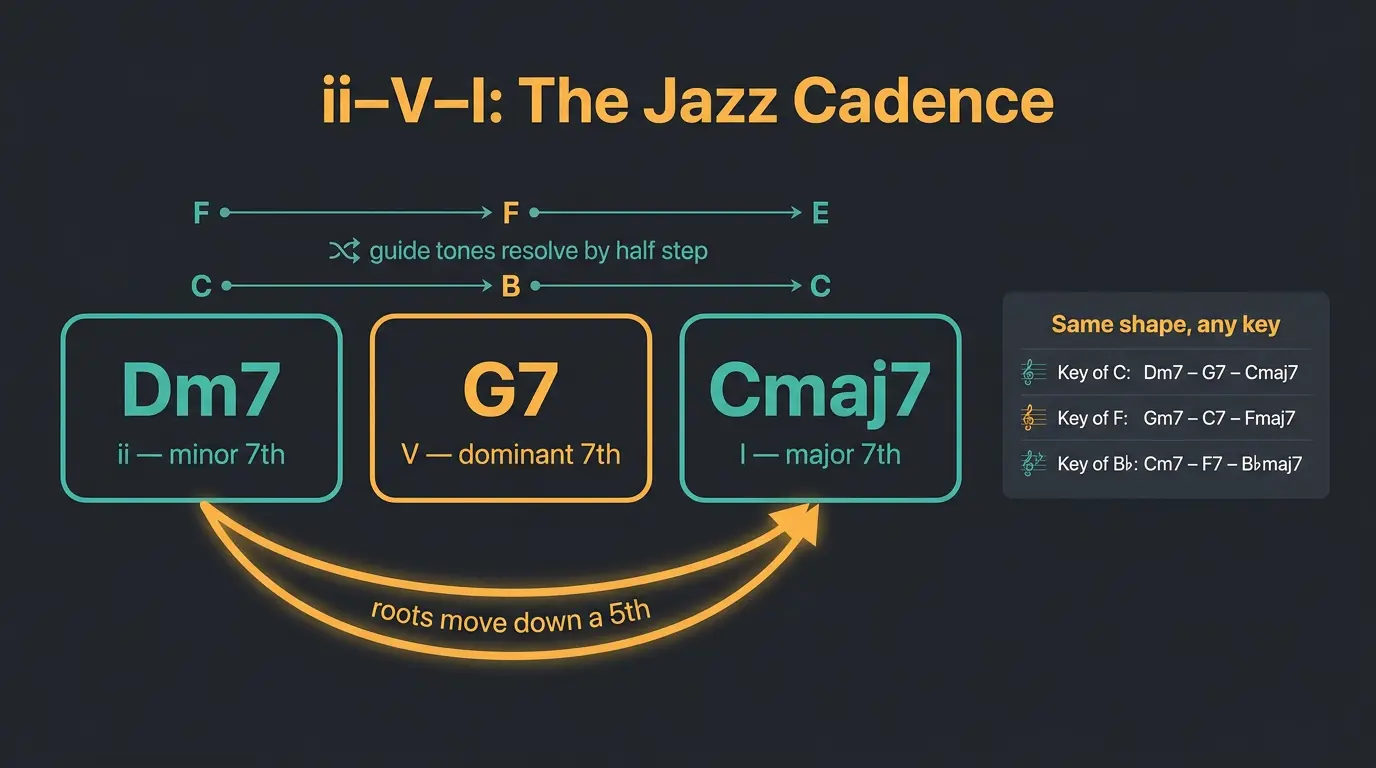
If you want to get into jazz, this is the one to know. The ii–V–I is the most common progression in jazz and the foundation of most jazz harmony. It's built on the 2nd, 5th, and 1st degrees of the scale, and it's almost always played with 7th chords.
In C, that's Dm7–G7–Cmaj7. In F, it's Gm7–C7–Fmaj7. In B♭, it's Cm7–F7–B♭maj7. Notice the chord qualities never change from key to key — minor 7th, dominant 7th, major 7th — only the roots move. In a minor key the qualities shift a bit (half-diminished ii, dominant V, minor i), but the shape is the same.
So why does it feel so satisfying? Two things working together. First, the roots move down by a fifth each time — D to G to C — which is the strongest root motion in tonal music. If you want the bigger picture there, our breakdown of the circle of fifths covers exactly why that motion pulls so hard.
Second is the voice leading. The 3rds and 7ths of each chord — the guide tones — resolve by half step. In Dm7, the 3rd is F and the 7th is C. Move to G7 and the F stays put as the 7th while the C drops to B. Move to Cmaj7 and the B settles to C while the F drops to E. Those tiny half-step moves are what make the whole thing feel inevitable. A pro will nod, and if you're new to it, just play it slow and listen — your ears will catch it before your brain does.
Quick reference: the progressions at a glance
- I-V-vi-IV (C-G-Am-F): the pop heartbeat, the most common progression in modern music.
- I-IV-V (C-F-G): the three-chord workhorse behind blues, rock, country, and pop.
- 12-bar blues (I-IV-V over 12 measures): the form that powers blues and rock and roll.
- ii-V-I (Dm7-G7-Cmaj7): the jazz resolution, built on circle-of-fifths motion and tight voice leading.
Frequently Asked Questions (FAQs)
What is the most common chord progression?
The I-V-vi-IV progression is the most common chord progression in modern pop and rock. In C major it's C-G-Am-F. It moves from home to tension to the relative minor and back to resolution, which is why it shows up in so many hit songs across decades.
What four chords are used in most pop songs?
Most pop songs lean on the I, IV, V, and vi chords. In C major, those are C, F, G, and Am. You can rearrange them in different orders, but the I-V-vi-IV sequence is the one you'll hear most often, since these are simply the most popular chords in the genre.
What is the ii-V-I progression?
The ii-V-I is the most common progression in jazz, built on the 2nd, 5th, and 1st scale degrees as 7th chords. In C, it's Dm7-G7-Cmaj7. It works because the roots move down in fifths and the guide tones resolve by half step, making the landing feel inevitable.
Why do so many songs use the same chords?
Songs reuse the same progressions because they sounded good when earlier writers used them, so later writers know they'll work too. It's not lazy. The chords are a starting point, and the melody, rhythm, lyrics, and arrangement are what make each song its own thing.
Can you use these progressions in any key?
Yes, every one of these progressions works in any key. That's the whole point of writing them as Roman numerals instead of letter names. Learn the I-V-vi-IV or ii-V-I shape once, then move the roots to fit whatever key suits the song or the singer's range.
Final Thoughts
Here's the takeaway: these progressions aren't a cheat sheet, they're a vocabulary. The more of them you have under your fingers, the freer you are to write — because you're not fighting the harmony, you're playing with it. Less is more applies here too. A familiar progression with a great melody beats a clever one with nothing on top.
So pick one, learn it in a couple of keys, and write something over it. Then change the rhythm, swap a chord, start the loop in a different spot, and hear what happens. The chords have been waiting around for years. The song is the part only you can add.
Some of the links within this article are affiliate links. These links are from various companies such as Amazon. This means if you click on any of these links and purchase the item or service, I will receive an affiliate commission. This is at no cost to you and the money gets invested back into Audio Sorcerer LLC.