A chord progression is just a series of chords played in sequence to give a song its harmony. That's it. The order you put them in is what makes a song feel the way it feels.
There aren't strict rules here. There are patterns that sound good because they lean on tension and release, and once you know a handful of them you can write for days. This post is guitar-first, not a theory lecture. I'll assume you can already play a few open chords and you want to arrange them into something that works. Grab your guitar.
TABLE OF CONTENTS
The quick version: numbers, not just chords
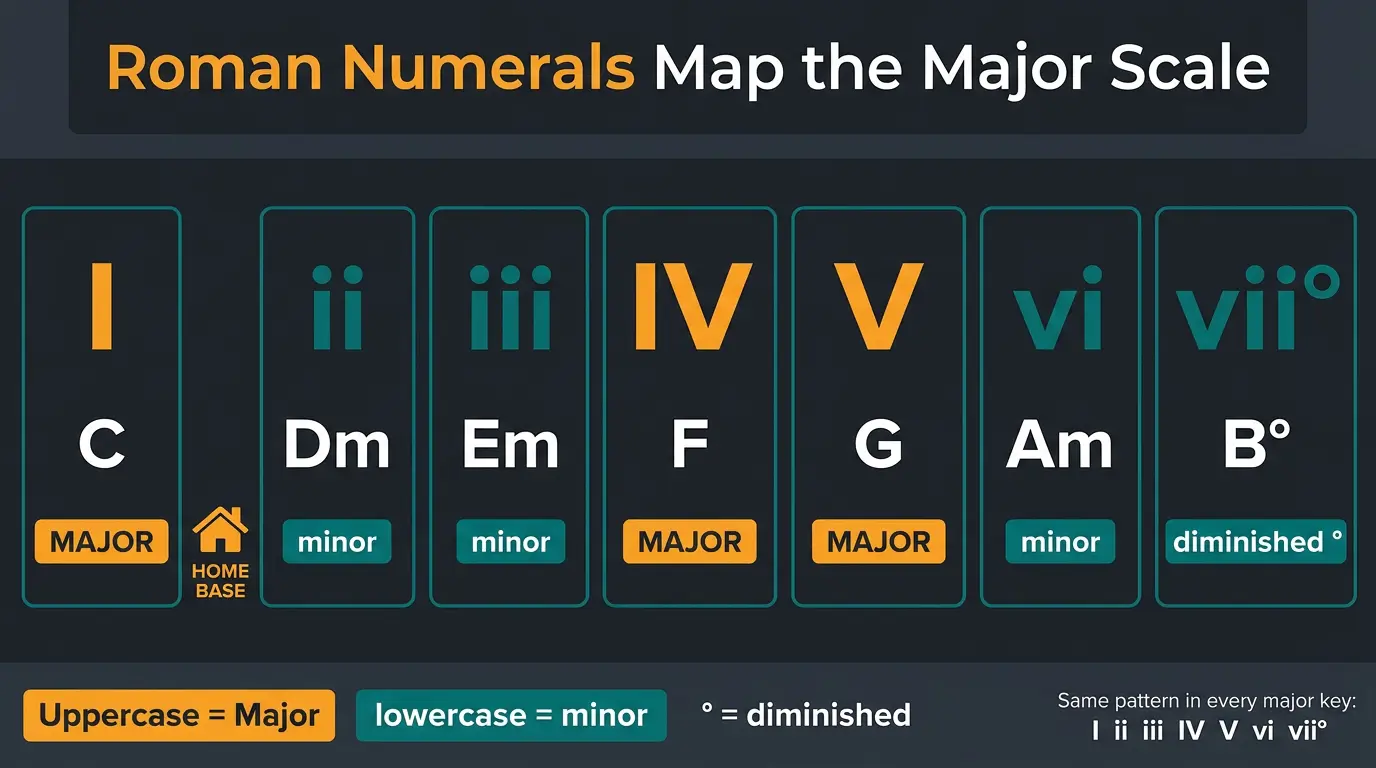
Progressions get labeled with Roman numerals tied to the notes of a scale. Uppercase means a major chord, lowercase means minor, and that little circle means diminished. In every major key the pattern is the same: I ii iii IV V vi vii°.
In C major, that gives you C, Dm, Em, F, G, Am, and B°. The first chord, C, is home base.
Here's the payoff. Because the numbers describe the relationship between chords instead of the chords themselves, you learn one progression once and move it to any key on the neck. If you want to go deeper on where the numbers come from, I've written about scale degrees and how they shape songwriting separately.
The progressions worth knowing
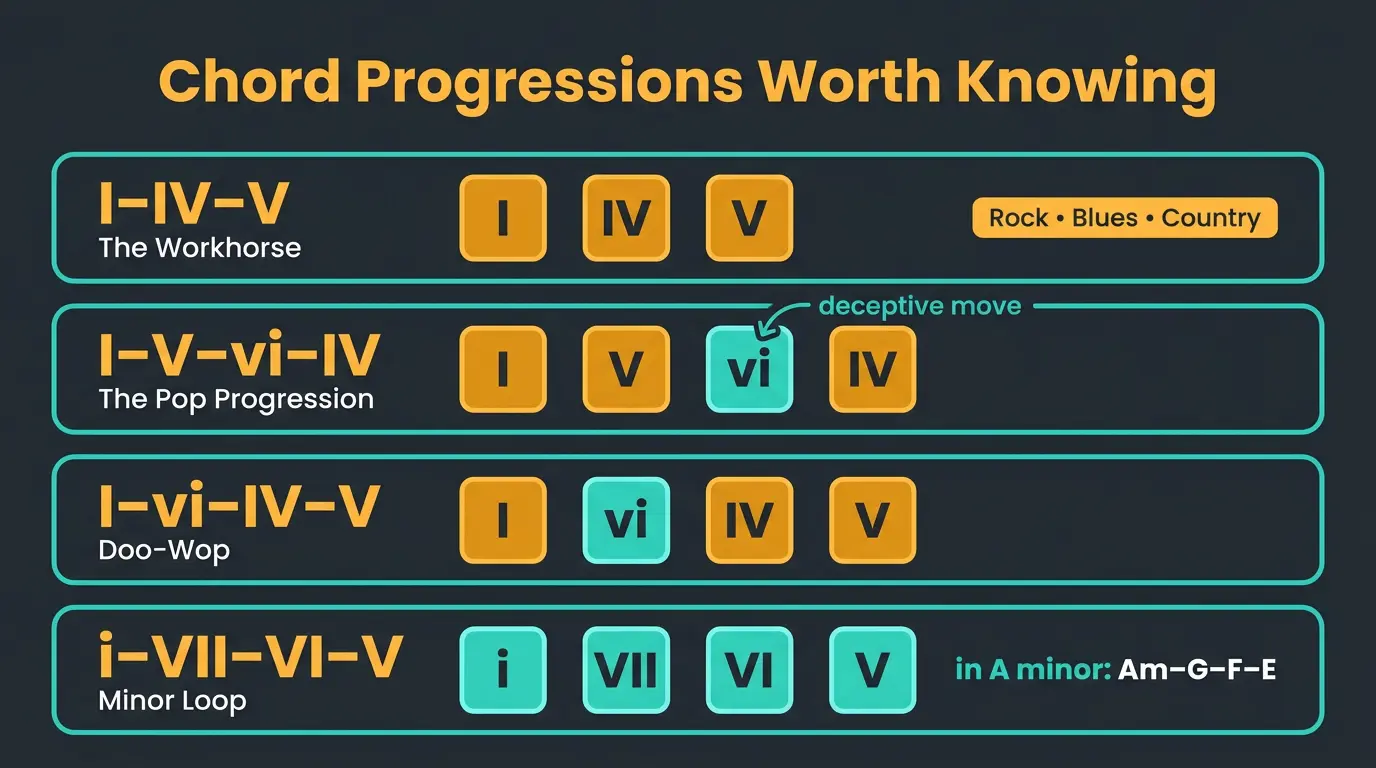
Start with I–IV–V. It's the three-chord workhorse behind most rock, blues, and country. Three major chords, instantly recognizable, and you already know most of the shapes. In blues you'll often hear it as dominant 7th chords (I7–IV7–V7) stretched across a 12-bar pattern. If that one grabs you, dig into the 12-bar blues structure next.
Then there's I–V–vi–IV, the big pop progression. You've heard it in more hit songs than you can count, and it works because it balances everything: I and IV are stable, V brings tension, and vi (the relative minor) adds emotional color. The move from V to vi is a deceptive one — your ear expects to land home on I, and instead it side-steps to the minor. That little surprise is what keeps the loop spinning under a verse or chorus.
Reorder those same four chords and you get I–vi–IV–V, the doo-wop progression. Same ingredients, different flavor. And if you want something moodier, try the minor loop i–VII–VI–V — in A minor that's Am–G–F–E. Let's give it a listen in your own hands: play Am–G–F–E a few times around and you'll feel it pull.
These guitar chord progressions cover a huge amount of ground. For a broader map of options, Berklee's rundown of common chord progressions and how to make them your own is a solid reference.
How to end a progression so it feels resolved
- The V chord builds tension that wants to fall back home to the I chord, so leaning on V near the end sets up a satisfying landing.
- A good rule of thumb is to end your loop on the IV or V — both chords pull toward the root and create the tension that resolves when you hit I.
- There's no single correct answer here. Trust your ears. If ending somewhere unexpected sounds right to you, that's a musical choice, not a mistake.
The five keys that sit well on guitar

C, A, G, E, and D are the guitar-friendly keys. Most of their diatonic chords fall as open shapes, which means less finger movement and shapes that line up neatly with the open strings (E, A, D, G, B, E).
You can play any key on a guitar — these five are just easier. The reason comes down to the instrument itself. The guitar doesn't have a separate string for every note, so keys loaded with sharps or flats push you into barre chords all over the neck. Open-string chords are simpler to fret, and honestly they ring out brighter and more resonant too. Guitarists gravitate toward keys where the home, dominant, and subdominant chords all sit in open positions.
G, E, and C up close
G major is about as beginner-friendly as it gets. G, D, and Em are among the first chords most people learn, and the C chord is your IV while D is your V — so the first three shapes a beginner picks up basically hand you the key of G.
E major leans hard on open strings. The root E sits on both your lowest and highest strings, and the dominant B lives on the open 2nd string. It looks like F#m, G#m, B, and C#m force you into barre chords, but because of how the guitar is tuned, songs in E can keep the first and second strings ringing open even through those shapes. That's part of why E feels so full.
C major has no sharps or flats at all, which makes it the easiest key to keep straight in your head. It's a great reference point when you're figuring out what everything else is doing.
Using a capo to change key or ease your fingers
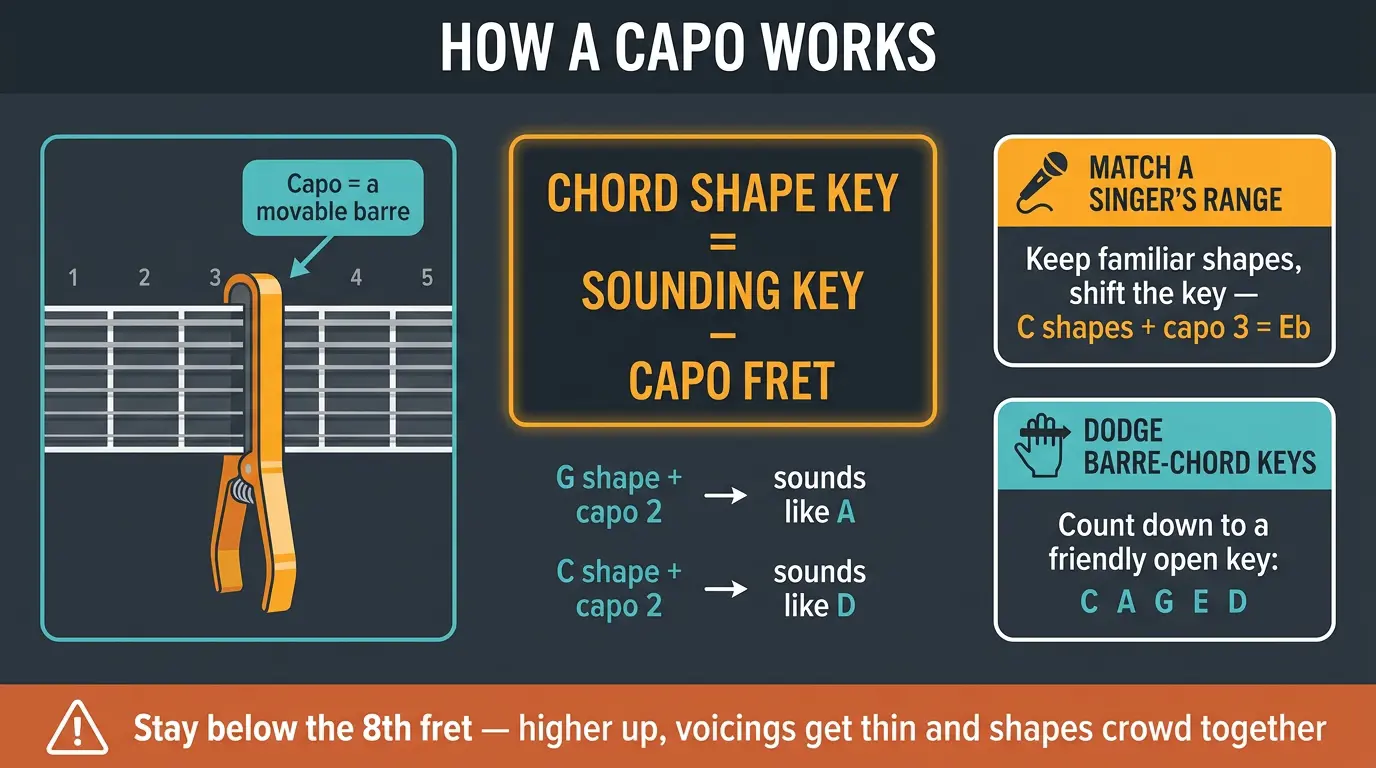
A capo changes the key without changing your tuning. Clamp it on a fret and it raises the pitch — think of it as a movable index finger holding down a barre for you. Put it on the 2nd fret and an open G shape sounds like an A; a C shape becomes a D.
The rule to memorize: chord shape key equals sounding key minus the capo fret. There are two very different reasons to reach for one.
Reason one: match a singer's range. If a song sits too high or too low for the vocal, a capo shifts the key while you keep your familiar shapes. Song's in C but your singer needs Eb? Capo the 3rd fret, keep playing C shapes, done.
Reason two: dodge the barre-chord keys. Songs in F, Bb, or Eb are full of barre chords. Count down the chromatic scale from your target key until you land on a friendly open-shape key — C, A, G, E, or D — count the semitones, then capo up that many frets and play the easy shapes. Same key, way kinder to your hand.
You get a tone bonus too: those open strings ring differently than the barred versions of the same chords. Make sure you don't push it too far, though. Past the 8th fret the voicings start getting high and thin, and the frets crowd together enough that the shapes get awkward. Below that, it's all upside.
Frequently Asked Questions (FAQs)
Is there a right or wrong way to write a chord progression?
No, there's no strict right or wrong way to write a chord progression. There are patterns that reliably sound good because they use natural tension and release, but they're starting points, not rules. Learn the common ones, then trust your ears and break them when it sounds right.
What's the easiest chord progression to learn on guitar?
I–IV–V is the easiest progression to start with — three major chords behind most rock, blues, and country. In G that's G, C, and D, which happen to be among the first chords most guitarists ever learn. Recognizable, forgiving, and it works in tons of songs.
What key is easiest to play in on guitar?
G major is generally the easiest key to play in on guitar. Its main chords — G, C, D, and Em — are the shapes beginners learn first, and they all use open strings. C, A, E, and D are close behind, since their diatonic chords also fall as easy open shapes.
Does a capo change the key or just the shapes?
A capo changes the actual key while letting you keep the same chord shapes. If you play a C shape with a capo on the 3rd fret, it sounds in Eb even though your fingers are doing C. The shape stays familiar; the pitch goes up.
What's the most popular guitar chord progression?
The I–V–vi–IV progression is probably the most popular, showing up in countless hit songs across genres. It works because it blends stability, tension, and a bit of minor-key color, with a deceptive move from V to vi that keeps the loop feeling fresh through verses and choruses.
Final Thoughts
You don't need a stack of theory to start writing. Learn a few progressions in numbers, stick to the keys that sit well under your fingers, and keep a capo handy for when a song wants a different home. Less is more — a great song rarely needs more than four chords.
So pick one of these, loop it, and start humming over the top. That's the whole game. If you want to keep building, the piano-side of this idea in how to write chord progressions covers the same thinking from a different angle.
Some of the links within this article are affiliate links. These links are from various companies such as Amazon. This means if you click on any of these links and purchase the item or service, I will receive an affiliate commission. This is at no cost to you and the money gets invested back into Audio Sorcerer LLC.