A time signature is the little symbol at the start of a song that tells you how the rhythm is organized. It's two numbers stacked on top of each other, and even though it looks like a fraction, it isn't one.
Once you understand what those two numbers mean, a lot of music suddenly makes sense. In this guide I'll break down what each number does, walk through the three you'll run into most, show you how to count them, and explain how the time signature sets the grid in your DAW. Let's get into it.
TABLE OF CONTENTS
What is a time signature?

A time signature, sometimes called a meter signature, is a symbol placed at the start of a piece of music, right after the clef and the key signature. It tells the performer how the beats are organized into measures.
It only appears once, at the beginning. The only time it shows up again is if the meter actually changes partway through the song.
Here's a bit of vocabulary that helps before we go further. The beat is the steady pulse you tap your foot to. The time signature is what organizes those beats into measures. The rhythm is the actual pattern of notes played on top of that framework. So a music time signature isn't the rhythm itself — it's the container the rhythm lives in.
And yes, it looks like a fraction. It has a top number and a bottom number. But there's no dividing line between them, and you never simplify it the way you would a fraction. Keep that in the back of your mind, because it matters later.
What the two numbers actually mean
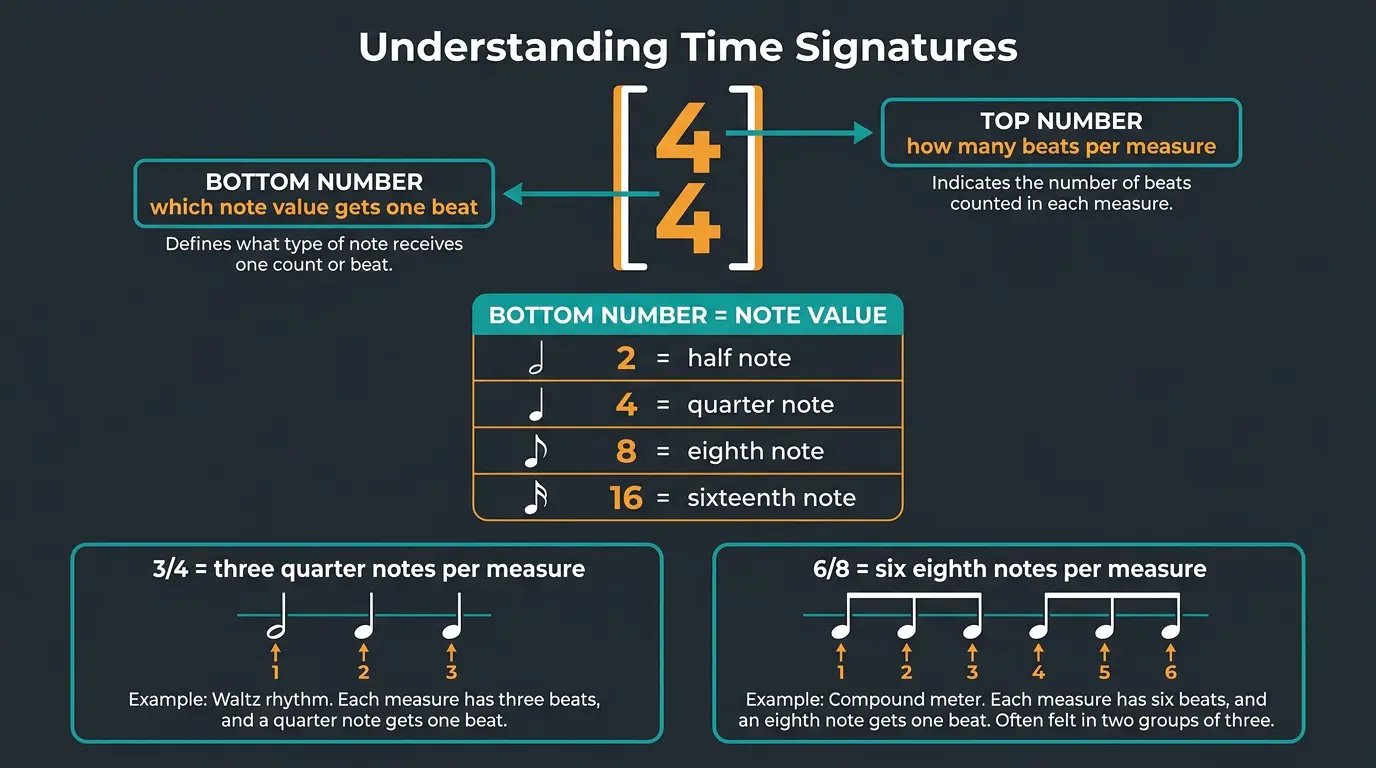
The two numbers answer two separate questions.
- Top number: how many beats are in each measure.
- Bottom number: which note value gets one beat.
The bottom number works like a code, and it reflects the fraction of a whole note:
- 2 = half note gets the beat
- 4 = quarter note gets the beat
- 8 = eighth note gets the beat
- 16 = sixteenth note gets the beat
The easiest trick is to read the whole thing as a sentence. In 3/4, there are three (top number) quarter notes (bottom number) per measure. In 6/8, there are six eighth notes per measure. Say it out loud and it clicks.
The big three: 4/4, 3/4, and 6/8
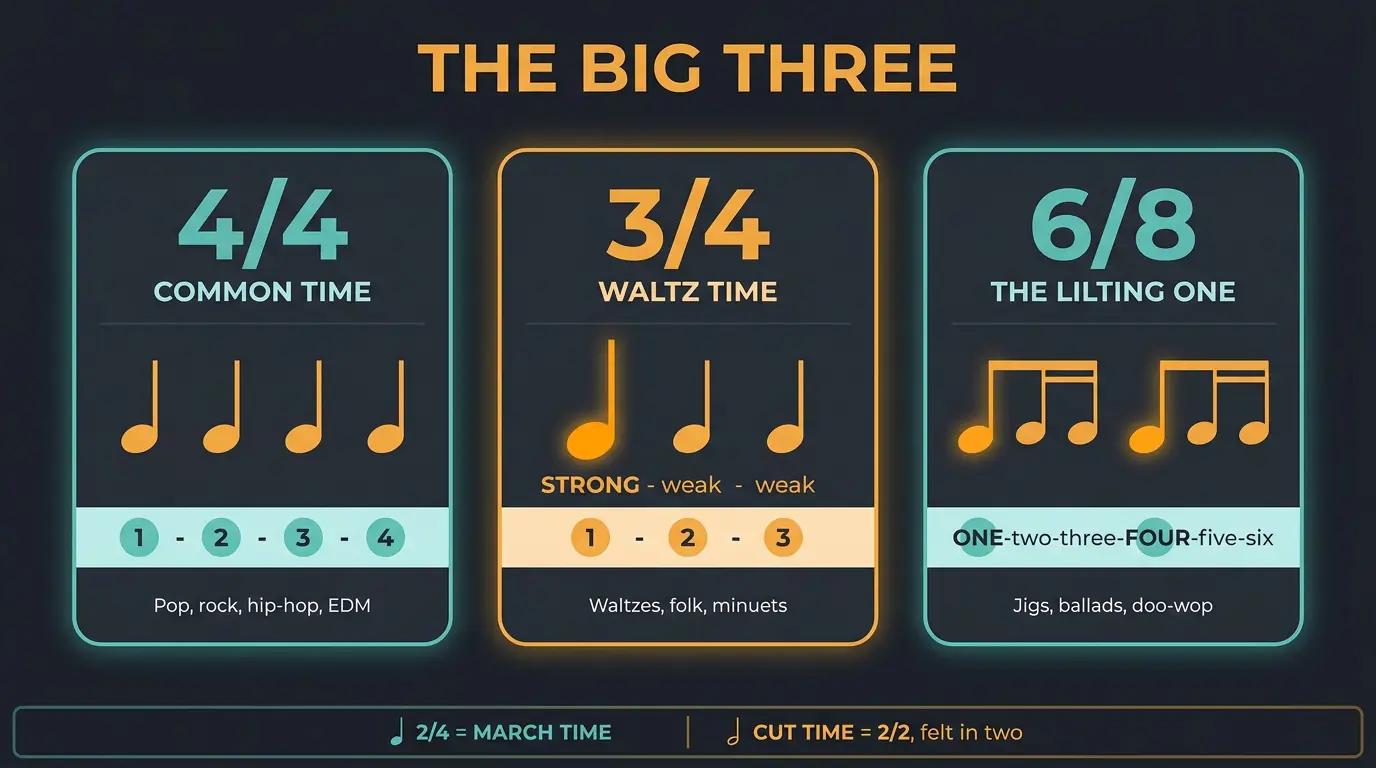
You could spend years playing music and mostly run into three time signatures. Here they are, with how to count each one.
4/4 — common time
Four quarter-note beats per measure. This is the one you'll see everywhere: pop, rock, hip-hop, EDM, country, most of it. You count it 1 – 2 – 3 – 4, then repeat.
You'll often see 4/4 written as a big "C" instead of the numbers. Most people assume the C stands for "common time," and that's the common misconception. It actually comes from an old broken-circle symbol from medieval notation, not an abbreviation. Little bit of trivia to impress nobody at parties.
3/4 — waltz time
Three quarter-note beats per measure. This is waltzes, minuets, and a ton of folk tunes. You count it 1 – 2 – 3, with a natural push on beat one: STRONG-weak-weak. Once you feel that emphasis on the one, you'll hear it everywhere.
6/8 — the lilting one
Six eighth-note beats per measure, but this is where beginners get tripped up, so we'll give it its own section next. For now: it's felt in two, with a rolling feel, and you count it ONE-two-three-FOUR-five-six. Think jigs, ballads, and doo-wop.
Two more worth knowing quickly. 2/4 is march time — marches and polkas. Cut time (that C with a line through it) equals 2/2 and gets felt in two, usually for faster pieces.
Why 6/8 isn't the same as 3/4
Math says 6/8 reduces to 3/4. Music says absolutely not. Both hold six eighth notes' worth of time in a measure, but they feel completely different, and here's why.
This comes down to simple versus compound meter.
- Simple meter: each beat divides into two. 4/4, 3/4, and 2/4 are all simple.
- Compound meter: each beat divides into three. 6/8, 9/8, and 12/8 are compound.
So 3/4 is three beats, each made of two eighth notes: ONE-two-three. But 6/8 is two felt beats, each made of three eighth notes: ONE-two-three-FOUR-five-six. Same total length, totally different accent pattern.
There's a handy shortcut for compound meters. Divide the top number by three to find how many beats you actually feel. 6/8 gives you two. 9/8 gives you three. 12/8 gives you four. That's the whole trick.
The best way to feel the difference is to count both out loud, tapping your foot on the strong beats. Trust your ears here — the feel difference is obvious once you hear it, and there's no substitute for just doing it a few times.
How time signatures work in your DAW
Here's where the theory connects to the actual work. In any DAW — Ableton, Logic, Pro Tools, FL Studio, whatever you're on — the time signature sets the grid. It's not just a notation thing.
That grid controls a few things at once:
- How the metronome clicks, usually accenting beat one of each measure to match the top number.
- How bars and beats display along the timeline.
- How quantization snaps your notes into place.
Loops, warping, and MIDI editing all reference the project time signature. So if you set the wrong one, everything misaligns to the grid — your quantize pulls notes to the wrong spots, your loops don't line up, and you spend an hour wondering why nothing feels right.
Make sure you set the time signature before you start building a project. It saves you a headache later. And one thing that trips people up: tempo and time signature are separate. Tempo is how fast (the BPM), the time signature is how the beats are grouped. A 4/4 song can crawl or fly. If you're building out chords over that grid, our guide on how to write chord progressions pairs nicely with getting your rhythm framework locked in first.
Quick reference cheat sheet
- The top number tells you how many beats are in each measure.
- The bottom number tells you which note value gets one beat (4 = quarter, 8 = eighth, and so on).
- 4/4 counts 1-2-3-4 and covers most popular music.
- 3/4 counts 1-2-3 with a strong push on beat one — that's waltz time.
- 6/8 is felt in two: ONE-two-three-FOUR-five-six. Tap your foot on the beat and count the top number out loud to lock any of these in.
Frequently Asked Questions (FAQs)
Is a time signature a fraction?
No, a time signature isn't a fraction. It looks like one, but there's no dividing bar and you never simplify it. The top number counts beats per measure and the bottom number names the note value that gets one beat. That's why 6/8 and 3/4 aren't the same, even though the math would reduce them.
Does the top number set the tempo?
No, the top number doesn't set the tempo. It only tells you how many beats are in each measure. Tempo is measured separately in BPM and is completely independent. A song in 4/4 can be slow or fast — the time signature and the tempo are two different settings.
What does the C on sheet music mean?
The C on sheet music means common time, which is the same as 4/4 — four quarter-note beats per measure. Most people assume the C stands for "common," but it actually comes from an old broken-circle symbol in medieval notation. A C with a vertical line through it means cut time, or 2/2.
What are odd or irregular time signatures?
Odd or irregular time signatures group beats unevenly instead of in tidy twos, threes, or fours. 5/4, like Dave Brubeck's "Take Five," splits into 3+2 or 2+3. 7/8 works the same way with an uneven grouping. They feel lopsided at first, but they're worth exploring once the basics feel comfortable.
What is the most common time signature?
4/4 is by far the most common time signature in Western music. It's used across pop, rock, hip-hop, EDM, country, and most mainstream genres, which is exactly why it's called common time. If you don't know a song's time signature, 4/4 is your safest first guess.
Final Thoughts
Time signatures look intimidating because they resemble math, but they're really just a quick label for how the beat is grouped. Learn the two numbers, learn to feel the difference between 4/4, 3/4, and 6/8, and you've got the foundation covered.
The rest comes from counting along with real songs and setting the grid correctly before you build a project. Less is more here — you don't need to memorize every exotic meter to write great music. Trust your ears, tap your foot, and the feel will start to stick.
Some of the links within this article are affiliate links. These links are from various companies such as Amazon. This means if you click on any of these links and purchase the item or service, I will receive an affiliate commission. This is at no cost to you and the money gets invested back into Audio Sorcerer LLC.