Here's the short version: to come up with your own chord progressions, pick a key, use the chords that belong to it, and move between them using function — home, away, and back home. That's it. That's the whole engine.
Chord progressions aren't magic. They're craft. Once you know which chords belong together and why some pull toward others, you stop guessing and start building on purpose.
By the end of this you'll be able to write progressions from scratch and actually know why they work. Let's get into it.
TABLE OF CONTENTS
Start with the chords that belong to your key
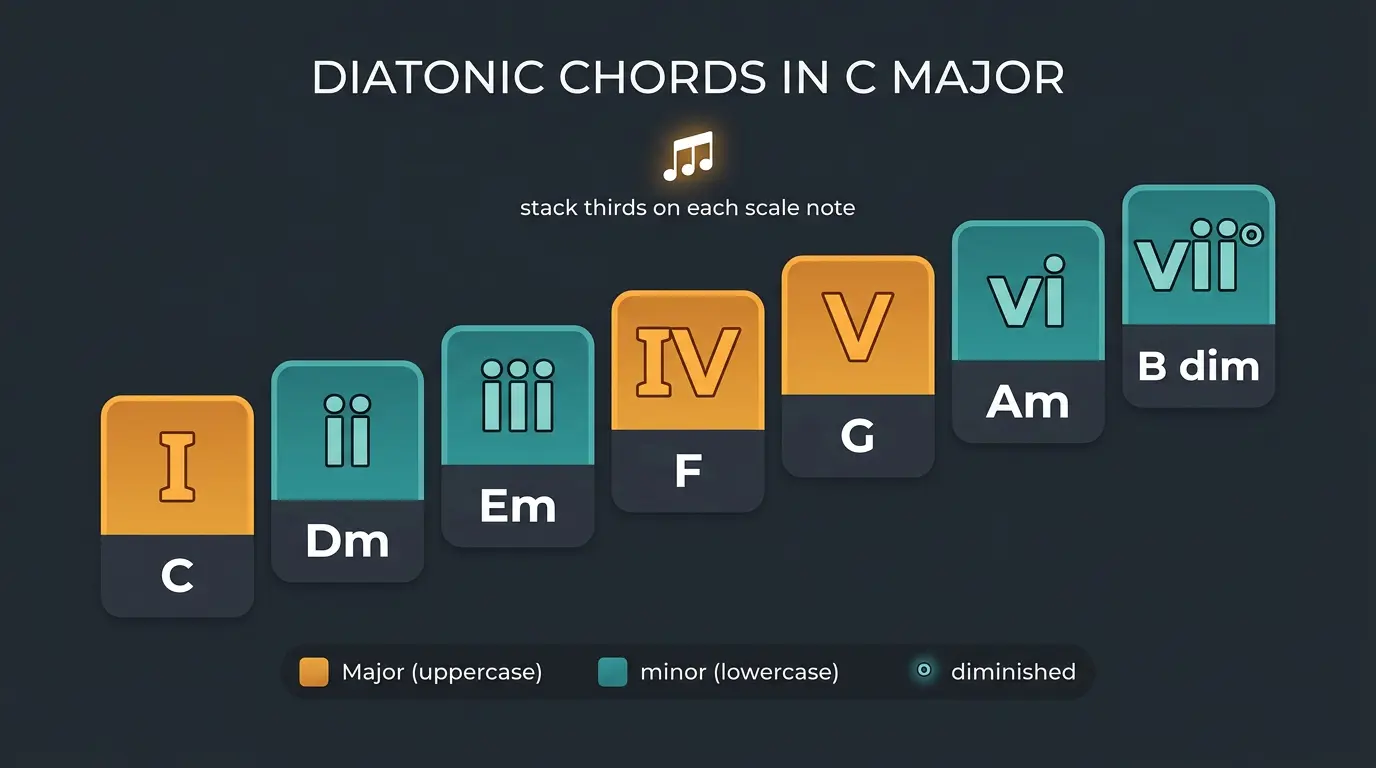
Every major and minor scale hands you seven chords built from its own notes. These are your diatonic chords — the ones that naturally belong together in a key. Stack thirds on each note of the scale and you get a chord for every step.
Here's the part that saves you a ton of memorizing: in every major key, the quality pattern is the same. It goes I, ii, iii, IV, V, vi, vii°. Learn that once and it works everywhere.
In C major, that gives you:
- I — C
- ii — Dm
- iii — Em
- IV — F
- V — G
- vi — Am
- vii° — B diminished
Those Roman numerals aren't just decoration. They're shorthand for the chord's spot in the key — uppercase for major, lowercase for minor, a little circle for diminished. Learn a progression as numbers instead of letters and you can move it to any key without redoing the math. If you want to go deeper on the specific chords here, we've got a full breakdown of the chords in the key of C, and there's a solid reference on diatonic chords in major if you like seeing the theory laid out.
Understand why chords move: tonic, subdominant, dominant
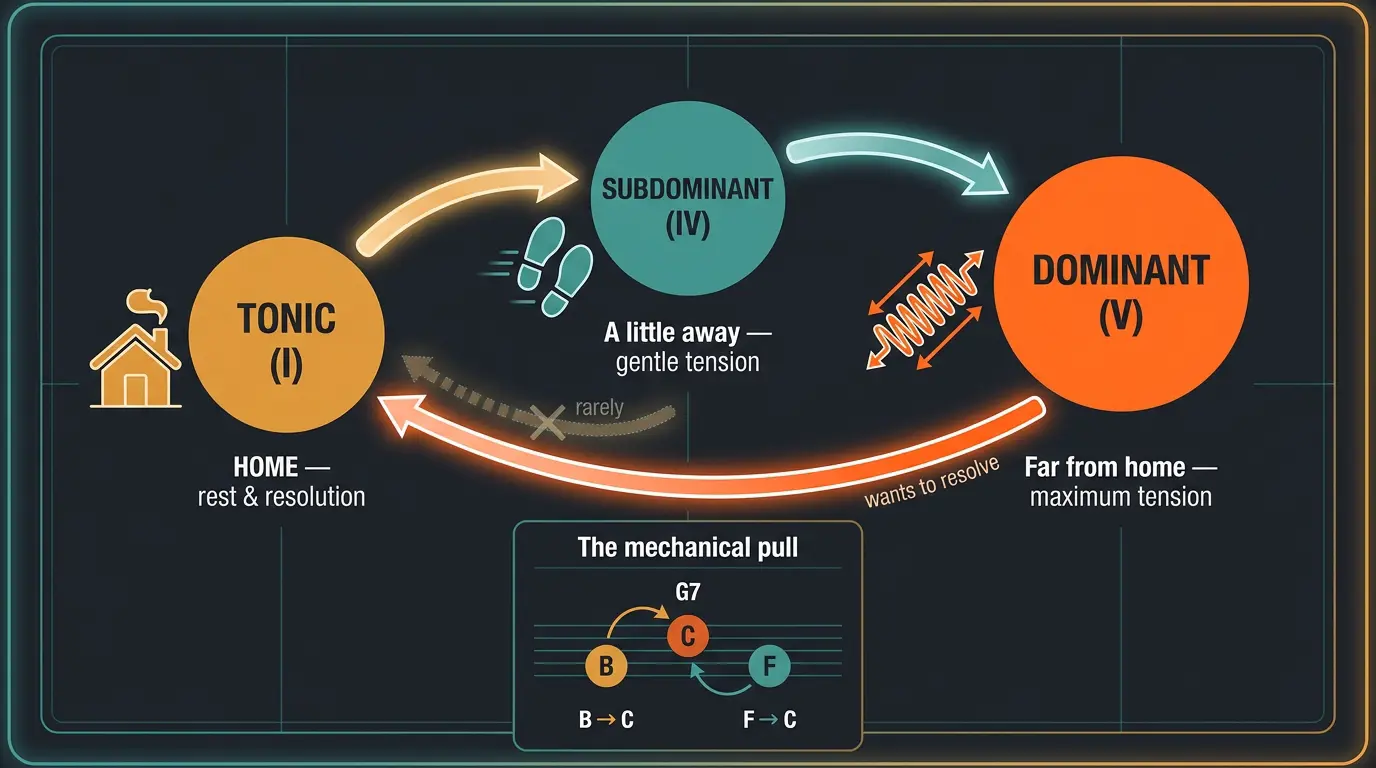
This is the engine of the whole thing. Every chord in a key does one of three jobs, and once you feel those jobs, progressions start writing themselves.
Think of it like leaving the house and coming back:
- Tonic (I) — home. Rest, resolution, the chord everything settles onto.
- Subdominant (IV) — a little ways from home. It steps away and builds gentle tension.
- Dominant (V) — far from home. Maximum tension, and it badly wants to get back to tonic.
That pull from the dominant isn't a vibe, it's mechanical. In C, the V chord is often played as G7, which contains a B and an F. That B is right below the tonic and that F wants to fall — the two of them squeeze inward and drag you home to C. Let's give it a listen sometime and you'll hear it snap into place.
One handy rule: the subdominant rarely goes straight back to tonic. It usually heads to the dominant first, then home. Home to away to further away and back — that's the classic shape.
Chords that can stand in for each other
Here's where you start making progressions your own. Chords with the same function can swap in for each other — same job, different color.
- vi and iii can stand in for tonic (they share notes with I).
- ii can stand in for IV as a subdominant.
- vii° can do the dominant's job.
So if a progression asks for IV and you want a slightly moodier feel, try ii instead. The logic holds, but the flavor shifts. Worth knowing: a chord's function doesn't always line up with its scale-degree spot. The ii chord sits on the second degree but often behaves like a subdominant, not something in between.
Steal these starter progressions and rearrange them
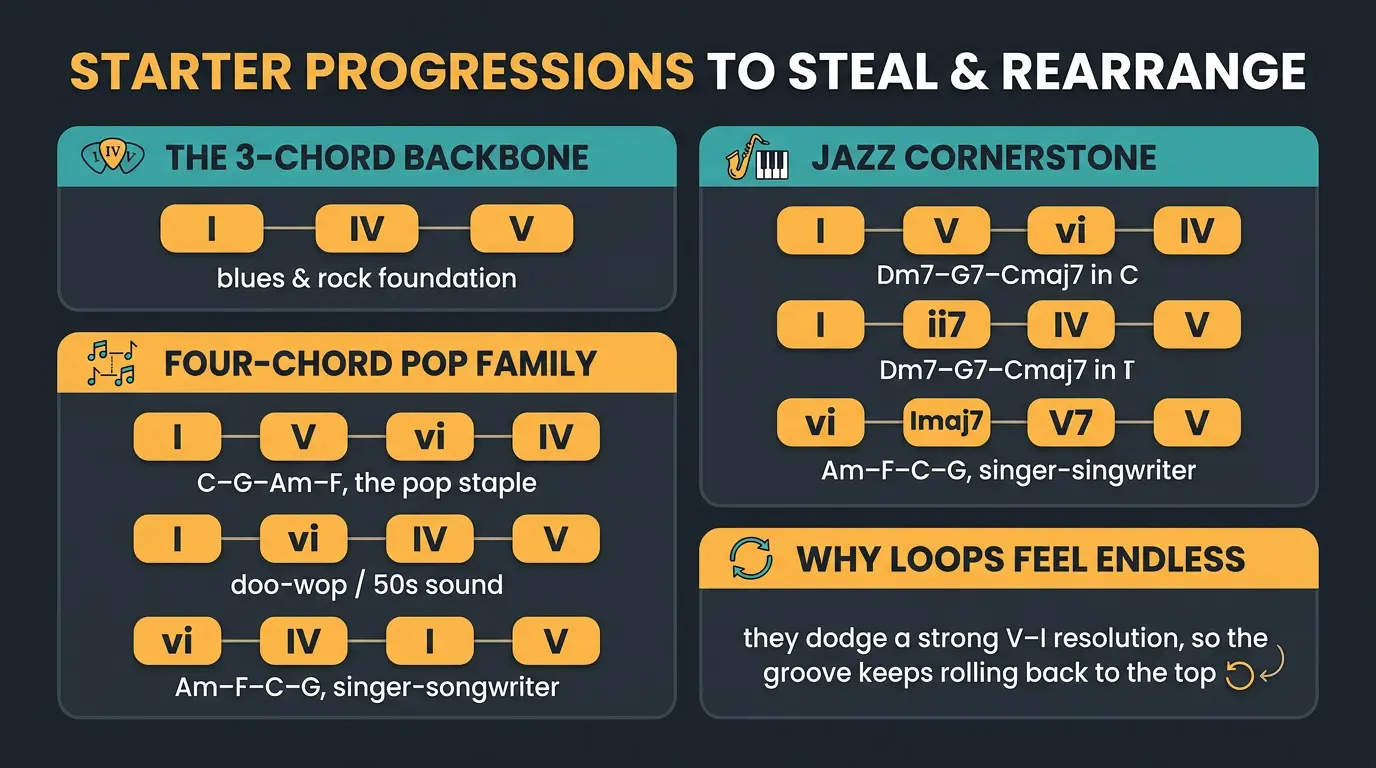
You don't have to invent from nothing. Grab a template, then bend it. Start with the three-chord backbone — I, IV, V. That's the whole foundation of the blues and a huge chunk of rock. If you want to hear it in action, our walkthrough of the 12 bar blues shows exactly how those three chords carry a song.
Then there's the four-chord pop family: I, IV, V, and vi. Same four chords, different orders, and each order has its own personality:
- I–V–vi–IV — C–G–Am–F. The one you've heard in a thousand songs.
- I–vi–IV–V — the doo-wop, '50s sound.
- vi–IV–I–V — Am–F–C–G. The singer-songwriter classic.
And for jazz, the cornerstone is ii–V–I — in C that's Dm7–G7–Cmaj7. Smooth as anything.
Here's why those looping four-chord progressions feel like they could go forever: they dodge a strong V–I landing inside the loop. Nothing fully resolves, so the groove keeps rolling back to the top. That lack of resolution is the feature, not a bug.
Make sure you play with the order and the substitutions. Swap ii for vi and see how it changes. That's how a borrowed template becomes yours. For more ready-made options, we rounded up common chord progressions every songwriter should know.
Make transitions smooth with common tones
Some chord changes feel effortless, and usually it's because the two chords share notes. Those shared notes are called common tones, and they act like a bridge between chords.
Take C and Am. They both contain C and E, so moving between them is buttery. Same with Am and F, which share A and C. Two notes stay put while the rest shift, and your ear barely notices the seam.
Bonus: progressions built on common tones make writing a melody easier, since you've got notes that live comfortably over more than one chord. Less work, smoother result.
Add color by borrowing chords
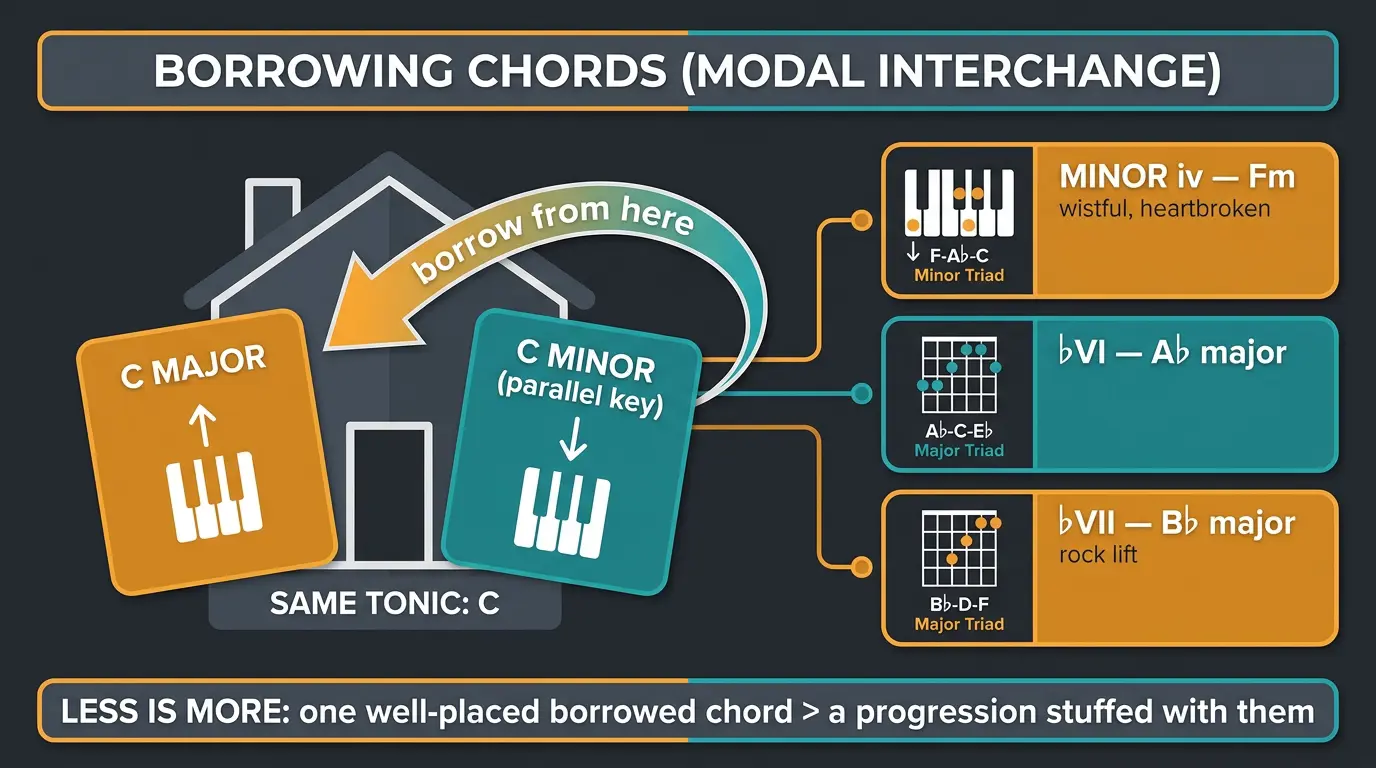
Once diatonic and function feel natural, you can level up by borrowing. Borrowing — also called modal interchange — means pulling a chord from the parallel key: same tonic, opposite mode. So in C major, you borrow from C minor.
Why does it work? C major and C minor share the same tonic, so their chords slot in without feeling foreign. They're relatives crashing at the same house. The borrowed chord adds a little unexpected color while the key still feels like home.
The most common ones to borrow into a major key, with C examples:
- Minor iv — Fm instead of F. That wistful, slightly heartbroken sound.
- ♭VI — A♭ major.
- ♭VII — B♭ major. Great for a rock lift.
Keep the spirit of less is more here. Borrowing is a splash of color, not the whole painting. One well-placed borrowed chord does more than a progression stuffed with them. If you want to understand the mechanics under this, our piece on major vs minor chords lays out why swapping between the two shifts the mood so hard.
A quick recipe for your first progression
- Pick a key and list its diatonic chords using the I, ii, iii, IV, V, vi, vii° pattern.
- Start on tonic, then plan a move away and a move back using function — home, away, home.
- Borrow a template like I–V–vi–IV, then reorder it or substitute ii for vi to make it yours.
- Trust your ears and tweak until it feels right — there isn't always one correct answer.
Frequently Asked Questions (FAQs)
What is the easiest chord progression to start with?
The easiest starting point is I–IV–V — in C that's C, F, and G. Those three chords cover the blues and a mountain of rock songs. They map perfectly onto the home, away, and tension functions, so you learn how progressions move while playing something that already sounds complete.
How many chords do you need for a good progression?
You need as few as three, and often four is plenty. The classic I–IV–V works with three, and the whole pop family runs on four. More chords isn't better — a strong progression is about how the chords move and resolve, not how many you cram in. Less is more.
Do chord progressions have to resolve?
No, chord progressions don't have to resolve. Plenty of pop loops deliberately dodge a strong V–I landing so the groove keeps cycling with no real endpoint. That lack of resolution is what makes them feel endless and loopable. Resolve when you want closure, hold off when you want momentum.
What key should I write my progression in?
Write in whatever key sits comfortably for your voice or instrument — C major is a great starting point since it has no sharps or flats. The key mostly affects how high or low things sit. Because Roman numerals let you transpose, the same progression idea works in every key anyway.
What's the difference between diatonic and borrowed chords?
Diatonic chords are built only from the notes of your key, so they always belong. Borrowed chords are pulled from the parallel key — same tonic, opposite mode — to add color. In C major, F is diatonic; Fm is borrowed from C minor. Diatonic is the foundation, borrowing is the seasoning.
Final Thoughts
Writing progressions isn't about memorizing endless charts. It's a handful of ideas — the chords in your key, the three functions, and a little borrowing for color — plus your ears telling you when something feels right.
So pick a key, list your chords, and steal a template to start. Then move things around until it sounds like you. The theory just gets you in the door faster; the good stuff comes from the tweaking.
Some of the links within this article are affiliate links. These links are from various companies such as Amazon. This means if you click on any of these links and purchase the item or service, I will receive an affiliate commission. This is at no cost to you and the money gets invested back into Audio Sorcerer LLC.