A pop filter is that little screen you clamp between the singer's mouth and the mic. Its whole job is taming plosives — those bursts of air on P and B sounds that slam the capsule and leave an ugly thump in your recording.
Here's the thing: most home vocal recordings have plosive problems that were completely avoidable. And a lot of the pop filter advice floating around online is either outdated or just wrong. So let's answer the two questions that actually matter — what does a pop filter do, and do you really need one?
TABLE OF CONTENTS
What a pop filter actually does
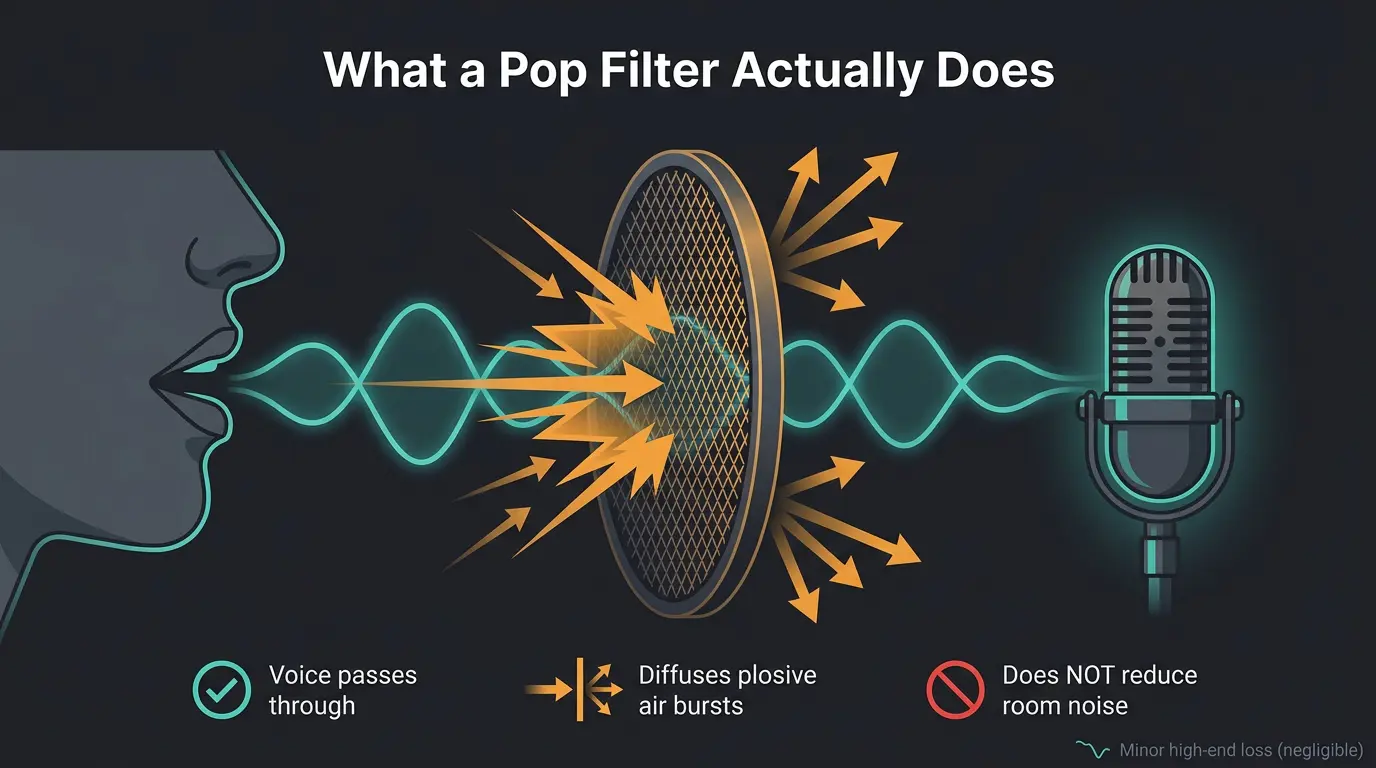
A pop filter doesn't block sound. That's the part people get backwards. The bulk of your voice travels straight through the mesh with almost no resistance. What the filter goes after is the burst of air — it diffuses and redirects that blast so it doesn't hit the diaphragm all at once.
There's a tiny bit of high-end loss on some designs, but it's mostly inconsequential. You're not trading away your top end to control plosives.
One thing to clear up while we're here: a pop filter does not reduce background noise. You'll see that claim repeated all over the place and it's just not true. A pop filter handles plosives and saliva. Room noise, hum, your neighbor's lawnmower — none of that is the pop filter's department.
Plosives, explained
Plosives are consonants made by stopping airflow completely and then releasing it in a sudden burst. In English that's P, B, T, D, K, and G. P and B are the worst offenders by a mile — they push the biggest gust of air and pile up the most energy in the low and low-mid range, right where the diaphragm is most sensitive to being shoved around.
Left untreated, that blast of air can saturate the capsule or even clip your preamp. So it's not just an aesthetic thing. A bad plosive can wreck an otherwise great take.
The mic protection benefit most people forget
Here's a benefit that almost never gets mentioned, and it might be the best reason to own one. When you sing or talk close to a mic, you're spraying a fine mist of moisture and salt onto the capsule every session. Over time, saliva actually corrodes condenser capsules.
A pop filter sits in the path and catches most of that before it reaches the mic. That extends the working life of the capsule in a real way. Even if you never had a single plosive problem, that alone makes a pop filter worth the money — especially if you're recording into something you'd rather not replace.
Nylon vs. metal pop filters
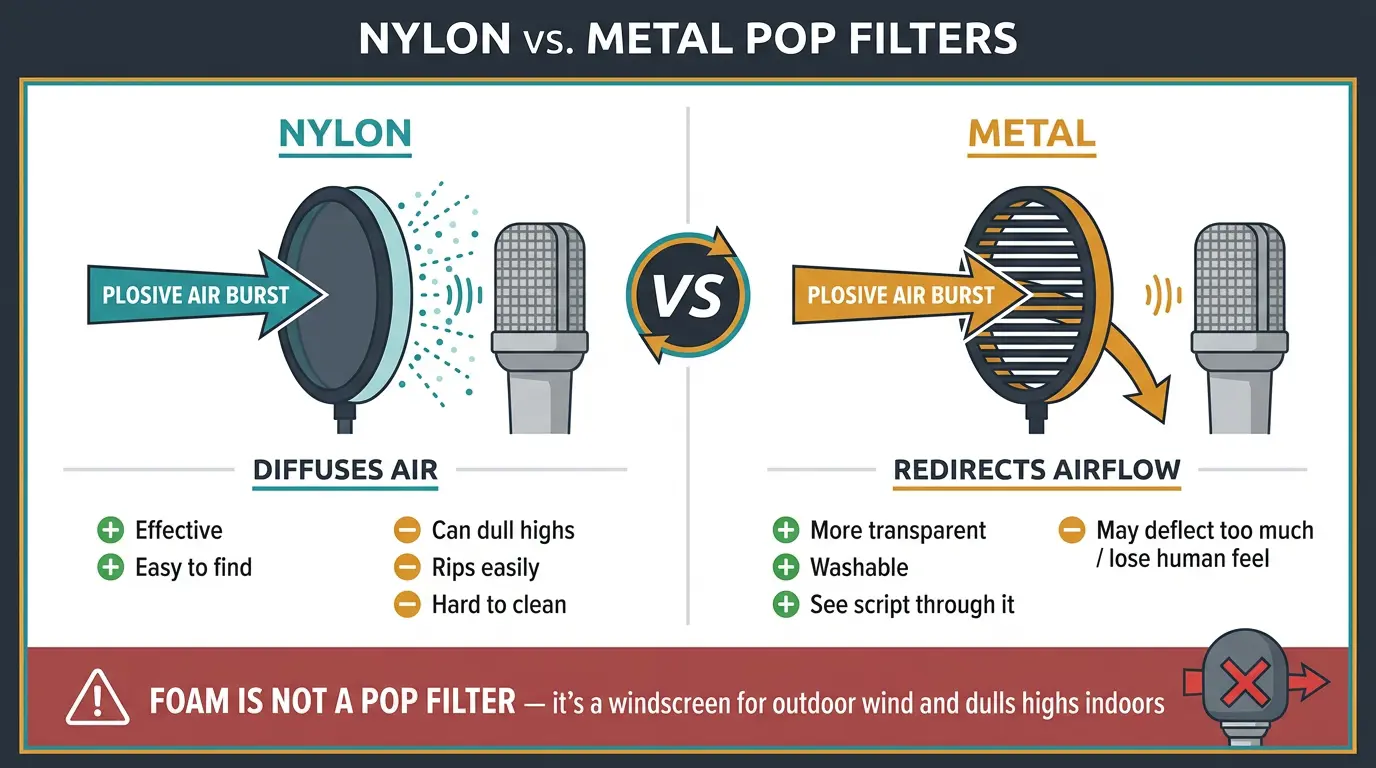
There are two real types worth talking about, and they work in completely different ways.
Nylon filters diffuse the air. They use one or two layers of tightly stretched fabric to slow the burst down before it reaches the diaphragm. They're effective and easy to find. The downsides: nylon can slightly dull your highs, it rips pretty easily, and it's a pain to clean.
Metal filters redirect instead of diffuse. Stedman-style screens use angled slats that steer the airflow downward, away from the capsule. They tend to be more transparent, they're washable, and you can read a script through them easily — which matters more than you'd think for voiceover and podcasting.
Now, there's a genuine debate here. Some engineers feel metal deflects too much and that vocals lose a bit of their human feel through it. Others swear by the transparency. There's no single right answer — trust your ears and pick what sounds good on your voice. If you want a solid outside read, this guide to pop filters for recording vocals covers the same ground.
One more thing: foam is not a pop filter. Foam is a windscreen, built for outdoor wind, and it dulls your highs more than you want in a studio. If someone hands you a foam ball for indoor vocals, that's the wrong tool.
Nylon vs. metal at a glance
- Nylon uses one or two layers of fabric to diffuse and slow the air, and it can slightly dull your high end.
- Nylon is easy to find and effective, but it rips easily and is harder to clean.
- Metal uses angled slats to redirect the air downward, tends to be more transparent, and is washable.
- Metal is easier to read a script through, which is handy for voiceover, podcasting, and long takes.
Do you actually need one?

If you're recording with a condenser, yes — pretty much. Condenser mics are sensitive to breath blasts, so they need the protection most. Dynamic mics are more forgiving. Something like the Rode PodMic even has a built-in filter, so an external one is often overkill there. If you're unsure which camp your mic falls into, our breakdown of dynamic vs. condenser microphones sorts it out.
And no, you can't reliably fix it in post. A high-pass filter cuts the low thump a plosive lives in, but it can't cleanly pull the plosive out without softening the low-mid body of the vocal that belongs there. You end up with a thinner, weaker vocal instead of a cleaner one.
A common beginner move is to turn down the input gain to dodge clipping on plosives. That works — technically — but it just makes your whole vocal quieter and noisier. You're treating the symptom, not the cause.
Honest caveat: a singer with great technique and a safe distance from the capsule can get by without one. But some plosives will always slip through. A pop filter just means you're not gambling on perfect mic technique every take.
How to position a pop filter
Positioning does most of the work, so let's get it right.
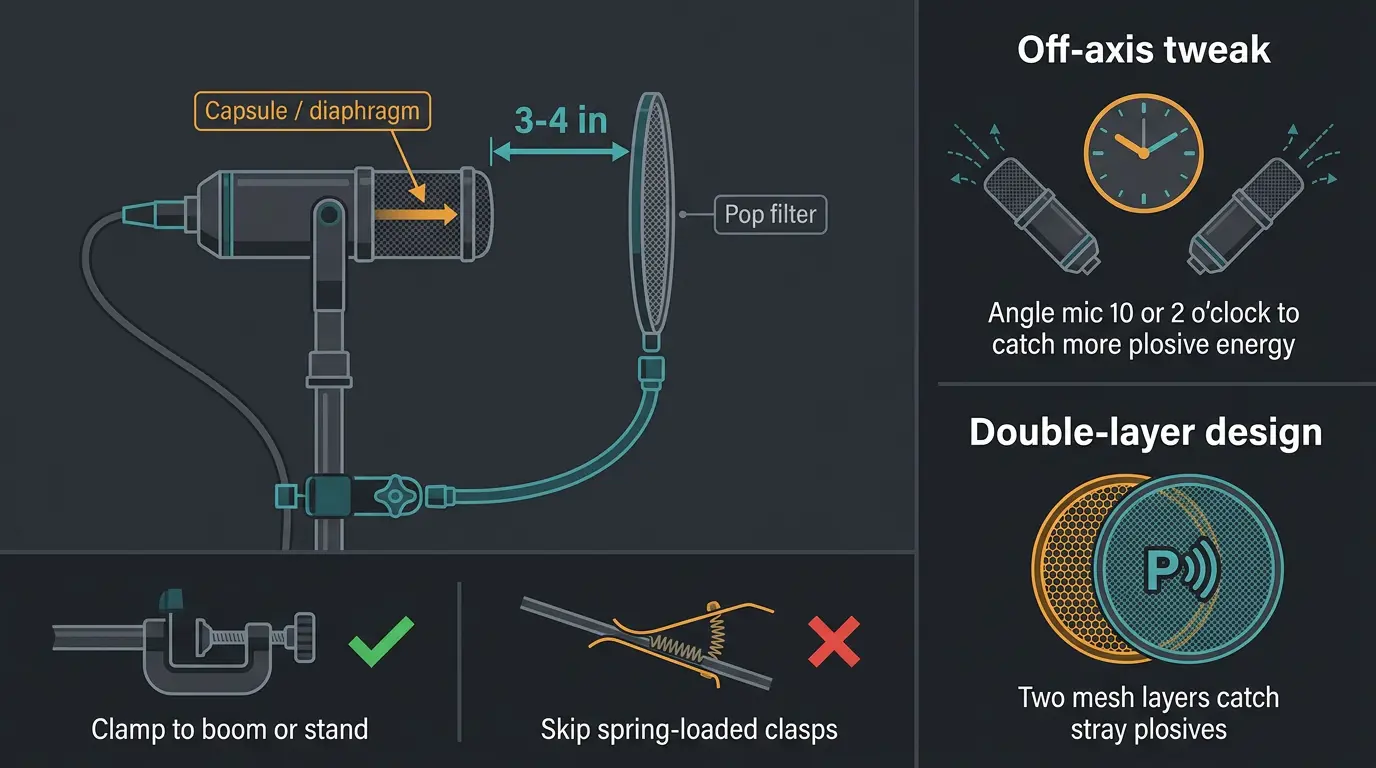
Put the filter roughly three to four inches from the capsule, squarely in front of it. That's the sweet spot for catching plosives without smothering the clarity of the voice. Too close and it's basically part of the mic; too far and air has room to build up before it gets there.
A scenario where a small tweak helps: if you're still getting the odd pop, angle the mic and filter slightly off-axis, to a 10 o'clock or 2 o'clock position. That catches more of the plosive energy before it reaches the diaphragm.
Double-layer designs help too — whatever slips past the first layer gets caught by the second, which is why they hold up against even the nastiest P sounds. When you buy one, make sure you get a filter that clamps to a boom or mic stand. Skip the spring-loaded clasps; they sag, they slip, and they'll drive you nuts.
Frequently Asked Questions (FAQs)
Does a pop filter reduce background noise?
No. A pop filter only handles plosives and blocks saliva from reaching the capsule. It does nothing for room tone, hum, or background noise. That claim gets repeated a lot, but it's just not what the filter is doing — you'd need acoustic treatment or a noise-reduction plugin for actual background noise.
Can I just use a high-pass filter instead of a pop filter?
Not cleanly. A high-pass filter cuts the low-end thump a plosive lives in, but it can't remove the plosive without also thinning out the low-mid body of the vocal. The only clean fix is not recording the plosive in the first place, which is exactly what a pop filter does.
Do dynamic mics need a pop filter?
Usually less than condensers do. Dynamic mics are more forgiving of breath blasts, and some, like the Rode PodMic, have a built-in filter already. That said, an external filter still helps on heavy plosives and protects the capsule, so it doesn't hurt to use one.
Nylon or metal — which pop filter is better?
It depends on your voice and preference. Nylon diffuses air well and is easy to find, but can slightly dull highs and rips easily. Metal is more transparent, washable, and easier to read a script through. Some engineers feel metal deflects too much. Trust your ears.
Do podcasters and streamers need a pop filter too?
Yes, especially on a condenser mic. Podcasters, streamers, and voice actors deal with the same plosives singers do, and often talk closer to the mic for longer sessions. A pop filter keeps the audio clean and protects the capsule from all that close-up moisture.
Final Thoughts
A pop filter is a small piece of gear that solves a real problem — plosives — and quietly protects your mic while it's at it. It's not magic and it won't transform a bad take, but it saves you a lot of cleanup you shouldn't have to do in the first place.
Nylon or metal, three inches out, slightly off-axis — that covers almost everyone. Less is more. Get the basics right and let your ears make the call from there.
Some of the links within this article are affiliate links. These links are from various companies such as Amazon. This means if you click on any of these links and purchase the item or service, I will receive an affiliate commission. This is at no cost to you and the money gets invested back into Audio Sorcerer LLC.