Phantom power is DC voltage sent down the same balanced cable that already carries your mic's audio. No separate power lead, no wall wart at the mic end — the power and the signal share the same wire. That's where the spooky name comes from.
Here's the thing: a lot of what people believe about phantom power is either oversimplified or flat-out wrong. The big one — "leaving it on will damage mics that don't need it" — mostly isn't true anymore. Let's clear it all up, plainly.
TABLE OF CONTENTS
What phantom power actually is
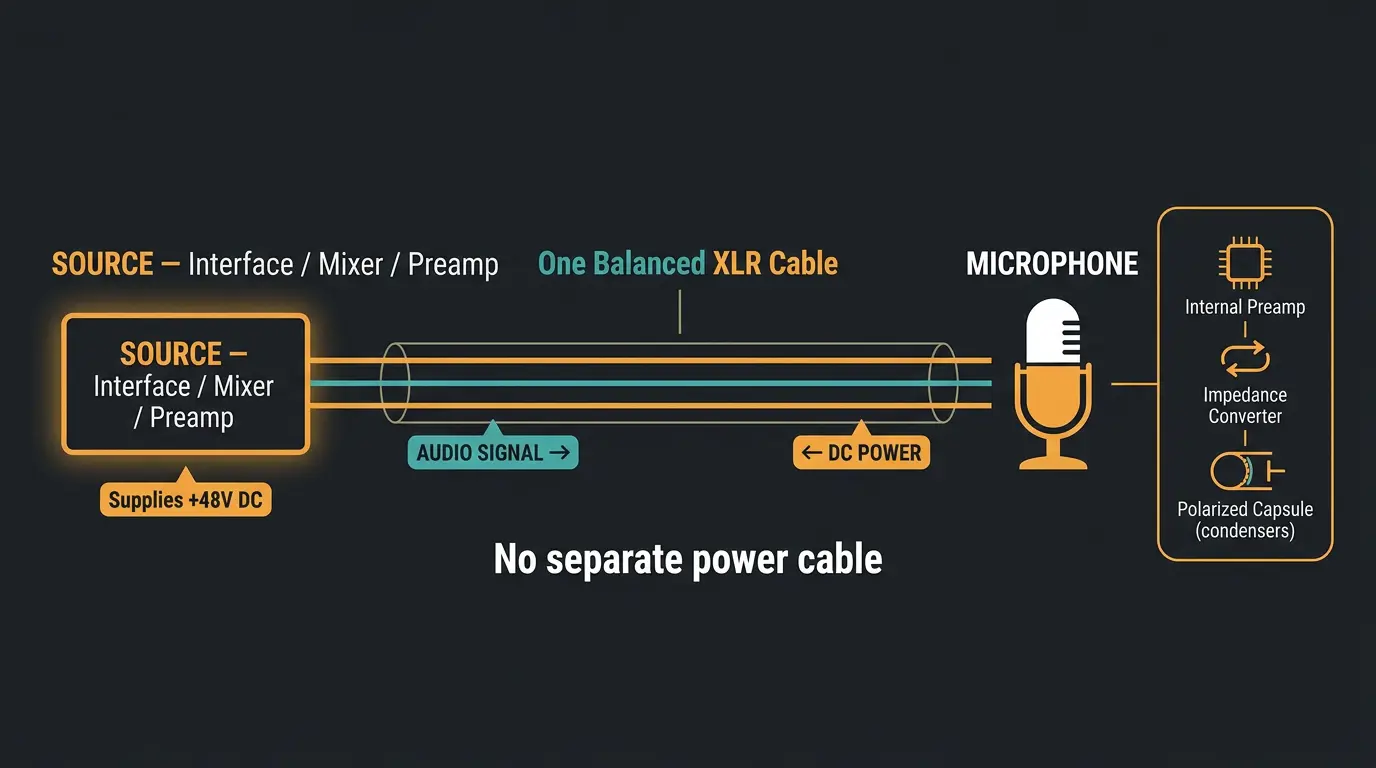
Phantom power is a DC voltage supplied from your source — an audio interface, mixer, preamp, or a standalone supply — to the mic over the same balanced XLR cable that sends the audio back. There's no dedicated power cable involved. Power and signal ride together.
Its job is to run the active electronics inside certain mics. That means the impedance converters and internal preamps, and in condensers that need it, polarizing the capsule so it can actually do its thing. If a mic has powered circuitry inside, phantom is often what feeds it.
It's not always 48 volts
People say "phantom power" and "48 volts" like they're the same thing. 48V — commonly written P48 — is the standard and by far the most common, but it isn't the only option. The governing spec, IEC 61938, also allows 12V and 24V, and you'll find real gear running 15V or 18V too. Some acoustic guitar amps and preamps live down there.
Here's the catch: a mic built for P48 might still work at a lower voltage, but performance suffers. You get reduced max SPL handling and more distortion. So lower isn't a free lunch.
Bit of history — P48 was pioneered by Neumann back in the 1960s, reportedly because the Norwegian Broadcasting Corporation told them their new mic had to run on 48 volts. And here we are.
How it reaches the mic without touching your audio
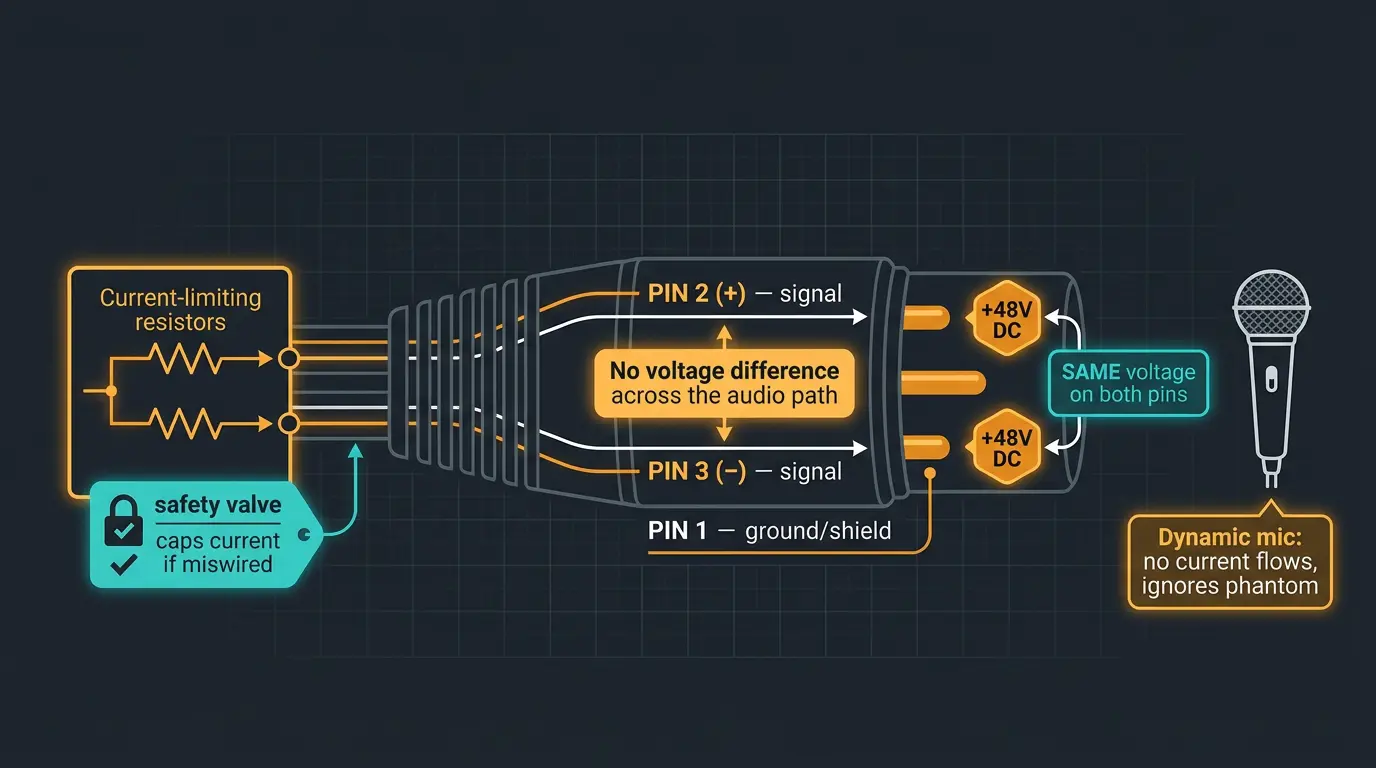
This is the detail most people miss, and it explains everything else. Phantom needs a balanced circuit. Pins 2 and 3 of the XLR both carry the same DC voltage relative to pin 1. Same voltage on both. That means there's no voltage difference across the mic's signal path.
So when a dynamic mic sees phantom power, nothing happens — the two pins are at equal potential, so no current flows through the audio path. The mic just ignores it.
There's also a safety valve built into the supply: current-limiting resistors. If a cable or mic is miswired, those resistors cap the flow and help prevent damage. It's a quietly clever system.
Which mics need phantom power
The core rule: only mics with built-in active electronics need phantom power. That's primarily condensers. A condenser's output is very high impedance, and it needs a powered circuit inside to bring that impedance down to something your preamp can use. No power, no usable signal.
Passive dynamics like the SM58 have no electronics inside — they're just a coil and a magnet doing their job — so they need nothing. If you're fuzzy on why those two mic types behave so differently, our breakdown of dynamic vs condenser microphones covers it well.
Two bits of nuance the simple version skips. Not every active mic uses phantom — DC bias and external power supplies exist too, depending on the design. And some dynamics do want phantom: active ribbon mics have electronics inside that run on it. So "dynamic" doesn't automatically mean "no power."
Does phantom power damage mics that don't need it?

This is the big correction, so let's be clear. The old myth says leaving phantom on will slowly kill mics that don't need it. For modern dynamic mics with balanced XLR outputs, that's false. They're designed to accept phantom and ignore it. With intact, symmetrically wired gear, no current flows through the signal path and nothing happens.
With that being said, there are real risk cases, and they're worth knowing:
- Ribbon mics through a bad connection. Send phantom to a ribbon through a miswired cable or a TRS patch, and you can stretch or snap the ribbon element — which can be about 1/100th the thickness of a human hair.
- Certain vintage ribbons. Some use a center-tapped output transformer with the center tap earthed, which essentially shorts the phantom supply and can push damaging current through the transformer.
- Faulty or imbalanced cables. If the voltage on the two pins isn't equal, that imbalance can damage even a dynamic mic.
Bottom line: modern XLR mics are fine, but some vintage ribbons and any unbalanced-wired mic are not. Make sure you check the manual before feeding phantom to a ribbon. If you want a solid second opinion, Sound On Sound has a good explainer on phantom power on dynamic mics. And if ribbons are your thing, our guide to the best ribbon microphones is worth a look.
Phantom power best practices
- Turn phantom off before you plug or unplug mics. It avoids pops and power surges that can wear on your speakers and headphones over time.
- Don't plug line-level instruments into XLR inputs with phantom engaged — that can damage your gear.
- Leaving phantom on generally won't hurt modern mics, but keep ribbons in mind and check the manual if you're unsure.
- For multi-mic setups, make sure the total current draw of all your mics doesn't exceed what the supply is rated to deliver.
Where inline preamps like the Cloudlifter fit in
Some dynamics put out a very low signal and are hungry for gain. The Shure SM7B and Rode PodMic are the usual suspects. Crank your interface preamp to feed them and you often invite hiss along for the ride.
That's where inline boosters come in — the Cloudlifter CL-1, the FetHead, the sE Dynamite. They give a clean gain boost right at the mic, before the signal hits your interface. If you're running an SM7B, our Shure SM7B review gets into why that extra gain matters.
Here's the neat part, and why phantom belongs in this conversation. These boosters draw 48V phantom to power themselves, but they do not pass that voltage on to the mic. So you get the boost without any phantom reaching the capsule — which is exactly why they're safe to use even with ribbons.
Frequently Asked Questions (FAQs)
Will phantom power damage a dynamic mic?
No, phantom power won't damage a modern dynamic mic with a balanced XLR output. Both signal pins carry the same voltage, so no current flows through the mic and it simply ignores the power. The exceptions are ribbon mics and any mic wired unbalanced or fed through a faulty cable.
Do I need phantom power for an SM7B?
No, the Shure SM7B is a passive dynamic mic and doesn't need phantom power to work. You'll often want phantom for a different reason, though — to run an inline booster like a Cloudlifter, which uses that 48V to add clean gain since the SM7B's output is very low.
Is it safe to leave phantom power on all the time?
Yes, it's generally safe to leave phantom on with modern condensers and dynamics, which reject or ignore it. The one thing to watch is ribbon mics — sending phantom to a ribbon through a bad cable can wreck it. If everything's condensers and modern dynamics, don't sweat it.
Can phantom power hurt a ribbon mic?
Yes, phantom power can damage a ribbon mic if it reaches the ribbon through a miswired or TRS cable, and some vintage ribbons are at risk even with proper wiring. Many modern active ribbons actually require phantom, so this is a real check-the-manual situation before you flip that switch.
Is all phantom power 48 volts?
No, phantom power isn't always 48 volts. 48V (P48) is the standard and most common, but the IEC 61938 spec also allows 12V and 24V, and some gear runs 15V or 18V. A P48 mic may still work at lower voltage, but you'll typically get less max SPL and more distortion.
Final Thoughts
Phantom power sounds mysterious, but it's really just DC voltage sharing a cable with your audio to run the electronics inside certain mics. Condensers and active ribbons need it, passive dynamics ignore it, and modern XLR gear is built to handle it without drama.
The one place to slow down is ribbons and anything wired unbalanced — check the manual, don't guess. Do that, and you can stop worrying about the switch and get back to actually recording.
Some of the links within this article are affiliate links. These links are from various companies such as Amazon. This means if you click on any of these links and purchase the item or service, I will receive an affiliate commission. This is at no cost to you and the money gets invested back into Audio Sorcerer LLC.