LUFS measures how loud your track actually sounds to a human ear, not how high the waveform spikes. That's the whole idea in one sentence. It's the number streaming platforms read when they decide whether to turn your song up, down, or leave it alone.
Let's clear up one thing right away: LUFS isn't new, and it isn't replacing dBFS. That old myth needs to go. It's a mature, standardized measurement that works right alongside your peak meters. And these days, the entire topic really comes down to one thing — how streaming platforms normalize your loudness on playback.
TABLE OF CONTENTS
What LUFS actually measures
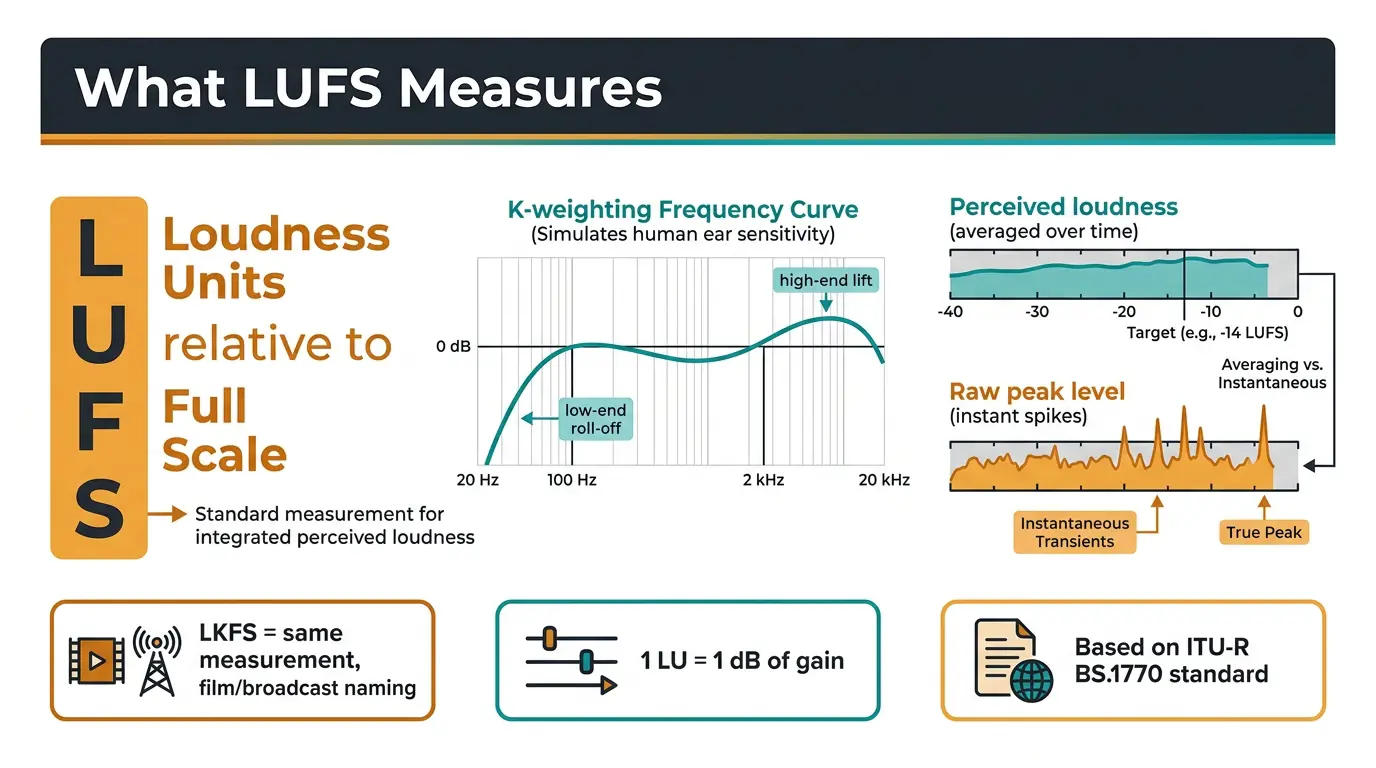
LUFS stands for Loudness Units relative to Full Scale. In plain terms, it tracks perceived loudness over time — averaging things out instead of reacting to every instant spike. It uses frequency weighting and gating to get closer to how we actually hear.
That weighting is called K-weighting. A LUFS meter gently rolls off the lows below around 100 Hz and lifts the highs above around 2 kHz, because that's roughly how our ears judge loudness. So a track heavy in the low end won't read as loud as its raw level might suggest.
You'll also run into LKFS, mostly in film and broadcast. Don't let it trip you up — it's the exact same measurement, just a different naming convention. One handy detail: 1 LU equals 1 dB of gain, so if a platform says you're 3 LU too loud, it's applying -3 dB. All of this sits on top of the ITU-R BS.1770 standard, which is the reference every meter is built around.
LUFS vs. dBFS: they're partners, not rivals
Here's the mistake I see everywhere. People treat LUFS and dBFS like one is replacing the other. They're not competitors — they measure completely different things.
dBFS is a peak meter. It tells you the instantaneous level against digital full scale. LUFS tells you perceived loudness over time. Two tracks can both peak at -1 dBFS while one feels a full 10 LU louder than the other. Peak level says almost nothing about how loud something actually feels, which is exactly why loudness normalization runs on LUFS.
Then there's true peak, measured in dBTP. This is your safety metric. Regular peak meters miss inter-sample peaks — the ones that show up between samples when the signal gets reconstructed. Lossy encoding like AAC and MP3 can push those over 0 dB and cause audible crackle. That's the whole reason platforms ask for a -1 dBTP ceiling. If you want to go deeper on that, I've got a full write-up on true peak limiting.
The three loudness windows you'll see on a meter
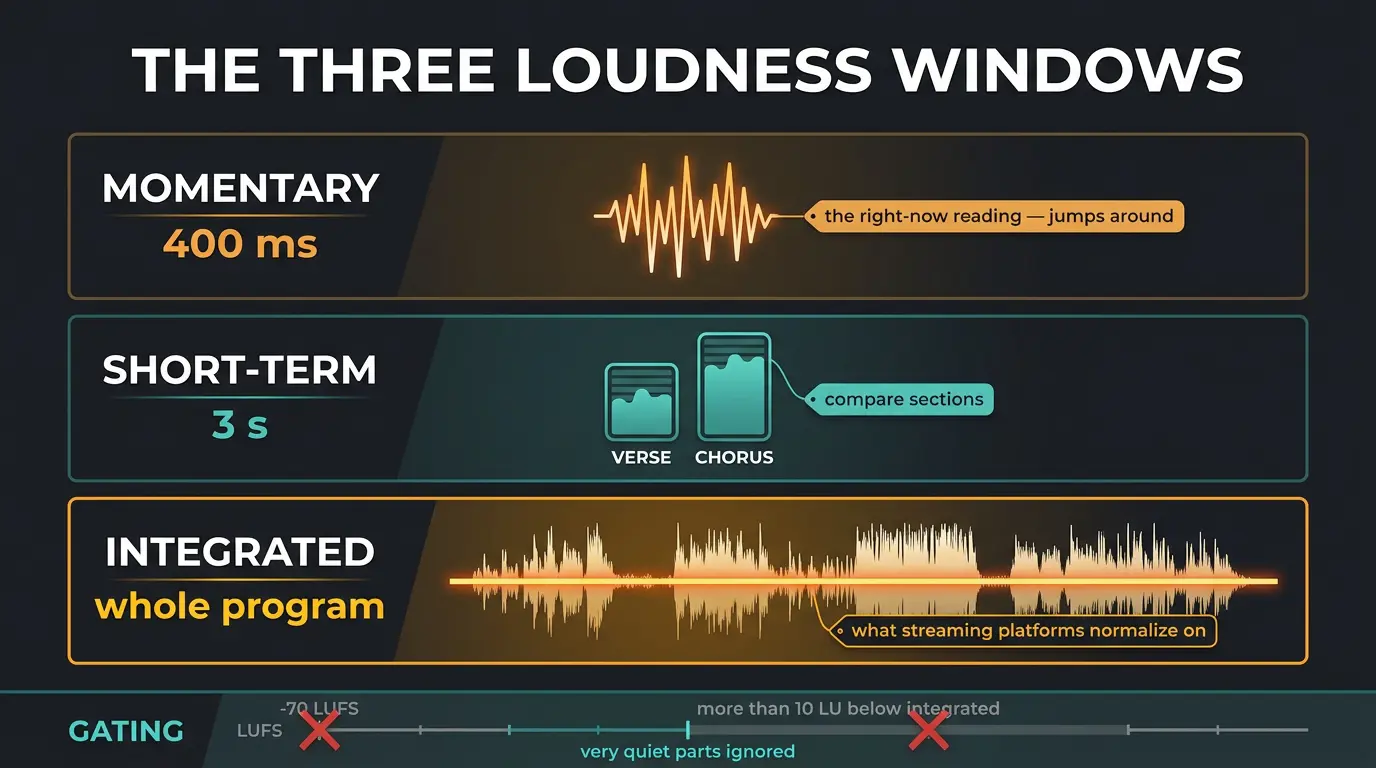
Open any decent loudness meter and you'll see three readings. Knowing which one to watch saves a lot of confusion.
- Momentary (400 ms) — the "right now" reading. It jumps around a lot. Useful for spotting a moment that's suddenly leaping out.
- Short-term (3 s) — great for comparing sections. Check your verse against your chorus and see how they stack up.
- Integrated — the loudness of the whole program from start to finish. This is the number platforms normalize on, so it's the one that matters for streaming.
You'll also see the word gating. It just means very quiet stuff gets ignored so it doesn't drag your average down — anything below -70 LUFS, plus anything more than 10 LU under the integrated reading, doesn't count. No mystery there. It's just the meter being smart about what to include.
How streaming loudness normalization works
This is the part that changed everything. When you upload a track, the platform measures your integrated LUFS and adjusts the playback volume so listeners aren't constantly reaching for the volume knob between songs. The file itself isn't touched — the adjustment happens on playback.
Now here's the detail that matters more than the target number. Not every platform behaves the same way. Spotify and Apple Music will turn quiet tracks up to hit their target. YouTube, Amazon, and Tidal only turn loud tracks down — they never boost. That behavioral difference is the thing to keep in your head.
Users can also switch normalization off. Apple's Sound Check is optional, and Spotify has selectable modes. But in practice, most people never touch the default — around 87% of Spotify listeners leave it exactly where it started.
| Platform | Integrated LUFS | True Peak |
|---|---|---|
| Spotify | -14 LUFS (-2 dBTP if louder than -14) | -1 dBTP |
| Apple Music (Sound Check) | -16 LUFS | -1 dBTP |
| YouTube | -14 LUFS | -1 dBTP |
| Tidal | -14 LUFS | -1 dBTP |
| Amazon Music | -14 LUFS | -2 dBTP |
| SoundCloud | -14 LUFS | -1 dBTP |
| Deezer | -15 LUFS | -1 dBTP |
| Broadcast (EBU R128) | -23 LUFS | -1 dBTP |
| Broadcast (ATSC A/85) | -24 LKFS | — |
| Netflix | -27 LKFS | -2 dBTP |
Should you master to -14 LUFS?
This is the debate I get asked about most, so let's be honest about it. Those targets are playback levels, not delivery specs. A master that sounds right at -9 LUFS gets turned down to the house level and keeps all its character. A master strangled down to exactly -14 to "avoid being turned down" gains nothing, and it often loses punch in the process.
Genre plays a big role here too. Electronic and hip-hop tracks often sit around -8 to -10 LUFS before normalization and sound great. Acoustic, classical, and ambient material tends to land closer to -16, sometimes lower, and that's fine.
So don't chase a single magic number. One well-balanced master with a -1 dBTP true peak will hold up across every major platform. Less is more — make the master sound right, keep your true peak in check, and trust your ears over a spec sheet. If you want the full breakdown, I go deep on this in the guide to mastering for streaming services, and iZotope has a solid overview of how normalization affects your masters if you want another take.
Is the loudness war really over?
Both answers are true, depending on how you look at it. On streaming, the competitive reason for pushing everything to a brickwall is gone. Since platforms normalize on LUFS, a crushed master doesn't win the loudness contest anymore — it just gets turned down like everyone else. In that sense, the war is functionally over.
But loud masters haven't disappeared. Plenty of people still push hard, and in practice the habit is alive and well. So it depends whether you mean the strategy or the sound.
Here's my honest take: louder, used right, genuinely sounds better. So I'm not going to be apologetic about pushing levels, and neither should you. Just do it because it serves the song — not to beat a normalization algorithm that's going to turn you down anyway.
Frequently Asked Questions (FAQs)
What LUFS should I master to?
Master to whatever sounds right for the song, then keep your true peak at -1 dBTP. There's no single magic number. Streaming targets are playback levels, not delivery specs, so one well-balanced master covers every platform. Loud genres often sit around -8 to -10 LUFS, acoustic material closer to -16.
What's the difference between LUFS and LKFS?
Nothing — they're the exact same measurement under different names. LUFS is common in music and streaming; LKFS (Loudness, K-weighted, relative to Full Scale) shows up in film, TV, and broadcast. If a spec sheet lists one or the other, don't overthink it. The reading is identical.
Why do platforms want -1 dBTP for true peak?
Because lossy encoding like AAC and MP3 creates inter-sample peaks that can push your signal over 0 dB and cause audible crackle. A -1 dBTP ceiling leaves headroom so that never happens. Regular peak meters miss these peaks, which is why you need a true peak meter to catch them.
Does Spotify change my audio file?
No. Spotify measures your loudness on upload but doesn't process or alter your file. The volume adjustment happens on playback only, so the original master stays intact. If a listener switches normalization off, they hear your track at its true loudness.
Will a quiet master get boosted on every platform?
No — only Spotify and Apple Music turn quiet tracks up to their target. YouTube, Amazon, and Tidal only turn loud tracks down, they never boost. So a quiet master stays quiet on those platforms. That behavioral difference matters more than the target number itself.
Final Thoughts
LUFS isn't complicated once you stop treating it like a rival to your peak meter. It measures loudness, dBTP keeps you safe, and the platform sorts out the playback volume. That's the whole game.
So make sure your master sounds right, keep that true peak around -1 dBTP, and don't lose sleep chasing a single target number. Trust your ears — they were the point all along.
Some of the links within this article are affiliate links. These links are from various companies such as Amazon. This means if you click on any of these links and purchase the item or service, I will receive an affiliate commission. This is at no cost to you and the money gets invested back into Audio Sorcerer LLC.