Getting better at songwriting isn't about talent, and it definitely isn't about waiting for a muse to knock on your door. It comes down to a few habits you can start today.
Four of them, really: write every day, actually finish your songs, borrow structures that already work, and beat writer's block before it beats you. Let's get into it.
TABLE OF CONTENTS
Write every day (even for ten minutes)
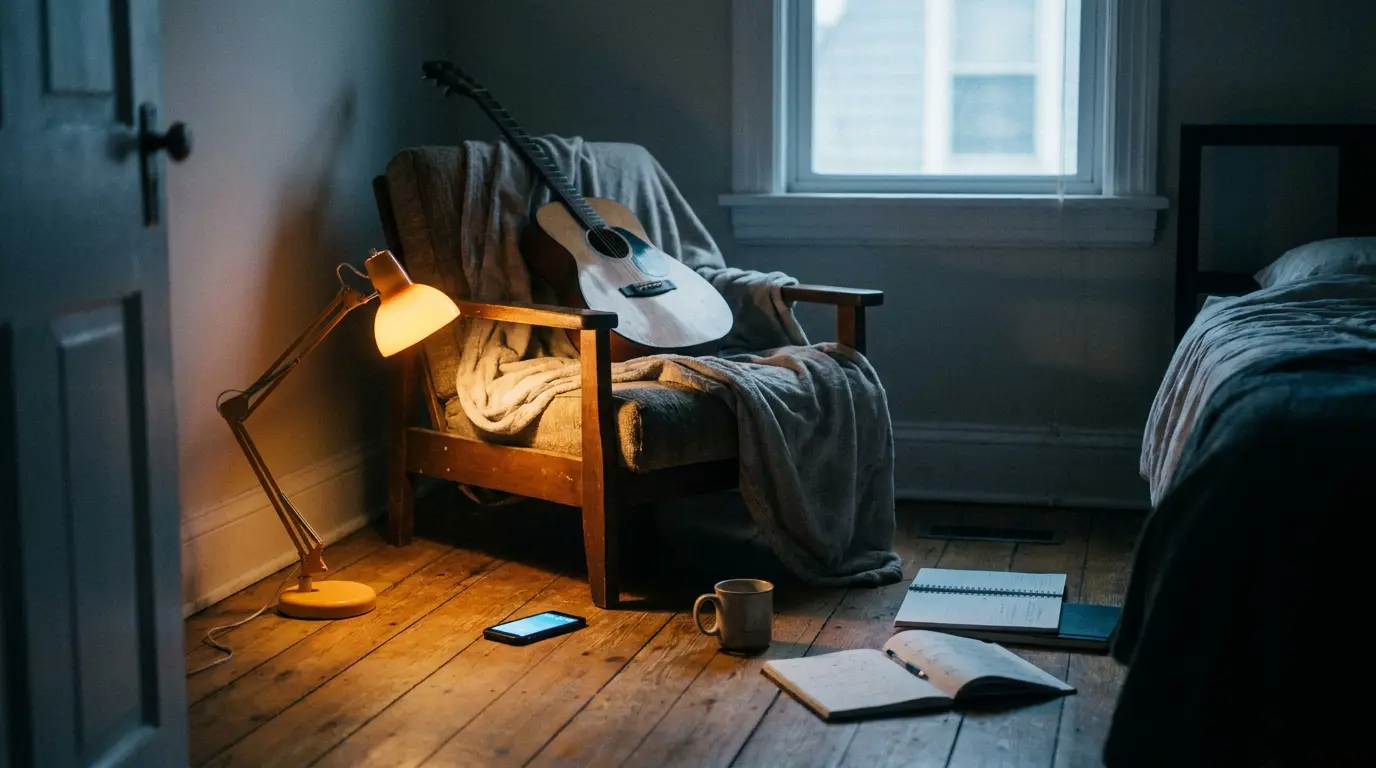
Creativity is a muscle. It gets stronger when you use it regularly, and consistency beats inspiration every single time. If you sit around waiting to feel inspired, you'll be waiting a long time.
Here's the myth I want to kill: you do not need two or three hours to get anything done. Most people believe that, so they never start. In reality, you can do a lot with ten minutes.
Try this drill. Sit at your instrument, push record, and just mess around. Don't judge whether it's new or original, just play and have fun. At the end of ten minutes, pick one melodic idea or chord progression that stood out and write it down. Next time you sit down, build a contrasting section off of it. Before you know it, you've got the bones of a song.
Make sure you lower the barrier to entry, too. Carve out a corner of a room for writing and keep your instruments out of their cases and ready to play. Half your session shouldn't be setup.
And never trust your memory. Use your phone's voice memos to grab melodies, lyrics, and progressions the second they show up. That rough little recording might be saving a great idea from vanishing forever.
Practice deliberately, not just a lot
A songwriter emailed me once, frustrated. They'd been writing two songs a day for a whole year and felt like they hadn't improved at all. That's a real thing, and it's worth understanding why.
Volume by itself doesn't make you better. If you're repeating the same habits, you're just reinforcing them, good and bad. Practice makes permanent, not perfect.
The fix is to aim at your weak spots. If your melodies feel flat, study hit songs and figure out what they're doing. If your lyrics feel generic, read poetry and dig into how to write lyrics that actually connect. Less is more here — a little intentional work beats a pile of mindless reps.
Finish your songs
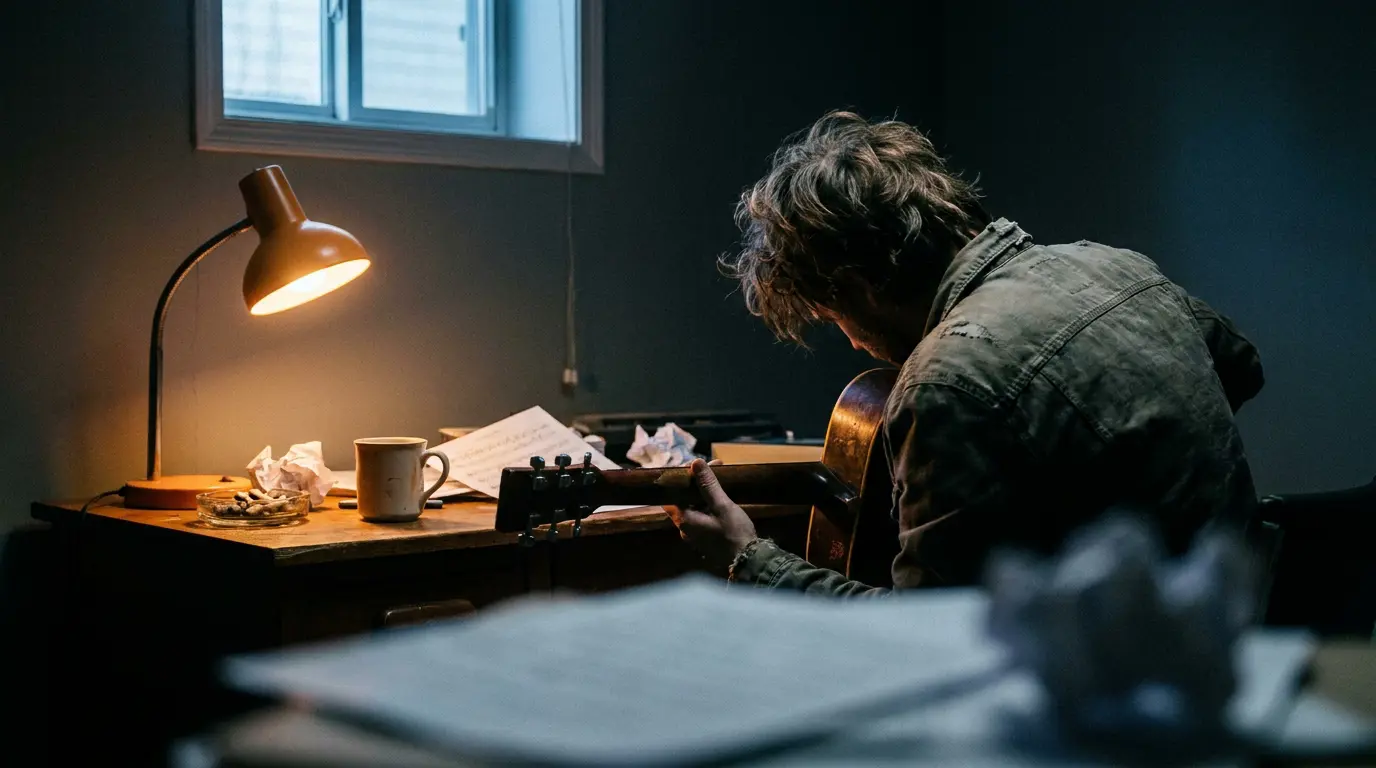
This is the thing that separates hobbyists from writers. Finishing. Set a completion goal — one song a week or one a month — and hit it regardless of quality. The quality comes later; the habit comes first.
A few ways to actually get to the finish line:
- Timebox the ending. Give yourself 20 minutes to finish. When the timer goes off, pencil down. What you've got is the song. Record it and come back to it in a week.
- Break it into chunks. Don't stare down the whole song. Start with a word, a chord, a thought. Finish small pieces you can actually control instead of trying to finish everything at once.
- Ask what the chorus is for. Stuck on the chorus? Ask yourself what you want the listener to walk away knowing. Summarize the whole song in one short sentence, then use those exact words as your title or first line.
Now, one important distinction. Finishing a first draft and finishing a song aren't the same thing. A lot of the best songs are re-written.
Here's the pro workflow. After a writing session, step away from the song for a week or two. Then come back, take off your creator hat, and put on your editor hat. Look hard at what you wrote and make sure it says what you meant in a fresh way. One error to hunt for: confusing pronouns, like talking to someone in the verses and about them in the chorus. Small thing, but it pulls a listener right out.
If you want a full walkthrough of getting a first idea all the way to a finished piece, here's a step-by-step guide to writing a song.
Steal proven song structures
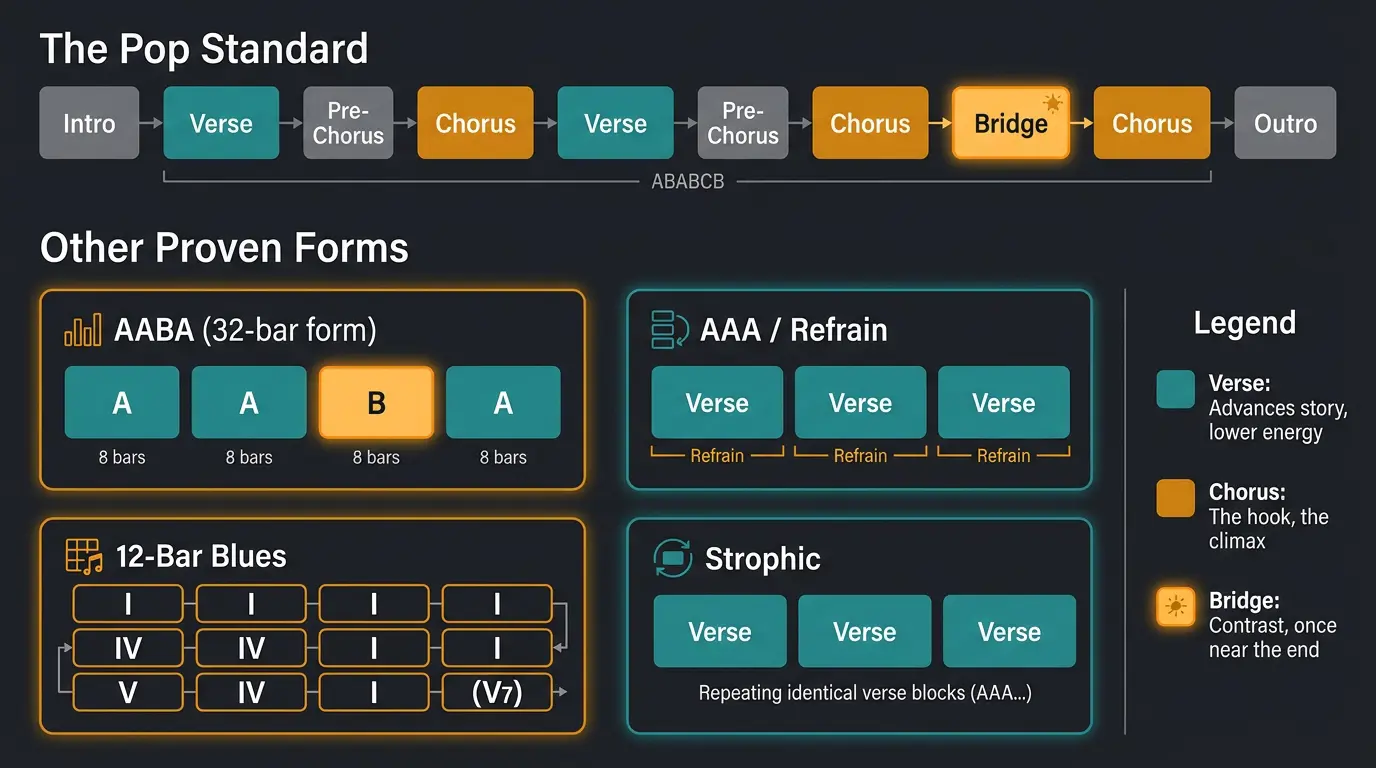
The most common format in modern popular music is intro, verse, pre-chorus, chorus, verse, pre-chorus, chorus, bridge, chorus, with an optional outro. In shorthand that's VCVC, or its close cousin ABABCB where A is the verse, B is the chorus, and C is the bridge.
Why steal it? Because it works. Look at the top songs on the Billboard charts and most of them are built on this exact skeleton. There's no shame in using a form that millions of songs already proved out — it frees you up to focus on the actual writing.
It's not the only form, though. A few others worth knowing:
- AABA (32-bar form) — the Tin Pan Alley classic. Two eight-bar A sections, a contrasting eight-bar B, then a final A.
- AAA / refrain form — no chorus at all. Each verse leans on a repeating refrain line to do the chorus's job.
- 12-bar blues — a fixed chord pattern you can write over all day.
- Strophic form — the same music repeating verse after verse.
Once you steal a form, know what each part is doing. The verse advances the story at a lower energy and fills in the details. The chorus is the climax — it holds the hook and releases the tension the verses built. Understanding how to write a chorus that's memorable is most of the battle. The bridge shows up once, usually near the end between the second and third chorus, and it's your one shot at contrast and surprise.
For more ways to shake an idea loose, Berklee has a solid list in their 20 tips for songwriting inspiration.
Song structures worth stealing
- VCVC / ABABCB — the modern pop default. Intro, verse, pre-chorus, chorus, repeat, bridge, chorus. Reach for this one first.
- AABA 32-bar — the Tin Pan Alley classic. Two A sections, a contrasting B, then a final A. Great for standards and jazzy pop.
- AAA refrain form — no chorus. Each verse ends or begins with a repeating refrain line. Good for narrative and folk songs.
- 12-bar blues — a fixed I-I-I-I-IV-IV-I-I-V-IV-I chord loop. Perfect for blues, roots, and getting comfortable writing over changes.
Beat writer's block before it starts
Here's a reframe that takes the pressure off: the goal isn't to finish a song every session. It's to stay connected. When you keep showing up, you're already in rhythm the day you get a longer stretch to write.
When the block does show up, shrink the task. Start with the smallest possible unit — a word, a chord, a single thought. Anything to get moving. And keep that ready-to-play space set up so starting doesn't feel like a chore.
If the chorus just won't come, go back to that one-sentence question. Say the whole song's point out loud, record it, and use whatever words fall out of your mouth as your title or first line. Some of the best hooks are just a plain thought said plainly.
There isn't one right way to do any of this. Trust your ears, keep the habit alive, and the songs will come. If you write on guitar, here's how to write a song on guitar when you need a jumping-off point.
Frequently Asked Questions (FAQs)
How do I get better at songwriting faster?
Write consistently and practice deliberately. Show up daily, even for ten minutes, and target your specific weak spots instead of grinding out songs on autopilot. Volume alone reinforces bad habits, so aim your practice at the parts of your craft that actually need work.
How often should I write songs?
Write something every day, even if it's just ten to fifteen minutes. Daily short sessions build creative momentum far better than one long session a week. Then set a completion goal — one finished song per week or per month — to make sure you're actually finishing, not just starting.
How do I finish a song I'm stuck on?
Set a 20-minute timer and commit to finishing before it goes off — pencil down when it does. Break the song into small chunks you can control instead of facing the whole thing. If the chorus is the problem, summarize the song's point in one sentence and use those words.
What is the most common song structure?
The most common modern structure is intro, verse, pre-chorus, chorus, verse, pre-chorus, chorus, bridge, chorus, with an optional outro — known as VCVC or ABABCB. Most songs on the Billboard charts use it or a close variant, which is exactly why it's worth borrowing.
Do I need to write a whole song in one session?
No. Many of the best songs get written in a first draft, then set aside for a week or two and re-written. The goal each session is to stay connected to the work, not to finish. Come back later with your editor hat on and tighten it up.
Final Thoughts
None of this requires talent you don't already have. Write a little every day, finish what you start, borrow the forms that work, and keep the habit alive when the block shows up. That's the whole game.
The magic isn't in a lightning bolt of inspiration — it's in the reps. Keep showing up, trust your ears, and your songs will get better whether you feel it day to day or not.
Some of the links within this article are affiliate links. These links are from various companies such as Amazon. This means if you click on any of these links and purchase the item or service, I will receive an affiliate commission. This is at no cost to you and the money gets invested back into Audio Sorcerer LLC.