ADSR is how you control the way a sound changes over time. Four sliders, and each one shapes a different part of a note's life — from the moment you press a key to the moment it fades out.
Most people think it only controls volume. That's the most common use, but it's not the whole story. An envelope can shape your filter, your pitch, and plenty of other things too.
Here's the plan: the four stages and what each one actually does, how envelopes shape real sounds, and the modern variants the old explanations tend to skip. Let's get into it.
TABLE OF CONTENTS
What ADSR actually is
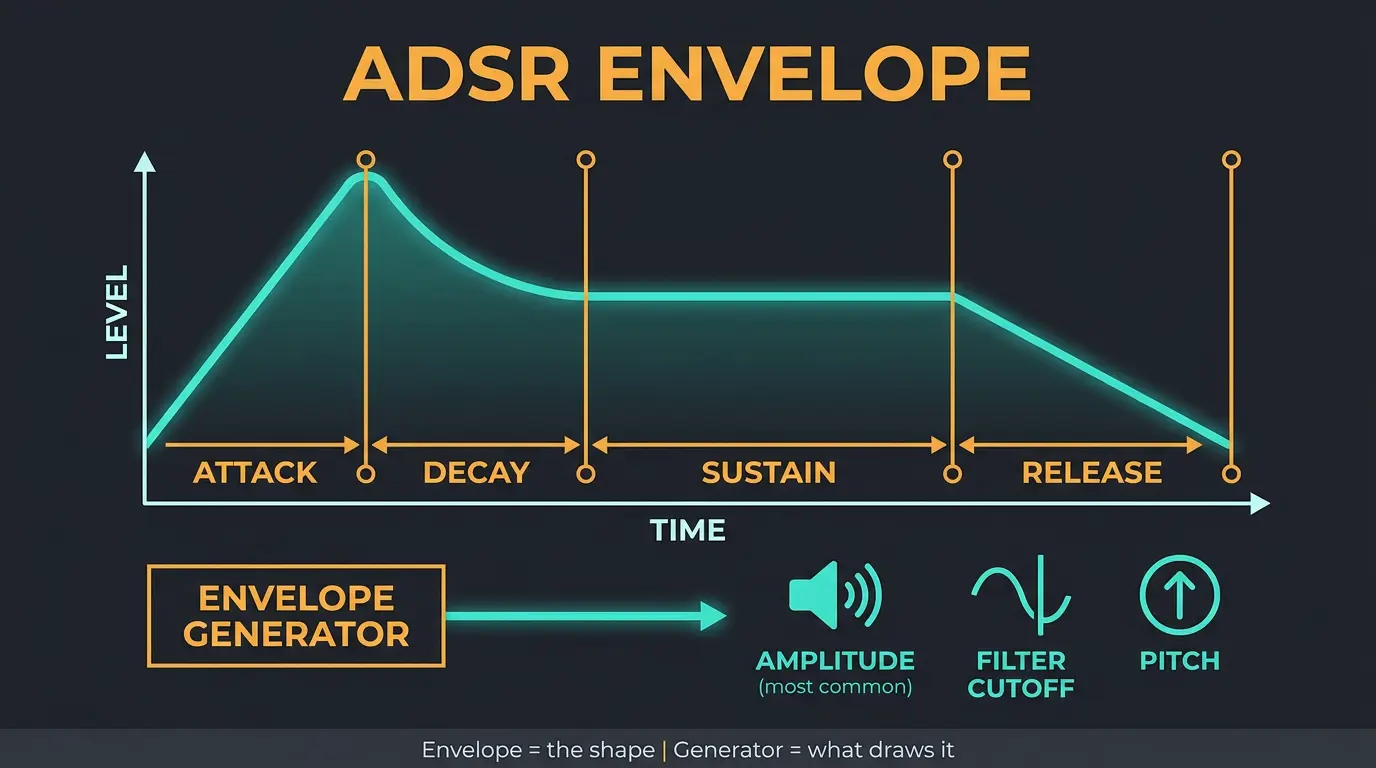
ADSR stands for Attack, Decay, Sustain, and Release. It's the most common type of envelope you'll find in synths and samplers, and it describes how a parameter moves through time when you play a note.
Now the big correction, because a lot of tutorials get this wrong. ADSR most commonly controls amplitude — the loudness of a sound. But it's really a modulation source, which means you can point it at other things too. Filter cutoff, pitch, and all sorts of modulation targets. Same four stages, different destination.
One more distinction worth making. An envelope is the shape itself — the trajectory the sound follows. An envelope generator is the module that produces that shape and tells the sound when and how to change. The envelope is the path; the generator is what draws it.
The four stages, one at a time
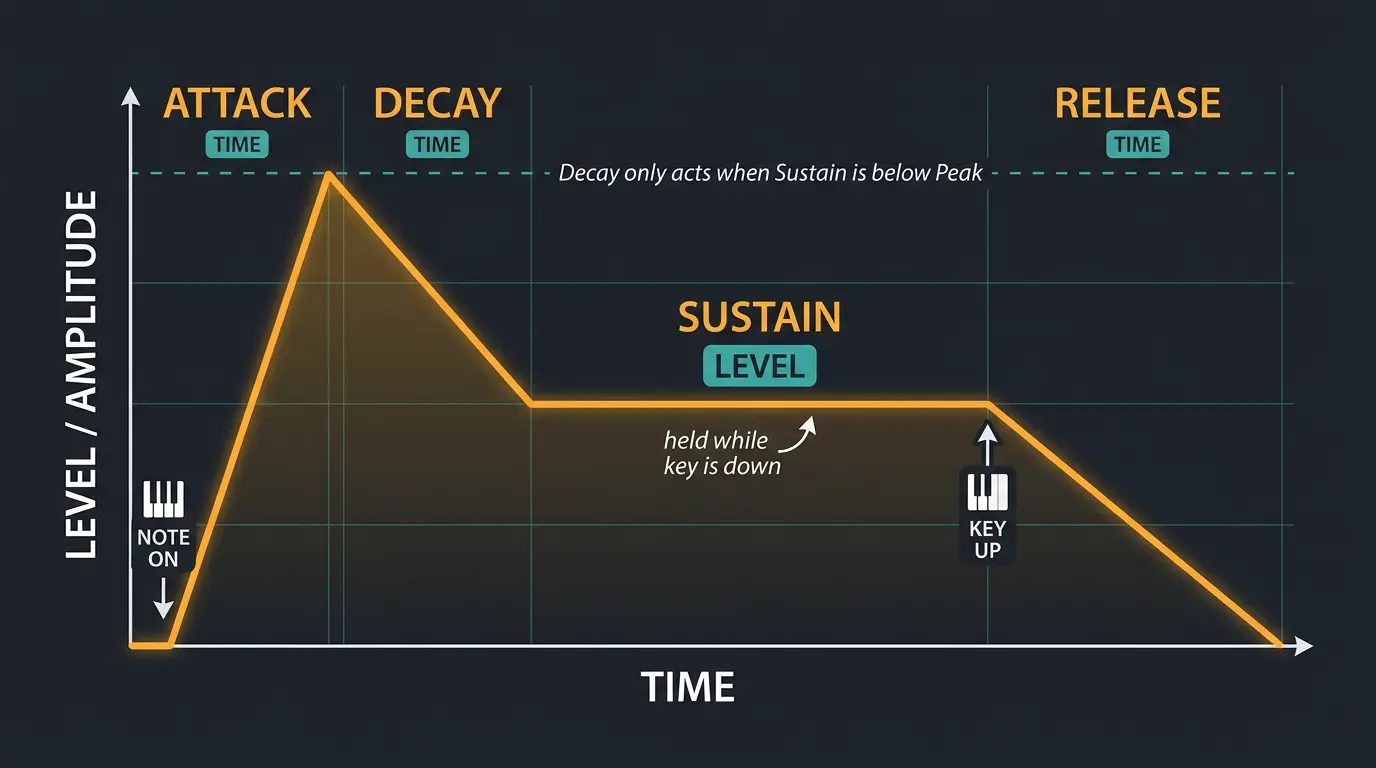
Three of these stages are times. One is a level. That mix-up trips up more people than anything else, so keep it in mind as we go.
- Attack — the time it takes for the level to rise from silence to its peak. Short attack means a sharp, percussive start. Long attack means a gradual fade-in.
- Decay — the time it takes to fall from that peak down to the sustain level.
- Sustain — the level held for as long as you hold the note down. This is a level, not a time. It doesn't say how long anything lasts. It says how loud the sound sits while your finger's still on the key.
- Release — the time it takes to fall back to silence after you let go of the note.
Here's a detail the old explanations skip: decay and sustain work together. Decay only matters when your sustain level is lower than the peak. If sustain is cranked all the way up, the decay stage has nothing to do — there's nowhere to fall to.
For a solid reference on the fundamentals, Sound on Sound's glossary entry on ADSR is worth a bookmark.
Quick reference: three times and one level
- Attack is a time — how long the sound takes to rise from silence to its peak.
- Decay is a time — how long it takes to fall from the peak down to the sustain level.
- Sustain is a level — how loud the sound holds while you keep the note pressed. Not a duration.
- Release is a time — how long it takes to fade to silence after you let go.
How envelopes shape real sounds

The most useful thing an envelope does is shape timbre — the character that makes one sound different from another, even at the same pitch and volume. It's not just a volume tool.
Think about a few real instruments and their shapes:
- Bell or pluck — short attack, long decay. The sound cracks in instantly, then rings out and fades.
- Organ — instant attack, no decay, full sustain, instant release. On the second you press, off the second you let go. No movement in between.
- Pad — long attack (try around 500ms), long decay and release (a few seconds each), max sustain. That's what turns a plain tone into something that swells and floats.
A couple of ranges to keep in your back pocket. Fast attack, somewhere in the 0–10ms zone, gives you an immediate, sharp start — great for drums and percussive hits. Slow attack, 100ms and up, gives you that gradual fade-in for pads and ambient textures.
Speaking of ambient: a very long release paired with reverb is the classic move for atmospheric sounds. The notes blur into each other and become a wash of tone. If you like that world, our breakdown of the different types of reverb pairs nicely with a long release.
And it's not just synths. Samplers and drum tools use ADSR too. Tighten the decay on a snare and you control its length — getting it to sit right in the mix without ringing on too long. If you're programming low end, the same idea applies when you're shaping an 808.
Beyond ADSR: modern envelope variants
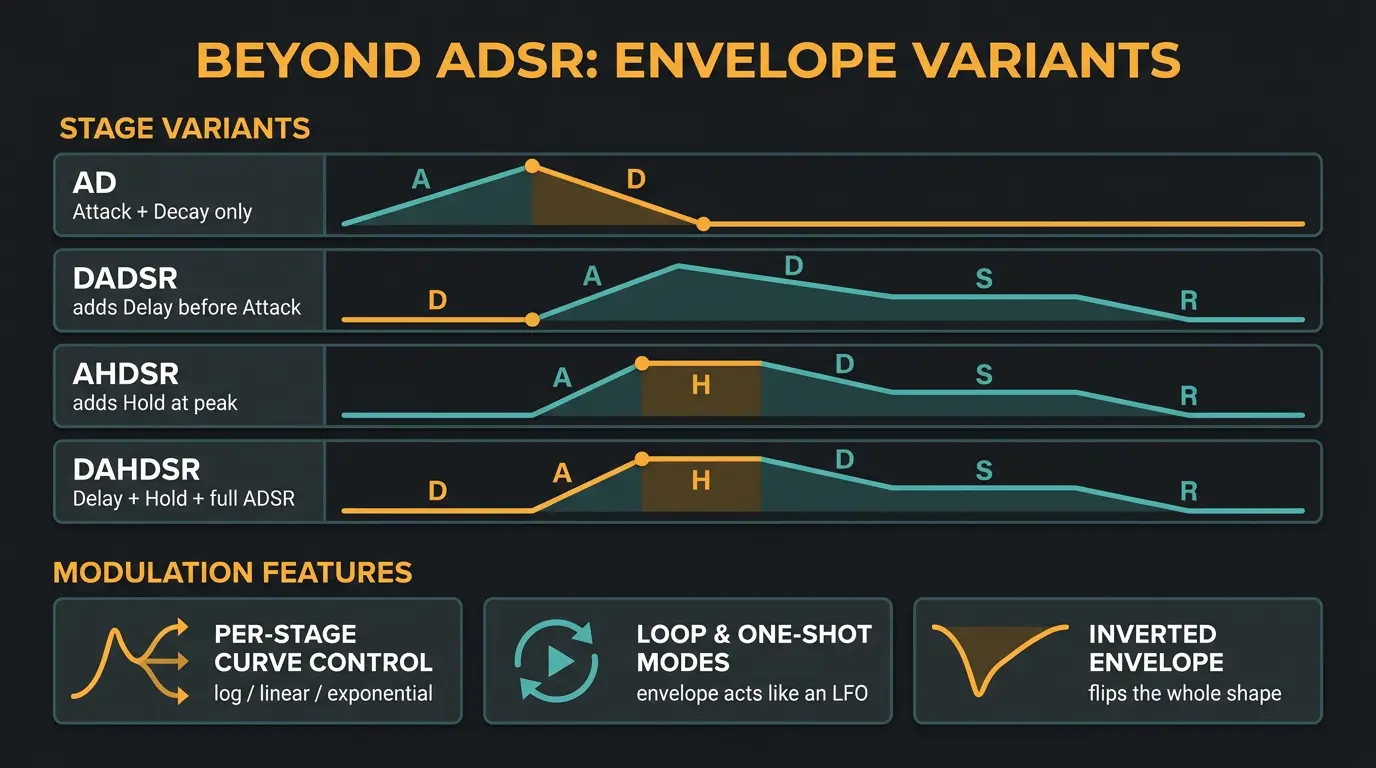
Four stages isn't the whole story anymore. Modern hardware and software routinely add more, and knowing what they do saves you a lot of guessing.
- DADSR — adds a delay before the attack. The delay sets how long the sound waits in silence after you hit the note before the attack even starts.
- DAHDSR and AHDSR — these add a hold stage, which keeps the envelope at full level for a set time before decay kicks in. Useful when you want the peak to stick around a moment before it falls.
- AD — the stripped-down version. Attack and decay only. Common and honestly all you need for a lot of percussive sounds.
Then there are the features that really open things up:
- Per-stage curve control — each stage can morph from logarithmic to linear to exponential. This changes the feel of the movement, not just the timing. A linear fall sounds different from an exponential one, and this is where a lot of the character lives.
- Loop and one-shot modes — loop the early stages continuously and the envelope starts acting like an LFO. One modulator, two jobs.
- Inverted envelopes — flip the whole thing upside down so the behavior reverses. Great for ducking a filter down on the attack instead of pushing it up.
Less is more still applies. You don't need every stage on every sound. But when a plain ADSR won't get you there, it's good to know these exist.
Where ADSR came from
The envelope generator came from Robert Moog, the man behind the Moog synthesizer. Composer Herbert Deutsch nudged him toward it, suggesting notes shouldn't just switch on and off — they should have some articulation, a way to breathe.
The four-parameter format traces back to Moog's conversations with engineer and composer Vladimir Ussachevsky. That led to a module with stages labeled T1, T2, ESUS, and T3 — attack time, initial decay time, sustain level, and final decay time. ARP later simplified all of that into the modern ADSR we use today.
Moog's 911 was the first commercially produced four-stage envelope. Different names on the knobs, but the same idea you're staring at right now.
Frequently Asked Questions (FAQs)
Is ADSR only for controlling volume?
No. ADSR most commonly controls volume, but it's a modulation source that can shape filter cutoff, pitch, and other parameters just as well. Point the same four stages at a filter and you can make a sound open up on the attack and close on the release.
Is sustain a time or a level?
Sustain is a level, not a time. It sets how loud the sound holds while you keep the note pressed, not how long it lasts. Attack, decay, and release are the three time values. This mix-up trips up more beginners than anything else in ADSR.
What's the difference between an envelope and an envelope generator?
An envelope is the shape or trajectory a parameter follows over time. An envelope generator is the module that produces that shape and tells the sound when and how to change. Simply put, the envelope is the path and the generator is what draws it.
What are DADSR and DAHDSR envelopes?
DADSR adds a delay stage before the attack, setting how long the sound waits in silence after you hit a note. DAHDSR adds both a delay and a hold stage, where hold keeps the envelope at full level for a set time before decay begins. Both are just ADSR with extra stages.
Do samplers use ADSR too?
Yes. Samplers and drum tools use ADSR just like synths do. A common move is tweaking the decay on a snare sample to control its tightness, shaping the sound's length so it slots cleanly into a mix. Same four stages, applied to recorded audio instead of a synth oscillator.
Final Thoughts
Once ADSR clicks, you start hearing it everywhere — the snap of a snare, the swell of a pad, the way a pluck rings out. It's four simple controls doing a lot of heavy lifting.
Make sure you actually turn the knobs and listen. Don't take my word for what decay does — set your sustain low, sweep the decay, and hear it for yourself. That's the fastest way to make this stick.
Some of the links within this article are affiliate links. These links are from various companies such as Amazon. This means if you click on any of these links and purchase the item or service, I will receive an affiliate commission. This is at no cost to you and the money gets invested back into Audio Sorcerer LLC.