Your overheads are the picture. Everything else — close mics on the snare, the kick, the toms — is just detail you paint in later. Most of what people hear as the drum sound comes straight off those two mics hanging over the kit.
So if your overheads are bad, no amount of close-mic magic saves you. Get them right and the rest is easy.
Here are five small-diaphragm condensers worth buying, ordered from premium to budget. They're all current and all good. There's no single right answer here — your kit, your room, and your ears decide more than any spec sheet does.
TABLE OF CONTENTS
What to look for in a drum overhead mic

Overheads are about capturing the whole kit as a balanced stereo image, with detail up top. That means a few things actually matter, and a lot of stuff doesn't.
- A matched pair. If the two mics aren't matched, your stereo image gets lopsided and weird. Most of these are sold as factory-matched pairs for exactly this reason.
- SPL handling. Drums hit hard, especially cymbals right under the capsule. You want a mic that won't fold under pressure.
- Cardioid pattern. It's the safe default. It rejects the room behind the mic and keeps the focus on the kit. Omni has its uses, but start here.
- Honest mids and highs. This is what you're really chasing — clean transient response and a top end that's detailed without being harsh.
One thing people underrate: your room and your kit shape the result more than the mic does. A great mic in a bad room still sounds like a bad room. Treat your space before you spend big on glass.
The short version
- Neumann KM 184 — best overall, the industry reference for a smooth, detailed top end over a kit.
- Shure KSM137 — most rugged, a workhorse that shrugs off loud drummers and loud rooms.
- AKG C414 XLII — most versatile, nine patterns and a mic that does far more than overheads.
- sE Electronics sE7 — best value, punching well above where you'd expect for the feature set.
- Rode M5 — best budget pair, the easy entry point for your first matched set of overheads.
- Lewitt LCT 040 MATCH — best calibrated pair, factory-matched for accurate, dependable stereo imaging out of the box.
Neumann KM 184

#1
Neumann KM 184
The KM 184 is the mic a lot of pros reach for without thinking, and there's a reason for that. It's part of Neumann's Series 180, a cardioid small-diaphragm condenser, and it just sits right over a kit. Detailed, smooth on top, never brittle.
Let's give it a listen and the thing you notice is how little you want to touch it afterward. Cymbals have air without that ice-pick edge. The kit reads as one cohesive image instead of a pile of separate sources. You can grab it in satin nickel or matte black, and factory-matched pairs are available, which is what you want for overheads.
Honest note: this is a premium choice and you pay for the pedigree. But the sound earns it, and these things hold their value for decades. If you can swing the pair, you won't be shopping for overheads again.
Pros
- Smooth, detailed top end that needs almost no EQ
- Cohesive stereo image over the whole kit
- Factory-matched pairs available
- Built to last for decades
Cons
- Premium pricing for the pair
- Single cardioid pattern, no extras
Shure KSM137

#2
Shure KSM137
If you've got a hard-hitting drummer and a room that lives somewhere between a studio and a garage, the KSM137 is your friend. It's an end-address cardioid condenser, single pattern, built for the studio but tough enough to live on the road. It handles very high SPL without flinching.
That's the headline here — it's a workhorse. You set it up, it does its job, and it doesn't get precious about loud cymbals an inch from the capsule. The cardioid pattern keeps the room behind it at arm's length, which helps in less-than-perfect spaces.
It's sold singly and as stereo pairs, so grab the matched pair for overheads. One practical heads-up: availability has had supply gaps at some retailers, but it's very much a current mic. Check a couple of shops if your first stop is out.
Pros
- Handles very high SPL with ease
- Tough enough for studio and stage
- Tight cardioid pattern helps in rough rooms
- Available as matched pairs
Cons
- Single cardioid pattern only
- Occasional stock gaps at some retailers
AKG C414 XLII

#3
AKG C414 XLII
The C414 XLII is the Swiss Army knife of this list. Nine selectable polar patterns, a peak-hold LED so you can catch overload peaks, and lockable controls for when you don't want anyone bumping a setting. The XLII capsule gives a slight presence boost and a spatial quality folks compare to the legendary C12.
For overheads alone, it's honestly overkill. But that's the point. If you want one pair of mics that does overheads today, room mics tomorrow, and lead vocals next week, this is the one that covers all of it. Less is more usually applies to settings, not to how many jobs one mic can do.
Quick note so you don't get confused shopping: the C414 XLS is a sibling, not a successor. Different capsule, slightly different flavor. The XLII is the one with the presence lift and that airy top.
Pros
- Nine polar patterns for total flexibility
- Presence boost and spatial quality reminiscent of the C12
- Peak-hold LED and lockable controls
- Handles overheads, room, vocals, and more
Cons
- More mic than overheads strictly need
- Easy to confuse with the sibling XLS
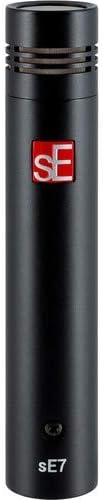
sE Electronics sE7
#4
sE Electronics sE7
The sE7 is the one that surprises people. It's a small-diaphragm back-electret condenser with Class A circuitry and a transformerless output, ready for studio or stage. Sold singly and as matched pairs, and for overheads it punches well above where you'd expect from its feature set.
The sound is clean and honest, with a top end that doesn't get fizzy. Pair them up, hang them over the kit, and you've got a real stereo picture without a lot of fuss. Less is more — you don't need to fight this mic.
Worth a quick mention: there's an sE7 sideFire variant with the capsule rotated 90 degrees for close-miking tight spots. It's a variant of the same mic, not a different one. For overheads, the standard sE7 is what you're after.
Pros
- Clean, honest sound that beats its feature class
- Class A, transformerless output
- Available as matched pairs
- Equally happy in the studio or on stage
Cons
- Single cardioid pattern
- Not quite the refinement of the premium picks
Rode M5

#5
Rode M5
The M5 is the easy way into your first overhead pair. It ships as a matched pair of small-diaphragm condensers with half-inch gold-sputtered cardioid capsules, matched within 1dB, and it comes with WS5 windshields and RM5 mounts in the box. You're ready to go out of the gate.
For overheads, these get the job done and give you a genuine stereo image to build from. They're a great starting point if you're recording your first kit and don't want to overthink the gear.
Honest caveat from a Sound on Sound review: it's a capable general-purpose mic, but probably not your first choice for kick drum. For overheads, though, it's right at home. Don't let anyone tell you a first pair has to break the bank to teach you good habits.
Pros
- Matched pair within 1dB, ready out of the box
- Comes with windshields and mounts included
- A genuine stereo image for first-time setups
- Easy, no-fuss entry point
Cons
- Not the first choice for kick drum
- Doesn't match the detail of the higher picks
Lewitt LCT 040 MATCH

#6
Lewitt LCT 040 MATCH
The LCT 040 MATCH is a small-diaphragm condenser from Lewitt, sold as a matched stereo pair built for acoustic guitar, drum overheads, room mics, and stereo piano. The transient response is fast and the top end is detailed without getting harsh or tizzy, so you can dial in cymbal presence easily and you won't need much corrective EQ to get a usable sound. The CNC'd aluminum housing is light and compact, which makes tight placement around a snare or a kit genuinely easy, and at 135 dB max SPL there's no reason not to put these over drums. Just keep in mind that mics this honest also capture the room, so make sure your recording space is up to the task.
Pros
- Factory-matched pair for accurate stereo imaging
- Lightweight aluminum housing that's easy to position
- Clean cardioid response well-suited to overheads
- Comes ready to use out of the box as a calibrated set
Cons
- Fixed cardioid pattern only (no versatility for other sources)
- Less of a known reference name than the Neumann or AKG options
| Model | Polar Pattern | Best For |
|---|---|---|
| Neumann KM 184 | Cardioid | Pros who want the reference top end |
| Shure KSM137 | Cardioid | Loud drummers and rough rooms |
| AKG C414 XLII | Nine selectable patterns | One pair that does everything |
| sE Electronics sE7 | Cardioid | Best feature-to-value for overheads |
| Rode M5 | Cardioid | Your first matched pair |
Frequently Asked Questions (FAQs)
Do overhead mics need to be a matched pair?
Yes, overhead mics should be a matched pair for a balanced stereo image. When the two mics have the same sensitivity and frequency response, the kit sits centered and even. Mismatched mics push the image to one side and make panning a guessing game. Most overhead mics are sold as factory-matched pairs for this reason.
How many overhead mics do I need?
Two overhead mics covers almost everyone. The choice is how you place them — XY puts the capsules together for a tight, mono-safe image, while a spaced pair pulls them apart for a wider feel. XY is the safer starting point. Try both over your kit and trust your ears on which fits the song.
Should I use cardioid or omni mics for overheads?
Cardioid is the safe default for drum overheads. It rejects the room behind the mic and keeps the focus on the kit, which helps in untreated spaces. Omni captures more of the room and can sound more natural, but only if your room actually sounds good. Start cardioid and experiment from there.
Do I need expensive condensers or will a budget pair work?
A budget pair absolutely works and will teach you good habits. Something like the Rode M5 gives you a real stereo image to build on. Premium mics like the KM 184 buy you a smoother top end and more detail, but your room and mic placement matter more than the price of the glass.
Should overheads be small-diaphragm or large-diaphragm mics?
Small-diaphragm condensers are the classic choice for overheads. They tend to have faster transient response and tighter, more consistent off-axis behavior, which keeps cymbals and the whole kit clean. Large-diaphragm mics can sound great too, with a fuller character, but small-diaphragm pencils are the reliable starting point.
Final Thoughts
If you're shopping the top of the range, the KM 184 is the one that'll outlast every other piece of gear you own. If you want flexibility, the C414 XLII does overheads and then keeps earning its spot on everything else. And if you're starting out, the M5 gets you a real matched pair without making it a big decision.
Whatever you grab, remember the mic is only half the job. Make sure you treat your room and spend time on placement — a few inches one way or the other changes more than a logo on the body ever will. Trust your ears and pick the pair that fits your kit.
Some of the links within this article are affiliate links. These links are from various companies such as Amazon. This means if you click on any of these links and purchase the item or service, I will receive an affiliate commission. This is at no cost to you and the money gets invested back into Audio Sorcerer LLC.