The kick mic does most of the work in getting a usable low end. You can fix a lot in the mix, but if the mic in front of the kick is capturing a thin, boxy thump, you're fighting an uphill battle all night.
All five of these are dynamic mics built to handle the high pressure of a kick drum up close without falling apart. Some give you a punchy, ready-to-go sound. Others stay flatter and let you shape the tone yourself. There's no single best here — it depends on your kit, your room, and the sound in your head.
One honest note before we get to the list: the source matters more than the mic. A well-tuned drum in a decent room will sound good through any of these. A flubby, dead kick will sound flubby through all of them. With that being said, here are five that consistently get you most of the way there.
TABLE OF CONTENTS
What to look for in a kick drum mic
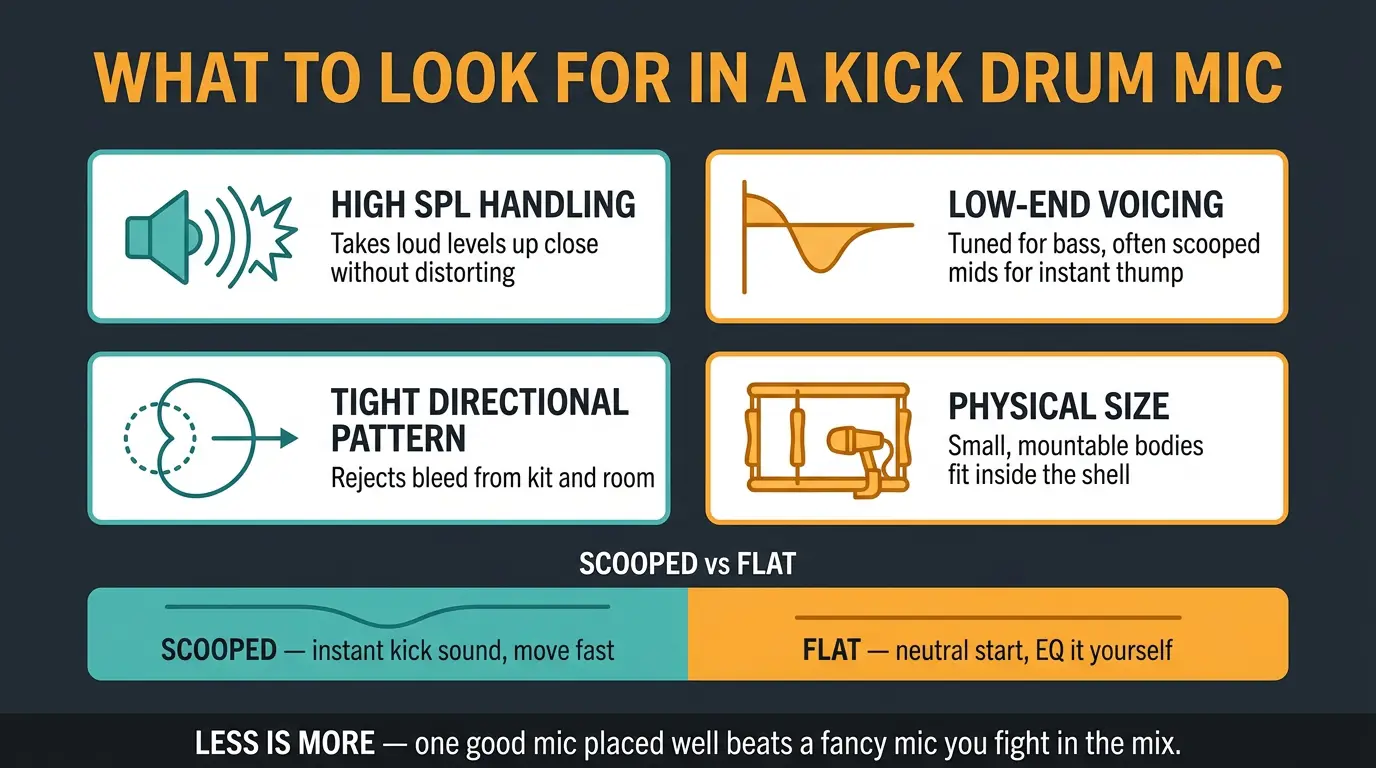
Most of what makes a kick mic a kick mic comes down to a handful of practical things. You don't need to obsess over every spec, but it helps to know what you're actually buying.
- High SPL handling. A kick drum is loud up close. These mics are built to take that level without distorting.
- Low-end voicing. Many kick mics are tuned for bass. Some have a scooped response that pulls out the boxy mids and gives you that modern thump right away.
- Tight directional pattern. A focused cardioid or supercardioid pattern rejects bleed from the rest of the kit and the room.
- Physical size. If you mic inside the shell, the mic has to fit and stay put. Smaller, mountable bodies make life easier.
The big fork in the road is scooped versus flat. A scooped mic hands you an instant kick sound — great when you want to move fast. A flatter mic gives you a neutral starting point and trusts you to EQ it. Neither is right or wrong. It's about how much shaping you want to do yourself.
And remember — less is more. One good mic placed well will beat a fancy mic you're constantly fighting in the mix.
Shure Beta 52A

#1
Shure Beta 52A
The Beta 52A is the safe default, and it earns that spot. It's a high-output dynamic with a frequency response tailored for kick and bass, and a modified supercardioid pattern that holds tight across the range. That means strong gain-before-feedback and solid rejection — which is why you see it on stages as much as in studios.
Out of the gate it gives you a punchy, slightly scooped sound. You get a clean low-end thump and a defined beater click without having to do much. It's fast, it's reliable, and it just works. If you want one mic that sounds good with minimal fuss, this is the one I'd hand a beginner without a second thought.
It's also sold in the DMK57-52 drum mic kit if you're building out a full set and want the kick mic bundled in.
Pros
- Punchy, ready-to-go sound with very little tweaking
- Tight supercardioid pattern means great rejection live and in the studio
- Reliable workhorse that holds up on the road
Cons
- The built-in scoop is a sound you're somewhat committed to
- Larger body can be awkward to position in tight setups
Audix D6

#2
Audix D6
The D6 is lightweight, compact, and easy to position — built for extended low-frequency sources like kick, floor toms, and bass cabs. It's designed and made in the USA, and it's become the go-to for that famously scooped, modern kick sound.
Drop it in front of a kick and you get instant punch and click with the boxy mids pulled right out. For a lot of rock, pop, and metal, that's exactly the sound people are chasing, and the D6 hands it to you immediately. Honest note though: that scoop is a sound, not a fact. If you want a flatter starting point to shape yourself, you'll be EQing against the mic's voicing, which can feel like swimming upstream.
Audix also released the D6X recently as a sibling with switchable voicing for folks who want more options. The standard D6 hasn't been replaced — it's still current, still great, and still the right pick if the classic scoop is your sound.
Pros
- Instant, modern scooped kick sound with no work
- Small, light body that's easy to mount and position
- Made in the USA and built tough
Cons
- The scoop is baked in — harder to get a neutral tone out of it
- No voicing switch on the standard model
AKG D112 MKII

#3
AKG D112 MKII
The D112 has been the industry-standard kick mic for a long time, and the MKII keeps everything that made it that way while adding an integrated flexible mount. It's a large-diaphragm cardioid dynamic that handles over 160 dB SPL without distortion, with a low diaphragm resonance frequency that delivers a solid, powerful response below 100 Hz.
Compared to the D6, this one's a touch more old-school and a lot less hyped. You get a strong fundamental and a clear beater, but it's a flatter, more honest starting point. It often wants a little top-end EQ to bring out the click — which some people love, because it means the mic isn't making the decision for you.
If you like building your kick tone from a solid foundation rather than starting with a sound that's already shaped, the D112 MKII is a workhorse that's been earning its keep for decades.
Pros
- Massive SPL handling and a strong, solid low-end fundamental
- Neutral, honest starting point for shaping your own tone
- Integrated flexible mount makes positioning simple
Cons
- Usually needs some top-end EQ to bring out the beater click
- Less of an instant sound than the scooped options
Electro-Voice RE320

#4
Electro-Voice RE320
The RE320 is the do-it-all pick. It's a professional dynamic with extremely low noise and great transient response, and it's at home on vocals, broadcast, bass cabs, guitar amps — pretty much anything you point it at.
The feature that lands it here is the dual-voicing switch. Flip it to the left position and the mic's response is tailored specifically for kick drum. Flip it back and you've got a clean, flat dynamic for everything else. A scenario where this is genuinely useful: you're a one-mic-budget person who needs a kick mic today but doesn't want it gathering dust between drum sessions. Buy it for the kick, keep using it on everything.
It won't give you the exact instant character of a dedicated scooped mic, but it gets close on kick and then does ten other jobs well. That kind of flexibility is hard to beat.
Pros
- Dual-voicing switch with a dedicated kick setting
- Genuinely excellent on vocals, amps, and bass cabs too
- Low noise and strong transient response
Cons
- Kick voicing is great but not quite as instant as a dedicated scooped mic
- Jack-of-all-trades design means it's not laser-focused on one job
Telefunken M82
#5
Telefunken M82
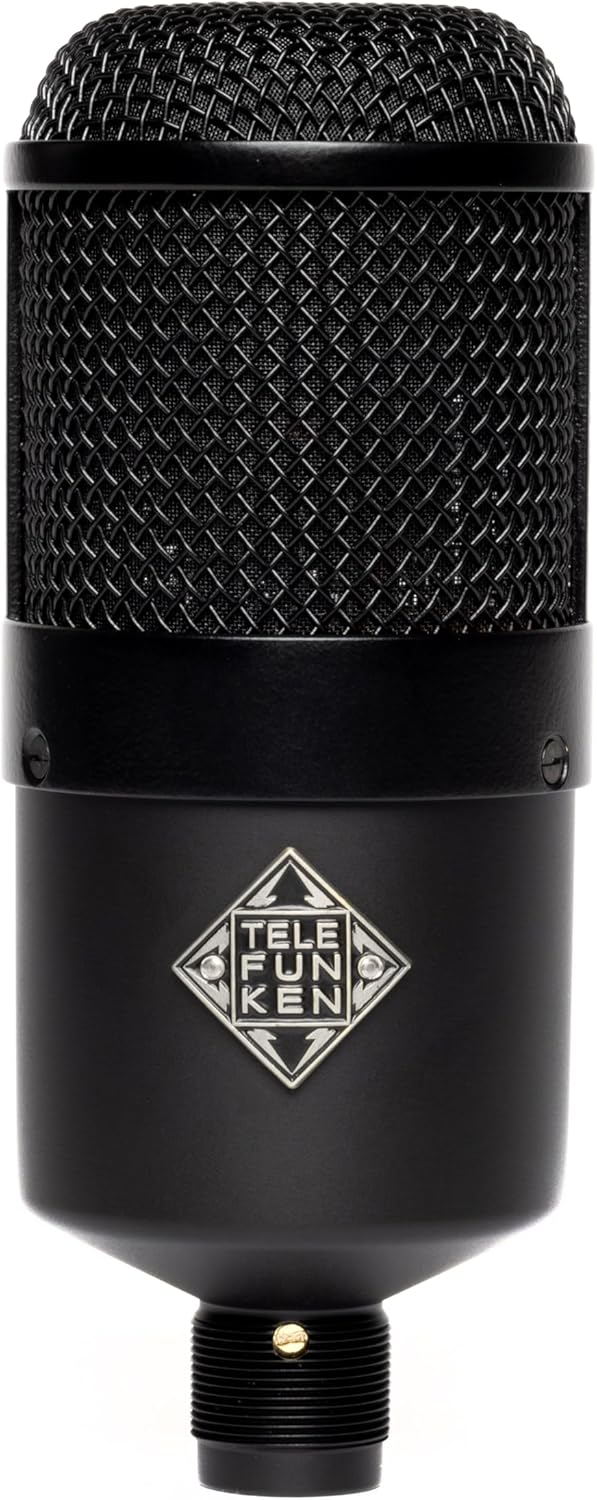
The M82 is hand-assembled and tested in Connecticut, with a large 35mm diaphragm and serious low-frequency capability. What sets it apart is two independent EQ switches right on the mic — KICK EQ and HIGH BOOST — giving you four usable voicings without touching a console.
That's the most flexible tone shaping of the bunch, and it happens before the signal ever hits your board. A scenario where this shines: you're tracking fast and want to commit to a tone at the source, or you're on a smaller console without a ton of EQ to spare. Dial it in at the mic and move on.
It's also a bigger, more open-sounding mic than some of the tighter scooped options. If you like sculpting your kick sound and want real control at the capsule, the M82 gives you more to work with than anything else here.
Pros
- Four voicings via two onboard EQ switches
- Big, open low end with strong tone-shaping range
- Hand-assembled and built like a tank
Cons
- More options mean more decisions to make up front
- Larger body to position in a tight kick setup
| Model | Polar Pattern | Voicing / Switches | Best For |
|---|---|---|---|
| Shure Beta 52A | Supercardioid | None | Punchy default that just works |
| Audix D6 | Cardioid | None | Instant modern scooped sound |
| AKG D112 MKII | Cardioid | None | Industry-standard solid foundation |
| Electro-Voice RE320 | Cardioid | Dual-voicing switch | Versatile do-it-all mic |
| Telefunken M82 | Cardioid | KICK EQ + HIGH BOOST | Tone shaping at the mic |
Frequently Asked Questions (FAQs)
Do you really need a dedicated kick drum mic?
No, you don't strictly need one, but a dedicated kick mic makes life much easier. A regular dynamic can capture a kick, but it usually won't handle the SPL or low end as cleanly. A purpose-built kick mic is voiced for the job, so you spend less time fighting the sound later.
What's the difference between a scooped kick mic and a flatter one?
A scooped kick mic pulls out the boxy midrange and boosts the lows and click, handing you a modern kick sound instantly. A flatter mic gives you a more neutral capture that you shape yourself with EQ. Neither is better — it just comes down to whether you want a sound out of the box or full control.
Do you need two mics on a kick drum?
No, one mic gets the job done for most situations. Some engineers add a second sub mic outside the shell to capture extra low end, blended in behind the main inside mic. It's a useful trick for big, modern low end, but it's a want, not a need. Start with one placed well.
Should you EQ at the mic or in the box?
Either works — there's no right answer here, so trust your ears. EQing at the mic, like with the M82's switches, lets you commit to a tone fast and free up console resources. EQing in the box gives you more flexibility to change your mind later. Plugins are every bit as capable as hardware, so don't feel you have to do it at the source.
Is the Audix D6X worth it over the standard D6?
It depends on whether you want switchable voicing. The D6X adds tone options the original D6 doesn't have, while the standard D6 still delivers that classic scooped sound that made it famous. If the classic D6 sound is what you're after, the original is still current and still excellent. Get the D6X if you want the flexibility.
Final Thoughts
If you want one mic and want to stop thinking about it, grab the Beta 52A. If you're chasing that instant modern thump, the D6. Want a neutral foundation to build on? The D112 MKII. Need it to pull double duty? The RE320. And if you love shaping tone at the source, the M82 gives you the most control.
Whatever you pick, spend more time tuning the drum and placing the mic than you do agonizing over which one to buy. All five of these are good. A great source through any of them beats a mediocre source through the priciest mic in the room.
Some of the links within this article are affiliate links. These links are from various companies such as Amazon. This means if you click on any of these links and purchase the item or service, I will receive an affiliate commission. This is at no cost to you and the money gets invested back into Audio Sorcerer LLC.