Right now, you don't have a song. You've got an idea, and honestly, that's the fun part. But an eight-bar loop you love isn't a track yet, no matter how good it sounds on repeat.
Arrangement is what turns that loop into a record. It's the bridge between songwriting and production — deciding which instruments play, when they enter, how the energy rises and falls, and what the listener actually feels moment to moment.
A lot of people think arrangement just means the order of your sections. It's more than that. It's instrumentation, energy, and space, all working together. Here's how to structure a song from the ground up.
TABLE OF CONTENTS
What song arrangement actually is
Arrangement is the architecture of your track. It sits right between composition and production, and it comes in two flavors worth naming.
Structural arrangement is the movement of energy across your song — the sections, the transitions, where things build and where they pull back. Instrumental arrangement is how the notes, chords, and melodies get laid out across the instruments you've got.
Both matter. Think of your eight-bar loop as a single brick. Arrangement is deciding how to stack all the bricks into something a person wants to listen to from start to finish.
The building blocks: song sections and what they do
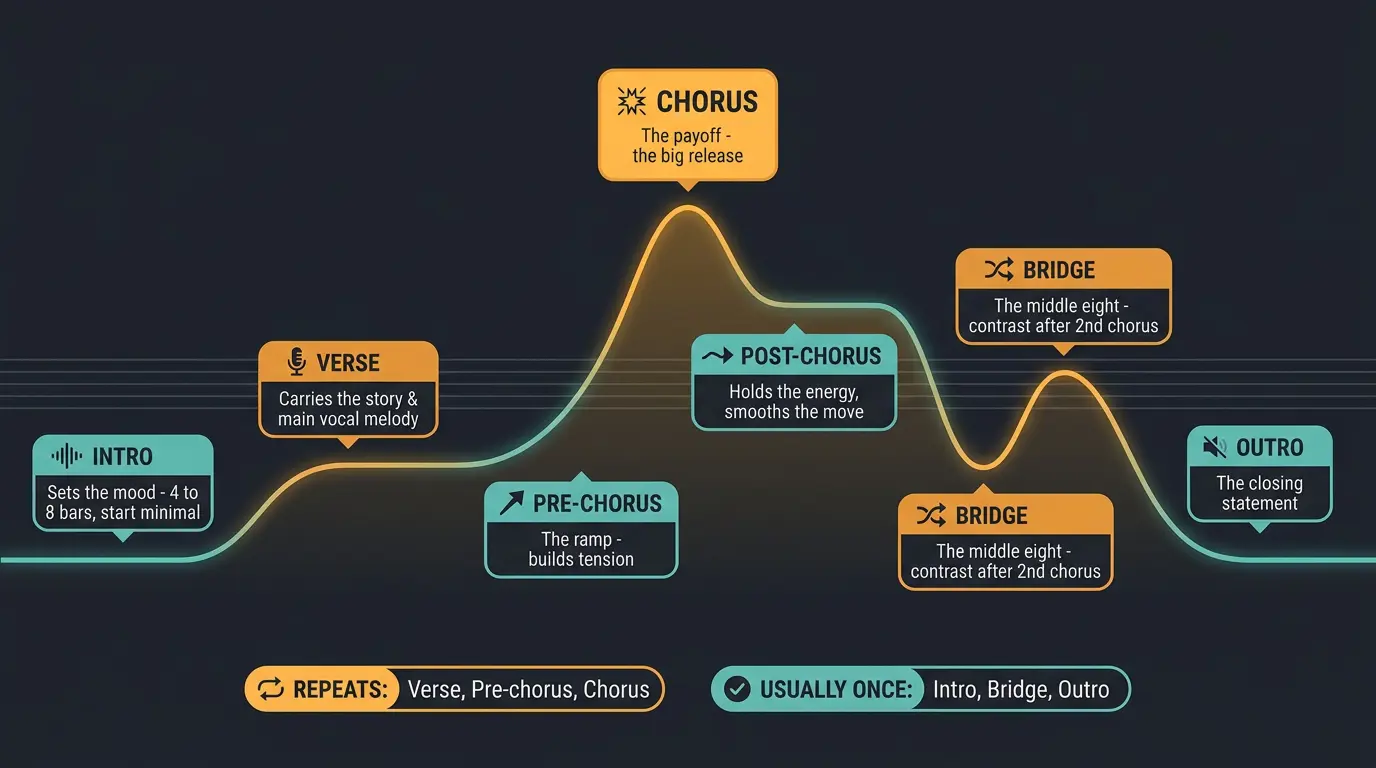
Before you can move sections around, you need to know what each one is actually for. Here's the job each part does, not just what it's called.
- Intro — the listener's first step into the song. Usually 4 to 8 bars. Sets the mood, and it's smart to start minimal.
- Verse — carries the story and the main vocal melody. When a verse repeats, differentiate it by adding or removing a part rather than copy-pasting.
- Pre-chorus — the ramp. It builds tension and points the listener toward the chorus, often by gradually adding elements.
- Chorus — the payoff. Everything before it builds up to this release, so it should feel like one.
- Post-chorus — holds the energy the chorus set, and smooths the move into whatever comes next.
- Bridge — also called the middle eight. It shows up after the second chorus and gives contrast, a break from the verse-chorus pattern with a different chord progression, melody, or rhythm.
- Outro — the closing statement. A fade, a wrap-up, or a spot to surprise the listener one last time.
One thing worth remembering: verses, pre-choruses, and choruses repeat throughout the song. The intro, bridge, and outro usually show up just once.
Common song structures to start from
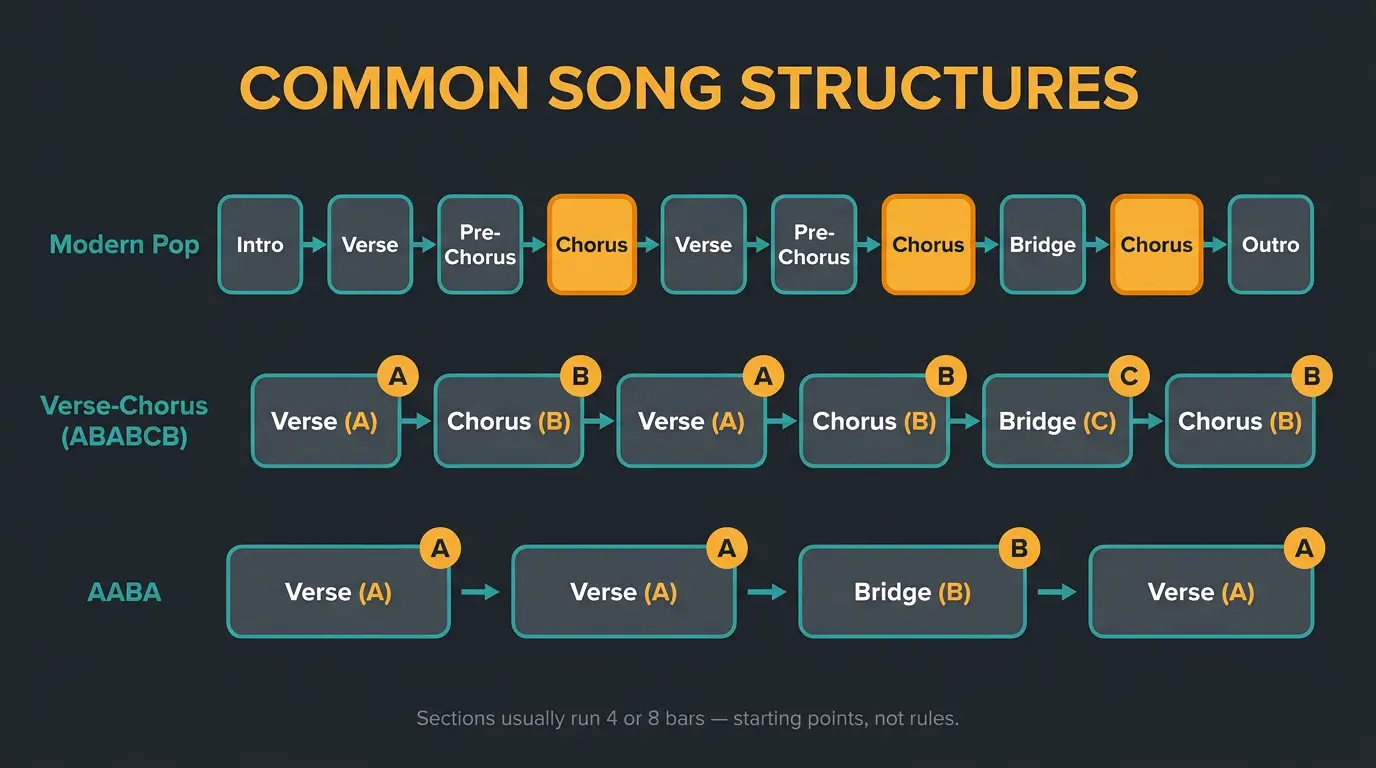
You don't have to invent structure from scratch. A few templates cover most of what you'll hear, and they make solid launch pads.
The most common structure in modern pop is Intro → Verse → Pre-Chorus → Chorus → Verse → Pre-Chorus → Chorus → Bridge → Chorus → Outro. There's also the classic verse-chorus ABABCB form, where A is the verse, B is the chorus, and C is the bridge. And for storytelling — think older pop and a lot of country — there's AABA: two verses, a contrasting bridge, then back to the original melody to close.
Sections usually run 4 or 8 bars, though nothing's stopping you from going longer or shorter. If you want to go deeper on the pop template specifically, we broke it down in our guide to pop songwriting structure. There's also a solid overview of the common forms on Wikipedia's song structure page.
With that being said, these are starting points, not rules. A good arrangement balances familiarity and variation so the listener stays engaged. Some of the best tracks ever made skip the bridge or drop the outro entirely. Trust your ears over the template.
Building energy: the dynamic arc
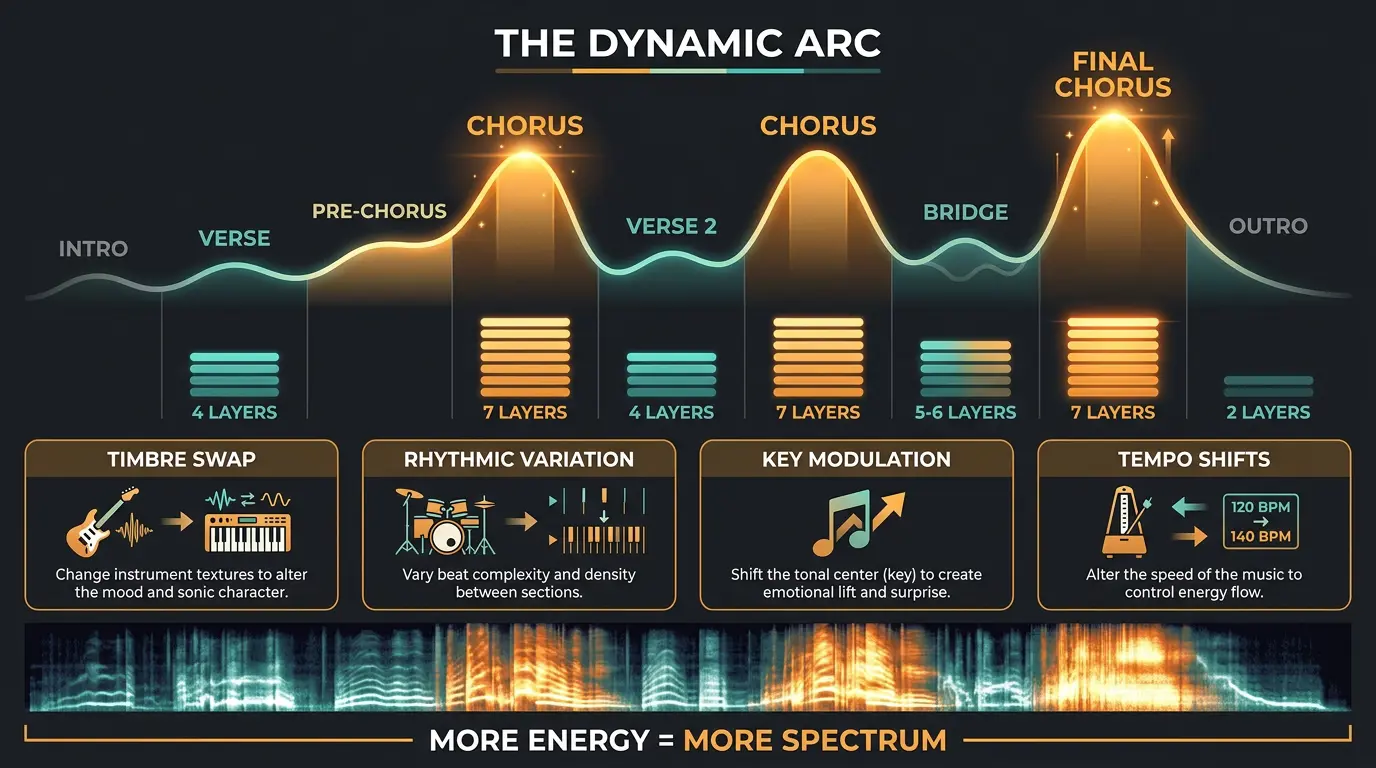
The dynamic arc is the overall shape of your song — quiet to loud, simple to complex and back again. And here's the thing a lot of folks get wrong: that arc is an arrangement decision, not a mixing one. You build it with the parts you choose, not with the fader at the end.
The main tool is layering and stripping. A verse might have 4 layers. A chorus might have 7. That difference is what creates impact. If everything plays all the time, nothing feels special because there's nowhere left to go.
A few more ways to move energy without just adding tracks:
- Timbre swap — play the same melodic part with a different instrument. Same notes, totally different feel.
- Rhythmic variation — going from a sparse kick-and-bass to a full kit changes momentum without touching the tempo.
- Key modulation — bumping the key up a section can inject fresh energy.
- Tempo shifts — a sudden change can pull a real emotional response.
If you pull up a spectrogram of a typical pop song, you'll see the fullest use of the frequency spectrum lands in the choruses. That's the arc showing up visually — more energy, more spectrum. And yes, louder used right does sound better, so don't be shy about letting the chorus be the loudest, biggest thing in the track. That's what it's there for.
A practical trick: build the climax first
Here's a workflow tip that flips the usual order. Instead of starting with the intro, build your biggest, most climactic section first. Throw every idea you have at it — every layer, every hook, the whole spectrum.
Then work backward. Once you know exactly what the peak sounds like, every other section has a clear job: get the listener to that moment. It makes decisions easier because you're always building toward something concrete. It's one way to work, not the only way, but give it a shot and see if it clicks for you.
Transitions: the connective tissue
Moving between sections can sound abrupt if you just dump a pile of new elements in all at once. It feels disconnected, like the song jumped tracks. That's what transitions are for — they smooth the seams so a big energy jump lands instead of jars.
The usual toolkit: risers, downsweeps, drum fills, melodic fills, reverse effects, and automation. All of them tell the ear something's coming.
A scenario where this really pays off is the move into a chorus. Try the drum pull — mute the drums for a beat or two right before the chorus hits. When the drums come back in with the rest of the section, the impact is noticeably bigger than if they'd just played straight through. It's a small move, and it works almost every time. Let's give it a listen in your own project and you'll hear the difference immediately.
Whitespace: why what you leave out matters most

Here's the part people skip, and it's the most important. The listener's attention is a spotlight, and that spotlight is only big enough for one or two elements at a time. So decide in advance which tracks are the most important, and build a frame around that centerpiece.
Silence is part of the music too. The quiet moment right before your loudest part is what gives that part its punch — contrast in dynamics is where impact comes from. A chorus only feels huge because something smaller came before it.
When you're deciding what stays, run every layer through one test: does this part need to be here? If you can remove a layer and the track doesn't get worse, it shouldn't be there. Avoid overcrowding, aim for balance across the frequency spectrum, and remember — less is more.
Quick arrangement checklist
- Pick the centerpiece of your song and build a frame around it.
- Vary the layer counts between sections — a verse with 4 layers and a chorus with 7 creates real contrast.
- Use transitions like risers, fills, and the drum pull to smooth big energy jumps.
- Add a quiet moment right before your loudest one so it hits harder.
- Cut any layer that doesn't earn its place — if removing it doesn't hurt the track, it goes.
Frequently Asked Questions (FAQs)
What is the most common song structure?
The most common modern structure is Intro, Verse, Pre-Chorus, Chorus, Verse, Pre-Chorus, Chorus, Bridge, Chorus, Outro. It works because it balances repetition with variation, giving listeners hooks they remember and enough change to stay engaged. Sections usually run 4 or 8 bars.
What's the difference between arrangement and mixing?
Arrangement decides what plays, when it enters, and how energy rises and falls across the song. Mixing balances and shapes those parts once they exist. Your dynamic arc — quiet to loud, simple to complex — is an arrangement decision. If the parts aren't right, no mix will save it.
Do I need a bridge in every song?
No, a bridge is optional. It adds contrast after the second chorus and gives the listener a break from the verse-chorus pattern, but plenty of great tracks skip it entirely. Add one when the song feels repetitive and needs a fresh moment, not just because the template has a slot for it.
How many layers should a chorus have?
There's no magic number, but a chorus usually has more layers than the verse before it — say 7 against 4. The exact count matters less than the contrast. The jump in layers is what makes the chorus feel bigger, so build the difference on purpose.
How long should each song section be?
Most sections run 4 or 8 bars, and that's a safe default to start from. Intros and pre-choruses often land at 4 to 8 bars. You can go longer or shorter when the song calls for it — the bar count is a guideline, not a rule, so trust your ears.
Final Thoughts
Arrangement is where a good idea becomes a good song, and it's a craft you get better at every time you finish a track. Start with a template if you want, build toward your loudest moment, use transitions to smooth the seams, and be ruthless about cutting anything that doesn't earn its spot.
None of this is magic. It's decisions, made one at a time, in service of the centerpiece. Trust your ears, leave room for space, and your eight-bar loop will start sounding like a record.
Some of the links within this article are affiliate links. These links are from various companies such as Amazon. This means if you click on any of these links and purchase the item or service, I will receive an affiliate commission. This is at no cost to you and the money gets invested back into Audio Sorcerer LLC.