Pop song structure isn't a fixed formula. It's a set of tools, and the tools shift with the times. The intro-verse-chorus-bridge template still holds up, but the way songs actually get built changed a lot over the last decade.
Streaming and TikTok compressed pop songs down to the bone for a few years — hook first, everything else optional. Then 2024 and 2025 quietly swung the pendulum back toward longer, fuller writing. Here's the fundamentals, what actually changed, and the one section most guides forget.
TABLE OF CONTENTS
The classic pop template still works
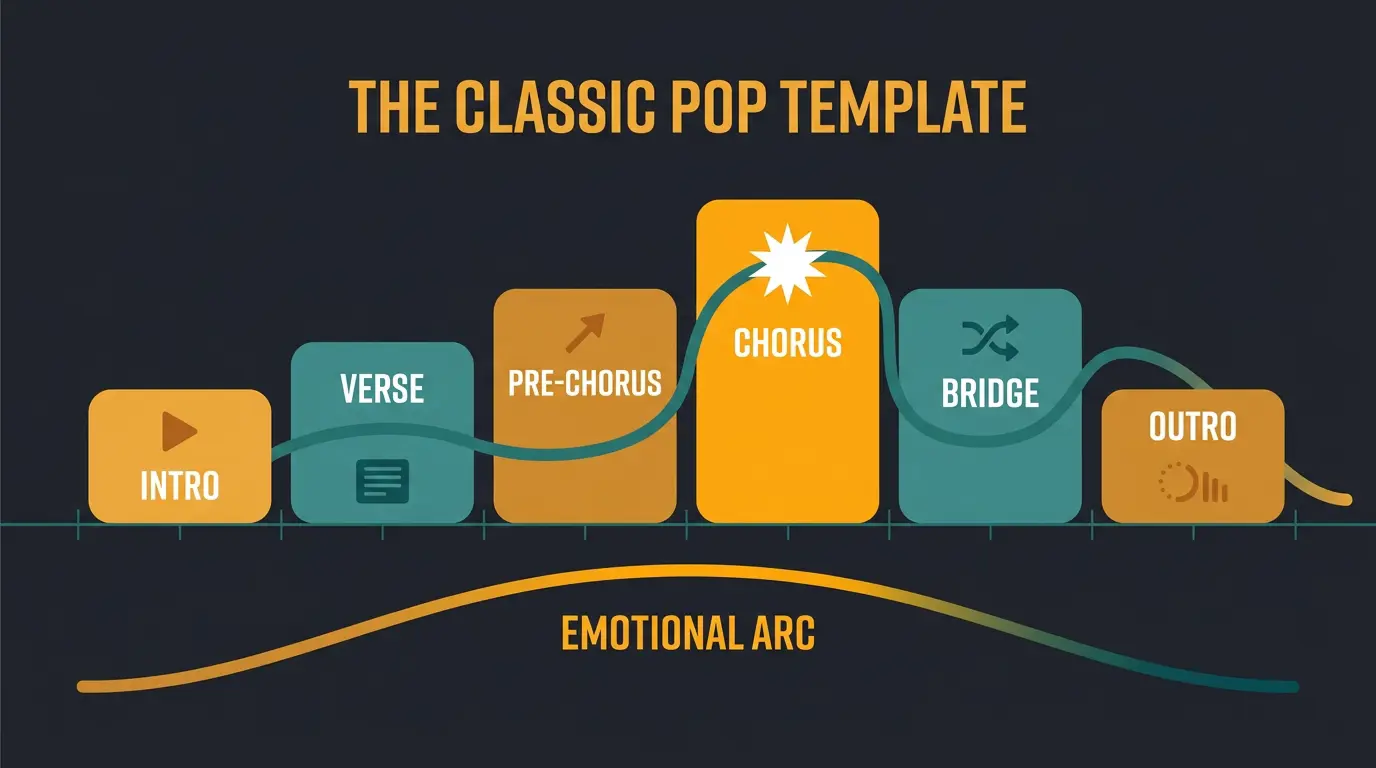
The most well-known template — intro, verse, pre-chorus, chorus, bridge, outro — is still a staple across pop, rock, country, and even a lot of electronic music. It sticks around for a good reason: it gives you a satisfying emotional arc and a sense of progression our ears already expect.
When a brand-new song sounds familiar the first time you hear it, that's usually the structure doing the work. Your ears have been trained on these shapes since you were a kid.
Hit songs tend to lean on this template. Jam bands and experimental acts diverge from it on purpose. Neither is wrong. Think of the classic template as your reference point, not a rulebook you have to obey.
What each section is actually doing
Each piece has a job. Once you know the job, you know when to keep it and when to cut it.
- Verse — where the story develops. Since the chorus and pre-chorus usually repeat the same lyrics every time, the verse is your real shot at getting the message across. If you want to go deeper, we've got a full guide on writing a verse that pulls its weight.
- Pre-chorus — builds tension and points the listener toward the chorus. It's the ramp before the payoff.
- Chorus — the emotional payload and the repeated hook. This is the part people remember, so it's worth sweating. Here's how to write a chorus that actually sticks.
- Bridge — contrast. A fresh angle, a new chord move, a different lyric before the final chorus hits harder.
There isn't one right way to use these. Trust your ears and let the song tell you what it needs.
The post-chorus: the piece most guides skip
Most structure guides stop at verse, pre-chorus, chorus, bridge. They skip the post-chorus, and that's a real gap — it's one of the most defining features of modern pop.
A post-chorus is a hook after the hook. It lands right after the chorus and often carries the actual viral moment, the bit designed to lodge in your head.
Lorde's "What Was That" saves its main hook for a post-chorus synth line rather than the chorus itself. On Lady Gaga's "Abracadabra," the grinding industrial post-chorus keeps ratcheting up the tension, then her vocal swoops back in for relief before the whole cycle restarts. That push-pull is the engine of the song.
The post-chorus got so central because it's the perfect place to park the moment people will clip and share. Which brings us to how streaming reshaped everything else.
How streaming and TikTok compressed the song
For a stretch there, the whole game became get-to-the-hook-fast. Shorter intros. Chorus upfront. Second verses trimmed. The best moment front-loaded into the first five seconds, because that's roughly all the time a song had to catch on.
The incentives explain it. On TikTok, a ten-second snippet can push a song onto the charts. On Spotify, payouts have long hinged on listeners passing somewhere around the 30-second mark — that exact number moves and gets debated, so treat it as an evolving rule of thumb, not gospel. Either way, the message to writers was clear: hook them fast or lose them.
So songs didn't just get shorter, they got compressed — stripped of bridges, intros, sometimes even a second verse. A catchy line, repeated a few times, done.
The bridge took the biggest hit. As one Grammy-nominated songwriter put it, a lot of songs don't have bridges anymore, and that's a genuine loss — the bridge is one of the most special parts of writing. I'm not here to moralize about it. The incentives were real, and writers responded to them.
The 2024-2025 swing back to fuller songs
Here's the freshest part. Song lengths are climbing again. The average hit is creeping back toward three and a half minutes, and some of the biggest tracks of the year are pushing four or five — something that would've felt risky just a few years back.
Look at who's charting. Benson Boone's "Beautiful Things" runs 3:30. Dua Lipa's "Houdini" clocks in at 3:53. Chappell Roan's theatrical "Good Luck, Babe!" sits at 4:05. Artists like Chappell Roan, Sam Fender, and Lola Young have all leaned back into longer, more developmental writing.
With the longer runtimes came something else: personality. The charts stopped being wall-to-wall copy-paste hooks and started making room for music that's quirky, theatrical, and emotionally raw.
With that being said, I wouldn't call this a clean win for either side. It's a pendulum. The tension between a bite-sized hook and a slow-burn story is probably going to shape songwriters more than either trend does on its own.
Modern length benchmarks worth knowing
- Around 3:17 is the broad Spotify-era catalog benchmark — roughly where the average track landed by 2020.
- Around 3:30 is the mainstream-hit benchmark from Billboard Hot 100 analysis, and it's been ticking upward.
- Most pop subgenres live in a comfortable 3:30 to 4:30 window, with synthpop sitting at the longer end near 4:26.
- K-pop sits at the short end, around 3:11, partly from tight label structures and heavy playlist optimization.
Pop is more genre-fluid than it used to be
Treating pop as one monolithic sound doesn't hold up anymore. The charts got a lot more genre-fluid. Country surged into the Hot 100 top 10 in a big way — it went from a sliver of entries a few years ago to leading the pack in the first half of 2025.
K-pop is now a mainstream structural reference too. A track like "Golden" from K-Pop Demon Hunters put that front and center. K-pop title tracks are honestly a great teaching example of maximalist structure — dynamic verses, a huge chorus, a meme-able post-chorus, and an explosive bridge. It's the exact opposite pole from the stripped-down streaming model.
The takeaway: borrow across genres freely. A country writer can steal a K-pop post-chorus idea. A pop writer can lift a folk bridge. Nobody's checking your genre card at the door.
How to use structure without being ruled by it
Learn the template cold. Then bend it to serve the song. That's the whole move.
Less is more where it genuinely helps — if an intro drags, trim it. But don't cut a bridge just because a trend says short songs win. If the song wants a bridge, give it one. The trend isn't writing your song; you are.
Make sure you're letting the story lead. Structure exists to deliver a feeling, not to check boxes. If you're still finding your footing, our step-by-step guide to writing a song is a solid place to start. Beyond that, trust your ears and decide for yourself. For a little more history on why the three-minute shape became so dominant in the first place, the write-up on the three-minute pop song is worth a read.
Frequently Asked Questions (FAQs)
What is the standard pop song structure?
The standard pop structure is intro, verse, pre-chorus, chorus, bridge, and outro, usually with the chorus repeating between verses. It's a reference point, not a rule. Plenty of hits move sections around, and modern pop often adds a post-chorus hook right after the chorus.
What is a post-chorus?
A post-chorus is a short, catchy section that lands right after the chorus — a hook after the hook. It's often where the most shareable, viral moment of a modern pop song lives. Think of a repeated vocal chant or a memorable synth line, like Lorde's "What Was That."
How long should a pop song be now?
Most modern pop hits land around three to three and a half minutes, with the mainstream-hit benchmark near 3:30. That number has been climbing back up in 2024 and 2025, and some big tracks now push four or five minutes. Serve the song rather than a target runtime.
Are bridges still used in modern pop?
Yes, bridges are back in modern pop. They thinned out during the peak TikTok era when songs got compressed for speed, but the 2024-2025 swing toward longer, fuller writing brought them back. A good bridge gives your final chorus more punch, so don't cut one out of habit.
Do I have to put the chorus first?
No, you don't have to put the chorus first. It became common during the streaming era to hook listeners fast, but it's a choice, not a requirement. Front-load the chorus if the song benefits from it. If a slow build serves the story better, do that instead.
Final Thoughts
Structure is a craft, not a magic spell. The classic template still works, the post-chorus earned its spot, and the pendulum keeps swinging between tight hooks and full songs. None of that tells you what your song needs — only the song can do that.
Learn the shapes, then write the one that serves the story. Trust your ears, and let the rest sort itself out.
Some of the links within this article are affiliate links. These links are from various companies such as Amazon. This means if you click on any of these links and purchase the item or service, I will receive an affiliate commission. This is at no cost to you and the money gets invested back into Audio Sorcerer LLC.