Finding chords for a melody is really just working backward. Instead of picking notes to fit a chord, you find chords that contain the notes you already have. That's the whole game.
It's part logic and part ear. The logic tells you which chords are even possible. Your ear picks the one that sounds right when a few options all work.
In this guide you'll learn to find the key, list the chord options for each note, and choose between them two ways — by ear and by theory. Let's get into it.
TABLE OF CONTENTS
Start by finding the key
Step one, always. Everything else depends on knowing what key you're in, so nail this down first.
Two clues make it easy. First, look at which sharps and flats your melody uses, then match them against the Circle of Fifths to see which key signature fits. Second, check the note your melody ends on — most melodies land on the tonic, the first note of the scale.
Here's where those two clues work together. Say your melody has an F# and a C# and it ends on B. Those sharps could point to D major, but since it resolves on B, it's more likely B minor. The ending note breaks the tie.
Write out the diatonic chords in that key
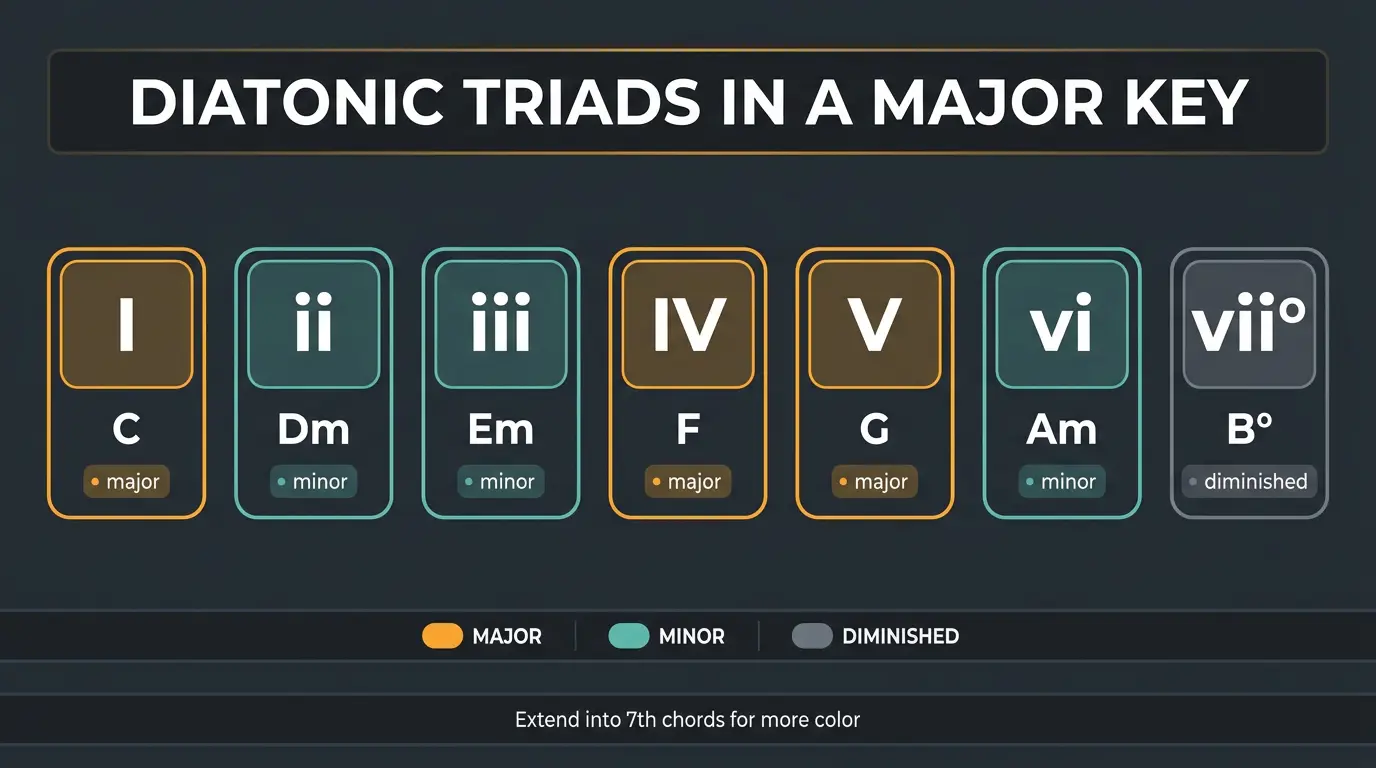
Once you know the key, write out its diatonic chords. Those are the three-note chords (triads) built on each note of the scale, using only notes from that scale.
In any major key, the qualities follow a fixed pattern:
- I — major
- ii — minor
- iii — minor
- IV — major
- V — major
- vi — minor
- vii° — diminished
You can extend each of these into a seventh chord if you want more color — that gives you major 7, minor 7, dominant 7, and half-diminished flavors down the line. But for now, less is more. Limiting yourself to these seven triads keeps the whole thing manageable. This is your palette to choose from.
Every melody note fits more than one chord
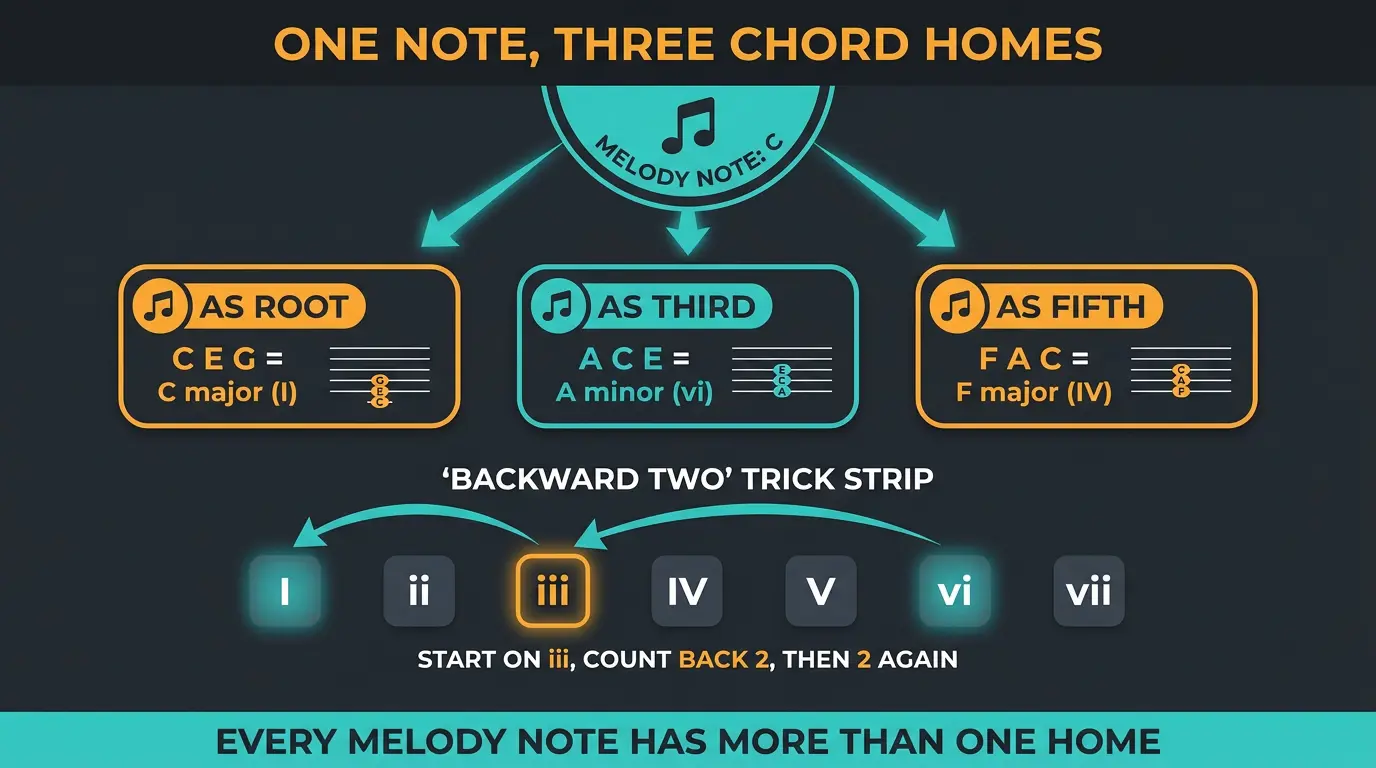
Here's the insight that unlocks everything: any single note can be the root, the third, or the fifth of a chord. So every melody note has more than one home.
There's a quick trick for finding those three options. Start with the chord built on that scale degree, then count backward two chords twice. Take scale degree 3 — it lives in the iii chord, the I chord (two back from iii), and the vi chord (two back from I).
That's exactly why harmonizing has options instead of one right answer. Your job isn't to find the chord. It's to choose from a handful of chords that all technically work.
The I, IV, and V shortcut
Here's a genuine superpower for beginners. Between them, the I, IV, and V chords contain every single note in the scale. That means you can harmonize any diatonic melody using just those three chords.
This is a big reason they're the most common chords in all of Western music, across every genre. They cover the whole scale, so there's always at least one that fits your melody note.
And make no mistake — this isn't training wheels. Plenty of great songs live entirely on I, IV, and V. It's a complete approach, not a shortcut you're supposed to grow out of.
Finding chords by ear
The by-ear method is a trial-and-error loop, and it's more fun than it sounds. Find the tonic, then try I, IV, and V under your melody and listen for which one has the melody note in it.
Say you're in C. Which of your three chords — C, F, or G — contains the melody note you're on? Sometimes only one fits. Sometimes two do, like when both C and G contain the note. When that happens, let's give it a listen — try one, then try the other, and go with the one that feels right.
Make sure you don't stress about getting it wrong. Trial and error is your friend here. You'll train your ear faster by testing bad guesses than by trying to be perfect on the first pass.
Finding chords by theory
The theory method does the same job, just systematically. It clarifies every option up front instead of guessing chord by chord. Here's the loop:
- Identify the key.
- Write out the diatonic chords in root position.
- Mark the scale degree under each melody note.
- List every chord option for each note.
- Find your cadence points and decide the harmonic rhythm (how often the chord changes).
- Eliminate the chords that can't work.
- Choose your progression.
The point is to lay out all the possible "colors" for a passage before you commit, rather than stumbling onto them. For a solid outside reference on this approach, iZotope's guide on how to choose chords for your melody walks through it well.
With that being said, don't treat ear and theory as rivals. Theory hands you the options; your ear picks the winner. They work best together.
How to choose when several chords fit
- Weight the downbeats and target notes most — those are the notes the melody builds toward, and they carry the harmony.
- Give prominence to notes on strong beats and longer notes; short notes between beats matter far less.
- Use harmonic function to guide the flow — tonic for rest, subdominant for movement, dominant for tension that wants to resolve.
- Land on strong cadences at phrase endings. V–I is the most common resolution in music, and ii–V–I is close behind.
- When the melody leaps, support it with a chord that contains both notes of the leap.
Not every note needs its own chord
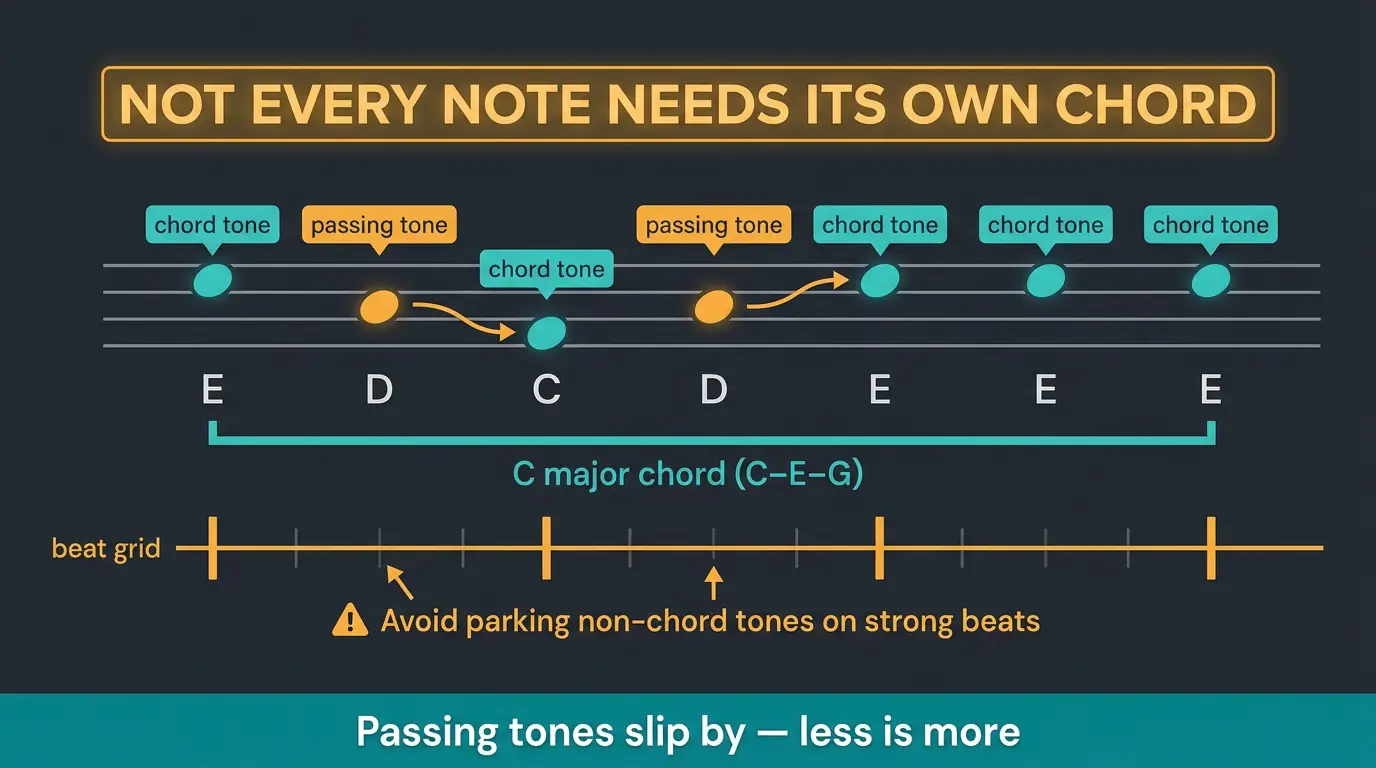
This is where a lot of people over-harmonize. They try to give every note its own chord and end up with a progression that lurches around for no reason. You don't need to do that.
Some melody notes are non-chord tones — notes that aren't part of the underlying chord. A passing tone moves stepwise between two chord tones. A neighboring tone steps away from a chord tone and right back.
Take "Mary Had a Little Lamb" (E–D–C–D–E–E–E) over a C major chord. The D notes aren't in C major (C–E–G), but they're passing tones — they slip by on the way to a chord tone, so they sound fine. The guardrail: avoid parking non-chord tones on strong beats. On quick passing notes, they're no problem. This is where less is more really earns its keep.
A quick word on minor keys
Minor keys are a little trickier. The 6th and 7th scale degrees can vary, which gives you even more diatonic chord options to sort through. That's more freedom, but also more to weigh.
The good news is there's a shortcut. Every major key has a relative minor that shares the exact same notes. To find it, move down a minor 3rd from the major tonic (or up a 6th) — so C major and A minor are relatives. The harmonizing logic is identical; you're just working from a different home base. If you want to go deeper, our guide on minor key chord progressions and the moods they create is a good next stop.
Frequently Asked Questions (FAQs)
How do I find the key of a melody?
Look at which sharps or flats the melody uses and match them to a key signature on the Circle of Fifths, then check the note it ends on — most melodies resolve to the tonic. When the sharps fit two keys, the ending note usually breaks the tie for you.
Can I harmonize a melody with just three chords?
Yes. The I, IV, and V chords contain every note in the scale between them, so those three can harmonize any diatonic melody. It's not a shortcut you outgrow either — plenty of great songs live entirely on I, IV, and V.
Do all melody notes need a chord?
No. Many notes are non-chord tones — passing tones and neighboring tones that move between chord tones. They sound fine on quick, weak beats, so you don't need to chase every note with a new chord. Trying to do that usually makes the progression worse.
How often should the chords change?
That's called harmonic rhythm, and it depends on the feel you want — one chord per measure is a common starting point. Slower changes sound stable and calm; faster changes add motion and energy. Pick a rate and let the strong beats guide where new chords land.
What's the difference between harmonizing by ear and by theory?
By ear means testing chords against the melody and trusting what sounds right; by theory means mapping out every chord option before you choose. Neither is better on its own. Theory hands you the possibilities and your ear picks the winner, so use both.
Final Thoughts
Harmonizing isn't magic, and it isn't guesswork either. Find the key, list your options, and choose the chord that fits both the notes and the feel. Once you've done it a handful of times, your ear starts making those calls before your brain catches up.
Start with I, IV, and V, don't over-harmonize, and trust your ears when two chords both seem to work. That's most of the job right there.
Some of the links within this article are affiliate links. These links are from various companies such as Amazon. This means if you click on any of these links and purchase the item or service, I will receive an affiliate commission. This is at no cost to you and the money gets invested back into Audio Sorcerer LLC.