Syncopation is when the emphasis lands where your ear doesn't expect it — on the off-beat instead of the strong beat. That's it. That's the whole idea.
It's also the reason a beat makes you nod your head instead of sitting still. Syncopation is what gives music its groove, its bounce, its human feel. Here's what it actually is and why it works.
TABLE OF CONTENTS
What is syncopation, plainly?

Syncopation is when the emphasis lands on a weak beat or an off-beat instead of the strong beat where you'd normally expect it. You're taking the accent and moving it somewhere surprising.
Here's the part people miss: syncopation only exists against a steady pulse. You need a regular beat first, because syncopation is the act of breaking that expectation. No underlying meter, nothing to push against. The regular flow has to be there for the disruption to mean anything.
How syncopation works: counting the off-beat
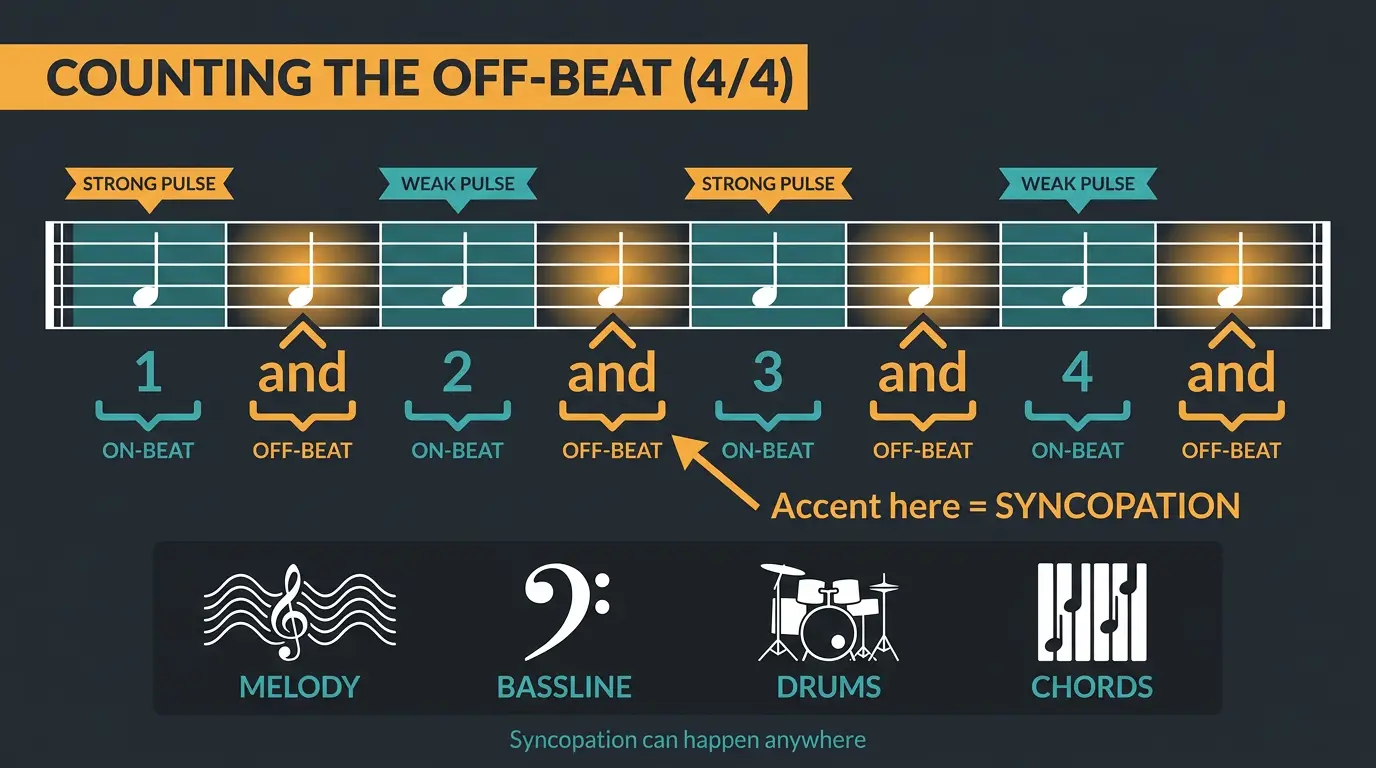
Let's use 4/4, since that's where most music lives. In 4/4, the strong pulse falls on beats 1 and 3, and the weak pulse falls on 2 and 4. Your ear naturally leans toward 1 and 3 as the anchors.
Now count it in eighth notes: "1-and-2-and-3-and-4-and." The numbers are the on-beats. The "ands" are the off-beats. When you put an accent on an "and" instead of a number, that's syncopation. Go smaller — sixteenth notes, parts of a triplet — and accenting those subdivisions counts too.
And it can happen anywhere in the arrangement. The melody, the bassline, the drums, the chords. Any spot that's normally weak can be made important with a long note, a chord change, or a written accent. If you're still getting comfortable with the underlying pulse, our guide on time signatures for beginners pairs well with this.
The main types of syncopation
People usually break syncopation into four types. You don't need to memorize the names, but knowing them helps you hear what's going on.
- Suspension — a note hit on a weak beat gets held over a strong beat, so it blurs the normal beat pattern.
- Even-note (backbeat) — accenting 2 and 4 instead of 1 and 3. This one's so common in rock and pop that it barely sounds syncopated anymore.
- Missed-beat (drop-one) — you replace a strong beat with silence. When the next accent lands on a weak beat, it hits way harder.
- Off-beat — accenting the upbeats between the main pulses. This works at the beat level and at smaller subdivisions like sixteenths, where it adds texture without changing the whole feel.
Two more worth knowing: ties, where a note held across a beat creates the syncopation, and the push (or anticipation), where you play the "1" of a bar a half-beat early, on the "and of 4" before it.
Syncopation at a glance
- Suspension: a weak-beat note held over a strong beat, blurring the normal pattern.
- Backbeat: accenting 2 and 4 instead of 1 and 3 — the heartbeat of rock and pop.
- Drop-one: replacing a strong beat with silence so the next accent hits harder.
- Off-beat: accenting the upbeats and smaller subdivisions between the main pulses.
Why syncopation grooves
Groove comes down to expectation and surprise. Your ear predicts where the beat should be, and syncopation nudges the accent somewhere else. That little tension between what you expect and what you get is the whole hook.
It also makes music feel human. When every note lands exactly on the beat, things can sound stiff and machine-made. Syncopation is where the imperfection lives, and that imperfection is what makes people move — tap a foot, sway, dance without deciding to.
One thing to keep in mind: how surprising syncopation feels depends on what you grew up hearing. In traditions built on it — funk, reggae, jazz, Latin music — your brain expects the complexity and enjoys it. In music with less of it, the same rhythm can jump out as something new.
The whitespace angle: silence as syncopation
Here's my favorite version of this. Sometimes the strongest syncopation isn't a note you play — it's a note you don't.
Leave a hole where the strong beat should be, and the next accent hits like a truck. That's the drop-one move: the drummer doesn't voice the "1," so the weak beat that follows feels enormous. The silence is doing the work. Reggae and dub built entire grooves out of this.
This is less is more in the most literal sense. The space isn't empty — it's part of the rhythm. Make sure you listen to what a groove sounds like with a beat pulled out, not just added in. You'll be surprised how much power lives in the gap.
Syncopation across genres
Once you know what to listen for, you'll hear syncopation everywhere. Here's a quick tour.
Ragtime is where a lot of this got codified in American music. Scott Joplin made syncopation a signature, and those rhythms trace back to the African-American tradition and its non-Western roots.
Jazz and swing. Swing feel itself is a form of off-beat syncopation — those offbeat accents are the swagger. Dave Brubeck's "Take Five" leans into it hard with its off-beat piano and sax phrasing.
Reggae and ska. The off-beat guitar "skank" is the whole identity. The guitar and piano hit the "ands," and that's your groove. Let's give it a listen to something like Bob Marley's "Natural Mystic" and you'll hear the accents sitting off the beat.
Funk. Funk is basically syncopation with a rhythm section. Clyde Stubblefield's drumming on James Brown's "Funky Drummer" is a clinic in off-beat accents and ghost notes, and "Papa's Got a Brand New Bag" rides off-beat rhythms that are hard to sit still through.
Rock and pop. The backbeat is syncopation you've heard a million times, and the phrasing in the Rolling Stones' "Satisfaction" plays with placement too. On the pop side, "Uptown Funk" runs a heavily syncopated bassline that drives the entire track. If you want to nerd out further, the Wikipedia entry on syncopation is a solid deep dive.
Frequently Asked Questions (FAQs)
What is syncopation in simple terms?
Syncopation is putting the emphasis on a beat where your ear doesn't expect it — usually the off-beat or a weak beat instead of the strong one. It only works against a steady pulse, and it's the thing that makes a rhythm feel like it's got some bounce to it.
What's the difference between syncopation and just being off-beat?
Being off-beat can mean you're accidentally out of time. Syncopation is intentional off-beat emphasis that plays against a clear, steady pulse. The pulse has to stay grounded — you're deliberately accenting the weak spots on purpose, not losing the beat.
Is a backbeat syncopation?
Yes, a backbeat is a type of syncopation — it accents beats 2 and 4 instead of the naturally strong 1 and 3. It's so common in rock and pop that it often sounds completely natural to the ear, but technically it's flipping the normal metric emphasis.
What genres use syncopation most?
Funk, jazz, reggae, ska, ragtime, and Latin music lean on syncopation the hardest, since they're built around dance and movement. Rock and pop use it too, mostly through the backbeat. Honestly, you'll find some syncopation in nearly every style if you listen closely.
Can silence be syncopation?
Yes. Leaving a rest where a strong beat should land is a real syncopation technique, often called drop-one. Reggae and dub use it constantly. The missing beat makes the next accent hit harder, so the silence is doing just as much work as any note.
Final Thoughts
Syncopation isn't some advanced trick reserved for jazz musicians. It's the simple act of putting the accent where the ear doesn't expect it, and it's baked into most of the music you already love.
Start counting "1-and-2-and" over your favorite tracks and notice where the accents actually land. Once you hear it, you can't unhear it — and you'll start using it in your own writing without even thinking about it.
Some of the links within this article are affiliate links. These links are from various companies such as Amazon. This means if you click on any of these links and purchase the item or service, I will receive an affiliate commission. This is at no cost to you and the money gets invested back into Audio Sorcerer LLC.