A minor key isn't one fixed set of chords. That's the whole point, and it's why minor keys can sound dark, dramatic, or melancholic but hopeful — all from the same starting note.
The reason is simple: there are three versions of the minor scale, so you get more chord options than you do in major. That extra flexibility is where all the mood comes from.
Here's what we'll cover: the diatonic chords of a minor key, the harmonic minor V chord that gives minor progressions their pull, and the common progressions along with the moods they tend to create. No long warm-up. Let's get into it — minor delay on my part, I promise.
TABLE OF CONTENTS
The diatonic chords of a natural minor key
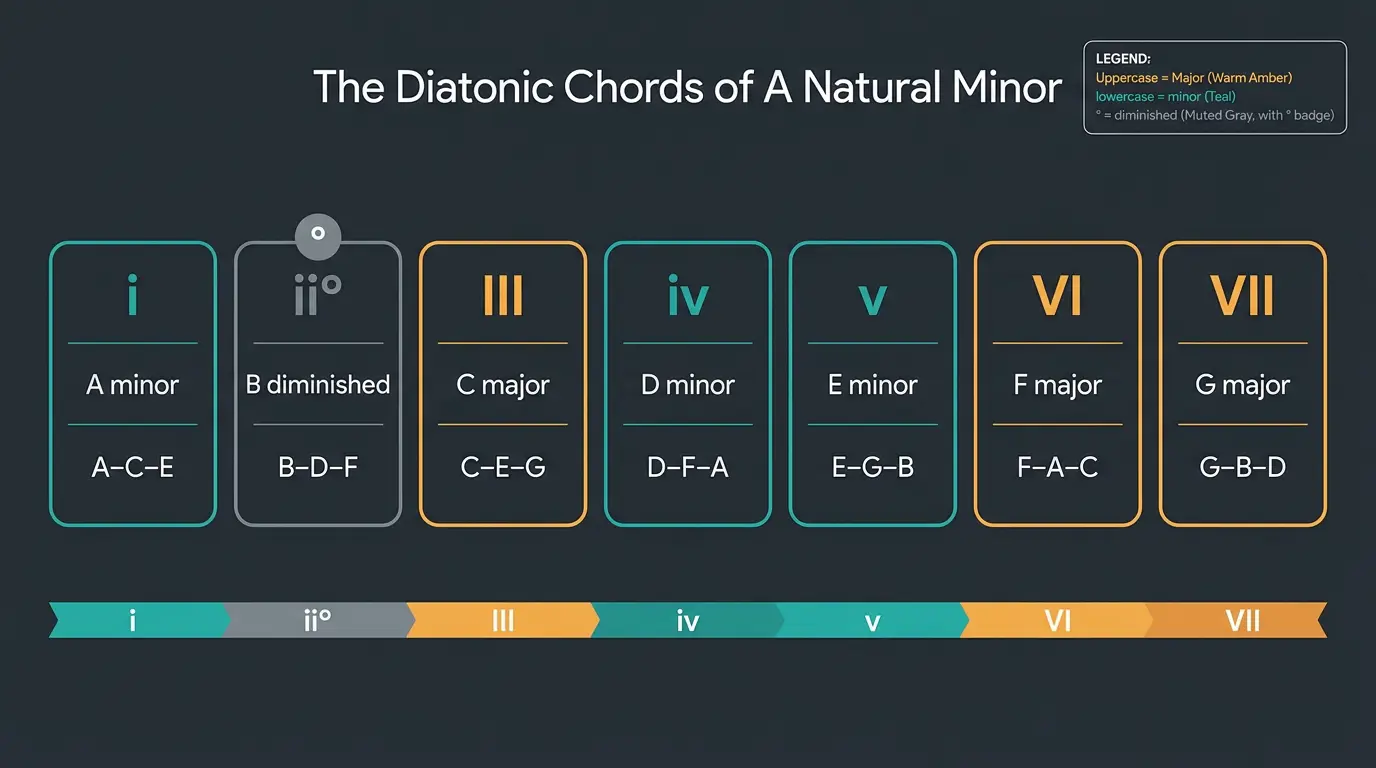
Let's set the baseline. In natural minor, the chords follow a fixed quality pattern: i, ii°, III, iv, v, VI, VII. In plain terms, the 1, 4, and 5 chords are minor, the 3, 6, and 7 chords are major, and the 2 chord is diminished.
Quick note on the symbols, since we'll use them the whole way through. Roman numerals show both the scale degree and the chord quality: uppercase means major, lowercase means minor, a little ° means diminished, and a + means augmented. The best part is they're key-independent, so you can take any progression and transpose it anywhere.
Let's work A minor, because it's all white keys and easy to follow:
- i = A minor (A–C–E)
- ii° = B diminished (B–D–F)
- III = C major (C–E–G)
- iv = D minor (D–F–A)
- v = E minor (E–G–B)
- VI = F major (F–A–C)
- VII = G major (G–B–D)
Notice there are three major chords built right in — III, VI, and VII. Those are your brighter colors inside a minor key, and they matter a lot when you start building minor key progressions with any kind of emotional range. If you want a broader refresher on how a key's chords fit together, our guide to the chords in the key of C covers the major-side version of the same idea.
The harmonic minor V chord and why it matters
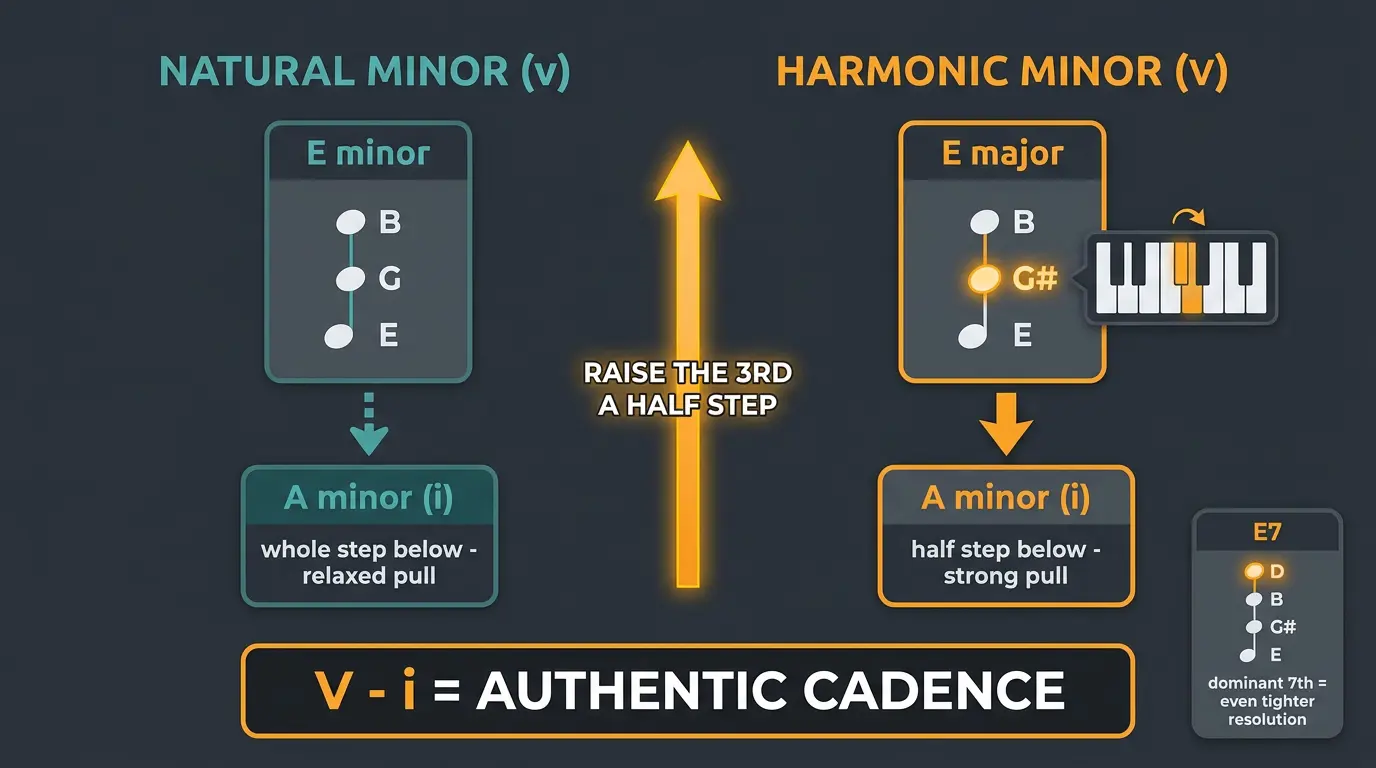
Here's the centerpiece. If you raise the 7th note of the natural minor scale a half step — in A minor, that's G going up to G# — you get the harmonic minor scale. That one change does something big.
The only chord that really cares is the v chord. In natural minor, v is E minor (E–G–B). Raise that G to G# and it becomes E major (E–G#–B). Now you've got a proper V chord, and it pulls back to the tonic much harder than the minor version ever could.
Why so much harder? It comes down to the leading tone. That raised 7th sits a semitone below the tonic instead of a whole step, and a note that close wants to resolve. In natural minor the 7th is a whole step below the tonic — it's more relaxed about getting home. The half-step version is not relaxed at all. It's leaning on the door.
That V–i move is called an authentic cadence: the tension of the dominant resolves to the tonic. Want more pull? Add a 7th and make it a dominant 7th chord — E7 to Am. That extra note tightens the resolution even more, which is why so many minor-key songs lean on V7. If sevenths are new to you, we break them down in our guide to seventh chords.
One practical thing: you don't need harmonic minor the whole time. You use natural minor until the dominant shows up, and that's when you reach for the raised 7th. Mechanically, converting v to V is just raising the third of that chord a half step. That's the whole trick.
The softer minor v and where it fits
The lowercase v chord still exists, and it has a softer, gentler color than the major V. It's rarer, but it shows up when you're harmonizing the top half of the melodic minor scale, or as a pivot chord when you're modulating to the relative major.
One craft caution, though: don't use the minor v at a cadence or right at the point of modulation. That's exactly where you want the leading tone doing its job, and the softer chord just won't pull hard enough to land it.
Common minor chord progressions and their moods
Now the payoff. These are all key-independent, so I'll give the Roman numerals plus an A minor example you can play right now.
Let's start with the flagship: the Andalusian cadence, i–VII–VI–V. In A minor that's Am–G–F–E. It descends stepwise, and it has that melancholy, moody feel that shows up everywhere from rock and pop to its flamenco roots. Notice the last chord is E major, not E minor — that's the harmonic minor leading tone doing its thing, which is why the progression resolves so strongly. Swap the E for E7 and the pull back to Am gets even more intense.
A few others worth knowing:
- i–iv–v (Am–Dm–Em): the basic, all-minor sound. Dark and plain in a good way.
- i–VI–III–VII (Am–F–C–G): melancholic but hopeful, because it balances the minor tonic against those three brighter major chords.
- ii°–V–i (Bm7♭5–E–Am): the jazz and bossa nova flavor, a little more sophisticated.
- i–♭VII–♭VI–V (Am–G–F–E): bluesy tension that works great in blues and rock.
Now, be honest with yourself about moods. When people search for sad chord progressions in minor, they're usually chasing a feeling, and these tendencies are real — but they're tendencies, not rules. Tempo, voicing, melody, and lyrics can flip the whole vibe. Trust your ears over any chart, including mine. For more on the emotional side, we go deeper in our post on sad chord progressions and minor keys.
| Progression | In A minor | Mood / use |
|---|---|---|
| i–iv–v | Am–Dm–Em | Basic, all-minor, dark |
| i–VI–III–VII | Am–F–C–G | Melancholic but hopeful |
| ii°–V–i | Bm7♭5–E–Am | Jazz, bossa nova, sophisticated |
| i–VII–VI–V (Andalusian) | Am–G–F–E | Moody, dramatic; rock, pop, flamenco |
| i–♭VII–♭VI–V | Am–G–F–E | Bluesy tension; blues, rock |
Ending on a major chord: the Picardy third
Here's a great mood payoff for the end of a section. A Picardy third is a major chord that ends a minor-key passage, made by raising the third of the tonic triad a semitone.
In A minor, instead of ending on A–C–E, you raise that C to C# and land on A major (A–C#–E). The effect is a little jolt of brightness and uplift right where the listener expected something darker. It's a nice surprise.
This goes way back to the Renaissance and Baroque eras. Bach used it constantly — nearly all the minor-mode fugues in Book 1 of the Well-Tempered Clavier end on a Picardy third. But it's not a museum piece. In modern pop you'll hear a "permanent Picardy third," where the major third is raised throughout the whole progression to brighten an otherwise somber set of chords. Same idea, spread across the whole thing instead of just the final chord.
Minor-key myths worth clearing up
- Minor doesn't have exactly 7 diatonic chords like major does. Because the 6th and 7th scale degrees can shift, you get up to 13 possible diatonic triads across the three minor scales.
- The chord on scale degree 7 isn't fixed. It's VII (major) in natural minor, but it becomes vii° (diminished) once you raise the leading tone.
- The major V in minor isn't really exotic borrowing. It comes straight out of harmonic minor, which exists precisely to supply it, and it's absolutely everywhere.
- VII isn't always a leading-tone chord. In natural minor it sits a whole step below the tonic, so it functions as the subtonic, not a leading tone.
Frequently Asked Questions (FAQs)
How many chords are in a minor key?
A minor key can produce up to 13 diatonic triads, not the seven you get in major. That's because the 6th and 7th scale degrees change between the natural, harmonic, and melodic minor scales, and those shifts alter every chord except the tonic.
What are the diatonic chords of A minor?
In A natural minor they're A minor (i), B diminished (ii°), C major (III), D minor (iv), E minor (v), F major (VI), and G major (VII). Raise the 7th for harmonic minor and the E minor becomes E major, giving you a stronger V chord.
Why is the V chord in minor usually major?
The V chord is major because it comes from harmonic minor, where the 7th is raised a half step. That raised note becomes a leading tone sitting a semitone below the tonic, which pulls back to the tonic far harder than the minor v ever could.
What makes a minor chord progression sound sad?
A minor progression sounds sad mostly because of the minor tonic and the darker intervals, often reinforced by slow tempo and descending motion like the Andalusian cadence. But sad is a tendency, not a rule — voicing, melody, and tempo can push the same chords toward hopeful.
What is a Picardy third?
A Picardy third is a major chord ending a minor-key section, created by raising the third of the tonic triad a semitone. In A minor, the closing A minor becomes A major, adding an unexpected brightness that lifts an otherwise somber passage.
Final Thoughts
The big takeaway is that minor isn't one color — it's a whole palette, and the three minor scales are what give you the range. Once the V chord and the leading tone click, most minor progressions stop feeling mysterious and start feeling like tools you actually control.
So grab a keyboard or a guitar and play through the A minor examples here. Make sure you listen for how the E minor versus E major changes the ending — that one half step tells you almost everything you need to know. Trust your ears and go write something.
Some of the links within this article are affiliate links. These links are from various companies such as Amazon. This means if you click on any of these links and purchase the item or service, I will receive an affiliate commission. This is at no cost to you and the money gets invested back into Audio Sorcerer LLC.