Here's the short version: to write a rap song, pick a beat that matches your energy, write the hook first to anchor what the song is about, then build your verses in 16-bar chunks with a rhyme scheme that locks to the rhythm of the beat. That's the whole shape.
The thing most people miss is that flow matters as much as what you say. Two writers can put the same words in the same order and sound completely different depending on where the syllables land against the kick and snare. So we're going to spend real time on that.
And I'll push back on one piece of advice you've probably heard: "just write what you feel." That fills notebooks. It doesn't finish songs. You need a little structure to turn feeling into a track. The good news is the barrier is low. You need a beat, a pen, and something to say. Let's get into it.
TABLE OF CONTENTS
Start with bars and the beat
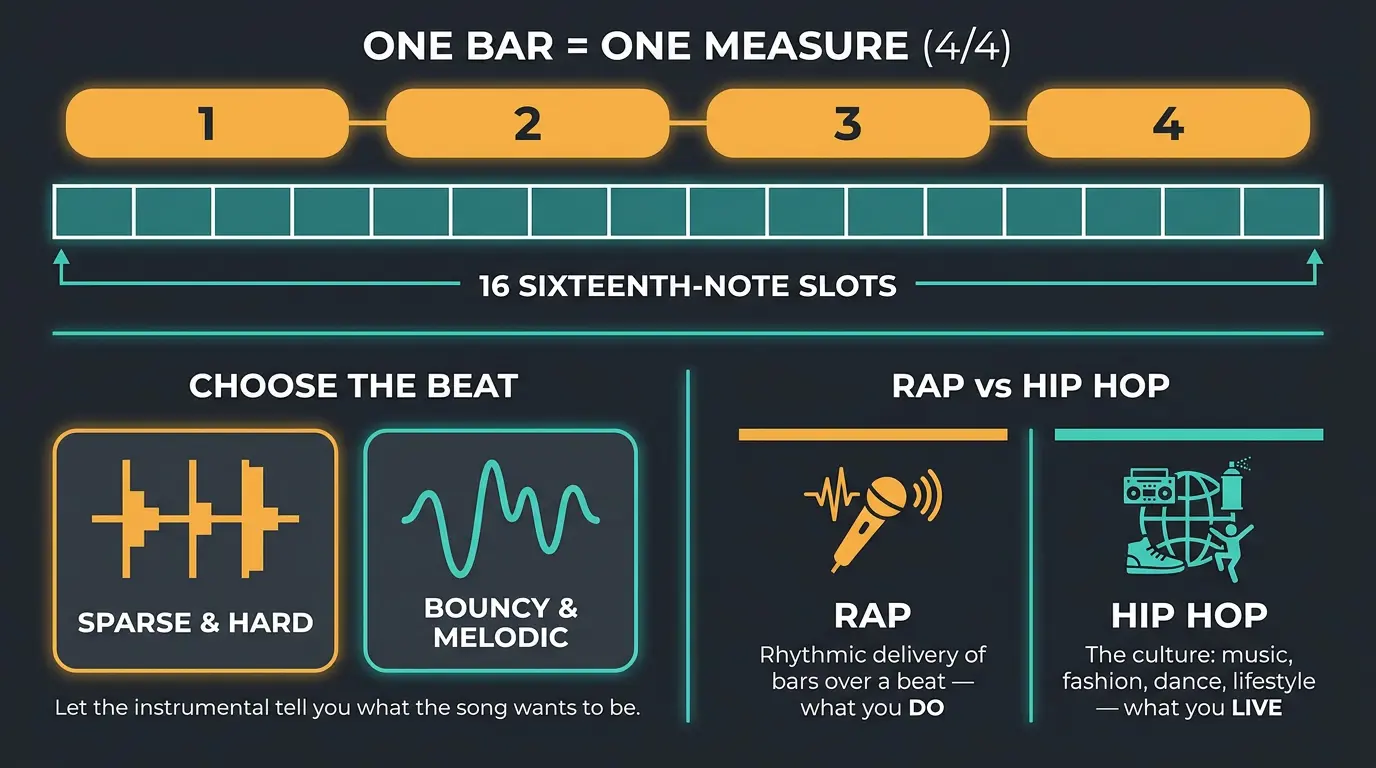
Before anything else, you need to know what a bar is, because every other term hangs off it. A bar is the same thing as a measure — a unit of time set by the song's time signature. In rap that's almost always 4/4, meaning you count "1, 2, 3, 4" and then start over. Every time you can count to four, that's one bar.
Here's the detail that helps later: a single 4/4 bar holds 16 sixteenth-note slots. That's the grid your words drop into whether you plan it or not. Once you see the grid, flow stops feeling like magic and starts feeling like placement.
Now the beat. Pick one that matches the energy and the message you're going for. A sparse, hard beat pulls different words out of you than a bouncy, melodic one. Don't fight the instrumental — let it tell you what the song wants to be.
Quick terminology note, because it comes up: rap and hip hop aren't the same thing. Hip hop is the culture — the music, the fashion, the dance, the whole lifestyle. Rap is the rhythmic delivery of bars over a beat. You do rap. You live hip hop.
How to structure a rap song
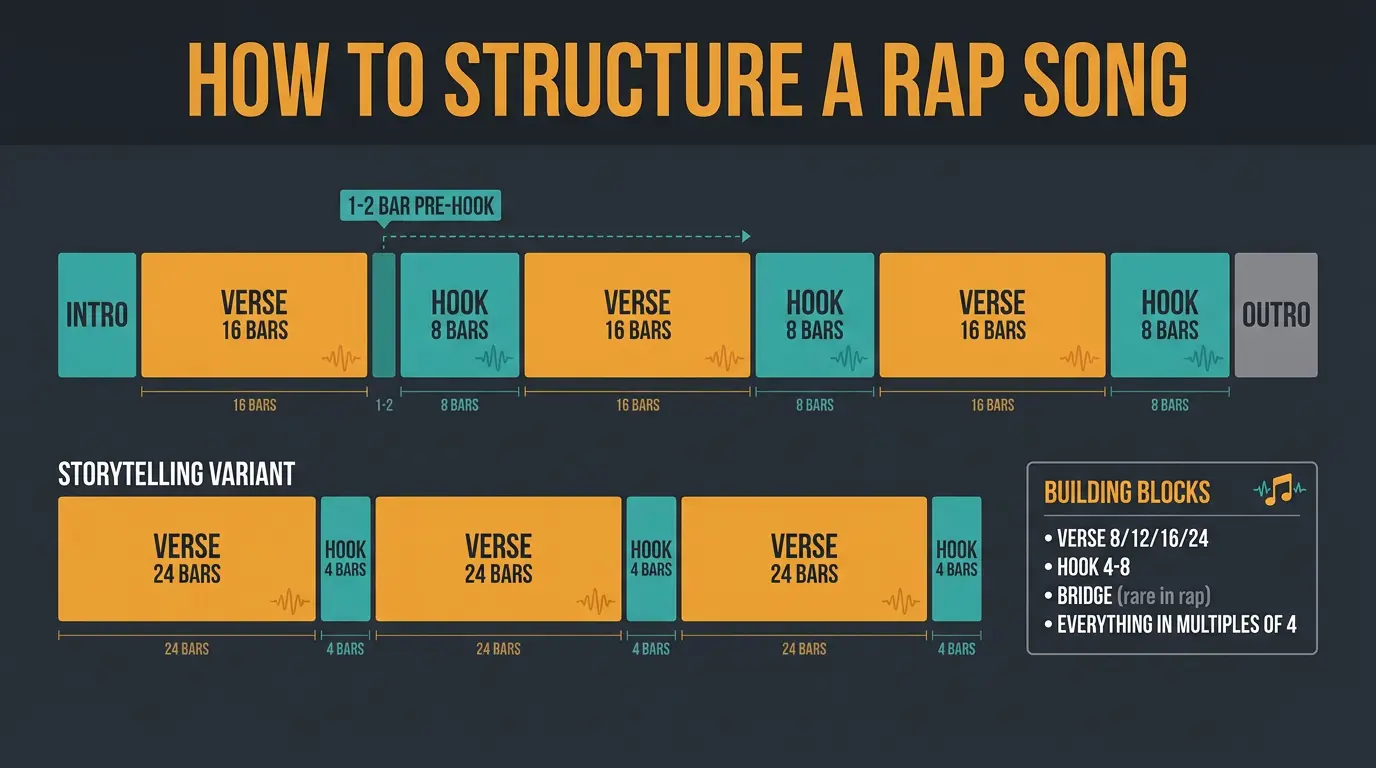
The standard building blocks are 16-bar verses and 8-bar hooks, with optional intros, outros, and bridges around them. Verses are flexible — 8, 12, 16, or 24 bars depending on the song. Hooks usually run 4 to 8. Almost everything clusters in multiples of 4 because that's what feels natural to a listener.
The most common full template looks like this: Verse–Chorus–Verse–Chorus–Verse–Chorus. If you're telling a story, flip the proportions — longer verses (often 24 bars) and shorter hooks (sometimes just 4), so the story has room and the song doesn't drag.
You'll also see a pre-hook now and then — a short 1-2 bar phrase that acts like a heads-up right before the hook lands. Bridges show up less in rap than in other genres. Plenty of great tracks skip them entirely and lean on strong verses and hooks instead. If you want to dig into the wider concept, our breakdown of verse, chorus, and bridge across song structure covers it.
Structure isn't busywork. It gives the listener landmarks, and it's the shared language producers and engineers use to talk to you. When someone says "drop your 16 after the hook," you want to know exactly what that means. With that being said, this is a starting point, not a law. Some of the best songs break it on purpose.
Should you open with the hook?
A lot of modern rap opens with the hook, and there's a practical reason. Streaming platforms count a play after roughly 30 seconds, and short clips live or die in the first few bars. Leading with your catchiest part does the work of pulling a listener past that line.
But it's not a rule. Storytelling records and emotional tracks often need the verse first so the hook means something by the time it hits. Trust your ears here. If the song feels stronger building up to the hook, build up to it.
How to write a verse
Treat each verse as a complete thought with an arc. The first four bars set the scene or state the premise. Bars five through twelve develop it, layer detail, and build a little tension. The last four bars deliver the payoff — the punchline, the conclusion, the hardest bar.
If you only nail one part, make it the ending. That's what the listener carries into the hook, and it's where the replay lives. A verse that limps into the chorus loses all its momentum right at the handoff.
A method that works well: write more than you need, then cut. Draft 24 bars of raw material and trim it down to a tight 16. That verse will always beat a 16 where you kept every line because it was the only line you wrote. Less is more, and cutting is where you find that.
One common mistake — don't overwork bar one. Write an opener that hands off to bar two cleanly and move on. A statement, a question, a scene detail. Save your hardest line for bar 15 or 16, where the contrast makes it land harder.
Flow: the rap-specific heart of it
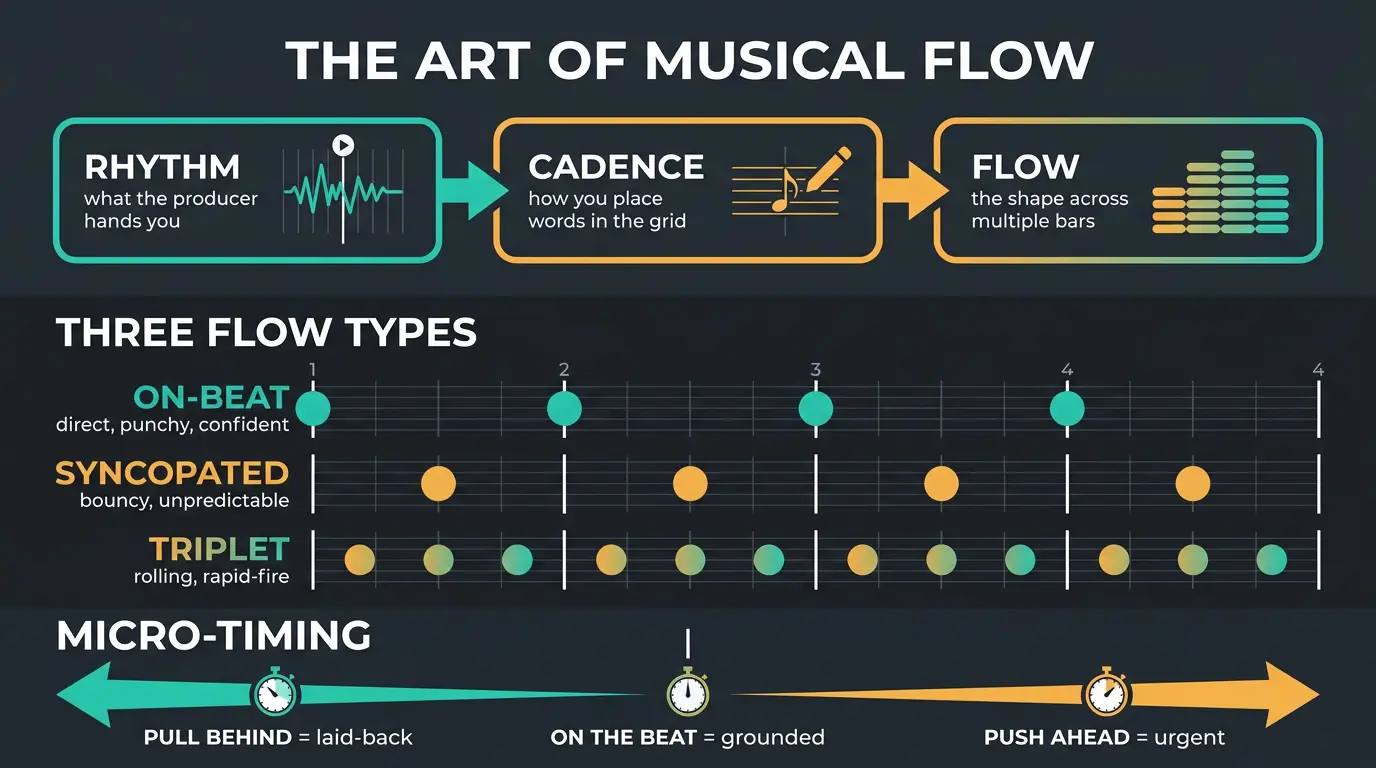
Three words get tangled up constantly, so let's separate them. Rhythm is what the producer hands you. Cadence is how you place your words into that grid. Flow is the shape that emerges once you stack those choices across multiple bars. Flow is the one that makes you sound like you.
There are three flow types worth knowing by name:
- On-beat — syllables land on the downbeats. Direct, punchy, confident. The backbone of boom-bap and lyrical rap.
- Syncopated — syllables land between the beats for a bouncy, unpredictable feel. Common in trap and melodic rap.
- Triplet — three syllables per beat instead of two or four. A rolling, rapid-fire cadence, popularized in the Migos era and now a standard tool.
Micro-timing is where it gets fun. Landing on the downbeat sounds grounded. Landing on offbeats creates bounce. Push a hair ahead of the beat and the verse sounds urgent. Pull a hair behind and it turns laid-back. Same words, different feel — all from placement.
Vary your flow so it doesn't get stale
Sixteen bars of the exact same pattern gets monotonous fast. The usual culprit is sneaky: the rhythm shape from bars 1 through 8 quietly copies into bars 9 through 16 with new words on top. Your brain doesn't notice you're doing it.
The fix is a pocket change around bar 9. Drop a triplet where you had straight eighth notes, or shift your rhymes off the downbeat for a couple bars, then come back. That contrast is what makes a verse memorable.
Here's a practice trick: hum the rhythm first with nonsense syllables before you write a single word. Once you've got a shape you like, fill in the actual words. This keeps you from sacrificing the flow just to cram in a bar you're attached to.
Quick rap songwriting checklist
- Pick a beat that matches your energy and the message you want to get across.
- Write the hook first so the whole song has something to anchor to.
- Build your sections in multiples of 4 bars because it feels natural to listeners.
- Put your hardest line at the end of the verse, not the start.
- Switch up the flow around bar 9 to reset the listener's attention.
Frequently Asked Questions (FAQs)
How many bars is a rap verse?
A standard rap verse is 16 bars. That said, it's flexible — verses commonly run 8, 12, or 24 bars depending on the song. Storytelling tracks often stretch to 24 to give the story room, while shorter songs and hooks-forward records lean on tighter 8 or 12-bar verses.
What's the difference between rap and hip hop?
Hip hop is a culture — music, fashion, dance, and lifestyle all wrapped together. Rap is one part of it: the rhythmic delivery of bars over a beat. People use the terms interchangeably, but strictly speaking you make rap music within the larger world of hip hop culture.
Do you write the beat or the lyrics first?
Most rappers start with the beat, then write lyrics to it. The instrumental sets the energy, tempo, and pocket your words drop into, which makes the flow easier to lock in. Writing lyrics with no beat in mind often leaves you rewriting everything once you find one.
What is flow in rap?
Flow is the shape that emerges from how you place your syllables against the beat across multiple bars. It's not what you say — it's where each word lands relative to the kick and snare. Two writers can use identical words and sound totally different based on their flow.
How long should a rap song be?
Most rap songs run between 60 and 72 bars total, which usually lands around two to three and a half minutes. On streaming, shorter and tighter tends to win — get to the hook fast and don't overstay. Structure it around strong verses and a hook that repeats, and the length takes care of itself.
Final Thoughts
Writing a rap song isn't mystical. It's a beat, a grid of bars, a hook that anchors the whole thing, and verses that build to a strong last line. The craft is in the flow — where your syllables sit against the drums — and you get better at that by writing, humming rhythms out loud, and trusting your ears over any rule.
Start one today. Pick a beat, write the hook, draft more than you need, and cut it down. For sharpening the part that makes people hit repeat, Berklee has a solid piece on writing killer song hooks, and if you want to go deeper on the words themselves, our guide on writing lyrics that actually connect pairs nicely with everything here.
Some of the links within this article are affiliate links. These links are from various companies such as Amazon. This means if you click on any of these links and purchase the item or service, I will receive an affiliate commission. This is at no cost to you and the money gets invested back into Audio Sorcerer LLC.