Song structure is the order of sections a listener hears, and why that order lands the way it does. Strip away the genre and the gear, and almost every song is built from a handful of parts doing specific jobs.
The whole thing runs on a simple tension. Repetition creates familiarity. Contrast keeps you from getting bored. Get the balance right and a listener stays hooked without quite knowing why.
Here's what you'll get in this post: the parts of a song, what each one is actually for, and the common forms you'll find across every genre. No theory degree required.
TABLE OF CONTENTS
What song structure actually is
At its core, song structure is sectional arrangement. You take distinct parts, you repeat some of them, and you put them in an order that makes sense to the ear.
Three things drive the choices. There's listener psychology, which runs on contrast and return. There's genre convention, the unwritten rules of whatever style you're working in. And there's commercial context, like the fact that radio and streaming reward getting to the good part fast.
It all comes back to one idea. Sections need to be different enough to register as separate, but related enough to feel like one song. That's the balance you're always chasing.
The parts of a song, one by one
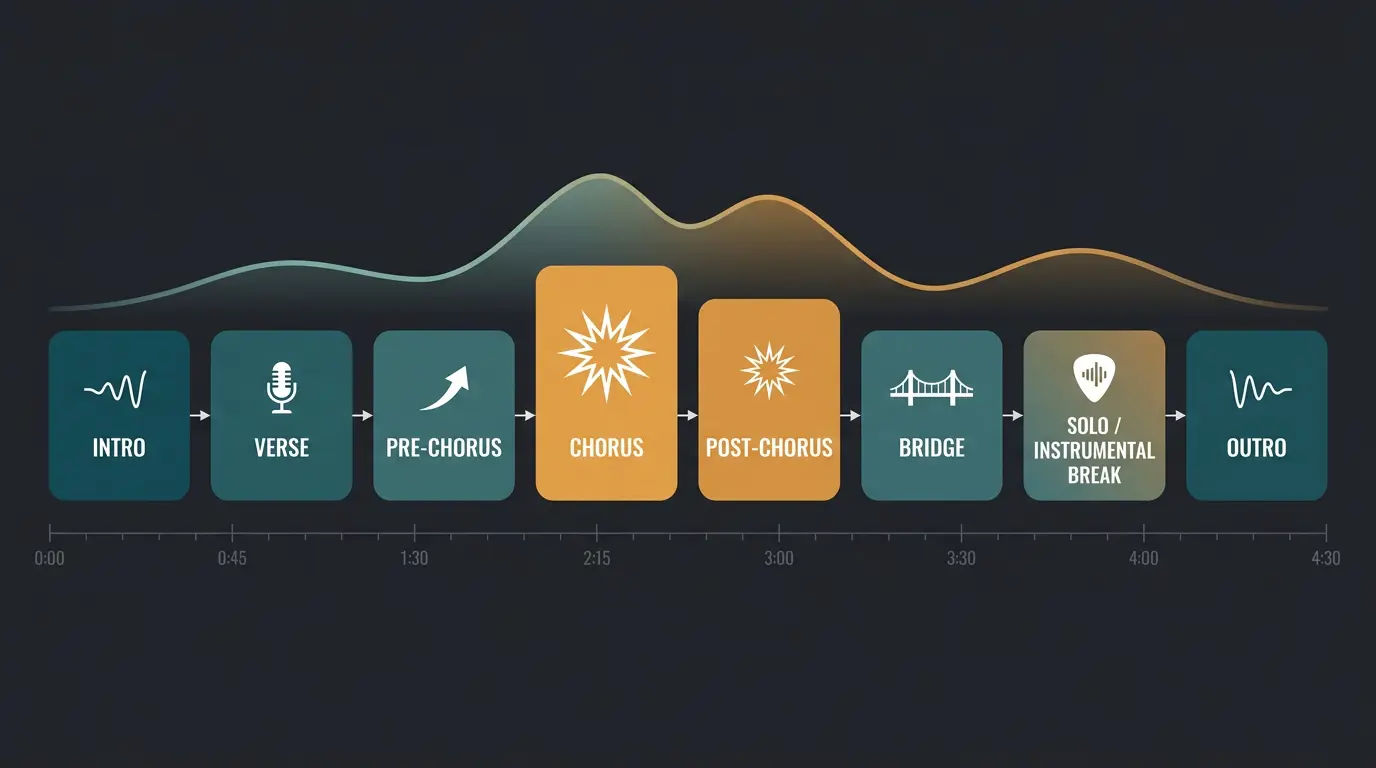
Here's your reference. We'll walk through the intro, verse, pre-chorus, chorus, post-chorus, bridge, the solo or instrumental break, and the outro.
One thing before we start. Less is more. Not every song needs every one of these, and some of the best ones use three or four parts total. Don't add a section just because it exists.
Intro
The intro sets the table. It establishes the key, tempo, mood, and instrumentation before any vocals show up, usually with music and no words.
Its real job is anticipation. A good intro builds a little suspense so that when the downbeat drops and the song proper kicks in, it feels like a release. It also quietly cues the singer's key, which is why intros so often land on a tonic or dominant chord right before the verse.
Verse
The verse keeps the same melody every time while the lyrics change. That's the defining trait: same tune, new words.
Its job is to develop the story and give context. The shorthand I keep in my head is simple. Verse equals explain. If you want to dig into the words themselves, we've got a whole piece on writing lyrics that actually connect.
Pre-chorus
The pre-chorus is an optional build that connects the verse to the chorus. You use it when the jump from verse straight into chorus feels too abrupt and you want a runway.
Think of it as the top of the roller coaster, that moment of suspension before the drop. Keep it short, four to eight bars. If your pre-chorus is as long as your verse, it's probably just a second verse wearing a disguise. It also usually repeats the same lyric each time, unlike the verse.
Chorus
The chorus is the payoff. It's the emotional climax, it repeats melodically and lyrically, and it almost always holds the song title. Everything before it was building to this moment of release. Shorthand: chorus equals deliver the feeling.
Quick clarification, because people mix these up. The hook is the catchiest single element, the bit that gets stuck in your head. The chorus is the whole section. The hook usually lives inside the chorus, but they're not the same thing.
Post-chorus
The post-chorus is a newer, optional section that follows the chorus and keeps its energy rolling, usually with a short new hook. You hear it all over current pop and hip-hop. Think a four-bar chant, a vocal riff, or a production hook.
The rule here is proportion. Keep it short. If your post-chorus runs longer than your chorus, something's off and the balance tips the wrong way.
Bridge (the middle eight)
The bridge brings a different melody and a different lyric than anything else in the song. It's a turning point, and it usually shows up just once near the end, between the second and third chorus.
You'll also hear it called the middle eight, because eight bars is a common length, though sixteen happens too. Its job is to jolt the listener and remind them there's more going on than repetition. Shorthand: bridge equals reframe. The best length is the shortest one that gives clear contrast and sets up that final chorus.
Solo, instrumental break, and outro
Solos are most at home in rock and metal, often dropping in after the middle chorus. They hand the spotlight to an instrument for a stretch.
An instrumental break gives the listener a non-vocal reset. It might be a synth breakdown, a drum moment, or a stripped-back section. In modern pop, that role often gets filled by a production drop or a beat switch instead.
The outro signals closure. You can repeat the chorus, fade out, or resolve to a held chord and let it ring. Whatever you pick, it tells the ear the ride's over.
The job of each section in one line
- Verse: explains the story and sets up context with new lyrics each time.
- Pre-chorus: builds energy and bridges the gap into the chorus.
- Chorus: delivers the emotional payoff and carries the hook and title.
- Bridge: reframes the song with a fresh melody and lyric near the end.
- Outro: signals closure through a repeat, a fade, or a final resolved chord.
Common song forms across genres
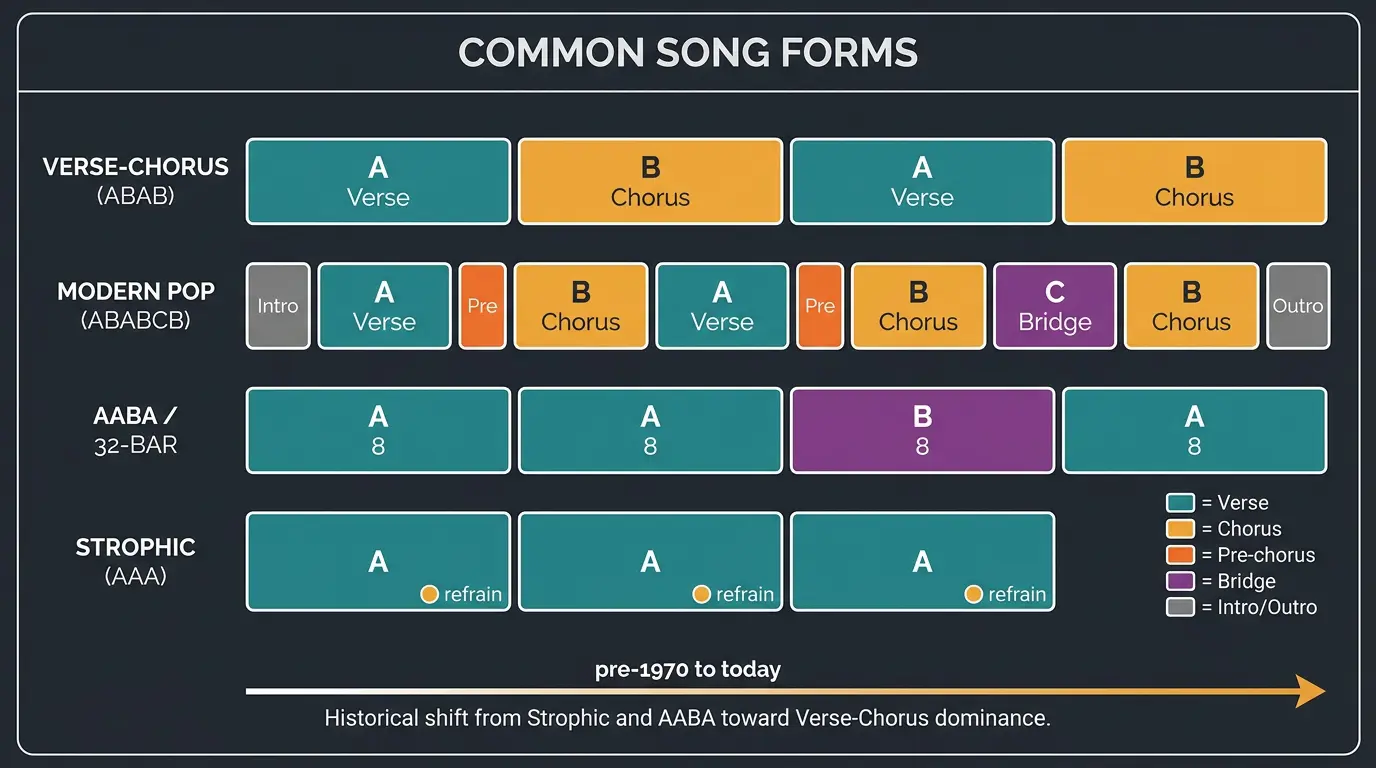
Musicologists map structure with letters, like AABA, ABABCB, or AAA. Each unique letter stands for a distinct section type, so you can write a whole arrangement in shorthand. Once you know the letters, the forms are easy to spot.
Verse-chorus form (ABAB) is the dominant modern shape. Two main sections, a verse and a chorus, that contrast in melody, rhythm, and dynamics. You hear it everywhere, from Adele's "Rolling in the Deep" to Ed Sheeran's "Shape of You" to The Weeknd's "Blinding Lights."
The standard modern layout extends that into ABABCB: intro, verse, pre-chorus, chorus, verse, pre-chorus, chorus, bridge, chorus, outro. A is the verse, B is the chorus, C is the bridge. If you only learn one map, learn this one.
AABA, also called 32-bar form, ruled the first half of the twentieth century. Two eight-bar A sections, a contrasting eight-bar B section, and a final A. The Beatles' "Yesterday" and Billy Joel's "Just the Way You Are" both live here.
Strophic form (AAA) repeats the same basic unit over and over, usually leaning on a refrain, often the title, to keep a focal point. Folk and early blues do this constantly. Speaking of which, the 12-bar blues is its own classic form worth knowing if you want to play or write in that style.
Here's the historical arc. Strophic and AABA dominated for decades, then verse-chorus form took over most pop genres after roughly 1970, and it's been the default ever since. For more on the terminology and a wider list of forms, the Wikipedia entry on song structure is a solid reference.
How to map any song you hear
Mapping a song is mostly listening for two things: contrast and return. When the music shifts, a new section probably started. When something familiar comes back, you've likely returned to a verse or chorus.
So put on a track and label sections with letters as they go by. First repeating part is A, the contrasting part is B, the one-off turning point is C. Notice where the title lands, because that's almost always your chorus.
With that being said, trust your ears over any rulebook. There isn't one correct structure, and plenty of great songs break the pattern on purpose. If you're writing your own, our step-by-step guide to writing a song picks up right where this leaves off. The letters are just a map. Your ears do the driving.
Frequently Asked Questions (FAQs)
What is the most common song structure?
The most common structure in modern music is verse-chorus form, usually laid out as ABABCB: intro, verse, pre-chorus, chorus, verse, pre-chorus, chorus, bridge, chorus, outro. It's been the default across pop, rock, and country since around 1970 because it balances familiarity with contrast.
What's the difference between a verse and a chorus?
The verse keeps the same melody but changes lyrics each time to develop the story, while the chorus repeats both melody and lyrics and delivers the emotional payoff. The chorus also usually carries the song title and the catchiest hook. Verse explains, chorus delivers.
Is the bridge always necessary?
No, the bridge is optional, and plenty of strong songs skip it entirely. Use one when you want a turning point near the end, a fresh melody and lyric that reframes the song and makes the final chorus hit harder. If it doesn't add contrast, leave it out.
What's a pre-chorus for?
A pre-chorus builds energy and bridges the gap between the verse and chorus when that jump feels too abrupt. Keep it short, four to eight bars, and it usually repeats the same lyric each time. Think of it as the moment of suspension right before the drop.
What does ABABCB mean?
ABABCB is letter shorthand for a song's structure where each letter marks a distinct section. A is the verse, B is the chorus, and C is the bridge. So it reads verse, chorus, verse, chorus, bridge, chorus, the standard layout behind most modern pop and rock songs.
Final Thoughts
Once you know the parts and the letters, you can't really unhear them. You'll catch the pre-chorus building, you'll feel the bridge reframe things, and you'll spot the title landing in the chorus every time. That awareness makes you a sharper writer and a better listener.
Just remember the structure serves the song, not the other way around. Use the parts you need, skip the ones you don't, and let your ears make the final call.
Some of the links within this article are affiliate links. These links are from various companies such as Amazon. This means if you click on any of these links and purchase the item or service, I will receive an affiliate commission. This is at no cost to you and the money gets invested back into Audio Sorcerer LLC.