Great lyrics aren't about big vocabulary or clever metaphors. They're about communication. The best lyrics feel inevitable, like the words couldn't possibly sit in any other order.
That's the goal, and it's a craft you can actually learn. This post covers five things that get you there: finding a theme, using imagery, rhyming without sounding tired, prosody, and hooks. It's example-driven, so let's get into it.
TABLE OF CONTENTS
Start with an emotional truth, not a clever idea

Lyric writing starts with honesty. The songs that stick come from real moments, and your job is to turn one of those moments into something a stranger can feel too.
Here's the part that trips people up. The more specific you get, the more universal it lands. "I miss you" is true, but it's flat. The way the light hits an old photo of someone, the exact way your stomach drops when a dream slips away — that's where people see themselves. Specificity isn't smaller. It's bigger.
One process note before you worry about any of this: don't run to the editor too early. Let the words flow first without judging them. You can always go back and cut, sharpen, and rearrange later. Generating and editing are two different jobs, and doing them at the same time chokes both.
Show, don't tell — with images that earn their place
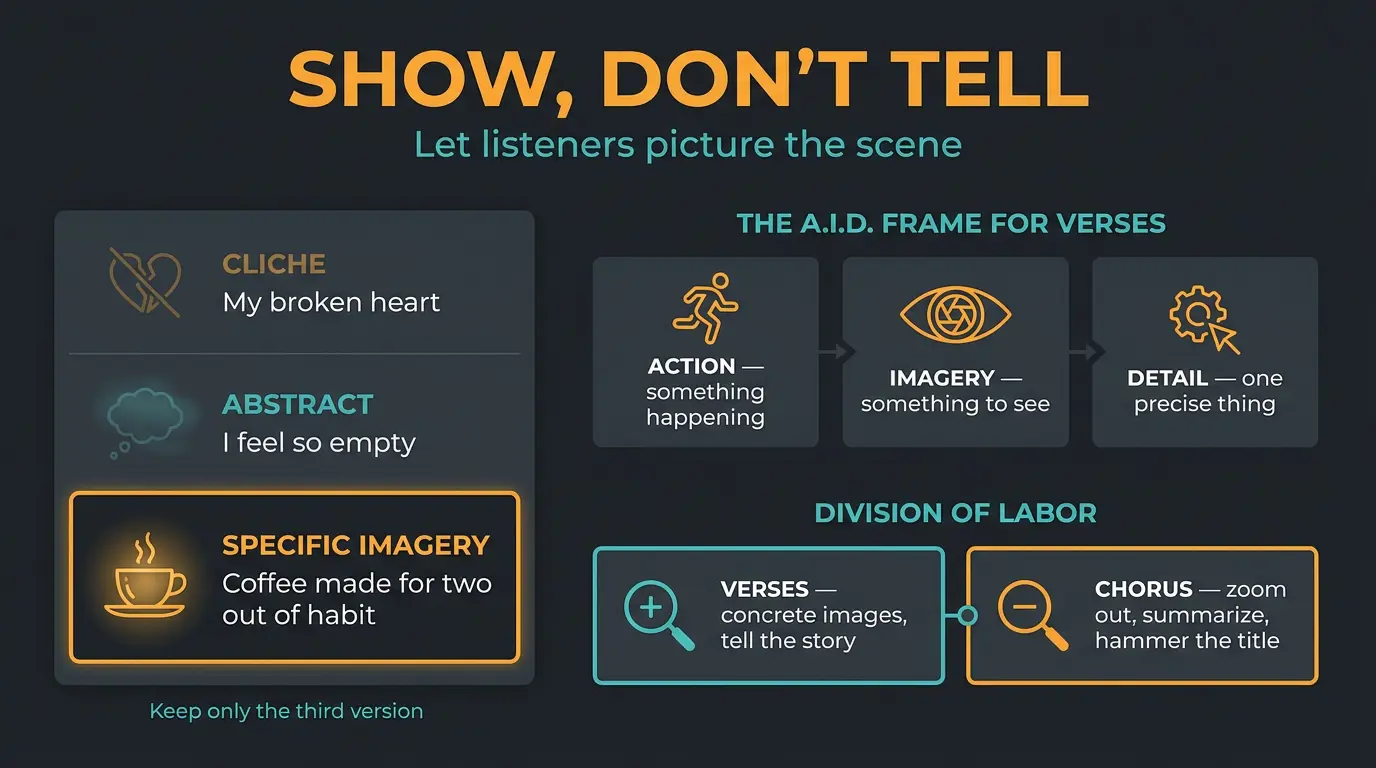
"Show, don't tell" means letting the listener picture the scene instead of just stating the feeling. Don't say someone's heartbroken — show the half-empty closet and the coffee made for two out of habit. When people can see it, they empathize with it.
Now, the misconception. Show-don't-tell does not mean you ban all direct language. Good writers toggle between showing and telling depending on the line. A useful frame for verses is Action, Imagery, and Detail — give the listener something happening, something to see, and one precise detail that makes it real.
There's also a division of labor worth knowing. Verses tell the story with concrete images. Choruses tend to zoom out, summarize the idea, and hammer the title home. So pour your specific details into the verses and let the chorus do the big-picture work.
Try this exercise. Take a plain emotion — heartbreak, joy, anger — and write it three ways: as a cliché, as abstract description, then as specific imagery. Keep only the third version. There isn't one right answer here, so trust your ears and use what feels true.
Rhyme without sounding like everyone else
First, kill the idea that lyrics need perfect rhymes. June, spoon, moon — you don't owe anyone that. Some of the best lines barely rhyme at all.
The trap is the cliché rhyme families. Once you write a line ending in "fly," your brain reaches for "sky" and "high" on autopilot. Same with "down on my knees and begging you please." These feel like rhyming, but they're really just the first thing everyone thinks of. And whatever you do, don't force a rhyme just to fill a slot — listeners hear it instantly.
The fix is a bigger toolbox. Beyond perfect rhyme, you've got family rhyme, additive and subtractive rhyme, internal rhyme, assonance, and consonance. That's a whole spread of options, and they let you land a rhyme that feels fresh instead of inevitable in the boring way.
One pro tip: sung rhymes aren't the same as written rhymes. Words that don't rhyme on paper can lock in perfectly when sung. So make sure you sing your lines as you write them — that's the only test that matters.
What assonance and family rhyme actually mean
Assonance is a vowel rhyme. The vowels match and the consonants don't relate at all — think "light" and "shine." On paper they look nothing alike, but sung, they share that long "i" and they ring together.
Family rhyme is a closer cousin of perfect rhyme. You swap a consonant for another from the same sound family — plosives like p/b/t/d, fricatives like f/v/s/z, or nasals like m/n. So you stay in the neighborhood of the original sound without being identical. Both tricks give you the feel of a rhyme with more room to say what you actually mean.
Prosody: making the music and words point the same direction
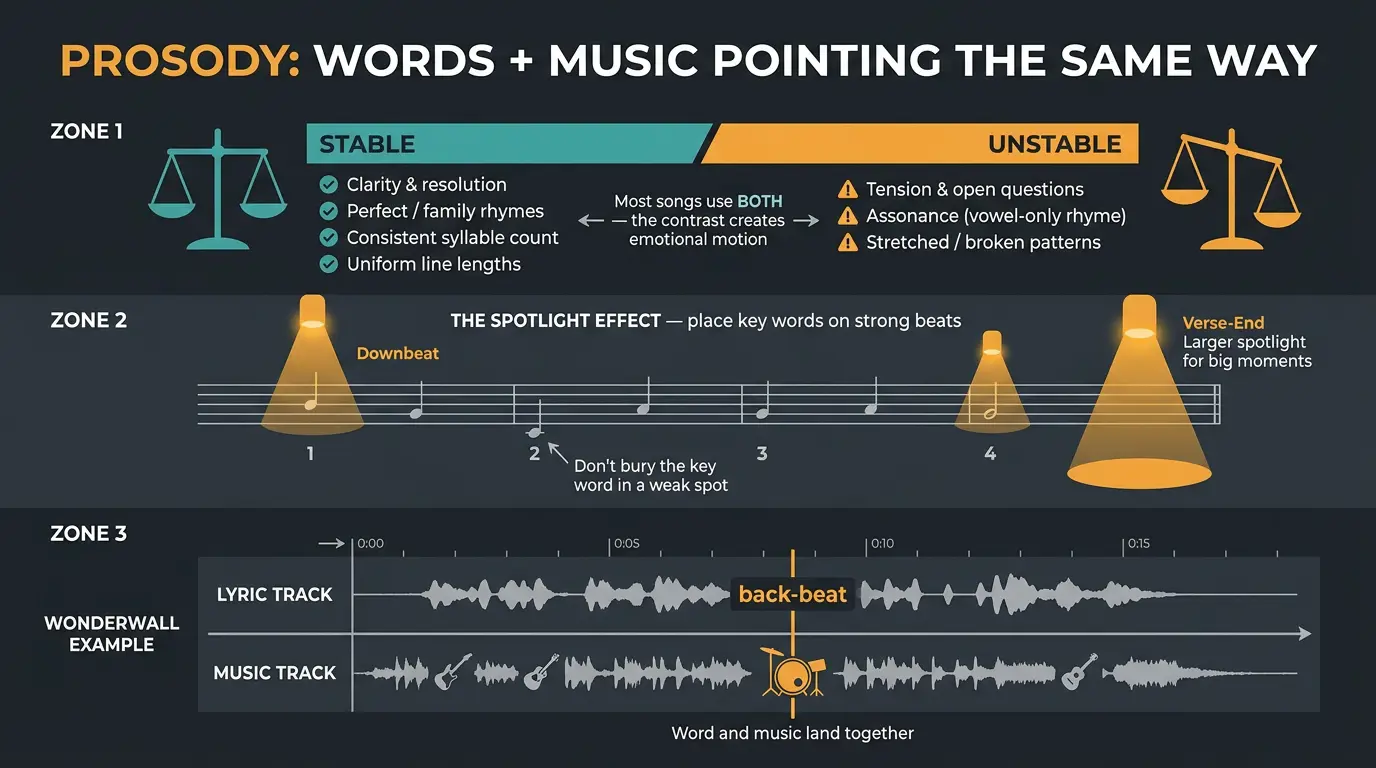
Prosody is just an appropriate relationship between elements — every musical and lyrical piece working together to support the song's central message. When the rhythm, melody, and words all push the same way, the song feels right even when a listener can't say why.
A clean way to think about it is stable versus unstable. Stable parts give clarity and resolution — the calm, steady moments where the meaning is plain. Unstable parts create tension and open questions. Most songs use both, and that contrast is what gives a song its emotional motion. For a deeper dive, Berklee's piece on prosody in music and songwriting is worth your time.
This ties straight back to rhyme. Perfect and family rhymes support stable, resolved meaning. Assonance — where only the vowel resolves — leaves a little ambiguity hanging, so it supports unstable, unresolved meaning. Match the rhyme type to what the lyric is doing.
You've got tools to build stability too: keep a consistent syllable count, use uniform line lengths. That predictability reads as steady. Stretch or break those patterns and you create tension. The structure works like a film score, quietly shaping how the listener feels.
Here's a concrete one. In Oasis's "Wonderwall," the moment the singer hits "back-beat," the drums kick in. Word and music land together, and it sticks. That's prosody doing its job.
There's also a spotlight effect. Certain spots in a bar naturally highlight whatever word lands on them — the downbeats, a big one at the end of each line, and an even bigger one at the end of a verse. So put your most important words on those strong beats. Don't bury the key word in a weak spot. Understanding how melody and rhythm interact here gets easier once you're comfortable with how pitch works in music.
Quick exercise: get a beat or instrumental on loop, pick any phrase, and say it in a few different rhythms over the top. You'll hear fast which placement makes the words land. Less is more — you don't need to cram a syllable into every gap.
Writing a hook that won't let go
A hook is anything that gets under the skin and won't leave. It can be lyrical, melodic, or rhythmic — and it isn't always the chorus. People use "hook" and "chorus" interchangeably, but the hook might be a riff, a vocal line, or a production detail.
A few flavors you'll run into:
- The chorus itself
- An instrumental riff
- A call-and-response phrase
- A drum or rhythmic pattern
- A spoken-word or arrangement moment
The number one rule is simple: keep it simple. Less is more here more than anywhere. The best hooks are easy to sing back after one listen. Land your title clearly in the chorus, put it on a strong beat, and don't clutter it. If people can hum it walking out the door, you did your job. This all connects to the bigger picture of writing a complete song.
Lyric writing tips at a glance
- Write specific, not generic — precise personal detail is what makes a lyric land universally.
- Show with images, but allow telling too — toggle between the two depending on the line.
- Expand past perfect rhyme — lean on family rhyme, assonance, internal rhyme, and more, and sing as you write.
- Match prosody to meaning — stable structure for clarity, unstable for tension, and put key words on strong beats.
- Keep the hook simple — make the title land in the chorus and let people sing it back after one listen.
Frequently Asked Questions (FAQs)
How do you start writing lyrics?
Start with one honest emotional moment, then write freely without editing yourself. Let the words flow first and worry about polishing later. The more specific and personal your detail, the more listeners will recognize themselves in it.
What makes lyrics good?
Good lyrics communicate clearly and feel inevitable, like the words couldn't sit any other way. They use specific imagery instead of generic statements, match the music to the meaning, and don't force rhymes. It's craft, not fancy vocabulary.
Do lyrics have to rhyme?
No, lyrics don't have to rhyme, and perfect rhymes aren't required even when you do. You can use family rhyme, assonance, consonance, or internal rhyme to keep things fresh. Never force a rhyme just to fill a slot — listeners hear it instantly.
What is prosody in songwriting?
Prosody is the appropriate relationship between a song's elements, where the music and words support the same central message. A useful frame is stable versus unstable: stable parts give clarity and resolution, unstable parts create tension. Most songs use both.
How long should a hook be?
A hook should be short and simple — usually a single memorable phrase or melodic line you can sing back after one listen. Keep it uncluttered, land your title on a strong beat, and don't overcomplicate it. Less is more with hooks.
Final Thoughts
None of this is mystical. Lyric writing is craft, and craft gets better the more honestly you do it. Write the specific detail, sing your rhymes out loud, line up your words with the music, and keep your hook simple.
Pick one of these ideas and try it on a song today. Trust your ears over any rule, including mine — and have a little fun with it.
Some of the links within this article are affiliate links. These links are from various companies such as Amazon. This means if you click on any of these links and purchase the item or service, I will receive an affiliate commission. This is at no cost to you and the money gets invested back into Audio Sorcerer LLC.