Anyone can write a song. It's not a magical talent handed to a chosen few at birth — it's a craft you learn and get better at with reps. The first songs you write probably won't sound like hits, and that's fine. Every finished song makes the next one easier.
Here's the process we'll use: concept, structure, chords, melody, lyrics, then revise and finish. Six steps. Follow them in order if you're new, because order keeps you from getting stuck.
One thing to know up front: experienced writers jump around constantly. There's no single right order. But a clear path beats a blank page every time, so let's start with one.
TABLE OF CONTENTS
The repeatable songwriting process at a glance
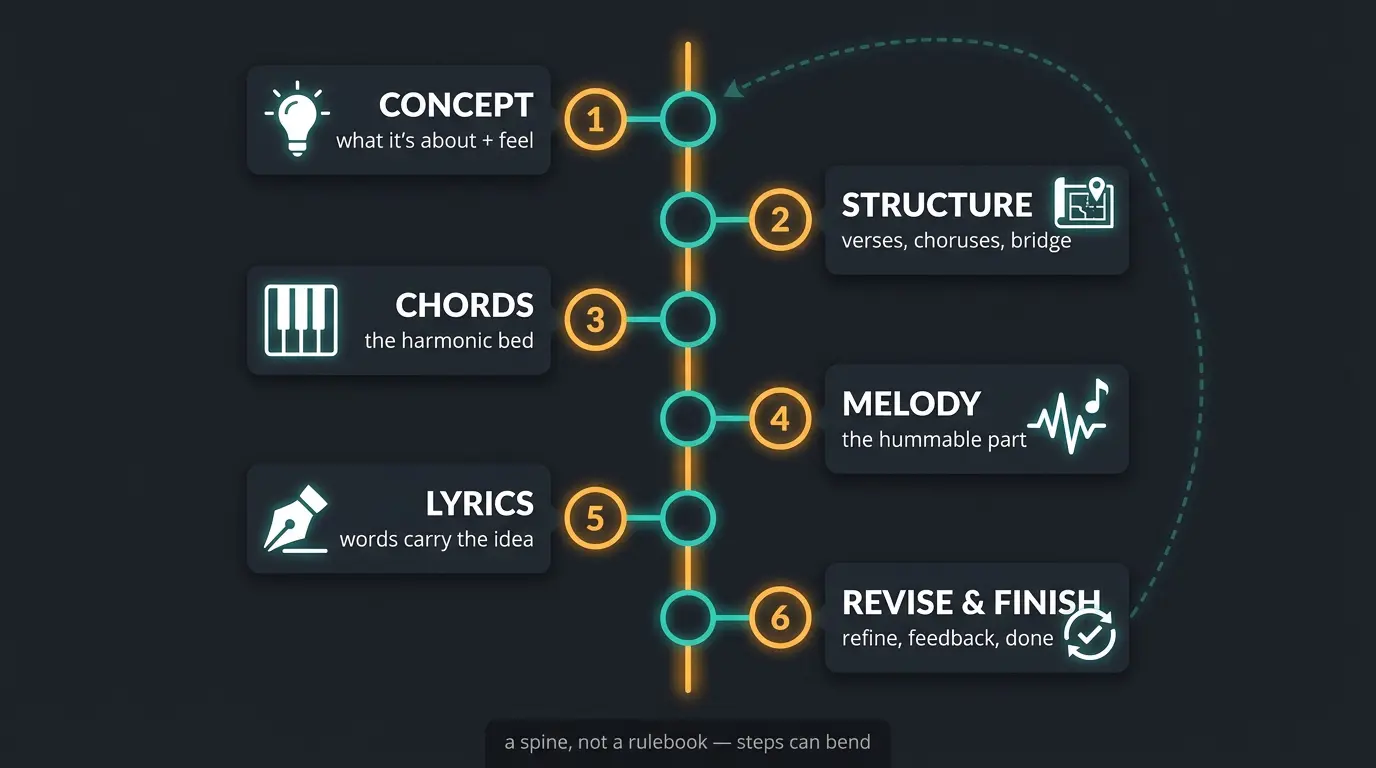
Think of these six steps as a spine, not a rulebook. You can do them in this order, or jump around once you're comfortable.
- Concept — what the song is about and how it should feel.
- Structure — the map: verses, choruses, maybe a bridge.
- Chords — the harmonic bed everything sits on.
- Melody — the part people hum in the shower.
- Lyrics — the words that carry the idea.
- Revise and finish — refine it, get feedback, call it done.
None of this is locked in. Placeholder lyrics are normal. Moving a line from a verse into the chorus is normal. The process is repeatable, but it bends to fit how you work.
Step 1: Start with a concept
Before you write a single line, decide what the song is about, what energy it has, and what you want a listener to feel. That's your concept. It gives you a target to aim at.
This matters more for beginners than you'd think. A song can go in an infinite number of directions, and infinite options are paralyzing. Constraints help. Give yourself parameters — a feeling, a situation, a single sentence you want to say — and suddenly you have something to work within.
Capture ideas constantly. A phrase you overhear, an image, a feeling at 2am. Voice Memos plus a notes app on your phone is the zero-friction standard — no excuses, it's already in your pocket.
Here's a pro move worth trying: write the chorus first. It's the emotional peak of the song, so nail that, then build the verse to lead the listener up to it.
Step 2: Pick a song structure
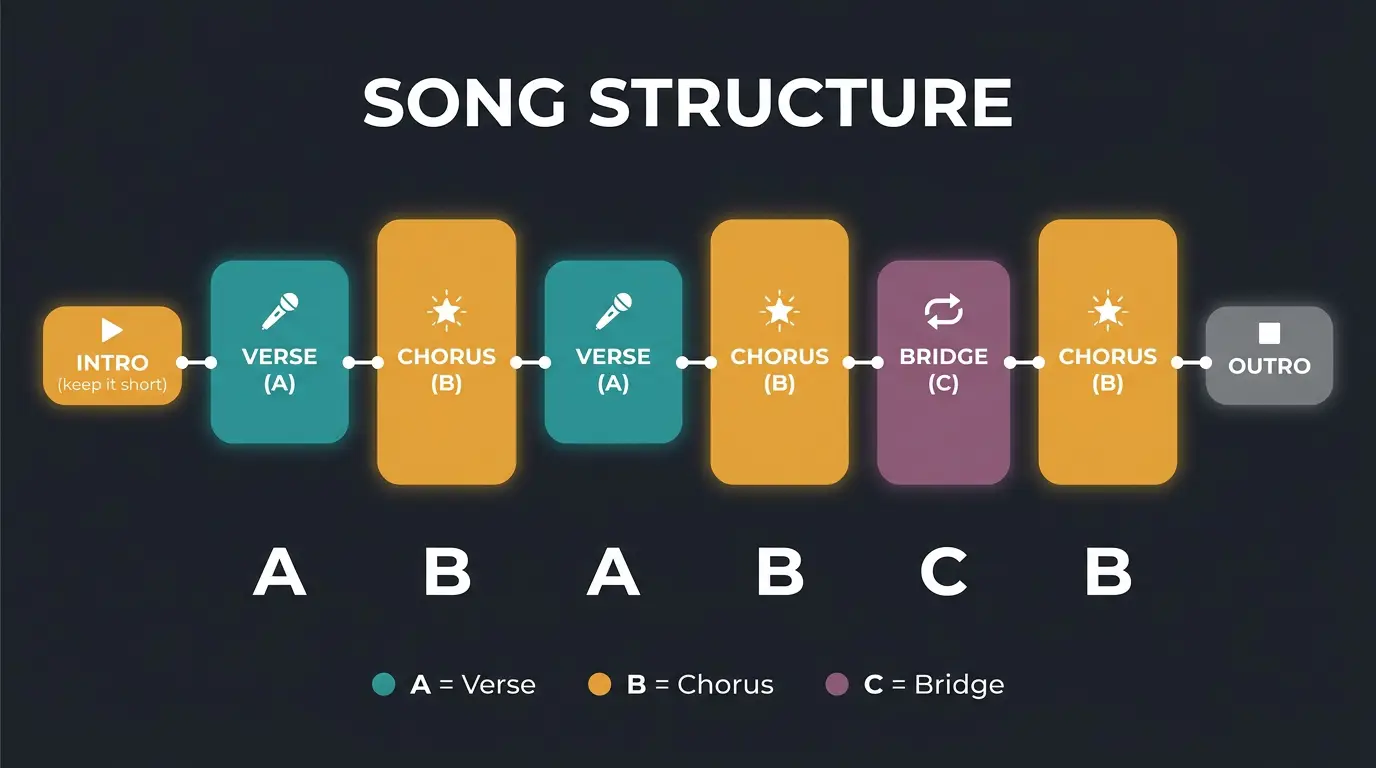
Structure is the map of your song — the order the sections come in. The most common modern layout is verse, chorus, verse, chorus, bridge, chorus. Writers shorthand that as ABABCB, where A is the verse, B is the chorus, and C is the bridge.
You'll usually have a short intro before the first verse and maybe an outro at the end. Keep the intro short. Radio songs get to the point fast, and so should you.
What each section does
- Verse — develops the story. Same melody each time, different lyrics. This is where you build context so the chorus lands.
- Chorus — the emotional payoff. It usually holds the hook and the song title, and it's the catchiest part of the whole thing.
- Pre-chorus (optional) — a short section that repeats each cycle and builds tension into the chorus.
- Bridge — shows up once, late in the song, usually between the second and third chorus. It's a change of pace lyrically and musically. Often 8 bars, which is why people call it the "middle 8."
Other structures that work
You don't need a bridge. Plenty of hits are just verse-chorus-verse-chorus. If you skip the bridge, find your contrast somewhere else — change up the arrangement, add a post-chorus, or end on an outro or a repeated tag.
There are older forms too. AABA is verse-based with a refrain instead of a full chorus. Some songs are verse-only, like a lot of folk and hymns. None of these are wrong.
And the hook doesn't have to live in the chorus. It usually does, but it can sit in a verse or a bridge just as easily. The hook is whatever sticks in your head after the music stops.
Step 3: Build a chord progression
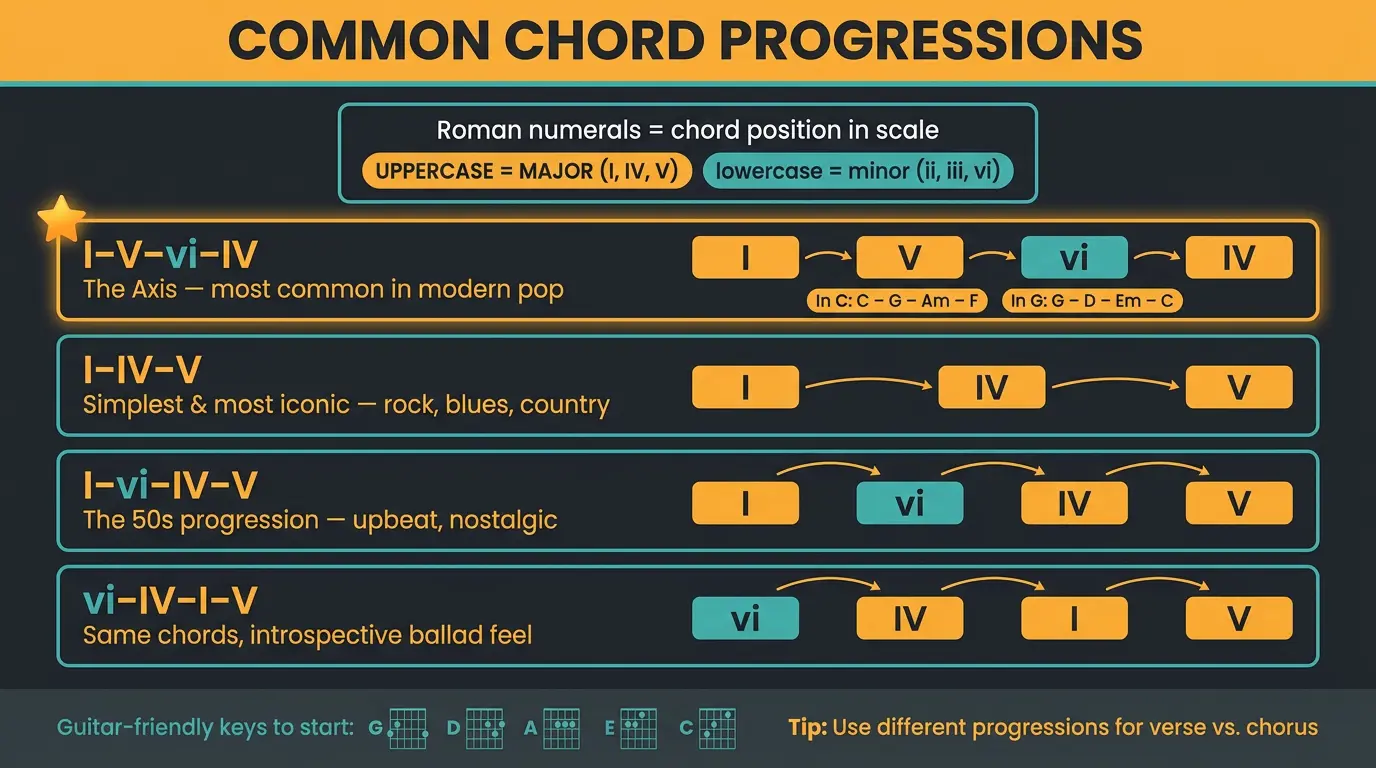
Quick bit of theory that pays off forever: Roman numerals. Musicians label chords by their position in the scale — uppercase for major (I, IV, V), lowercase for minor (ii, iii, vi). The benefit is that a progression written this way works in any key, so you can move it around to fit your voice.
The one to learn first is I-V-vi-IV, sometimes called the Axis progression. It's the most common in modern pop, and you've heard it a thousand times. In C, that's C-G-Am-F. In G, it's G-D-Em-C.
A few more staples worth knowing:
- I-IV-V — the simplest and most iconic. Great for rock, blues, country, and anthemic choruses.
- I-vi-IV-V — the '50s progression. Upbeat and a little nostalgic.
- vi-IV-I-V — the same chords with a more introspective, ballad feel.
A couple of practical things. Use a different progression for the verse than the chorus — that contrast helps the chorus pop. Don't be afraid to modify a progression to make it your own. And if you're on guitar, the friendly keys to start in are G, D, A, E, and C.
Less is more here. Most songs you love are built on a handful of chords. The richness comes from the melody, rhythm, lyrics, and arrangement — not from cramming in fancy harmony.
To learn more, check out our article: Major Vs Minor Chords: How They Shape The Sound Of Music
Step 4: Find a melody
Now the fun part. Play your chord progression on a loop and hum over it. Don't overthink it — just sing nonsense syllables and chase whatever feels good. Start with the chorus melody, since that's your peak.
The moment you land on something, record it on your phone. I'm serious about this. Good melodies vanish from your memory faster than you'd believe, and there's nothing worse than knowing you had something great and losing it.
Keep your verse melody at a lower energy than the chorus. That contrast is what makes the chorus feel like it lifts off. If the verse is already maxed out, you've got nowhere to go.
There isn't always a right answer here. Play with it until something feels right, and trust your ears over any rule.
Step 5: Write the lyrics
Here's the big misconception to drop: lyrics usually aren't a linear story. They're closer to a collage of lines that convey a thought, an image, or a feeling. You can often move a line from one spot to another without breaking anything — so don't treat the first draft as set in stone.
Open strong. Make your first line interesting — a question, a striking image, a setup. In the second line, restate it differently or add information. Don't rush to the next idea. Let each thought breathe.
Verse one has one job: give the listener enough to understand the chorus when it arrives. Set the table.
And no, not every line has to rhyme. That's a myth that traps beginners into writing clunky filler just to land a rhyme. Slant rhymes — near rhymes that almost match — are a real tool that pros lean on constantly. Use them.
Step 6: Revise and finish
First drafts are drafts. Sit with the song, sing it a few times, and fix the lines that feel forced or the melody bits that don't sit right. Play it for someone you trust and listen to what they say.
The single best way to get better is to keep writing. Finish songs, even imperfect ones. Every finished song teaches you something the next one needs.
And study the songs you love. Pull one apart — how the lyrics work, how the melody flows, how it's structured. Then try rewriting it in your own style as an exercise. You'll learn more doing that than reading any guide, this one included.
Songwriting myths to ignore
- You need innate talent. False. It's a craft that gets better with practice, full stop.
- You have to write start to finish. False. Jumping around and using placeholder lyrics is completely normal.
- Every line must rhyme. False. Unrhymed lines and slant rhymes are legitimate tools.
- You need lots of complex chords. False. Most beloved songs use a few. The richness comes from melody, rhythm, lyrics, and arrangement.
- A song needs a bridge. False. Verse-chorus-verse-chorus with no bridge is everywhere.
- Intros should be long. False. Keep them short and get to the song.
Frequently Asked Questions (FAQs)
Can anyone learn to write a song?
Yes, anyone can learn to write a song. It's a craft, not an inborn gift, and it improves with practice like any skill. Your early songs won't be your best, and that's the point. Keep writing and finishing them, and you'll get noticeably better.
Should I start with lyrics, melody, or chords?
Start with whatever sparks the idea — there's no single right entry point. Many writers begin with a concept and a chord progression, then hum a melody, then add lyrics last. If a lyric or a melody hits you first, chase that instead. The order is flexible.
What's the easiest chord progression for beginners?
I-V-vi-IV is the easiest and most useful progression to start with. In C that's C-G-Am-F, and you've heard it in countless pop songs. I-IV-V is even simpler if you want something more rock or country flavored. Both transpose to any key.
How long should a song be?
Most modern songs run roughly two and a half to four minutes, but there's no hard rule. Keep your intro short and get to the first verse fast. The right length is whatever serves the song — when it's said what it needs to say, end it.
Do my lyrics have to rhyme?
No, your lyrics don't have to rhyme. Forcing a rhyme often leads to clunky lines that hurt the song more than the rhyme helps. Slant rhymes and unrhymed lines are real tools that working songwriters use all the time. Serve the meaning first.
Final Thoughts
Songwriting isn't magic. It's concept, structure, chords, melody, lyrics, and revision — done over and over until it starts to feel natural. You won't nail it on the first try, and you're not supposed to.
So pick a feeling, grab a few chords, and start humming. The fastest way to write a good song is to write a bunch of okay ones first. Make sure you finish them.
Some of the links within this article are affiliate links. These links are from various companies such as Amazon. This means if you click on any of these links and purchase the item or service, I will receive an affiliate commission. This is at no cost to you and the money gets invested back into Audio Sorcerer LLC.