Songwriter's block is a temporary creative wall. It stops you from moving forward and writing new songs, and it can feel like the well ran dry for good. It didn't.
Here's the important part: getting blocked is not a verdict on your talent. It doesn't mean you're a bad writer or that you've lost your touch. It means you've hit a mental obstacle, and mental obstacles have doors in them.
Everybody hits this wall. The Beatles hit it. Bernie Taupin and Elton John hit it. Dave Grohl hits it. St. Vincent talks about dealing with it openly. So this post isn't a pep talk full of vague inspiration. It's a toolkit — constraints, co-writing, switching instruments, and a few prompts to get the pen moving.
TABLE OF CONTENTS
The real culprit is usually your inner critic

Most of the time, block isn't a lack of ideas. It's perfectionism. The pressure to write something amazing keeps you so frozen that you don't write anything at all.
St. Vincent has a simple fix for this — separate the making from the judging. She makes things without judging them in the moment, and saves the critical part for after. That order matters. You can't create and critique in the same breath.
So give yourself permission to write badly on the first pass. Write "TBD" where a rhyme should go and keep moving. Skip a whole line if you need to. Write three versions of the same lyric and pick your favorite later. The goal of a draft is to exist, not to be finished.
Here's a prompt that sounds silly but works: write a song you have zero intention of keeping. Make it cheesy on purpose. Make it objectively bad. When there's nothing to protect, the inner critic has nothing to do, and words start showing up again. If you want more foundational habits, our songwriting tips to get better faster pair well with this.
Why constraints beat the blank page
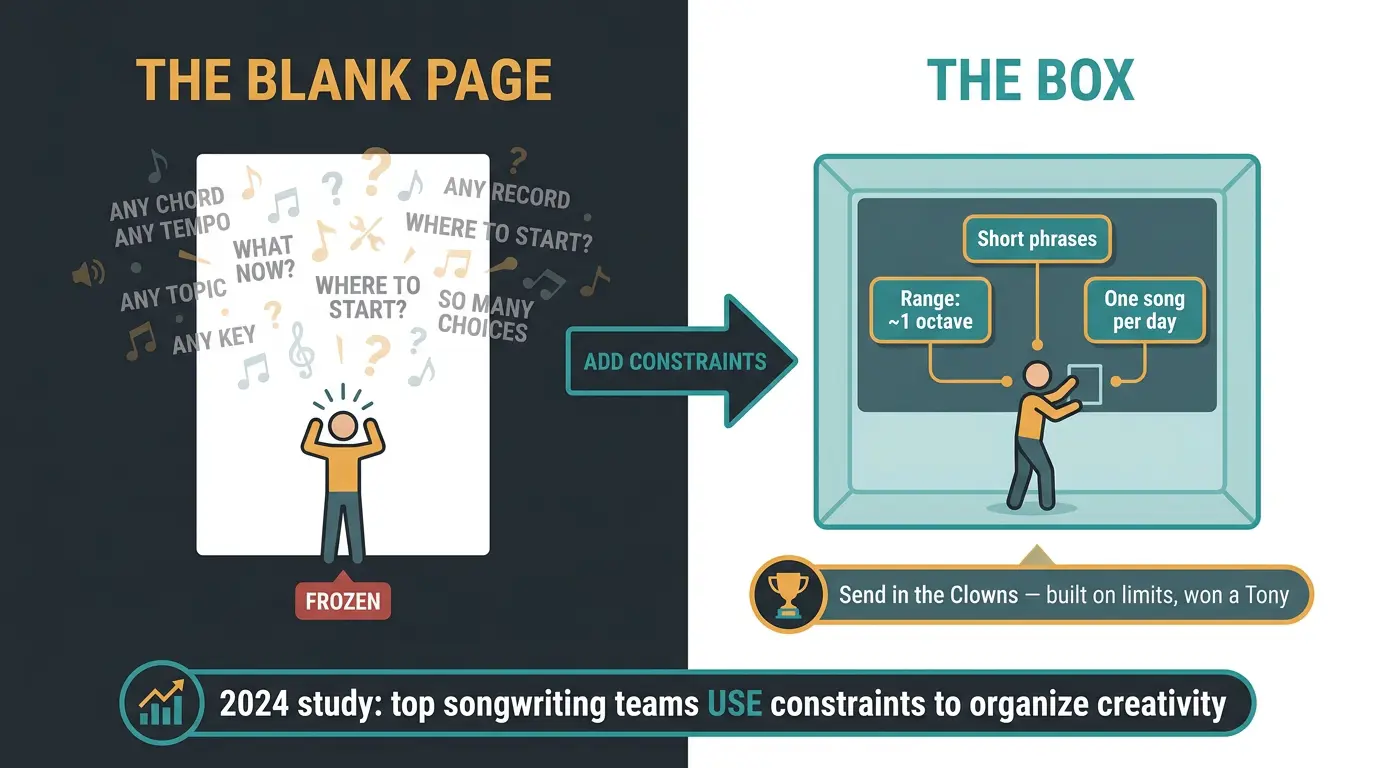
Here's the paradox. A song can be about anything, go anywhere, use any chord — and that total freedom is exactly what freezes you. Too many options is its own kind of trap.
Constraints fix that. When you give your brain a specific box to work in, it stops staring at the horizon and starts solving a real problem. Limits aren't walls to keep you small. They're frameworks that push you to think harder and go somewhere you wouldn't have found otherwise.
Look at Stephen Sondheim's "Send in the Clowns." He wrote it around a specific singer's voice — short phrases, a vocal range of about an octave, so she wouldn't run out of breath or get stuck on notes she couldn't hit. Built entirely around limitations. It won a Tony.
And this isn't just a nice story. A 2024 study on professional songwriting teams found that top writers don't just tolerate constraints — they actively use them to organize the creative process. Many of those teams work to a brutal norm too: one finished song per day. Constraints are how they hit that. Less is more, even when it comes to your options.
Constraint prompts to try right now
These are exercises, not attempts at a masterpiece. Don't grade them. Just run one and see what falls out.
- Narrow the theme, then narrow it again. "Love" is too big. Try "love from afar." Tighter still: "love from afar during the first snowfall." Now you've got a setting, a mood, and an angle nobody else has.
- Lock the structure before you start. Two verses and a repeating chorus. Pick a rhyme scheme — AABB or ABAB — and commit to it before writing a word.
- Write with fewer notes and chords. Hand yourself three chords and a small handful of notes. Scarcity forces melody.
- Time-box it. Force a full draft in 30 minutes, or set a 15-minute timer and freewrite without stopping. Don't fix anything mid-stream. Just keep the pen moving.
If narrowing a love theme is where you want to start, our guide on how to write a love song goes deeper on that specific angle.
Switch instruments — or ditch the instrument entirely
When you write on your main instrument, your hands know the way home. You reach for the same chord shapes and the same three fingerings, and your melodies quietly follow those shapes around. That's comfort, and comfort is where block likes to live.
So pick up something you're clumsy on. A secondary instrument you barely know forces fresh choices, because you can't fall back on muscle memory. You have to actually think about the note.
Or drop the instrument altogether. Sing or hum a melody with nothing in your hands. When there are no chords under your fingers, the melody stops gravitating toward familiar shapes and moves a lot quicker. Your imagination does the driving instead of your hands.
Want a middle ground? Write on bass or with single notes. One note at a time gives you the foundation of a chord without committing to the full voicing, so there's still room to imagine. The bigger point is this — if you want a different sound, you have to do something different. New process, new song.
Co-writing: bring in another brain
Sometimes the fastest way out of your own head is to invite someone else into the room. A co-writer brings ideas you'd never reach for and hears things you've gone deaf to. Two brains catch more.
The numbers back it up. Per a 2014 Hit Songs Deconstructed report, roughly 90 percent of Billboard Hot 100 top 10s were written by two or more writers, and nearly half had four or more. That's an older snapshot, but the trend has only leaned harder into collaboration since. Writing with people is how a lot of hits actually get made.
One important caveat when you're blocked, though. Your inner artist is a little injured right now, so be picky about who you sit down with. Write with people who bring positive energy and who you're genuinely excited to work with. Steer clear of the negative ones — a bad-vibe collaborator can bury a fragile idea before it has a chance.
Co-writing etiquette that keeps sessions flowing
A good co-write lives or dies on how you treat each other's ideas. A few ground rules keep the energy up.
- Play "Yes, and…" Never flatly shut an idea down. Build on it first, then steer. Killing an idea outright teaches the room to stop offering them.
- Frame critique like a partner, not a judge. Not "your chorus sucks." Try "the chorus doesn't hit hard enough yet — let's see if we can push it." Same note, opposite effect.
- Don't over-edit early. Squeezing one line too hard too soon drains all the creative energy out of a session. Keep it moving; polish later.
- Sort the splits up front. Agree on percentages before you dig in so nobody's doing money math mid-verse. A classic clean split is one person on music, one on lyrics, 50/50.
On the in-person versus remote question, there's real magic when writers share a room that's tough to fully copy online. That said, remote lets you write with anyone, anywhere, anytime. Both work — pick what gets the song done. For more on splitting the lyric-writing load, our guide on how to write lyrics that actually connect is a good companion.
Quick fixes when you're stuck right now
- Start from a title. Find an interesting phrase and let the song write itself. Flip through magazine tables of contents or a book of poetry for wordplay that sparks something, then tweak it to make it your own.
- Keep an idea bank. Voice memos and quick notes for when inspiration hits off the clock. Good ideas rarely show up on schedule, so catch them before they evaporate.
- Set a 15-minute timer and freewrite. No stopping, no structure, no quality control. Just get past the frozen part and see what surfaces.
- Write one deliberately terrible song. When there's nothing to protect, perfectionism has nothing to do, and the words start moving again.
Frequently Asked Questions (FAQs)
What is songwriter's block?
Songwriter's block is a temporary creative barrier that stops you from writing new songs. It's not a sign you've lost your ability — it's a mental obstacle, usually driven by pressure or perfectionism, that passes once you change your approach or lower the stakes on the page.
How long does songwriter's block last, and is it normal?
It's completely normal and usually short-lived, lasting anywhere from an afternoon to a few weeks depending on what's fueling it. There's no set timeline. The block tends to lift fastest when you stop waiting for inspiration and start writing badly on purpose to get moving again.
Do professional songwriters get writer's block too?
Yes, professional songwriters absolutely get blocked. The Beatles, Elton John, Dave Grohl, and St. Vincent have all dealt with it. The difference is pros treat it as routine, not as a crisis — they lean on constraints, co-writers, and daily writing habits to push through instead of waiting it out.
What's the fastest way to break out of songwriter's block?
The fastest fix is to set a 15-minute timer and freewrite without stopping or judging a word. Give yourself a tight constraint — one narrow theme, one rhyme scheme, three chords. Constraints and time limits bypass the inner critic and get you writing before the pressure can freeze you.
Does co-writing help with writer's block?
Yes, co-writing is one of the best ways to get unstuck because a second brain brings fresh ideas and hears what you've gone numb to. Just choose your collaborator carefully when you're blocked — write with someone positive you're excited to work with, and steer clear of negative energy.
Final Thoughts
Songwriter's block isn't proof of anything except that you're human and you care about the work. The way out is almost never sitting there waiting to feel inspired. It's picking one small move — a title, a timer, a weird instrument, a good co-writer — and letting it pull the next idea loose.
Pick one thing off this list and try it today. Make sure you keep the stakes low and let the first draft be ugly. For more angles and further reading, iZotope's rundown on 9 ways to overcome writer's block as a musician is worth a look. Now go write something bad on purpose.
Some of the links within this article are affiliate links. These links are from various companies such as Amazon. This means if you click on any of these links and purchase the item or service, I will receive an affiliate commission. This is at no cost to you and the money gets invested back into Audio Sorcerer LLC.