Jazz harmony has a reputation for being complicated. Stacks of strange chord symbols, extensions you've never heard of, players talking about "changes" like it's a secret language. Here's the good news: most of it traces back to a handful of moves, and one progression sits at the center of all of it.
That progression is the ii-V-I. Learn it and you've cracked the door open on most jazz standards ever written.
You don't need to be a jazz player to follow along here. If you write songs, produce, or just want to understand why jazz sounds the way it does, this is for you. We'll cover four things: the ii-V-I itself, turnarounds, 7th chords and extensions, and the voice-leading trick that makes it all sound smooth. By the end you'll be able to recognize these progressions and build them yourself.
TABLE OF CONTENTS
What is a ii-V-I progression?
A ii-V-I (also written 2-5-1) is the most common chord progression in jazz, built on the 2nd, 5th, and 1st degrees of the major scale. It's the foundation almost everything else is built on.
In C major, the ii-V-I is Dm7 – G7 – Cmaj7. In F major it's Gm7 – C7 – Fmaj7. Notice what changes and what doesn't: the chord qualities stay the same in every key — minor 7th, dominant 7th, major 7th — and only the roots move.
Each chord in the ii V I progression has a job. The minor 7 is the setup. The dominant 7 is the tension. The major 7 is the resolution. Setup, tension, release — that's the whole emotional arc of the progression, and your ear has heard it a thousand times even if you never knew what to call it.
Why the ii-V-I works
Two forces are doing the heavy lifting. First, the roots move by fifths: D down to G down to C. That falling-fifth motion is the strongest pull in Western harmony, which is why this progression feels like it's leaning forward. The circle of fifths shows you exactly why those roots feel connected.
Second, there's the voice leading — the way the inner notes move smoothly between chords. We'll get to that in detail later, because it's the real magic.
Here's a tip if you're just starting to improvise. In a major key, the major scale of the I chord works over the whole ii-V. Both chords come from the same parent scale, so over Dm7 – G7 in C, the plain C major scale fits the entire thing. That makes soloing far less overwhelming when you're getting started — one scale, two chords.
The minor-key version
When the tune is in minor, two of the qualities shift. The ii becomes half-diminished (written ø7) and the I becomes minor (mi7). The V stays dominant whether you're in major or minor.
So a minor ii-V-i in C looks like Dm7♭5 – G7 – Cm7. Same root motion, darker color. If you like the sound of minor keys, our piece on minor-key chord progressions goes deeper on why they hit the way they do.
Turnarounds: how jazz progressions loop back
A turnaround replaces the static I chord in the last bars of a tune with motion that leads you back to the top when the form repeats. Instead of sitting on the home chord, you keep things moving.
The most common one is the I-VI-ii-V. In C that's Cmaj7 – Am7 – Dm7 – G7. You'll also run into the vi-ii-V-I and iii-vi-ii-V variants, which are just different starting points on the same idea.
Here's the insight that makes turnarounds click: a I-VI-ii-V is really an embellished I-V. You're taking a simple two-chord move and dressing it up with passing chords. Once you see that, jazz progressions stop looking random and start looking like decorated versions of stuff you already know.
One modern variation worth knowing — sometimes the ii gets swapped for a II7, giving the turnaround a more dissonant, bluesy feel. You'll hear that a lot in blues-based jazz.
7th chords and extensions
Jazz uses 7th chords, not triads. That's the first big shift coming from pop or rock. The common ones are:
- Major 7 — lush and resolved
- Minor 7 — mellow and dark
- Dominant 7 — tense, wants to resolve
- Diminished 7 — unstable, passing
- Half-diminished 7 — the minor-key ii chord
Extensions are the next layer. You just keep stacking thirds above the 7th: a 9th, then an 11th, then a 13th. Here's the part that trips people up — the 9th is the same pitch as the 2nd, the 11th the same as the 4th, and the 13th the same as the 6th. They're only named as extensions because of where they sit in the stack, above the 7th.
There are also four alterations you'll see: ♭9, ♯9, ♯11, and ♭13. In practice, major chords tend to use the 9, ♯11, and 13 — the ♯11 dodges the harsh half step against the major 3rd. Minor chords commonly use the 9 and the natural 11.
Now the misconception-buster. Lead sheets often don't write the extensions out at all. That's not a gap — that's your freedom as the player. And if you look at the melody note over a given chord, it's frequently an extension anyway. You don't have to pile them all on, either. Less is more. A well-placed 9th does more than a seven-note chord that fights itself.
Voice leading: why these progressions sound smooth
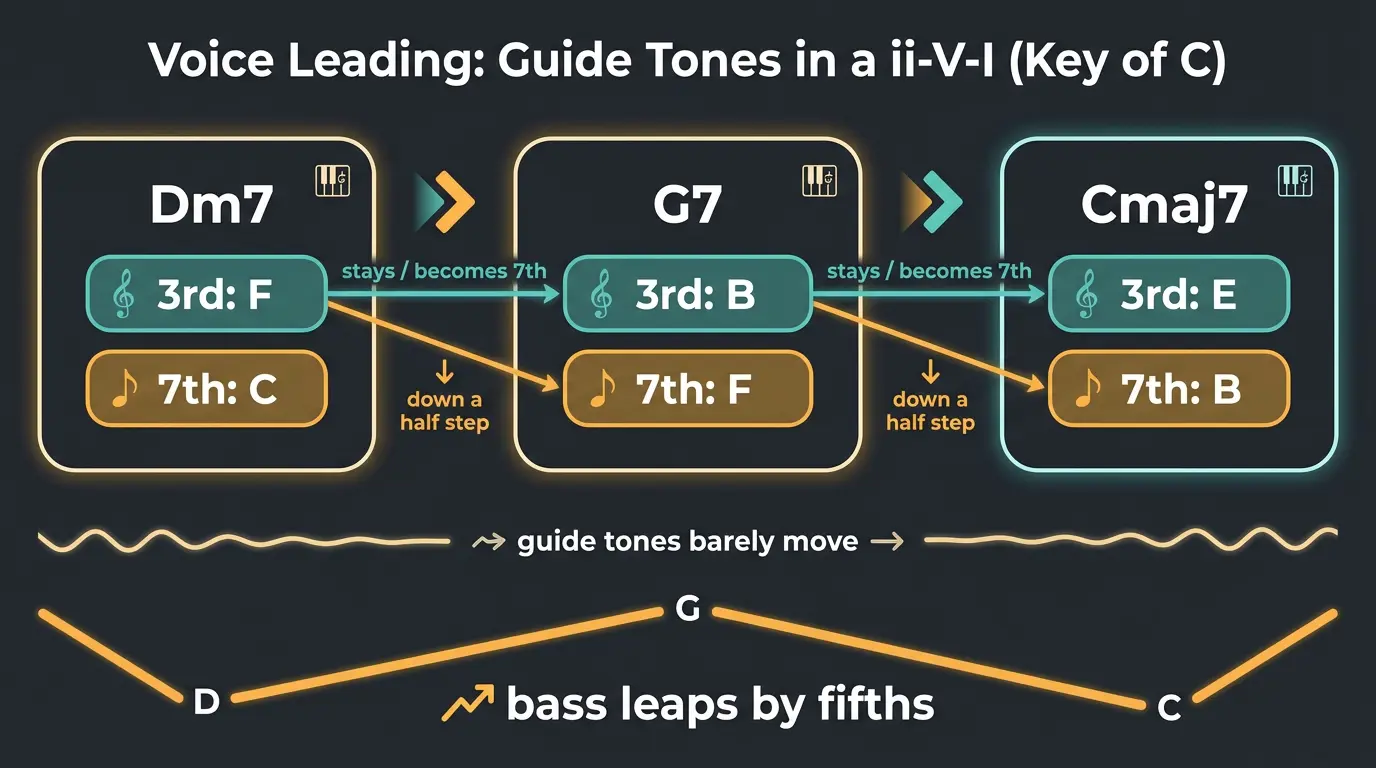
This is the technical heart of the whole thing, and it's simpler than it sounds. The key players are the guide tones — the 3rd and 7th of a 7th chord. Those two notes are what give a chord its quality. Major, minor, dominant — the 3rd and 7th tell your ear which one it is.
Here's the rule that makes a ii-V-I glide. The 7th of each chord drops down a half step to become the 3rd of the next chord. Let's walk it through in C.
In Dm7, the 7th is C. Move to G7 and that C slides down to B — the 3rd of G7. Meanwhile the 3rd of Dm7 (F) just stays put and becomes the 7th of G7. The same thing happens from G7 to Cmaj7: the 7th (F) falls to E, the 3rd of Cmaj7.
So while the bass leaps around by fifths, the guide tones barely move. That's the secret. Smooth progressions keep each voice moving stepwise or in small leaps. And this isn't jazz-only magic — it's the same voice-leading idea classical composers were using centuries ago.
One step further: tritone substitution
Here's a seed to plant for later. You can replace the V7 with a dominant chord a tritone away. In C, G7 becomes D♭7, so your ii-V-I turns into Dm7 – D♭7 – Cmaj7. Suddenly the bass walks down chromatically: D – D♭ – C. Smooth and a little spicy.
It works because both chords share the same tritone — the defining interval inside any dominant chord. So D♭7 can stand in for G7 and still pull toward home.
Don't chase this on day one. Get the plain ii-V-I sounding good first, then come back and try the substitution once it feels comfortable. For more standard moves to build on, the reference at Puget Sound's music theory site is worth a look.
Jazz progression cheat sheet
- The ii-V-I in C is Dm7 – G7 – Cmaj7: setup, tension, resolution.
- The chord qualities stay the same in every key — only the roots change.
- The most common turnaround is the I-VI-ii-V (in C: Cmaj7 – Am7 – Dm7 – G7).
- Guide tones — the 3rd and 7th of each chord — are what make it all sound smooth.
Frequently Asked Questions (FAQs)
What is the most common jazz chord progression?
The ii-V-I is the most common jazz chord progression by a wide margin. It appears in nearly every jazz standard, often several times in different keys within a single tune. In C major it's Dm7 – G7 – Cmaj7. Learn it once and you'll recognize it everywhere.
What does ii-V-I mean?
ii-V-I refers to chords built on the 2nd, 5th, and 1st degrees of the major scale. In a major key those come out as a minor 7, a dominant 7, and a major 7. The lowercase Roman numerals signal minor chords, the uppercase signal major or dominant ones.
Do I need extensions to sound like jazz?
No, you don't need extensions to sound like jazz — solid 7th chords and good voice leading get you most of the way there. Extensions like 9ths and 13ths add color and richness, but they're seasoning, not the meal. Start with clean ii-V-I motion and add extensions once that feels natural.
What's the difference between a major and minor ii-V-i?
In a major ii-V-I the chords are minor 7, dominant 7, major 7 (like Dm7 – G7 – Cmaj7). In a minor ii-V-i the ii becomes half-diminished and the I becomes minor (Dm7♭5 – G7 – Cm7). The V chord stays dominant in both cases.
What is a turnaround in jazz?
A turnaround is a short progression that replaces the static I chord at the end of a tune with motion that leads back to the top when the form repeats. The classic one is the I-VI-ii-V. Think of it as an embellished I-V — a simple move dressed up with passing chords.
Final Thoughts
If you only take one thing from this, make it the ii-V-I. It's the spine of jazz harmony, the qualities stay the same in every key, and the smoothness all comes down to those guide tones quietly stepping into place while the bass jumps around.
Sit down and play a ii-V-I in a few keys until your ear knows it cold. Then add a turnaround, then an extension or two. Build it slow and trust your ears as you go — there isn't one right way to voice these things, and the fun is in finding what sounds good to you.
Some of the links within this article are affiliate links. These links are from various companies such as Amazon. This means if you click on any of these links and purchase the item or service, I will receive an affiliate commission. This is at no cost to you and the money gets invested back into Audio Sorcerer LLC.