Yes, you can release AI-generated music on Spotify and most streaming platforms in 2026 — AI vocals included. The catch is you have to play it straight: disclose that AI was involved, don't clone a real artist's voice without consent, and don't game the system with spam uploads or fake streams.
There's one big exception worth naming up front. CD Baby bans AI-generated content entirely, even if you paid for a Suno or Udio subscription. So the answer depends a lot on who you distribute through.
This post is about the AI-specific rules only — what's allowed, what gets pulled, and how disclosure actually works. We're not covering general payouts or copyright basics here. Let's get into it.
TABLE OF CONTENTS
The short answer on AI vocals and Spotify
Synthetic AI vocals are fine on Spotify. You can generate a voice, sing through a model, or build a track around AI-made vocals and release it — no problem.
What's not fine is cloning an identifiable real artist's voice without their consent. That's a deepfake, and it gets pulled. Same goes for spam uploads and buying streams — those get flagged and demonetized fast.
The honest version of this is simple. Use AI as a real creative tool and you're in the clear. Use it to impersonate someone or trick the algorithm, and you'll have a bad time.
What Spotify's AI policy actually says
Spotify rolled out its current AI policy in September 2025, and it's still in effect in 2026 with no major changes. It stands on three pillars.
First, the voice clone ban. Spotify identifies and labels AI music using industry-standard tools, and it bans unauthorized voice clones and deepfakes outright. This is the direct answer to the vocal question — a synthetic voice is fine, but stealing a real person's voice is not.
Second, the spam filter. Because AI makes it easy for anyone to flood the platform, Spotify built a filter that spots spam behavior, tags it, and stops recommending those tracks. Worth noting: it's targeting behavior, not AI itself. Spotify isn't out to detect and punish AI generation — it's chasing bad actors.
Third, DDEX disclosure, which we'll break down in the next section.
Spotify has been pretty open about where it stands. Their global head of music, Charlie Hellman, put it roughly like this: they're not here to punish artists using AI responsibly — they want AI to help people be more creative — but they are here to stop the folks gaming the system.
There's also newer stuff worth knowing. As of August 2026, Spotify labels "AI Personas" and keeps them out of editorial and algorithmic recommendations by default — unless a user actually follows one. And they're working with distributors to shut down profile mismatches, where someone sneaks a track onto another artist's profile.
How AI disclosure works (the DDEX standard)
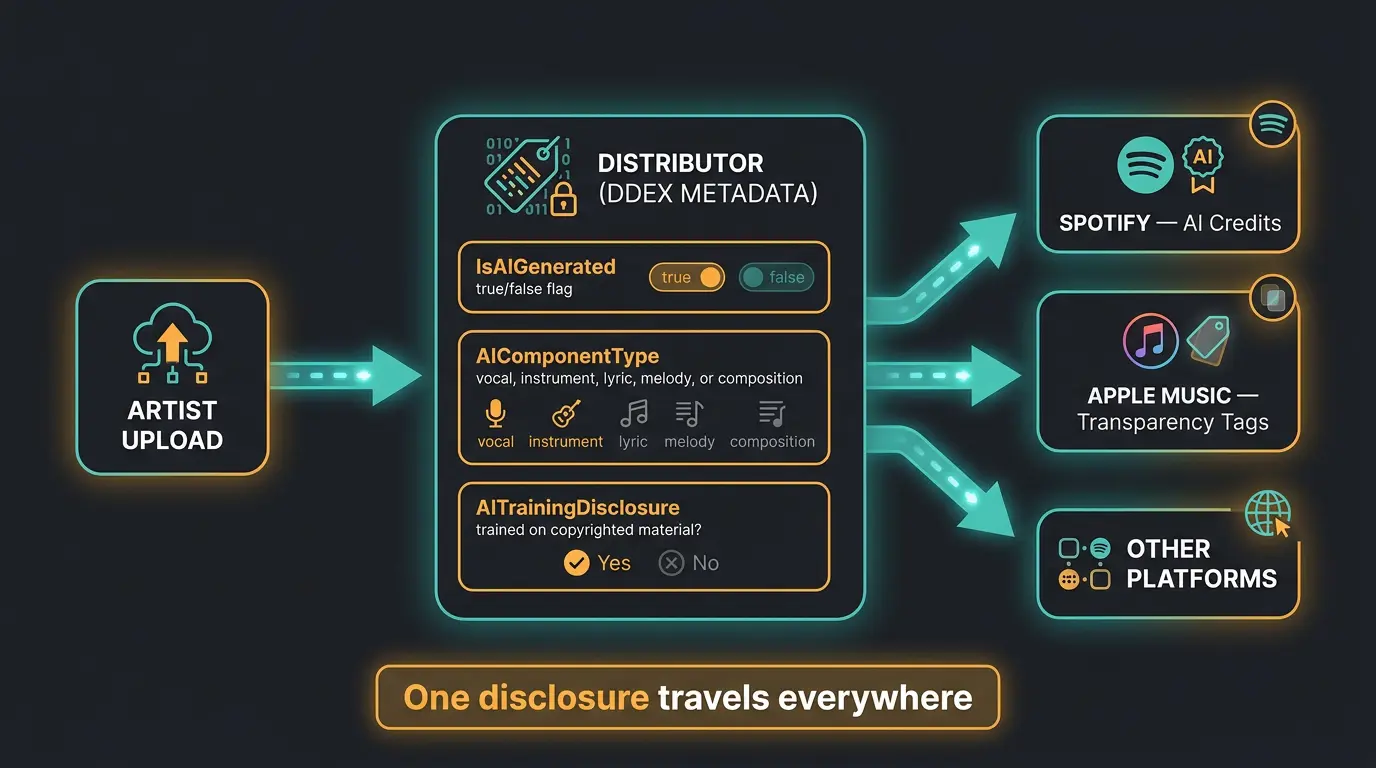
Here's the part most people get wrong. Disclosure doesn't happen on Spotify — it happens at your distributor, in the metadata, and then flows out to every platform they deliver to.
The standard behind it is called DDEX. And it's not a simple yes-or-no "is this AI" checkbox. It's detailed. You specify whether AI touched the vocals, the instrumentation, or the post-production. Spotify then shows that alongside your other track credits.
DDEX v5.0 added three fields worth knowing:
- IsAIGenerated — a true/false flag for whether the recording is fully synthetic.
- AIComponentType — what the AI actually made: vocal, instrument, lyric, melody, or full composition.
- AITrainingDisclosure — whether the model was trained on copyrighted material.
Here's the important bit: you don't get punished for being honest. Spotify treats disclosure as an industry supply-chain standard, and transparent tracks aren't downranked for it. Disclosing costs you nothing.
The rollout is already moving. Spotify launched its AI Credits beta in April 2026, starting with DistroKid, and Apple Music began phasing in Transparency Tags in March 2026. One disclosure at upload travels everywhere. If you want a deeper read on the platform side, this rundown of Spotify's AI stance in 2026 covers it well.
Distributor rules at a glance
- DistroKid allows AI music with a mandatory disclosure checkbox at upload, and runs its own detection scan to catch undisclosed tracks.
- TuneCore allows AI that enhances human work, requires granular attribution in the metadata, and may reject fully AI-generated tracks.
- CD Baby bans all AI-generated content outright, enforces it retroactively, and may hold earnings or terminate accounts.
Your distributor is the real gatekeeper
Spotify sets rules, but your distributor is the actual door between you and every platform. They decide what gets delivered, and their AI policy is the one that matters most for you.
The good news is that getting disclosure right at the distributor level cascades everywhere. Check the right box, fill in the right metadata, and compliance flows out to Spotify, Apple Music, and the rest automatically. Make sure you pick a distributor whose policy actually fits your track. Here's how the big three stack up.
DistroKid: allowed with disclosure
DistroKid is the most permissive of the bunch, and it's leaned into being the home for AI music creators. The policy is straightforward — AI is allowed as long as you disclose it. When you upload, you check the AI disclosure box, and that's the deal.
They also run a detection scan before delivery. If their system spots AI on a track where you didn't check the box, the upload gets held for manual review. So don't try to skip the disclosure — it's easier and safer to just check it.
TuneCore: more granular, stricter on fully-AI tracks
TuneCore allows AI that enhances human creation, but it wants more detail than DistroKid's single checkbox. During upload, you specify the nature of the AI involvement — full generation, vocal synthesis, or instrumental composition — right in the metadata.
One thing to flag: sources conflict a bit here. Some describe TuneCore rejecting works that are 100% AI-generated, while others describe an attribution requirement. If your track is fully AI-made with no human performance, TuneCore may push back where DistroKid wouldn't. Worth checking their current terms before you commit.
CD Baby: a full ban you should know about
CD Baby is the strictest, and this one trips people up. They ban all AI-generated content, full stop — even if you hold commercial rights from a paid Suno or Udio subscription. Their support page spells it out plainly.
And the enforcement has teeth. Tracks get removed from every platform, accounts can be terminated, and unpaid earnings may be held. It's also retroactive — a track you distributed a while back can get pulled later if it's identified as AI-generated.
The only AI-adjacent thing they allow is production tooling — mastering, mixing, or stem separation — where the composition and performance are entirely human. So if you're using AI to master a fully human track, you're fine. Generating the song itself? Not through CD Baby.
Deezer and the AI flood
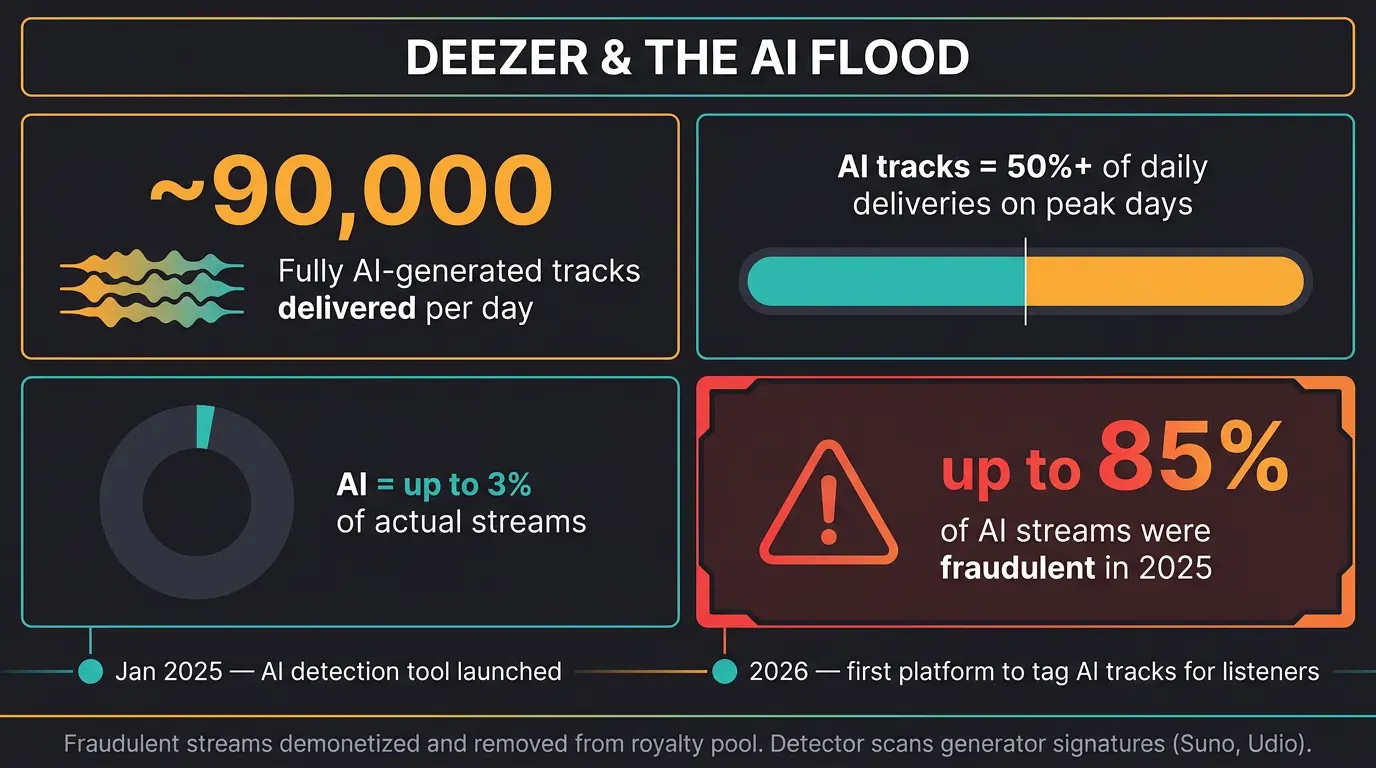
Deezer's the outlier here, and it's worth a look because it shows where things are heading. Since January 2025 they've run a patent-pending AI detection tool, and in 2026 they became the first platform to tag AI tracks for listeners directly.
The scale is genuinely wild. Deezer now receives nearly 90,000 fully AI-generated tracks every day — more than half of total daily deliveries on peak days. AI is still a small slice of actual streams, up to around 3%. But here's the ugly part: up to 85% of those AI streams were fraudulent in 2025, depending on the month.
Fraudulent streams get demonetized and pulled from the royalty pool, which is exactly right. Deezer's detector scans the signatures left by generators like Suno and Udio to flag them automatically. It doesn't fully ban AI, but the restrictions are tightening, and it's clearly setting the tone for the rest of the industry.
How to release AI music the right way
None of this is complicated if you're honest about it. Do these things and you'll be fine:
- Disclose AI at upload. Check the box, fill in the metadata. It doesn't hurt your reach, and skipping it can get your track held or pulled.
- Never clone a real artist's voice without their consent. Synthetic voices are fine — impersonation is not.
- Don't spam-upload or buy streams. That's the behavior these filters are built to catch, and it'll sink you faster than the AI itself.
- Pick a distributor whose policy fits your track. DistroKid if it's AI-heavy, and steer clear of CD Baby if the song is AI-generated.
- Keep your metadata and rights clean. Make sure the composition is genuinely yours to release.
If you're new to the paperwork side of releasing music, it's worth understanding what ISRC codes are before you release and the basics of how to copyright a song. AI or not, clean rights and metadata make everything downstream easier.
Frequently Asked Questions (FAQs)
Can I use AI vocals on Spotify?
Yes, you can use AI vocals on Spotify as long as they're synthetic and you disclose the AI involvement. What's banned is cloning a real, identifiable artist's voice without their consent — that counts as a deepfake and gets removed. Generated or synthesized vocals are completely fine.
Will disclosing AI hurt my streams or reach?
No, disclosing AI does not downrank your track or hurt your reach on Spotify. Spotify treats disclosure as an industry supply-chain standard, not a penalty, and transparent tracks are shown with normal credits. You lose nothing by being honest — and you risk holds or removals by hiding it.
Can I distribute AI music through DistroKid?
Yes, DistroKid allows AI music as long as you check the AI disclosure box at upload. It's the most permissive of the major distributors. They also run a detection scan, so if AI is found on an undisclosed track, the upload gets held for manual review before delivery.
Does Spotify pay out on AI tracks?
Yes, Spotify pays out on legitimately released AI tracks the same as any other track. The payouts get cut off when streams are fraudulent — bot streams or manipulation get demonetized and pulled from the royalty pool. Real listeners streaming honest AI music earn royalties normally.
Can I get in trouble for releasing AI music?
You can get in trouble if you clone a real artist's voice, spam-upload, buy streams, or hide AI involvement where disclosure is required. Released honestly, AI music is allowed on most platforms. The big exception is CD Baby, which bans AI content outright and can terminate accounts and hold earnings.
Final Thoughts
The rules aren't as scary as the headlines make them sound. Release AI music honestly — disclose it, don't impersonate anyone, don't fake your numbers — and you're welcome on Spotify and most platforms. The only real trap is picking the wrong distributor for your track, so read their policy before you upload.
All right, cool. AI is just another tool in the box now, same as any plugin. What you do with it is what matters — so make something worth listening to, keep it clean, and you'll be fine.
Some of the links within this article are affiliate links. These links are from various companies such as Amazon. This means if you click on any of these links and purchase the item or service, I will receive an affiliate commission. This is at no cost to you and the money gets invested back into Audio Sorcerer LLC.