Here's the short version: in the US, you can't copyright music that a machine fully generated on its own. Copyright requires a human author. But if you used AI as a tool inside your own creative process, the human parts of your song can still be protected.
The whole thing turns on one distinction — who determines the creative choices you actually hear. That's it. That's the ballgame.
One thing before we get going: this isn't legal advice. I'm an audio guy, not your attorney. If you've got real money riding on a specific release, talk to a lawyer who does this for a living.
TABLE OF CONTENTS
The short answer
US copyright law requires human authorship. So a track that a machine fully generates from a text prompt isn't copyrightable — only the human contributions to a song are protectable.
This part is settled enough that the Copyright Office and the courts agree on it. If you type a prompt into an AI generator and it spits out a finished song with nothing else from you, there's no copyright to claim on that output. The human creativity is what the law protects, and a prompt alone doesn't count as enough of it.
AI-assisted vs. AI-generated: the line that matters
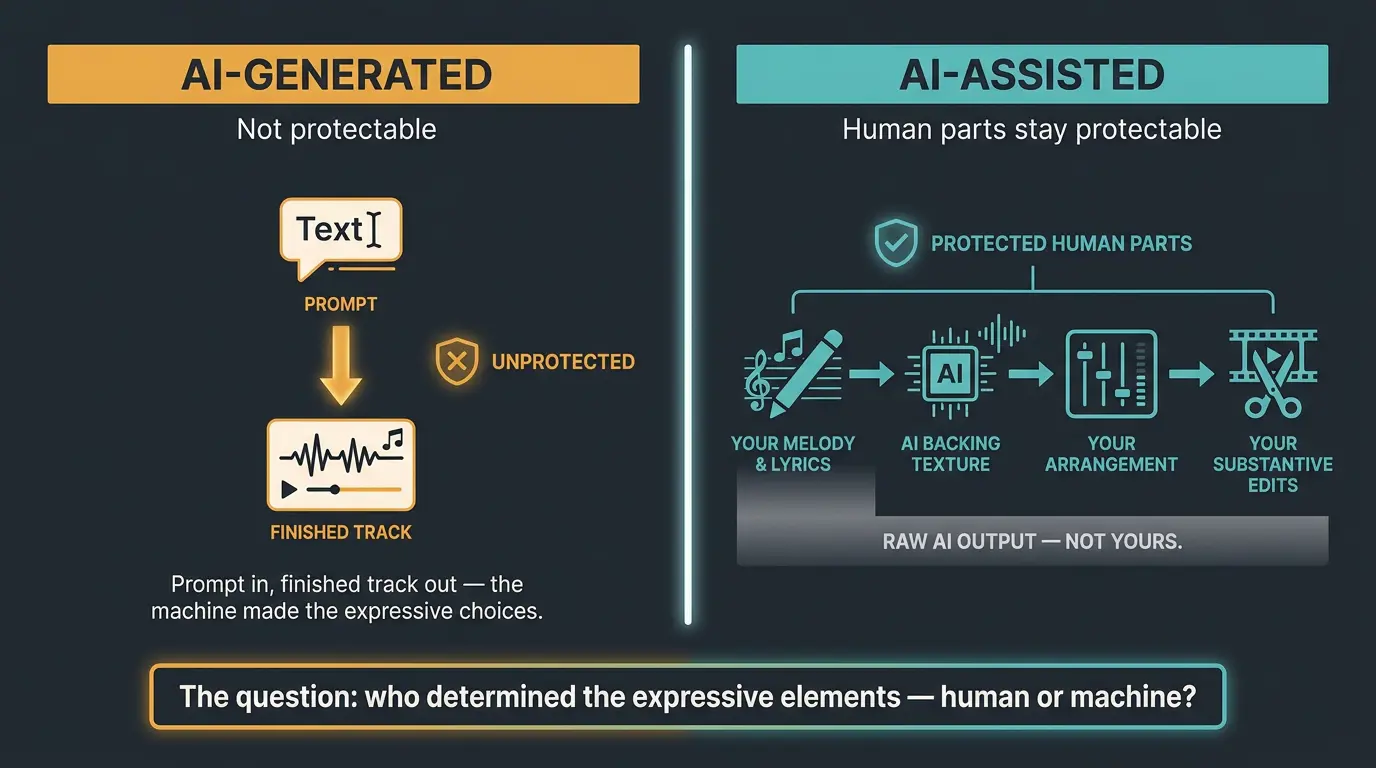
This is the part everyone trips over, so let's slow down. The question the law asks is simple: who determined the expressive elements you're hearing? A human, or the machine?
AI-generated means you typed a prompt and got a finished track. The machine made the melody, the arrangement, the performance. That output isn't protectable, no matter how clever your prompt was.
AI-assisted means you used AI as a tool somewhere inside your own creative process — and the human parts you brought stay protectable. Using AI doesn't poison the whole song. It just doesn't magically make the machine's output yours.
A plain music example: say you wrote your own melody and lyrics, then used an AI tool to generate a backing texture, and then you arranged it all, comped the takes, and made real edits to shape what the listener hears. Your melody, your lyrics, your arrangement, your substantive edits — those are yours. The raw AI output sitting underneath isn't. The Copyright Office has specifically pointed to AI tools that let musicians and engineers modify recordings as a place where real human contribution shows up. The catch is that whether your contribution clears the originality bar is a case-by-case call.
Three ways human authorship survives
- Your own human-authored work is perceptible in the output — your melody, your lyrics, your recorded performance sitting inside the track.
- You creatively select and arrange AI outputs. The arrangement gets protection; the raw AI output itself does not.
- You creatively modify the AI output to a meaningful degree, changing what the audience actually hears. Each of these is a case-by-case originality call, so there's no guaranteed line.
Where the law actually stands right now
Two authorities are doing the heavy lifting here, and it's worth knowing what each one is and isn't.
First, the US Copyright Office AI Report, Part 2 — the "Copyrightability" installment — came out in January 2025. It laid out the whole human-authorship framework: prompts alone don't cut it, AI-as-a-tool doesn't bar protection, and only the human contributions in a mixed work are eligible. Make sure you treat this as authoritative guidance, not binding law. Courts don't have to adopt the Office's reading of the statute.
Second, Thaler v. Perlmutter. In March 2026 the Supreme Court declined to hear it, which leaves the human-authorship requirement standing. Here's the nuance people miss: Thaler was a pure-AI test case. He didn't prompt it, didn't edit it, and listed the AI itself as the sole author. So the ruling confirms the floor — no human, no copyright — but it doesn't answer the harder AI-assisted questions about how much human input is enough.
One more thing to keep separate. There are ongoing lawsuits over whether Suno and Udio trained their models on copyrighted recordings without permission. That's a real, unresolved fight — but it's a different question. "Was the tool trained legally?" and "Can I copyright my song?" are two different problems. Don't let one confuse you about the other.
Myths worth clearing up
A few things get repeated online that just aren't right:
- "A detailed prompt earns me a copyright." Not under current technology. However careful your prompt, it doesn't give you enough control over the output to make you the author. The Office hedged it as "current technology," so this could shift someday — but that's where it sits now.
- "Using any AI ruins the whole song." False. AI as a tool inside a human-made work doesn't bar protection. The AI-generated portions are unprotected; your human-authored parts aren't.
- "My Suno or Udio license means I own the copyright." Different things. A paid license gives you commercial-use rights. It doesn't hand you a copyright on fully AI-generated material.
- "I have to register to be protected." Registration isn't mandatory, though it comes with real benefits. If you want the step-by-step, I already wrote a full guide on how to copyright a song — no need to repeat it here.
How to protect your AI-assisted music
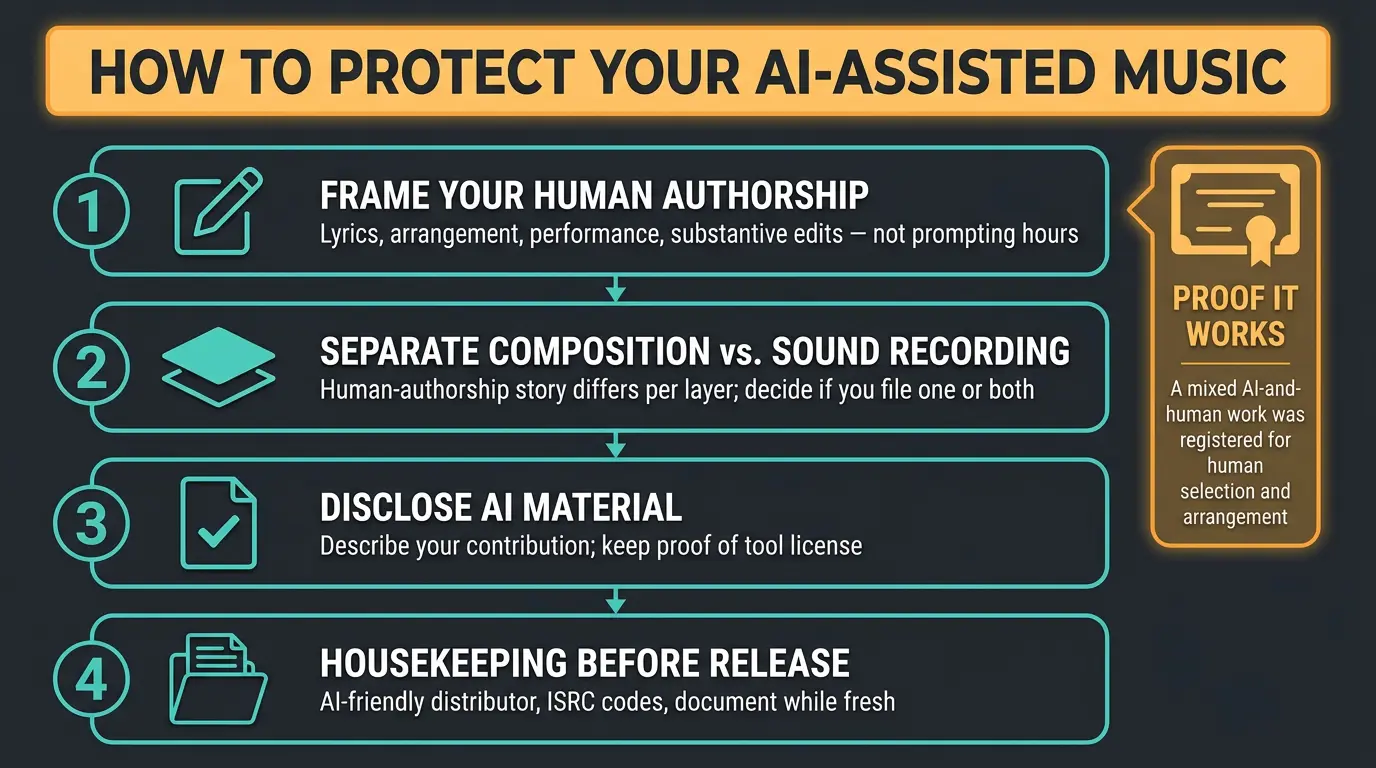
If your song has real human authorship and you want to register it, here's the practical shape of it.
When you register a work with more than a trivial amount of AI-generated material, you have to disclose that and describe your human contribution. So frame your claim around what you actually made — the lyrics you wrote, the arrangement you built, the performance you recorded, the substantive edits you made. Not the hours you spent prompting.
Keep the composition and the sound recording straight in your head, because the human-authorship story can differ for each layer. You might have a strong claim on the recording and a weaker one on the underlying composition, or the other way around. Sort out whether you're filing for one or both.
On the paperwork side: keep proof of your tool license, document your contribution while it's fresh, and use distributors that openly accept AI-assisted content before you spend on release marketing. Getting your ISRC codes sorted before release is part of that same housekeeping.
And if you're wondering whether a mixed AI-and-human work can actually be registered — it can. The Office registered a piece called "A Single Piece of American Cheese" because it found enough human authorship in the selection and arrangement of the AI material. You can read the Harvard Journal write-up on that registration if you want the details. It's proof the door isn't closed — you just have to walk through it with real human work in hand.
Frequently Asked Questions (FAQs)
Can you copyright a song made entirely with Suno or Udio?
No. If you typed a prompt and the platform generated the whole track with no further creative input from you, that output isn't copyrightable in the US. Copyright requires human authorship, and a prompt alone doesn't provide enough of it under current technology.
Does a paid AI license give me copyright?
No. A paid license from an AI music platform gives you commercial-use rights, which is a different thing from owning a copyright. It lets you sell and use the track, but it doesn't create copyright protection over fully AI-generated material.
Do detailed prompts count as authorship?
Not under current technology. However detailed and thoughtful your prompt is, the Copyright Office has concluded it doesn't give you enough control over the output to make you the author. The Office hedged this as a "current technology" position, so it could evolve down the road.
Can I copyright a song where I wrote the lyrics but AI made the beat?
Your human-authored lyrics can be protected; the AI-generated beat on its own can't. The AI portions stay unprotected, but your original contribution remains yours. When you register, you'd disclose the AI material and describe what you actually created.
Is AI music legal to sell?
Yes, selling AI-assisted or AI-generated music is generally legal, as long as your tool license permits commercial use. The catch is ownership — legal to sell isn't the same as protectable by copyright. Keep proof of your license and use distributors that accept AI content.
Final Thoughts
The confusion around AI music copyright almost always comes back to that one word: authorship. Once you get that the law protects human creativity, not the button you pushed, most of the fog clears. Machine-made output isn't yours. The real work you put in around it can be.
So bring something to the table — write, arrange, perform, edit, shape what people hear — and document it. That's not a loophole. That's just what copyright has always asked for. The tools changed. The rule didn't.
Some of the links within this article are affiliate links. These links are from various companies such as Amazon. This means if you click on any of these links and purchase the item or service, I will receive an affiliate commission. This is at no cost to you and the money gets invested back into Audio Sorcerer LLC.