Parallel keys are two keys that share the same tonic but flip between major and minor — like G major and G minor. Same home note, different mode.
Swapping between them is one of the most dramatic moves you can make in a song. The ground stays put but everything on top of it shifts, and your ear feels that instantly. Here's what actually changes, how parallel keys differ from relative keys, and how to put the swap to work in your own writing.
TABLE OF CONTENTS
What are parallel keys?
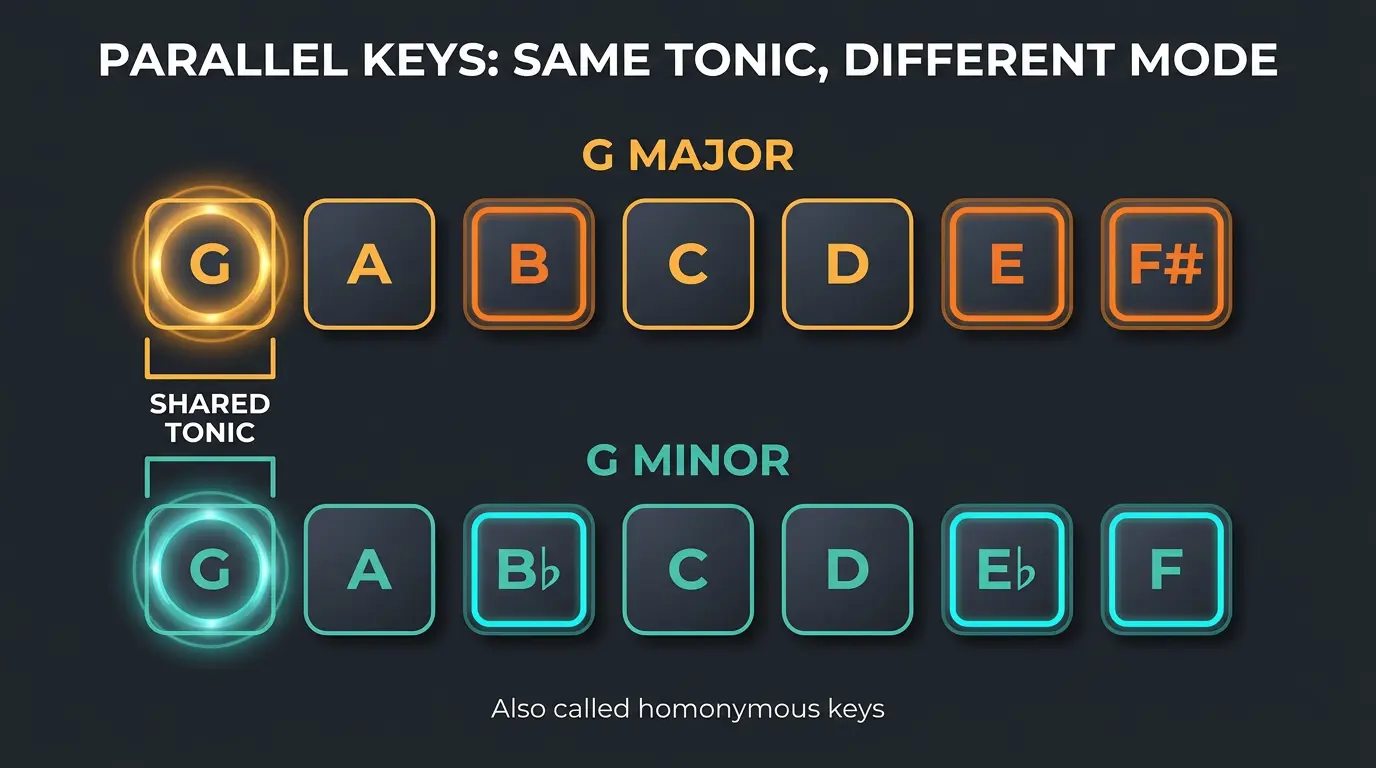
Parallel keys share the same tonic but use a different mode — one major, one minor. Take G. The G major scale is G A B C D E F#. The G minor scale is G A Bb C D Eb F. Same starting note, different color.
Every major key has a parallel minor, and every minor key has a parallel major. So G minor is the parallel minor of G major, and vice versa. You'll occasionally see these called homonymous keys, but parallel is the term almost everyone uses.
What changes when you flip the mode
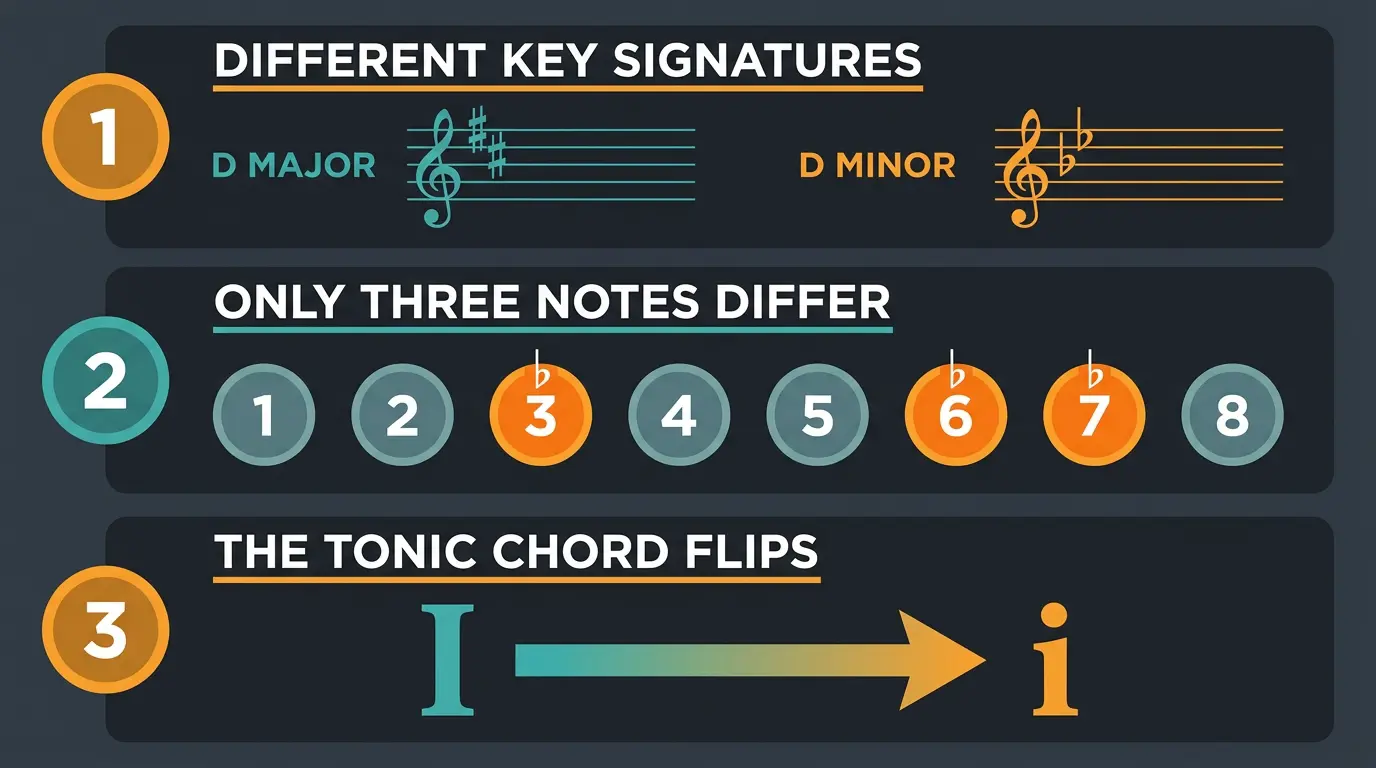
Three things worth knowing when you switch a key to its parallel.
- They do not share a key signature. D major has two sharps. D minor has one flat. Same tonic, totally different signature on the page.
- Exactly three notes differ. Compared to the major scale, the minor has a flatted 3rd, 6th, and 7th. Everything else stays.
- The tonic chord flips. Your major I becomes a minor i. That's a real harmonic shift, and it's the heart of the whole effect.
The emotional read is the obvious part — major sounds bright, minor sounds darker and more serious. You don't need me to label it. Play both and your ear does the rest.
Parallel vs. relative keys
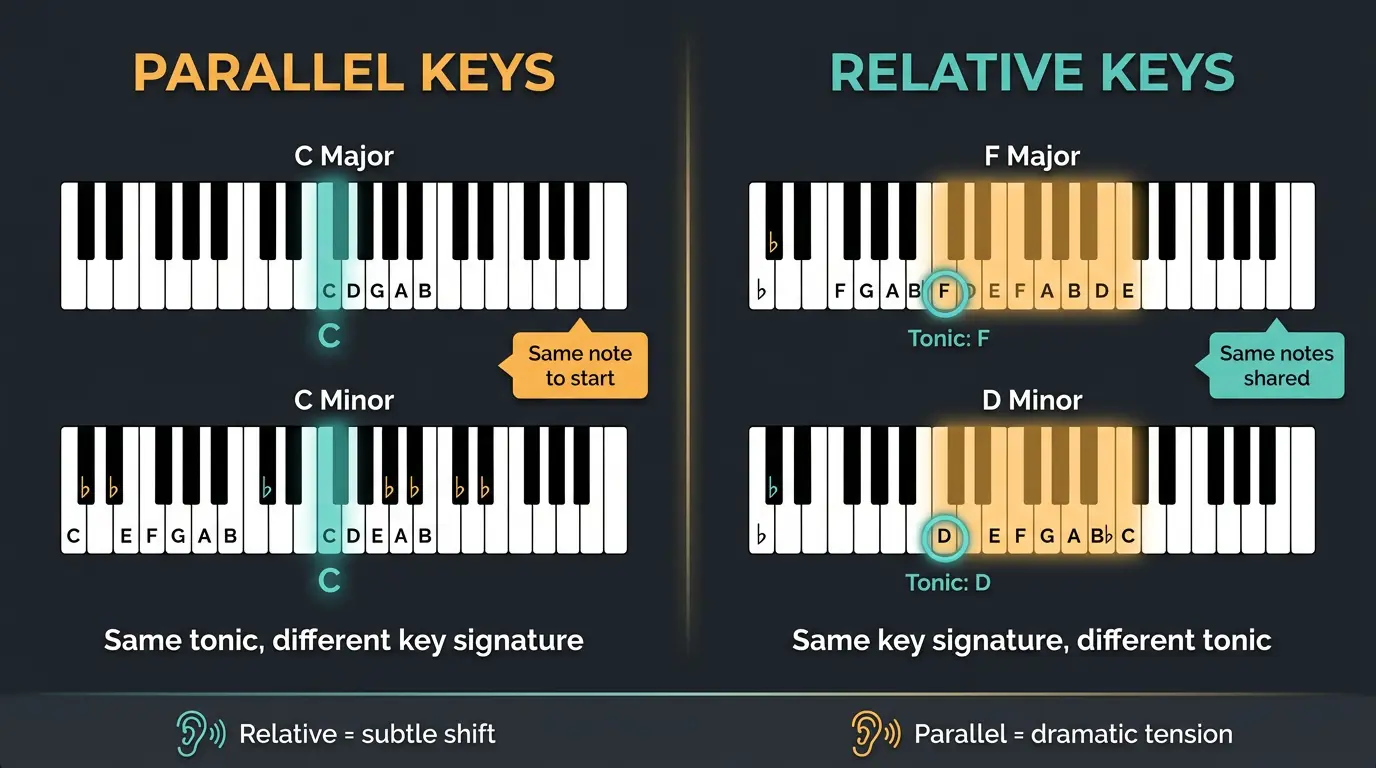
This is where people get tangled up, so let's clear it. Parallel keys share the same tonic but have different key signatures. Relative keys share the same key signature but have different tonics. They're opposites in what they hold constant.
Here's the mnemonic that sticks: parallel keys start with the same note, relative keys share the same notes. F major and D minor are relative — both have one flat, so they use the exact same collection of pitches, just centered differently. Want the full breakdown on that side of it? I wrote a whole piece on relative major and minor keys.
The ear reacts differently to each. A relative change is subtle — same notes, you're just shifting the sense of home. A parallel change is dramatic. The tonic holds steady but the notes underneath it move, and that tension is what makes it land.
Why parallel keys feel distant even though they share a tonic
Here's the counterintuitive part. Sharing a tonic does not make parallel keys close relatives. They differ by three accidentals, which puts them a good distance apart on the circle of fifths.
That distance is a feature, not a problem. Because it's such a drastic move, the swap sounds sophisticated and impactful — where a relative shift stays quiet in the background. If you want the bigger emotional statement, parallel is your tool.
How to use parallel keys in your songs

The main move is mood flipping. Go major to minor when you want a section to darken — a bridge that suddenly gets serious. Or run it the other way, minor to major, for a lift. That minor-to-major climb shows up all over pop, and for good reason. It feels like the sun coming out.
Now the mechanical tip that makes it easy: parallel keys share the same dominant. The V chord is the same in both. In C major and C minor, that dominant is G (or G7) either way.
So the V is your bridge. Land on it, and you can resolve to either the major or minor tonic — swap between the parallels at will. This is sometimes called mode modulation, since you're moving between the major and minor mode over a fixed tonic. Make sure you try it both directions and let your ear pick the one that fits the song.
Real songs that swap parallels
Let's give it a listen with a couple of records that do this out in the open.
Happy Together by The Turtles keeps the verses in F# minor, then the chorus jumps to F# major. The move happens over a B major chord — F# minor borrowing the IV from its parallel major. The lift into that chorus is obvious once you know to feel for it.
While My Guitar Gently Weeps by The Beatles runs a verse in A minor and modulates to the parallel A major, bridged with an E7 — the V7 that both keys share. It's not subtle. The shift in mood is right there in the front of the track.
Parallel keys at a glance
- Same tonic, different mode — G major and G minor both start on G.
- Exactly three notes differ: the flatted 3rd, 6th, and 7th.
- They share the same dominant V chord, so the V is an easy pivot for swapping between them.
The link to borrowed chords
Parallel keys are also the whole basis of borrowed chords. Instead of fully modulating, you reach over into the parallel key and grab a single chord — the tonic never gets displaced. That's called modal mixture or modal interchange.
Direction matters here. Most borrowing goes major-to-minor. A classic is pulling a minor iv chord from the parallel minor into a major key. Borrowing the other way — from parallel major into a minor key — is mostly limited to the Picardy third, where a minor progression ends on a major tonic chord for a final bit of brightness.
If you want the full toolkit and a bunch of progressions to steal, I go deep on it in the post on borrowed chords and modal interchange. For a plain reference on the definitions, the parallel key entry on Wikipedia is a solid starting point.
Frequently Asked Questions (FAQs)
What are parallel keys in music?
Parallel keys are two keys that share the same tonic but use different modes — one major, one minor, like G major and G minor. They start on the same note but have different key signatures, so three of their notes differ. Every major key has a parallel minor and vice versa.
What's the difference between parallel and relative keys?
Parallel keys share the same tonic but different key signatures; relative keys share the same key signature but different tonics. The mnemonic: parallel keys start with the same note, relative keys share the same notes. Parallel swaps sound dramatic, relative swaps sound subtle.
Do parallel keys share a key signature?
No, parallel keys do not share a key signature. D major has two sharps and D minor has one flat, even though both are built on D. They share the tonic note, not the signature — three notes differ between them: the flatted 3rd, 6th, and 7th.
What chord connects parallel keys?
The dominant (V) chord connects parallel keys, because it's identical in both. In C major and C minor, the dominant is G either way. Land on that V chord and you can resolve to either the major or minor tonic, making it the easiest bridge for swapping between parallels.
Are parallel keys closely related?
No, parallel keys are distantly related despite sharing a tonic. They differ by three accidentals, which puts them a real distance apart on the circle of fifths. That's exactly why swapping between them sounds so dramatic, where a relative key change stays quiet and subtle.
Final Thoughts
Parallel keys give you a whole extra palette without leaving home. Same tonic, different mode, three notes moved — and a shared dominant that lets you slide between them whenever you want.
Try flipping a section to its parallel the next time a song feels one-note emotionally. Push it too far first, hear what it does, then dial it back to taste. Trust your ears — there's no single right answer here, just the move that serves the song.
Some of the links within this article are affiliate links. These links are from various companies such as Amazon. This means if you click on any of these links and purchase the item or service, I will receive an affiliate commission. This is at no cost to you and the money gets invested back into Audio Sorcerer LLC.