A chord inversion is just a chord with a note other than the root sitting in the bass. The notes don't change. The chord doesn't change. Only the lowest note changes.
That's the whole idea, and it's a lot simpler than most explanations make it sound. Quick recap before we go: a triad is three notes — the root, the third, and the fifth. Keep that in your head and the rest of this falls into place fast.
TABLE OF CONTENTS
What are chord inversions?
An inversion is a chord whose lowest-sounding note is something other than the root. That's it. The thing that decides the inversion is the bass note — the lowest note you hear — not the order of the notes stacked on top.
This is the part people miss, so let me say it plainly. Same three notes, same chord identity, different bass. A C major chord with E in the bass is still a C major chord. It's written C/E, but it's not an E chord — it's C major, inverted.
The three positions of a triad
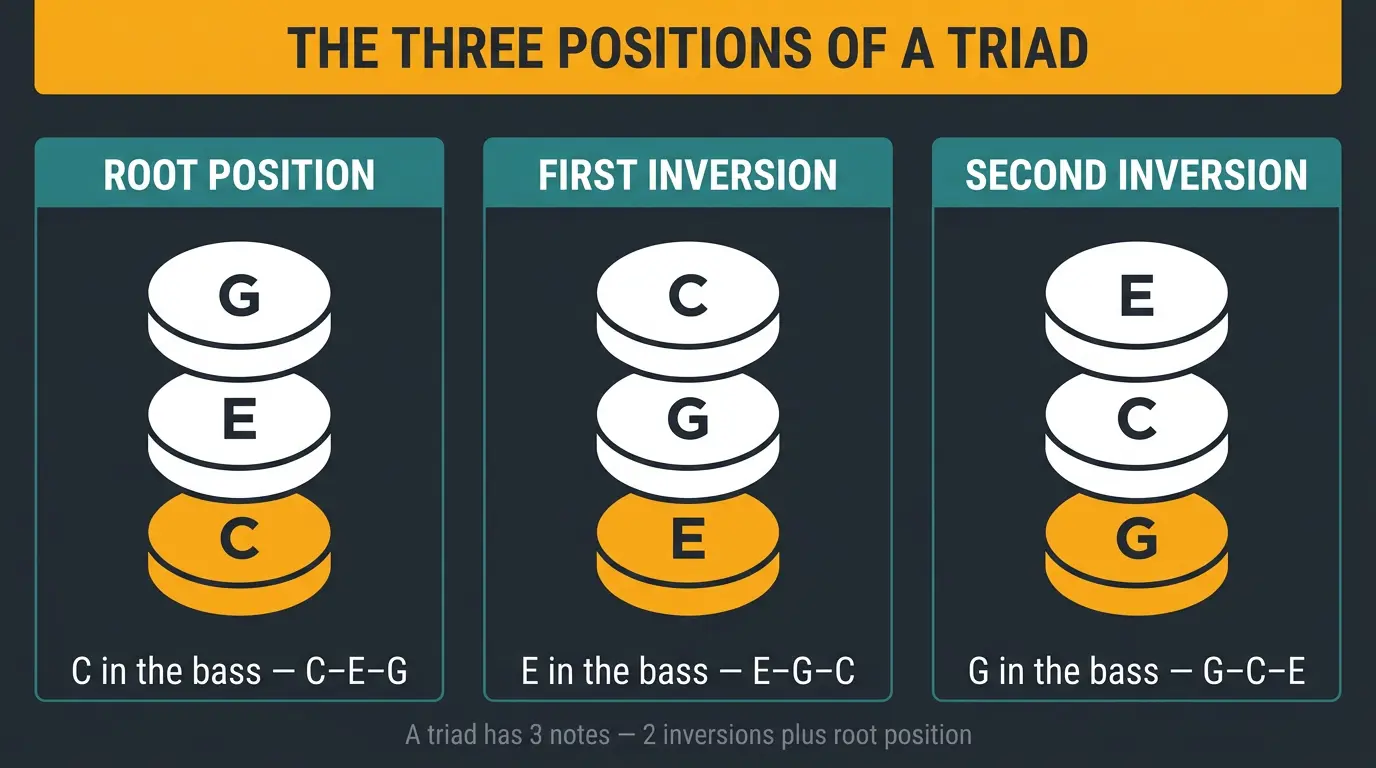
Let's run a single chord through every position so you're tracking the same three notes the whole way. We'll use C major: C, E, and G.
- Root position — C in the bass. From the bottom: C–E–G.
- First inversion — E in the bass. From the bottom: E–G–C.
- Second inversion — G in the bass. From the bottom: G–C–E.
Here's the thing that surprises people: a triad only has three notes, so it only has two inversions plus root position. Three positions total. That's all you get.
Seventh chords have four notes, so they add a third inversion. Take G7 (G–B–D–F): root position is G in the bass, first inversion is B, second inversion is D, and third inversion is F. The table below lays the triad version out clean.
| Position | Bass note | Figured bass | Slash chord |
|---|---|---|---|
| Root position | C | — (just I) | C |
| First inversion | E | 6 | C/E |
| Second inversion | G | 6/4 | C/G |
How inversions are written
You'll run into two systems, depending on where you're reading. Both say the same thing in different handwriting.
Figured bass shows up in classical and Roman numeral analysis. The numbers are intervals above the bass note. Root position is technically 5/3, but it's almost always left off — you just see the Roman numeral. First inversion is 6. Second inversion is 6/4. For seventh chords it's 7, then 6/5, 4/3, and 4/2 as you go up the inversions.
Slash chords are what you'll see on lead sheets, in pop, jazz, and guitar charts. It's the chord name, a slash, then the bass note. C/E is C major in first inversion. C/G is second inversion. Simple and readable, which is why it caught on. If you want more on reading these in context, our guide to common chord progressions uses this notation throughout.
One caveat. A slash chord doesn't always mean an inversion. The bass note can be a note that isn't even in the chord — something like C/D, where D isn't part of a C major triad. So the slash just tells you what's in the bass. It doesn't promise you an inversion.
Why inversions matter: voice leading
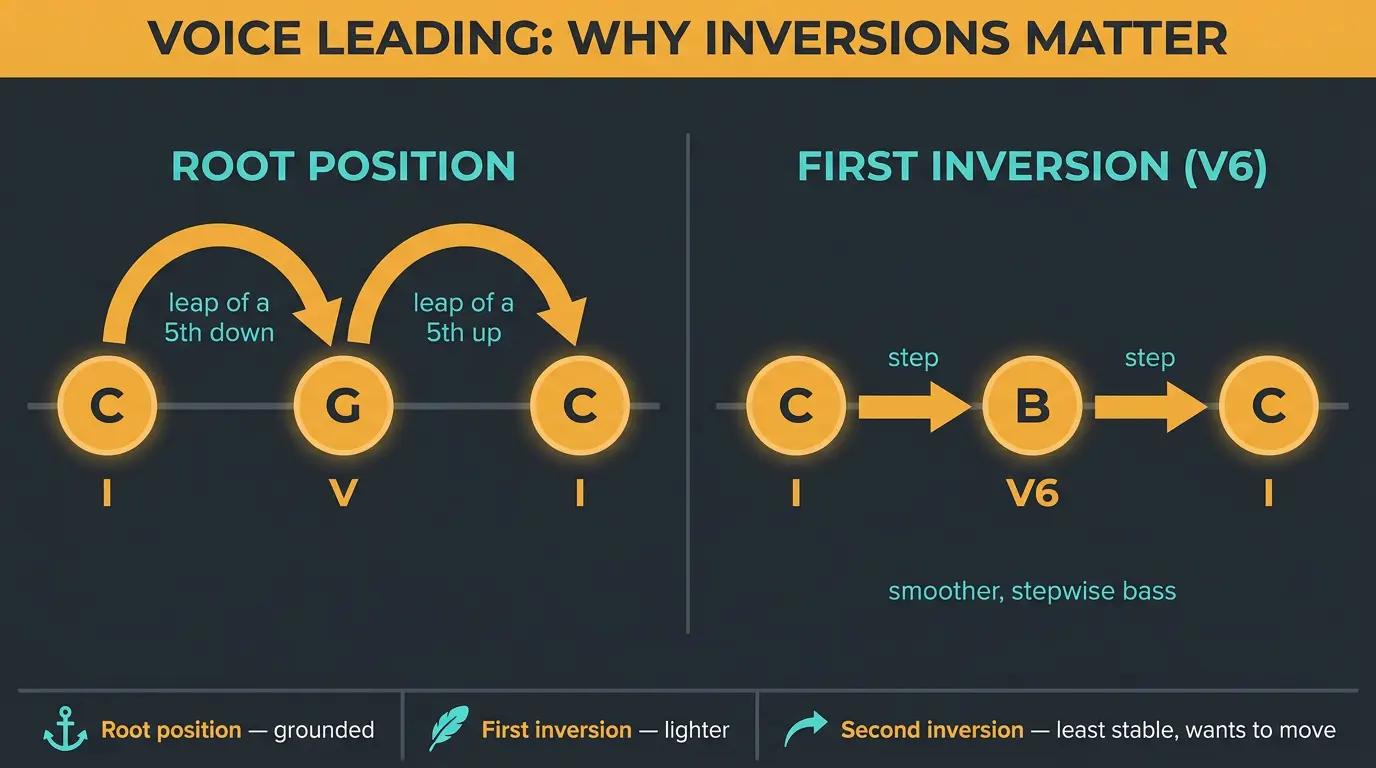
This is the real reason to care. Inversions let your bass line move in small steps instead of leaping all over the place.
Here's the cleanest example. Play a I–V–I in C using all root-position chords and your bass goes C–G–C. That's a jump of a fifth down, then a fifth back up. Now use V in first inversion — V6, with B in the bass — and your bass becomes C–B–C. That's a smooth, stepwise move. Same chords, much smoother bottom end. Let's give it a listen and the difference is obvious.
That's voice leading in a nutshell: keep shared notes where they are, move everything else the shortest distance possible. First-inversion chords are great for stitching together root-position chords with a walking, scale-like bass. Picking the right inversion also helps you sidestep parallel fifths and octaves, which is the classical reason for a lot of this in the first place.
There's a color side too. Root position is the most grounded and settled. First inversion is lighter and a little warmer. Second inversion is the least stable of the three — it wants to move somewhere. None of that is good or bad. It's a tool. If you're building progressions from scratch, our beginner piano chord progressions are a good place to try these moves out.
Common myths about inverted chords
- An inversion is not just reordering the top notes. Only the bass note decides it. C–E–G and C–G–E are both root position because C is on the bottom — reordering the upper voices gives you a different voicing, not a different inversion.
- An inverted chord is not a different chord. C/E is still C major, not an E chord. The identity comes from the notes, not the bass.
- A triad has only two inversions, not three. Three notes means root position plus two inversions. You need a four-note chord, like a seventh, to get a third inversion.
- Don't confuse 6/4 with 6/5. The figure 6/4 is a second-inversion triad. The figure 6/5 is a first-inversion seventh chord. Different animals.
How to play inversions on piano and guitar
On piano there's a quick trick. Play a chord in root position, then take the bottom note and move it up an octave. That gives you the next inversion. Do it again and you get the one after that. Try it with C major and you'll feel how the shape walks up the keyboard while the chord stays the same.
On guitar, inversions show up as different chord shapes, each with your chosen bass note landing on a particular string. It's less of a single trick and more a handful of shapes worth learning over time.
Make sure you actually play through them and listen, rather than memorizing rules on paper. Notice how root position sounds settled and how second inversion feels like it's leaning forward. There isn't one right answer here — trust your ears and use whichever inversion makes the line move the way you want.
Frequently Asked Questions (FAQs)
What is a chord inversion?
A chord inversion is a chord with a note other than the root in the bass. The notes themselves don't change — only the lowest-sounding note does. So C major with E in the bass (written C/E) is still C major, just inverted.
How many inversions does a triad have?
A triad has two inversions, plus root position, for three positions total. Because a triad only has three notes, you run out of bass notes after the third and fifth. Four-note chords like sevenths add a third inversion.
What's the difference between an inversion and a voicing?
An inversion is decided entirely by the bass note, while a voicing is how all the notes are arranged and spaced. Reordering the upper notes changes the voicing but not the inversion. Only moving a different note into the bass changes the inversion.
Does a slash chord always mean an inversion?
No, a slash chord doesn't always mean an inversion. It only tells you which note is in the bass. If that bass note is one of the chord tones, it's an inversion. But if the bass note isn't in the chord at all, like C/D, it's not an inversion.
Why do inversions sound different from root position?
Inversions sound different because the bass note shapes how stable and grounded a chord feels, not just its register. Root position sounds the most settled. First inversion sounds lighter and warmer, and second inversion is the least stable, often pulling toward the next chord.
Final Thoughts
Inversions look intimidating with all the figured-bass numbers floating around, but the core idea fits in one sentence: change the bass note, keep the chord. Once that clicks, the rest is just notation and a little practice.
The real payoff is smoother bass lines and progressions that flow instead of jump. Sit at your instrument, run C major through its three positions, and listen for the shift in color. Less is more — you don't need to invert everything, just the spots where the line wants to move by step.
Some of the links within this article are affiliate links. These links are from various companies such as Amazon. This means if you click on any of these links and purchase the item or service, I will receive an affiliate commission. This is at no cost to you and the money gets invested back into Audio Sorcerer LLC.