A chord progression is just a sequence of chords played in order that sound good together. Most are short — usually 4 to 8 bars — and they repeat. That's the whole idea.
Here's the part that makes this worth your time: learn a handful of progressions and you've basically unlocked hundreds of songs. The same few patterns show up again and again across pop, rock, and everything in between.
And on a keyboard, you get a shortcut. Before you ever play with both hands, you can hold down the chord progression with one hand and sing the melody. That alone is enough to play real music tonight.
TABLE OF CONTENTS
The theory you actually need first
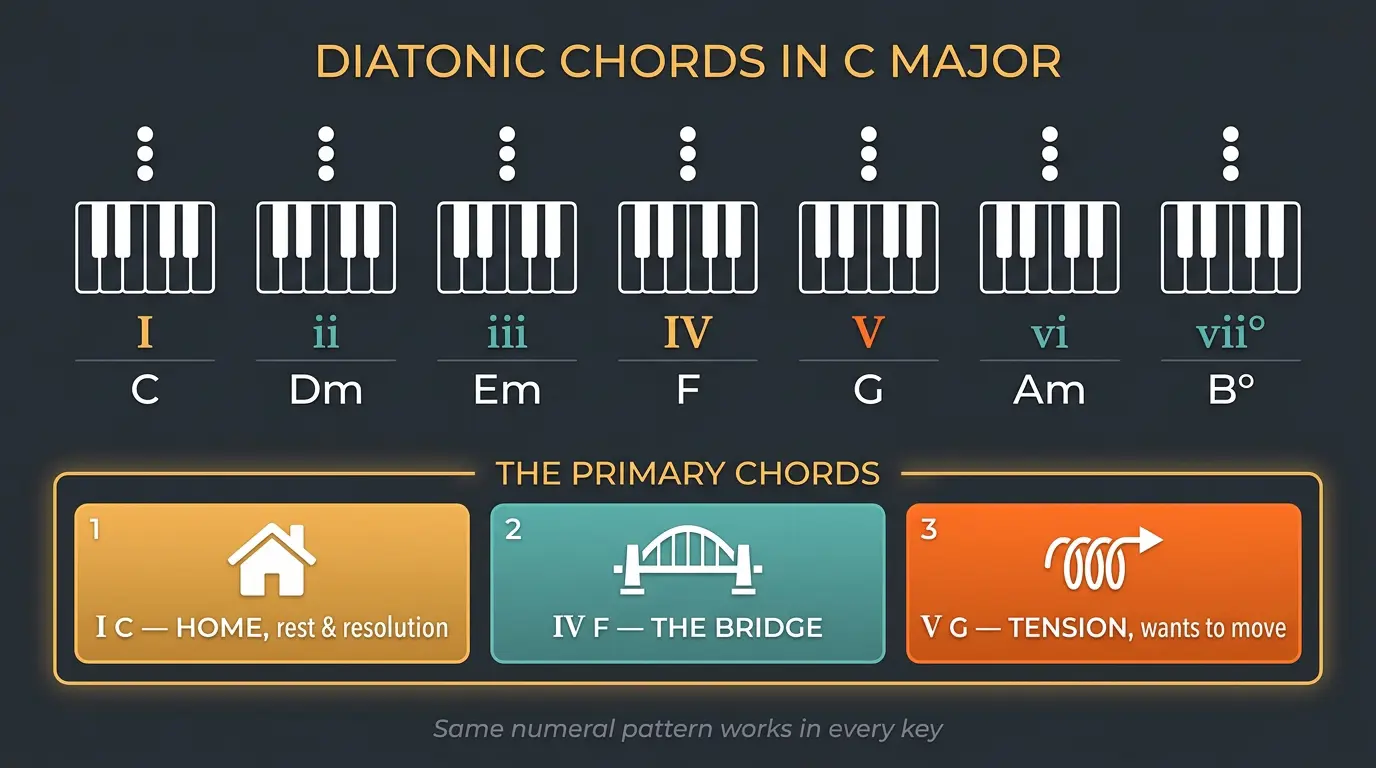
Take the C major scale and stack a triad on top of every note. Some of those chords come out major, some come out minor. Those are your diatonic chords — the chords that live naturally in the key.
To talk about them without getting tangled, we use Roman numerals. Uppercase means major, lowercase means minor. In any major key the pattern is I ii iii IV V vi vii°. In C that gives you C, Dm, Em, F, G, Am, and B diminished.
The reason this matters: the numeral pattern is the same in every key. Learn it once and you can play it anywhere — C, G, whatever you want. If you want to go deeper on this, scale degrees are the same idea from a slightly different angle.
Three of these do most of the heavy lifting: the I, IV, and V, your primary chords. The I is home — it's rest and resolution. The V creates tension and wants to move. The IV is the bridge between the two. Get those three roles in your ear and a lot of music starts to make sense.
The most common piano chord progressions
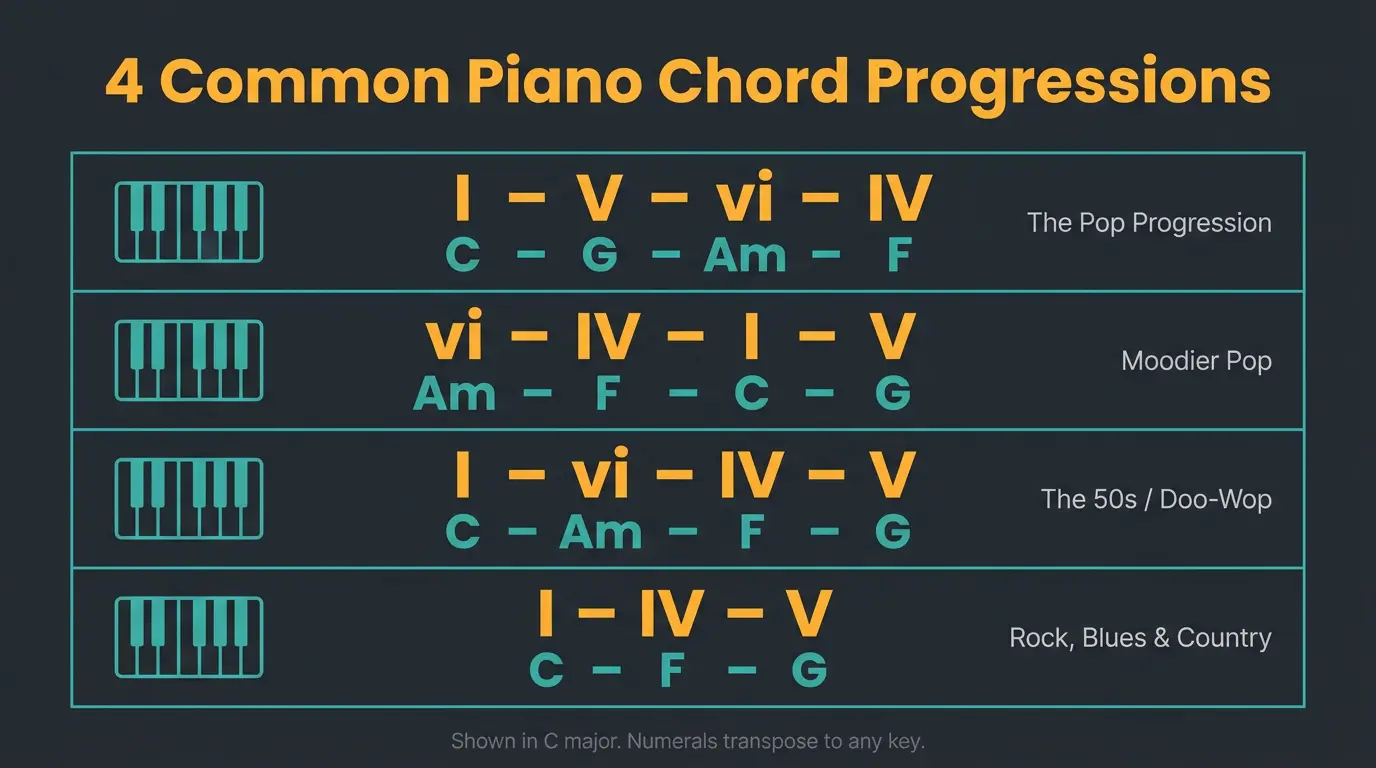
Here are the four to start with. They're all shown in C major so you can play them right now, but remember — the numerals transpose to any key.
I–V–vi–IV (C–G–Am–F). Learn this one first. It's nicknamed the Pop Progression, or the Four Magic Chords, and it's behind a genuinely silly number of hits. Bright, catchy, hard to mess up.
vi–IV–I–V (Am–F–C–G). Same four chords, reordered. Because it starts on a minor chord, it feels moodier — but it's no less catchy. A lot of people find this the easiest one to start with.
I–vi–IV–V (C–Am–F–G). The '50s progression, sometimes called the doo-wop progression. You've heard it in everything from Unchained Melody to more modern ballads. Warm and nostalgic.
I–IV–V (C–F–G). The backbone of rock, blues, and country, built entirely from your primary chords. Three chords, complete journey. It feels finished because it is.
If you want more patterns once these are comfortable, this rundown of common chord progressions every songwriter should know picks up where this leaves off.
Start with these four
- I–V–vi–IV (C–G–Am–F) — the Pop Progression. Bright and catchy, behind countless hits. Learn this first.
- vi–IV–I–V (Am–F–C–G) — same chords reordered. Starts minor, so it's moodier. A great first progression.
- I–vi–IV–V (C–Am–F–G) — the '50s / doo-wop progression. Warm and nostalgic.
- I–IV–V (C–F–G) — the rock, blues, and country backbone. Three primary chords, complete journey.
Chord shapes and fingering for keyboard players
For a basic root-position triad, the standard fingering is 5–3–1 in the left hand and 1–3–5 in the right. In the left, your pinky (5) takes the root, finger 3 takes the third, and your thumb (1) takes the fifth. In the right, the thumb takes the root, finger 3 the third, finger 5 the fifth.
If your hand wants to spread out a bit, 5–2–1 in the left and 1–2–5 in the right works just as well. Use whatever feels natural under your hand.
One rule worth burning in early: fingers 2, 3, and 4 are your best bets for black keys. Try to keep your thumb and pinky off the black keys when you can — they're shorter and sit too far back to reach comfortably.
When you get to seventh chords (four-note tetrads), the fingering grows by one: 5–3–2–1 in the left, 1–2–3–5 in the right. None of this is law, by the way. It's what works for most hands most of the time — if your ears and fingers find something smoother, trust them.
Use inversions for smooth chord changes
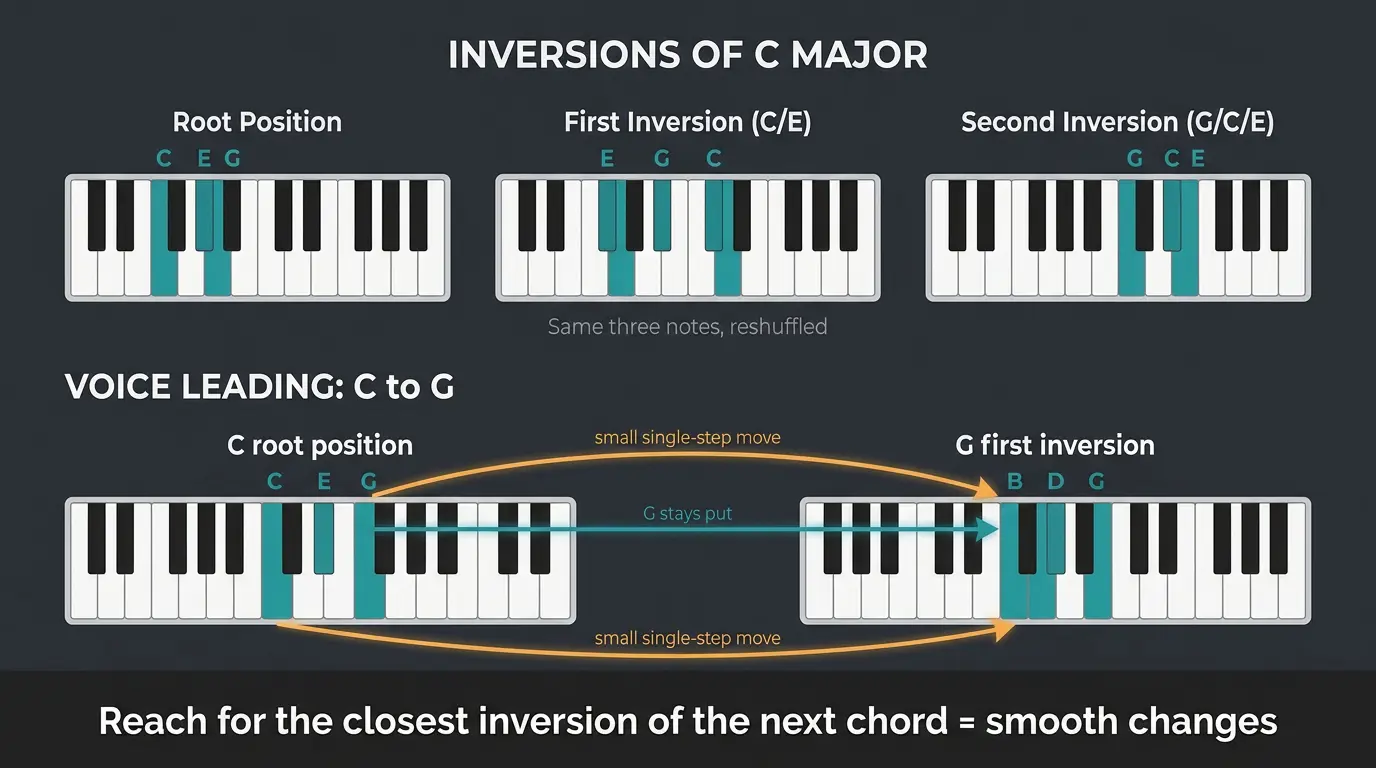
An inversion is the same chord with a different note on the bottom. The notes don't change — the root just isn't the lowest one anymore.
Take C major: root position is C–E–G. First inversion is E–G–C. Second inversion is G–C–E. Same three notes, reshuffled. On a lead sheet you'll see these written as slash chords — C/E means a C major chord with E in the bass, which is first inversion.
So why bother? Jumping from one root-position chord straight to another usually sounds clunky. Your whole hand leaps across the keys, and the chords feel disconnected. Inversions fix that by minimizing how far each note has to travel from one chord to the next. That's called voice leading, and it's most of what separates a smooth-sounding progression from a jerky one.
The method is simple: from each chord, reach for the closest inversion of the next one. Let's give it a listen in our I–V–vi–IV. Keep C in root position (C–E–G). Now instead of leaping down to a root-position G, play first-inversion G — B–D–G. The G on top stays put, and the other voices move by a single step. Suddenly the change is seamless.
This takes practice, and there's no single correct set of inversions — let your ears be the judge. For more worked examples, this guide on how to improve progressions with chord inversions is a solid next read.
Inversion fingering, quickly
Here's the quick reference so you're not guessing at the keyboard.
- First inversion — left hand: 5 on the third, 3 on the fifth, 1 on the root. Right hand: 1 on the third, 2 on the fifth, 5 on the root.
- Second inversion — left hand: 5 on the fifth, 2 on the root, 1 on the third. Right hand: 1 on the fifth, 3 on the root, 5 on the third.
Play them slowly a few times and your hand will memorize the shapes faster than your head does.
Where to go next
Once the four core progressions feel automatic, there are two patterns worth aiming at. Think of them as the next mountain, not beginner homework.
The first is the 12-bar blues: I-I-I-I-IV-IV-I-V-IV-I-I, usually played with seventh chords instead of clean triads. It's the structural backbone of blues, rock and roll, and a ton of R&B. The second is the ii–V–I, the building block of jazz harmony — in C that's Dm7–G7–Cmaj7.
With that being said, don't rush there. Take the four progressions you already know and play them in a couple of different keys first. Less is more — you'll learn way more from four progressions you really own than from twenty you sort of recognize.
Frequently Asked Questions (FAQs)
What is a chord progression on piano?
A chord progression is a sequence of chords played in order that sound good together, usually 4 to 8 bars long and often repeated. On piano, you can play the whole progression with one hand while you sing or play the melody — which means you can perform real songs before you ever use both hands.
What's the easiest chord progression for beginners?
vi–IV–I–V (Am–F–C–G in C major) and I–V–vi–IV (C–G–Am–F) are the easiest to start with. Both use the same four chords and show up in countless songs. Start with whichever feels better under your hand and your ear — there's no wrong choice.
Why do my chord changes sound clunky?
Clunky changes usually come from jumping root-position chord to root-position chord, so your whole hand leaps across the keys. The fix is inversions: reshuffle the notes so each voice moves the shortest distance to the next chord. That smooth movement is called voice leading, and it cleans things up immediately.
Do I have to learn chord progressions in every key?
No. Learn the Roman numeral pattern once — I–V–vi–IV, for example — and you can transpose it to any key. The chord qualities stay the same in every major key, so the I is always major, the vi is always minor, and so on. Learn the pattern, not 12 separate versions.
What does a slash chord like C/E mean?
C/E means play a C major chord with E as the lowest note — that's a first-inversion C major. The letter before the slash is the chord, the letter after is the bass note. You'll see slash chords on lead sheets all the time, and they're just a shorthand for inversions.
Final Thoughts
You don't need a hundred progressions to make music. Four well-practiced patterns, a little inversion work to smooth out the changes, and the Roman numeral system to move it all to any key — that's a complete toolkit for playing songs.
Get those four under your fingers, let your ears guide the inversions, and play them until they're boring. That's when the real fun starts. Now go make some noise.
Some of the links within this article are affiliate links. These links are from various companies such as Amazon. This means if you click on any of these links and purchase the item or service, I will receive an affiliate commission. This is at no cost to you and the money gets invested back into Audio Sorcerer LLC.