The Decca Tree is a three-mic array that helped shape the sound of orchestral records and film scores for the last seventy years. If you've heard a big, wide, natural-sounding orchestra on a soundtrack, there's a good chance a version of this technique was involved.
It's worth talking about right now because Neumann just brought back the M 50 — the microphone at the heart of the tree — with a reissue announced at NAMM in early 2026. So this classic setup is having a real moment.
Here's what the Decca Tree actually is, how it got started, how to set one up, and how engineers are using it for surround and Dolby Atmos today.
TABLE OF CONTENTS
What the Decca Tree actually is
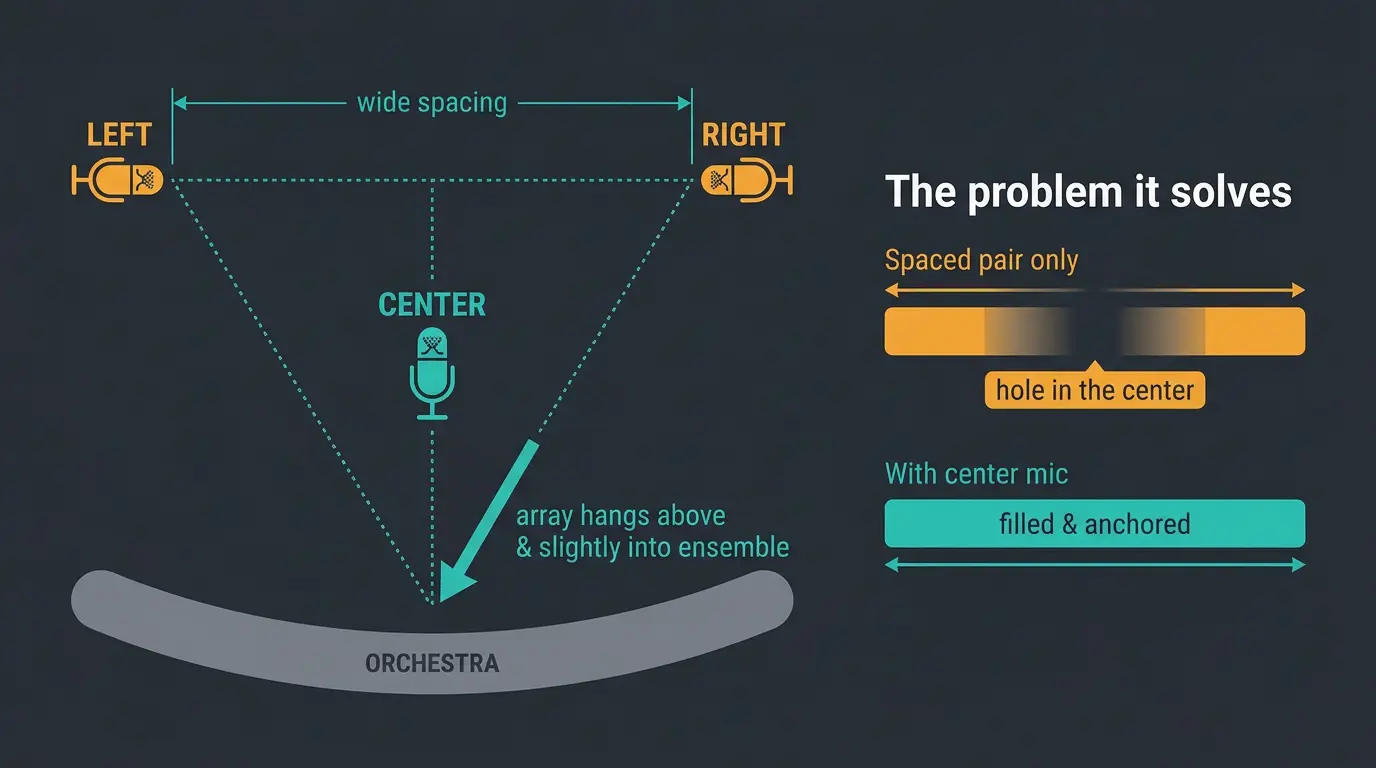
At its core, the Decca Tree is three microphones arranged as an isosceles triangle — picture an inverted T. You've got two mics spaced wide apart on the sides and a third mic pushed forward in the center.
Here's the problem it solves. When you space a stereo pair far apart, you decorrelate the left and right signals, which gives you a wide, spacious image and helps avoid phase issues. Great for width. But you pay for it with a weak, hollow spot right in the middle — the famous "hole in the center." A big orchestra ends up feeling unnaturally split into two halves.
The center mic fills that hole. It anchors the middle of the image so everything holds together. One more thing worth knowing: the array doesn't sit politely out front. It hangs above and slightly into the orchestra, giving you a bird's-eye perspective on the whole ensemble.
The real history (and a couple of myths to clear up)
The technique was developed in the early 1950s at Decca Records and first used commercially in 1954 by engineer Roy Wallace, working with Arthur Haddy. That much you'll see repeated everywhere.
What gets told wrong all the time is that it started with omnidirectional mics. It didn't. When Wallace first used the array in Geneva in 1954, he reached for Neumann cardioid KM 56s, tilted roughly 30 degrees toward the orchestra. The switch to omnis came later, and it's a big part of the story.
The person who usually gets left out is Kenneth Wilkinson. He's the one who standardized the whole thing so it gave repeatable results session to session. Wilkinson moved to omnidirectional Neumann M 50s and added two outrigger mics on the sides, creating the five-mic version most people picture today.
And the name? That comes from Haddy looking up at the contraption hanging over the podium and grumbling, "It looks like a bloody Christmas tree." The name stuck. If you want to go deeper on the timeline, the Decca tree entry on Wikipedia is a solid starting point.
Why the Neumann M 50 (and why it's back)
The M 50 came out in 1951 and became the mic of choice for the tree. There's a technical reason for that, and it's the part most write-ups skip over.
The M 50 isn't a true omni. Its small pressure capsule is mounted in a 40mm sphere, which gives it high-frequency lift and a bit of directivity as you go up in frequency. That's not a flaw — it's the whole point. That behavior actually helps the imaging, giving you precise placement, controlled highs, and deep, extended low end all at once. That's why engineers kept coming back to it for large ensembles. If you want the background on how capsule directionality shapes sound, our guide to microphone polar patterns covers it.
The original M 50 has been out of production for decades, surviving only as pricey vintage units. That changed in January 2026, when Neumann announced the M 50 V at NAMM. They kept the original acoustic concept — the sphere-mounted capsule — but updated the guts. It uses a new K 33Ti capsule with an ultra-thin titanium diaphragm for better stability, a new 5703 tube in place of the discontinued original, and a modernized, better-shielded power supply. Matched sets are available too, which matters a lot for tree use since your three mics need to agree with each other.
If a tube reissue isn't on the table, you've got real options. The DPA 4006 is a common choice, and Neumann's own solid-state TLM 50 gets used as the center mic for a lot of the same reasons the original does. With that being said, if you can get your hands on matched M 50s, that's the classic sound.
How to set up a Decca Tree
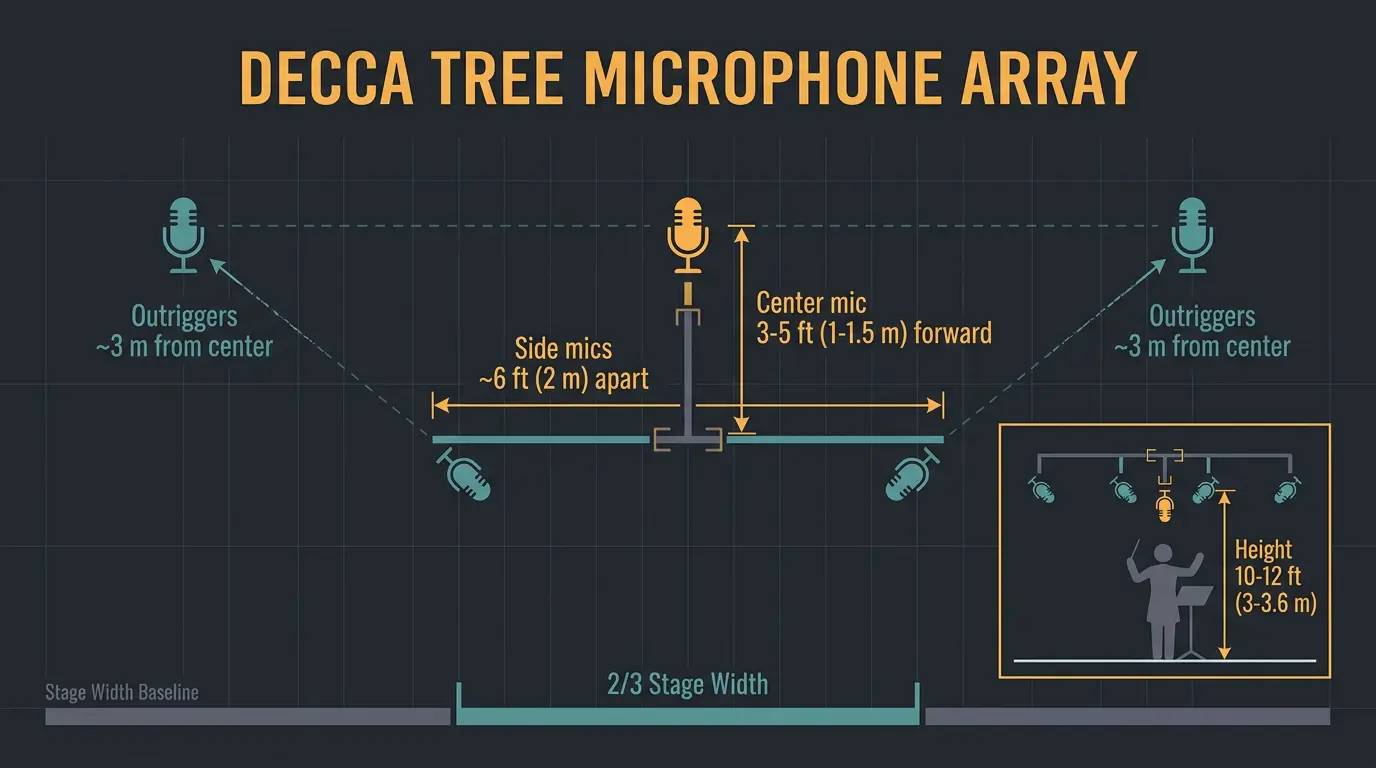
The standardized dimensions are the ones Wilkinson landed on, and they've held up well. Here's the basic three-mic layout:
- Side mics: roughly six feet (two meters) apart, angled down and outward.
- Center mic: pushed three to five feet (about 1 to 1.5 meters) forward of the side mics, angled downward.
- Height: the whole array sits about 10 to 12 feet (3 to 3.6 meters) off the floor, above and in front of the conductor.
For the five-mic version, you add two outriggers. Place them at the same height as the main tree, roughly 3 meters left and right of center, sitting at about two-thirds of the stage width. These widen the whole picture and pull in more of the outer ensemble.
Make sure you get your matched mics as consistent as you can — if the three tree mics don't share a character, the imaging gets muddy. You can buy purpose-built bars like the Grace Design Spacebar or the AEA Decca Tree, but plenty of engineers build their own. A DIY tree works completely fine. The geometry is what matters, not the branding on the bar.
Routing and mixing the tree
The routing is refreshingly simple. The center mic goes equally to both channels. The right tree mic and right outrigger go to the right channel, and both left mics go to the left. That's the tree itself handled.
From there you add spot mics as sweeteners to taste. Violins usually get panned left, cellos right, and you might spot the harp, timpani, and any soloist to place them in the image. Less is more here — the tree is doing the heavy lifting, and the spots are just there to nudge things into focus.
The Decca Tree in surround and Dolby Atmos
Here's where the technique is genuinely evolving. The tree isn't just a stereo trick anymore — it's become a foundation for immersive and Atmos film scoring.
The common move is to layer height mics above the standard tree to feed the ceiling speakers. Engineers put up their normal tree plus spot mics, then add an elevated array to cover the top layer for Atmos delivery. There are purpose-built products for this now too — Schoeps makes a Decca Tree-3D set built for 5.1.4 formats like Dolby Atmos and Auro-3D, extending the classic array up into surround and height channels.
Neumann is leaning right into this, positioning the new M 50 V explicitly for stereo, surround, and immersive work. And if you go down the immersive road, you'll run into a couple of related arrays engineers pair with the tree: the Fukada Tree for a fuller surround pickup, and the Hamasaki Square — four bidirectional mics arranged in a square to capture the diffuse, ambient part of the room. The tree gives you the front image; those help fill out everything around and above it.
Decca Tree quick reference
- Three mics in an isosceles triangle: two wide side mics plus a center mic pushed forward to fill the hole in the middle of the stereo image.
- The Neumann M 50 is the classic mic for it, thanks to its sphere-mounted capsule. The DPA 4006 and Neumann TLM 50 are common alternatives.
- Standard spacing: side mics about two meters apart, center mic three to five feet forward, whole array 10 to 12 feet up over the conductor.
- It's no longer stereo-only. Layer height mics above the tree to feed ceiling speakers for surround and Dolby Atmos.
Frequently Asked Questions (FAQs)
What is the Decca Tree used for?
The Decca Tree is used to record large ensembles like orchestras with a wide, natural stereo image. It's the go-to technique for classical recordings and film scores because it captures the whole room in a way that feels realistic and holds together in the center.
What microphones do you need for a Decca Tree?
Traditionally you need three matched Neumann M 50s, the omnidirectional tube mic the technique was built around. If those aren't within reach, the DPA 4006 and Neumann's solid-state TLM 50 are common, well-respected alternatives that get you most of the way there.
What are the standard Decca Tree dimensions?
The side mics sit about six feet (two meters) apart, with the center mic pushed three to five feet forward, forming a triangle. The whole array hangs roughly 10 to 12 feet off the floor, above and slightly into the orchestra over the conductor.
Can you use a Decca Tree for Dolby Atmos?
Yes, the Decca Tree is widely used as the front foundation for Dolby Atmos and immersive recordings. Engineers add height mics above the standard tree to feed the ceiling speakers, and purpose-built sets like the Schoeps Decca Tree-3D extend it into surround and height channels.
Do you need the outriggers, or is three mics enough?
Three mics is a complete, working Decca Tree and sounds great on its own. The two outriggers, added in the five-mic version, widen the image and pull in more of the outer ensemble. Use them when you want a bigger picture, but you're not doing it wrong with just three.
Final Thoughts
The Decca Tree has lasted this long because it works. It solves a real problem — the hole in the center of a widely spaced pair — with three mics and a bit of geometry, and it still sounds fantastic seventy years later.
With the M 50 back in production and the technique branching out into immersive and Atmos work, it's a good time to actually try one. Build a tree, borrow some mics, and let's give it a listen. Trust your ears from there.
Some of the links within this article are affiliate links. These links are from various companies such as Amazon. This means if you click on any of these links and purchase the item or service, I will receive an affiliate commission. This is at no cost to you and the money gets invested back into Audio Sorcerer LLC.