Here's the part nobody tells you up front: your song is already copyrighted. The second you record it, U.S. law considers it protected. No form, no fee, no waiting.
So the real question isn't how do I copyright my song — it's why should I register it. And the answer is simple. Automatic copyright makes you the owner. Registration is what gives you teeth in court if someone ever rips you off. Let's walk through it plainly.
TABLE OF CONTENTS
The two copyrights in every song
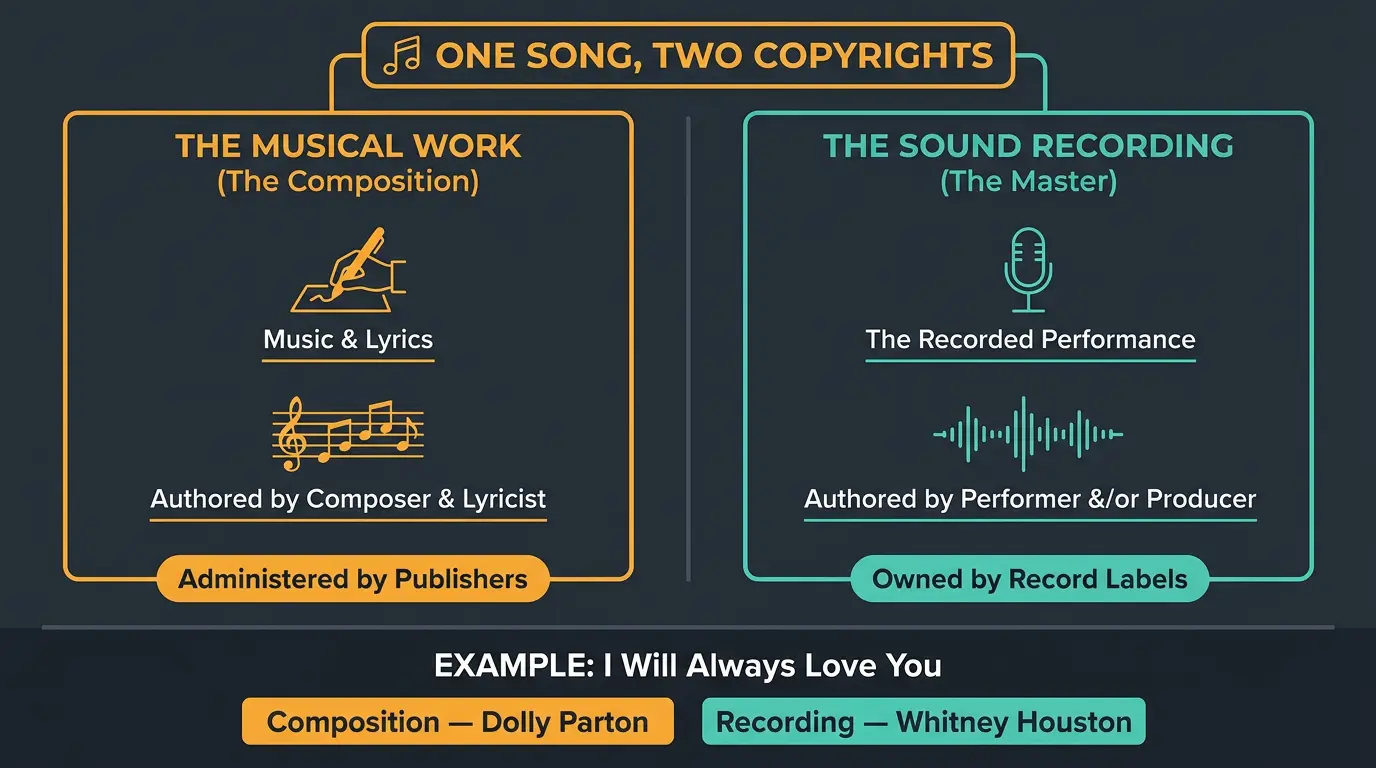
This trips up almost everyone, so let's clear it up first. Every recorded song actually contains two separate copyrights.
- The musical work (the composition) — the music and lyrics themselves. This is authored by the composer and the lyricist.
- The sound recording (the master) — the actual recorded performance and production. This is authored by the performer, the producer who captured and shaped those sounds, or both.
The easiest way to make this stick is Whitney Houston's "I Will Always Love You." That song was written by Dolly Parton, so Dolly owns the composition. Whitney's recording of it is a completely separate work with its own copyright. Same song, two copyrights, two owners.
In the real world, publishers usually administer compositions and record labels own the recordings. If you want to go deeper on the recording side specifically, here's a solid overview of sound recording copyright.
One more thing while we're here. "Mechanical" and "performance" are types of royalties — not types of copyright. You'll hear people mix these up constantly. We'll come back to it, but keep that filed away.
Your song is already copyrighted — so why register?
Copyright kicks in the moment your work is "fixed" — meaning recorded or written down. That's automatic. Registration is a separate step, and it's the one that matters when things go wrong.
Without registration, someone can use your song and your options are basically letters they can ignore. With registration, you can actually take it to federal court and go after real remedies.
Those remedies have teeth. Under 17 U.S.C. § 504, statutory damages run from $750 to $30,000 per work infringed — and up to $150,000 for willful infringement. You can also recover attorney's fees, which changes the whole math of whether a case is worth pursuing.
But timing is everything. If you register after someone infringes, you generally lose access to statutory damages and fees. So register early, before there's a problem. Make sure you don't wait until you need it to find out it's too late.
Why registration is worth the small fee
- It gives you the right to actually enforce your ownership in federal court, not just send letters people can ignore.
- It unlocks statutory damages and attorney's fees, which makes going after an infringer realistic instead of a money pit.
- Your protection dates back to the day you submit, even though processing takes a few months.
How to register with the U.S. Copyright Office
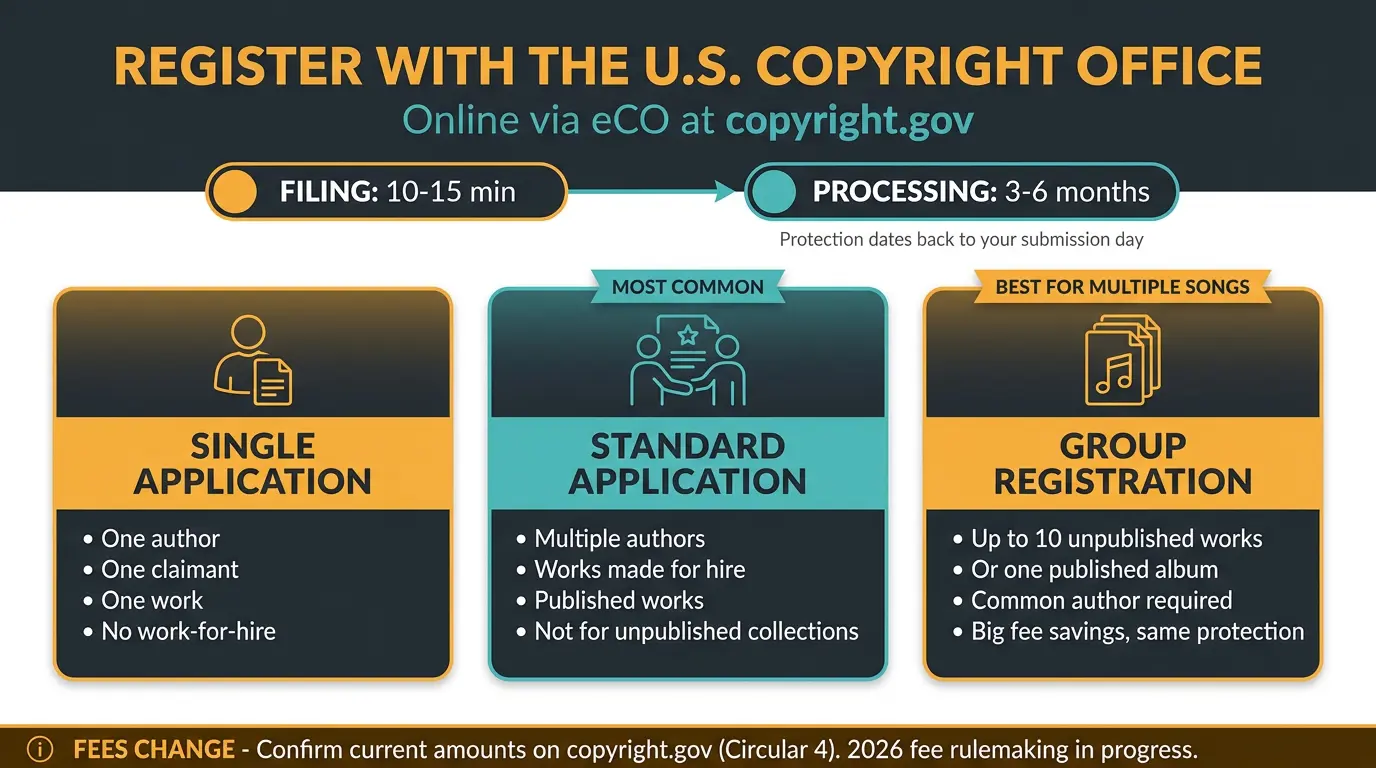
You register online through the U.S. Copyright Office's eCO system at copyright.gov. Filing takes about 10 to 15 minutes. Processing takes roughly 3 to 6 months — but again, your protection dates back to the day you submit, so the wait doesn't cost you anything.
There are three online paths, and picking the right one saves you grief:
- Single Application — the narrow lane. One author, one claimant, one work, and no work-for-hire. Perfect if you wrote and own a single song by yourself.
- Standard Application — the most common one. It handles multiple authors, works made for hire, and published works. One catch: it can't be used to register a collection of unpublished works. Try to bundle several on it and the Office may register just one and drop the rest.
- Group registrations — the smart move for multiple songs. You can register up to ten unpublished works together, or a group of works published on the same album, as long as they share a common author. Registering ten songs individually versus as a group is a big difference in fees for the exact same legal protection.
A note on money: the Copyright Office sets the fees, and a 2026 fee rulemaking is currently in progress. That means the exact dollar amounts can change. Before you file, confirm the current fees on copyright.gov (Circular 4) so you're working from real numbers.
Registering composition and recording together
You can register both copyrights on a single application — but only if ownership is exactly the same for both.
The streamlined Single Application works only when all three of these are true: the composition and the sound recording are on the same phonorecord, you're the only performer on the recording, and you're the sole owner of both works. That's the classic solo-artist situation: you wrote it, you played it, you own it.
If any of those don't hold — say there's a featured performer or a co-writer — you use Form SR to register a claim in both works on one application. Still one filing, just the right form for the situation.
Filing tips that save you headaches
A few practical things on the deposit side. Upload each file individually — don't bundle everything into a ZIP, and keep each file under 500MB. It sounds small, but bad uploads are one of the most common reasons a filing gets held up.
Make sure you also know that special handling exists. That's the Copyright Office's expedited path, and it's available if you've got a compelling need — pending litigation, a customs matter, or a contract or publishing deadline breathing down your neck. There's an added fee for it, but if you're in a genuine time crunch, it's there.
Registering doesn't collect your royalties — here's what does
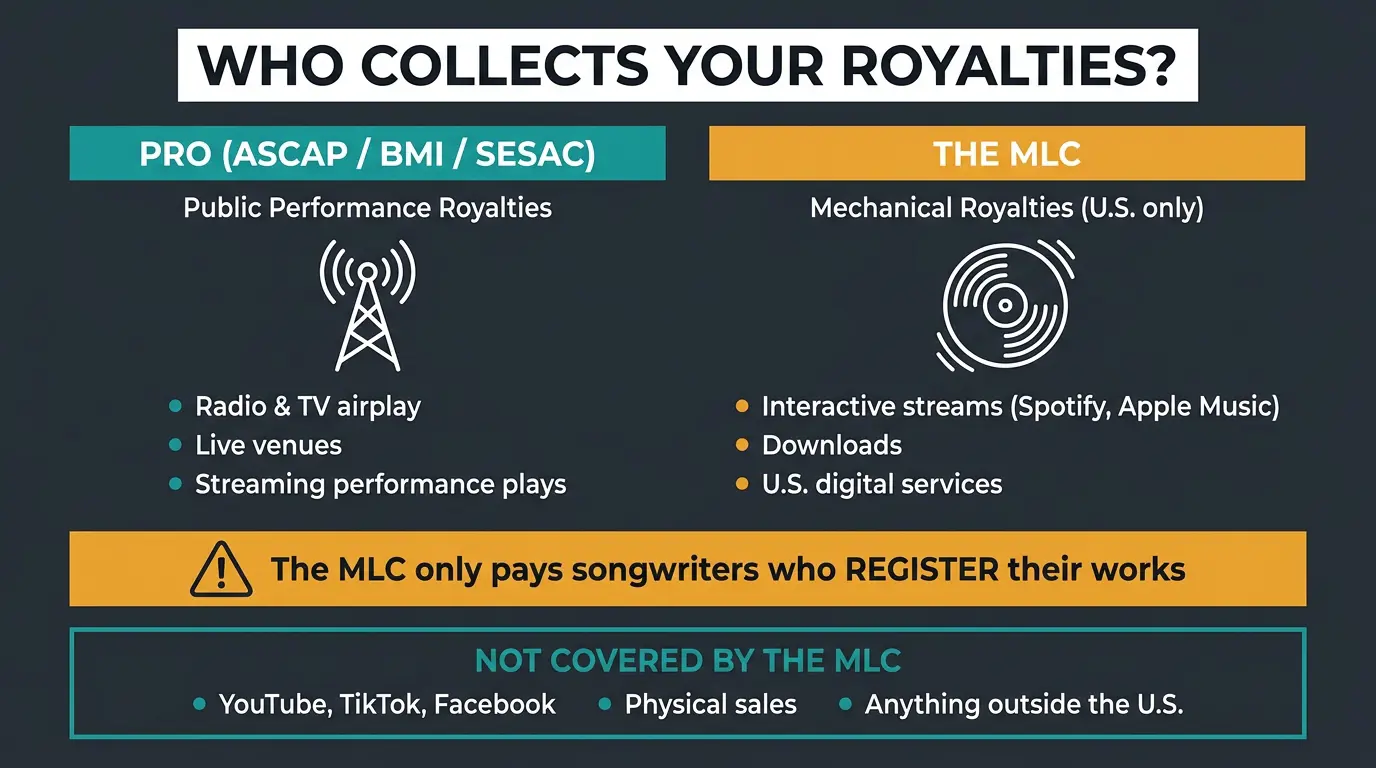
Here's a myth worth killing. Registering your copyright does not collect your royalties. Those are two different jobs done by two different systems.
Let's sort out the royalty side. Your PRO — ASCAP, BMI, or SESAC — collects public performance royalties. That's it. They do not collect mechanicals. If you want to understand the performance side more fully, we've got a full breakdown of what a public performance license actually covers.
Mechanical royalties are a whole separate stream. A mechanical is owed every time your song is reproduced — every interactive stream on Spotify or Apple Music, every download, every physical copy sold. Different royalty, different collector.
Since 2021, mechanicals on U.S. streaming services are handled by the MLC (Mechanical Licensing Collective), created by the Music Modernization Act. The MLC issues blanket mechanical licenses to eligible U.S. digital services and pays out the resulting royalties. But be clear on the scope — it covers interactive streaming and download DSPs in the U.S. only. It does not cover YouTube, TikTok, or Facebook, it does not cover physical sales, and it does not cover anything outside the U.S.
And this is the part people miss: the MLC only pays songwriters who've actually registered their works with it. Register your works, or the money just sits there. Between your PRO, the MLC, and knowing where each royalty comes from, the collection side deserves as much attention as the copyright side. It's the same mindset behind understanding deals like a 360 deal — knowing exactly who's collecting what.
Frequently Asked Questions (FAQs)
Is my song copyrighted before I register it?
Yes. Your song is copyrighted automatically the moment it's recorded or written down — U.S. law calls this being "fixed." No form or fee required. Registration is a separate step that gives you the right to enforce that copyright in court and go after real damages.
Do I need to register the composition and the recording separately?
Not always. If you own both the composition and the recording exactly the same way, you can register them together on one application. Use the streamlined Single Application when you're the sole author, performer, and owner, or Form SR when there are co-writers or featured performers involved.
How long does copyright registration take?
Filing takes about 10 to 15 minutes online, and processing runs roughly 3 to 6 months. The good news is your protection dates back to the day you submit, not the day it's approved, so the wait doesn't leave a gap in your coverage.
Do PROs collect mechanical royalties?
No. PROs like ASCAP, BMI, and SESAC collect public performance royalties only. Mechanical royalties are a separate stream, owed every time your song is reproduced through streams, downloads, or physical sales. In the U.S., those are handled by the MLC, not your PRO.
Do I need to sign up with the MLC to get paid?
Yes, if you want your U.S. streaming mechanicals. The MLC only pays songwriters who've registered their works with it, so unregistered work means the money sits uncollected. Note it covers U.S. interactive streaming and downloads only — not YouTube, TikTok, physical sales, or anything overseas.
Final Thoughts
Copyright is one of those things that feels like paperwork until the day it isn't. Your song's already protected the moment you hit record, but registration is the piece that actually lets you defend it. Do it early, do it once, and you're covered.
Then remember that protecting your song and getting paid for it are two different jobs. Register with the Copyright Office for the rights, and register with the MLC and your PRO for the royalties. Handle both, and your music is actually working for you instead of just sitting there.
Some of the links within this article are affiliate links. These links are from various companies such as Amazon. This means if you click on any of these links and purchase the item or service, I will receive an affiliate commission. This is at no cost to you and the money gets invested back into Audio Sorcerer LLC.