An ISRC is the digital fingerprint on your recording. It's a small code embedded in your track's metadata that lets your music get tracked, credited, and paid across every platform and territory. If you're releasing a song commercially, it needs one. No exceptions.
Here's the thing, though. A lot of the guides floating around online get the details wrong. They call it "12 digits" (it isn't), they tell you the prefix reveals your country of origin (it doesn't), and they use terminology the standard retired years ago. This one is current and accurate. Let's get into it.
TABLE OF CONTENTS
What an ISRC code actually is
ISRC stands for International Standard Recording Code. It's a 12-character unique, permanent identifier for a specific recording. Think of it as a digital fingerprint embedded in the track's metadata, so it can be tracked, credited, and monetized wherever it goes.
Here's the part people miss: an ISRC identifies the recording, not the song. Those are two different things. The song is the composition — the melody, the lyrics, the chords. The recording is the specific performance you captured and mixed.
The code is also format-independent. Whether your track lives on a CD, a download, or a stream, the ISRC stays the same. And it stays with the recording no matter who owns the rights down the line.
The four parts of an ISRC, broken down
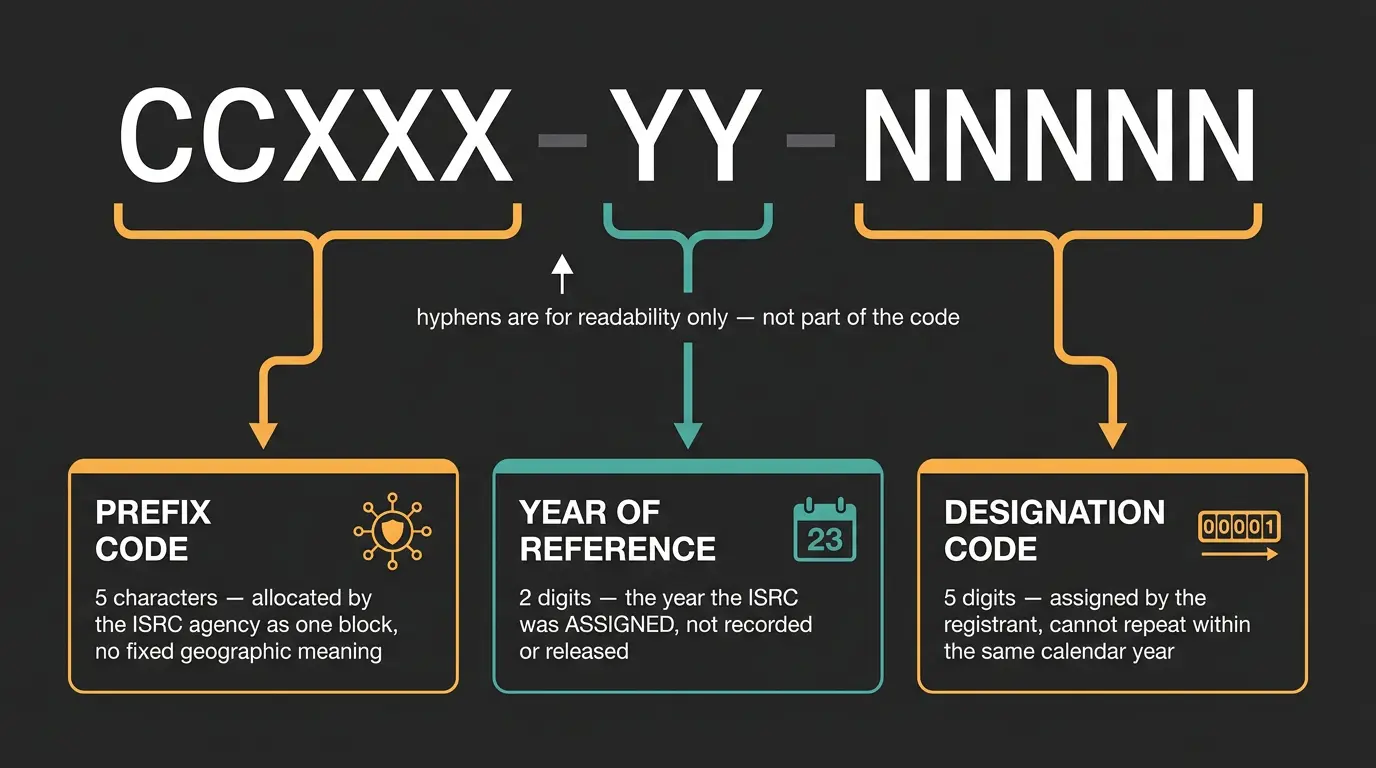
An ISRC is often written in the form CC-XXX-YY-NNNNN. Quick note before we go further: those hyphens are just there for readability. They're not actually part of the code. You'll see them in print because it's easier to read that way.
The code breaks into three meaningful segments. First is the Prefix Code — five characters allocated by the ISRC agency. This used to be split into a "country code" plus a "registrant code," but under the current standard it's treated as one allocated block with no fixed geographic meaning.
Next is the Year of Reference — two digits. And this trips people up: it's the year the ISRC was assigned, not the year the track was recorded or released. So a 2026 code on a song you cut in 2019 is correct, not a mistake.
Last is the Designation Code — five numeric digits the registrant assigns, and these can't repeat within the same calendar year.
| Segment | Length | What it means |
|---|---|---|
| Prefix Code | 5 alphanumeric characters | Allocated by the ISRC agency. No fixed geographic meaning under the current standard. |
| Year of Reference | 2 digits | The year the ISRC was assigned — not recorded, not released. |
| Designation Code | 5 digits | A unique number the registrant assigns, not repeated in the same calendar year. |
Two ISRC myths worth killing
- It is not 12 digits — it's 12 characters. The code mixes letters and numbers, and only the last five (the Designation Code) are numeric. Anyone calling it "12 digits" is working from an old script.
- The prefix does not tell you the country of origin. It only reflects where the registrant got their prefix allocated. US registrants can end up with US, QM, QZ, or QT prefixes because US demand exhausted the supply of registrant codes. So if you audit your catalog and spot a QZ prefix, don't panic — that's a perfectly normal US allocation, not an error.
ISRC vs. ISWC vs. UPC
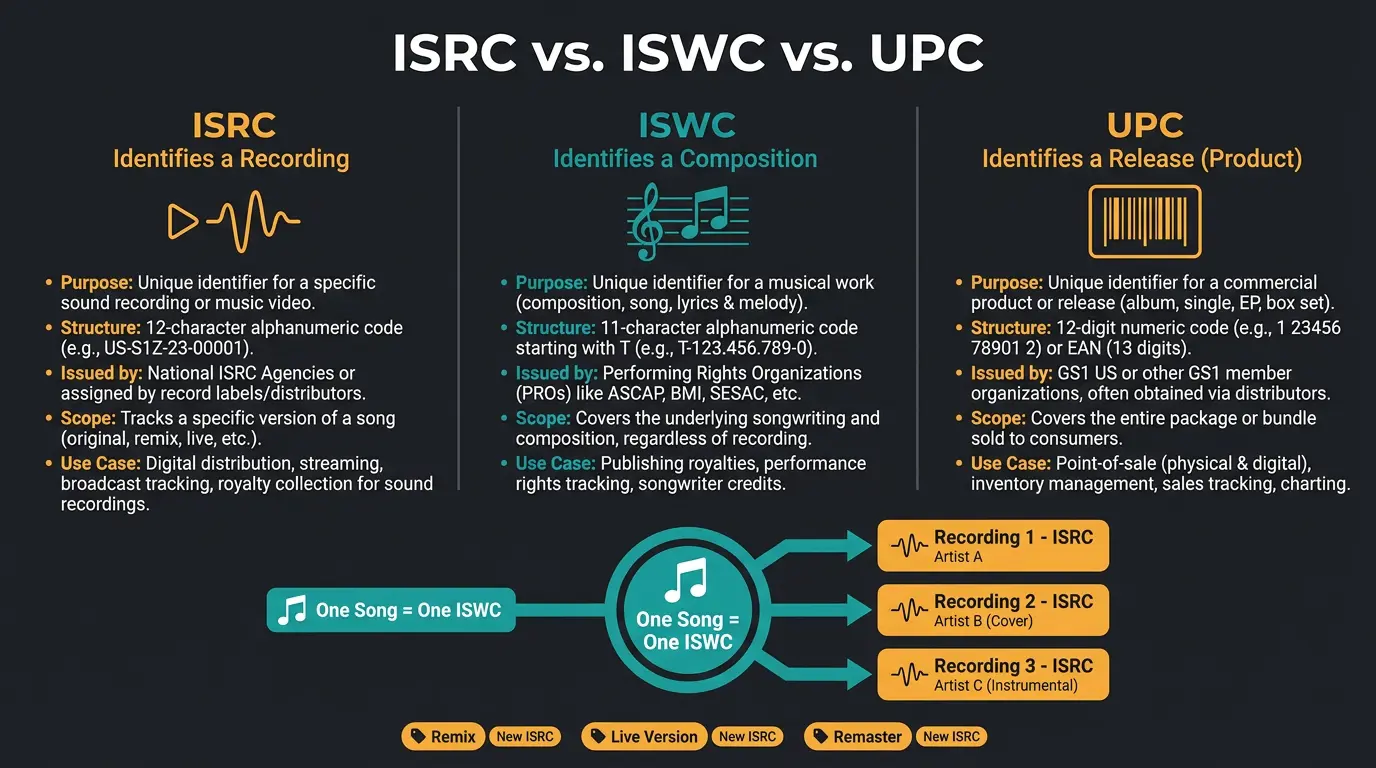
These three get mixed up constantly, so let's sort them out fast. The ISRC identifies a specific recording. The ISWC identifies the underlying composition — the song itself. And the UPC identifies the release or album as a product.
Here's the clean example. If three different artists record the same song, each recording gets its own ISRC, but all three share one ISWC. Same song underneath, three different recordings on top.
This is also why remixes, live versions, and remasters each get a brand-new ISRC. Every distinct version of a recording is its own thing as far as royalty reporting and metadata systems are concerned. It keeps one version from getting confused with another. If you're thinking about the composition side of the equation, it's worth understanding how to copyright a song so the underlying work is protected too.
How to get an ISRC code
There are three routes, and one of them covers the vast majority of people reading this.
- Through a distributor. CD Baby, DistroKid, TuneCore and the rest assign ISRCs automatically when you upload. This is the easiest and most common way, and for most independent artists it's all you'll ever need.
- Through your national ISRC agency. If you want your own registrant prefix, you go straight to the source. In the US that's the RIAA-run agency at usisrc.org. Internationally, ISRC is managed by IFPI.
- Through a CD manufacturer or authorized provider. Less common now, but still an option if you're pressing physical.
The big update from the old days: codes are typically free and instant now. Make sure you avoid any site charging you for a plain ISRC — that's money you shouldn't be spending. For a deeper reference on how these identifier standards work, the overview of the International Standard Music Number system is a solid read.
Your ISRCs move with you when you switch distributors
This one gets missed all the time. Your ISRCs belong to the recording, not the distributor. So when you jump from one platform to another, don't let the new one assign fresh codes.
Instead, enter your existing ISRCs manually in the new distributor. That preserves your streaming history and keeps your royalty continuity intact. Fresh codes on the same recording split your history in two, and nobody wants that.
One caveat worth knowing: standard public uploads to YouTube, Bandcamp, or SoundCloud don't assign ISRCs. Some distribution-backed tiers (like SoundCloud's distribution option) may assign them during delivery, but a plain public upload won't.
ISRCs and charting
If you've got any chart ambitions, this matters. To be considered for the Billboard charts, each track needs its own ISRC. No code, no counting.
The tracking is handled by Luminate (formerly SoundScan), the company that powers the Billboard charts. Every sale and stream tied to your code gets counted through that system. So the ISRC isn't just plumbing — it's how your numbers actually show up.
Frequently Asked Questions (FAQs)
Do I need an ISRC for every song?
Yes. Every commercially released recording needs its own ISRC. That includes remixes, live versions, and remasters, since each one is a separate recording. The good news is your distributor handles this automatically when you upload, so it's rarely something you set up by hand.
Are ISRC codes free?
Yes, ISRC codes are typically free and instantly generated now. Don't pay for a plain code — any site charging you for a basic ISRC is one to avoid. Your distributor assigns them at no extra cost, and national agencies issue them without gouging you either.
Does a QZ prefix mean my code is wrong?
No, a QZ prefix is a perfectly normal US allocation. US registrants can receive US, QM, QZ, or QT prefixes because demand exhausted the original supply of US registrant codes. So if you spot a QZ code in your catalog, it's not foreign and it's not an error.
Does a remix need its own ISRC?
Yes, a remix gets its own ISRC. Any new version of a recording — remix, live take, remaster — is treated as a distinct recording, so it needs a distinct code. This keeps royalty reporting clean and stops one version from being confused with another in metadata systems.
Does the year in my ISRC mean the recording year?
No. The two-digit year in an ISRC is the year the code was assigned, not the year the track was recorded or released. So a code with a 2026 year on a song you wrote in 2019 is completely correct. It's about assignment, not creation.
Final Thoughts
ISRCs aren't glamorous, but they're the thing that makes sure your work gets counted and paid. Get the basics right — 12 characters not digits, the prefix doesn't reveal your country, and the year is when the code was assigned — and you're already ahead of most of the guides out there.
For most of you, your distributor already handles all of this. Just make sure you carry your existing codes with you when you switch platforms, and you'll keep your history intact. And if you're getting into the business side of releasing, understanding how sync licensing works is a good next stop.
Some of the links within this article are affiliate links. These links are from various companies such as Amazon. This means if you click on any of these links and purchase the item or service, I will receive an affiliate commission. This is at no cost to you and the money gets invested back into Audio Sorcerer LLC.