A sync agent pitches your music to music supervisors and takes a cut when a placement lands. No upfront cost. You only pay when they get you paid.
Sync used to mean film and TV. That framing is way too narrow now. The money shows up in streaming originals, ads, games, trailers, TikTok trends, and short-form content nobody thought about a few years ago.
There's more going on than most people realize. A single placement can pay you twice, not once. And AI has completely shaken up the bottom of the market while making the human stuff more valuable at the top. Let's get into how it actually works.
TABLE OF CONTENTS
What a sync agent actually does
Sync agents, publishers, and publishing administrators do the legwork. They pitch your tracks to supervisors, work out the fees, clear the rights, and chase the paperwork so a deal doesn't fall apart. The job is part sales, part legal, part hustle.
They get paid on commission, which means no cost to you until something lands. At the artist-friendly end, that's roughly 15% to 25% of the sync fee. Depending on the agency and how much they do for you, it can run all the way up to 50%. Contracts usually run one to three years.
That's a wide range, and it should be. A boutique agent taking 20% and doing focused work is a different deal than a big platform taking half and pitching your song alongside thousands of others. Read what they're actually offering before you sign.
Exclusive vs. non-exclusive deals
With an exclusive deal, one agent has the sole right to pitch your catalog. The upside is dedicated attention and a real stake in your success — they invest more because they're the only ones who profit. The downside is you lose flexibility, and if they underperform, you're stuck until the term ends.
Non-exclusive means you can work with several agents at once. More lines in the water, less commitment to any one relationship.
There isn't one right answer here. Trust your read of the situation and the people involved. A new writer might want exclusive attention from someone hungry, while a bigger catalog might do better spread across a few non-exclusive partners.
The two income streams from one placement
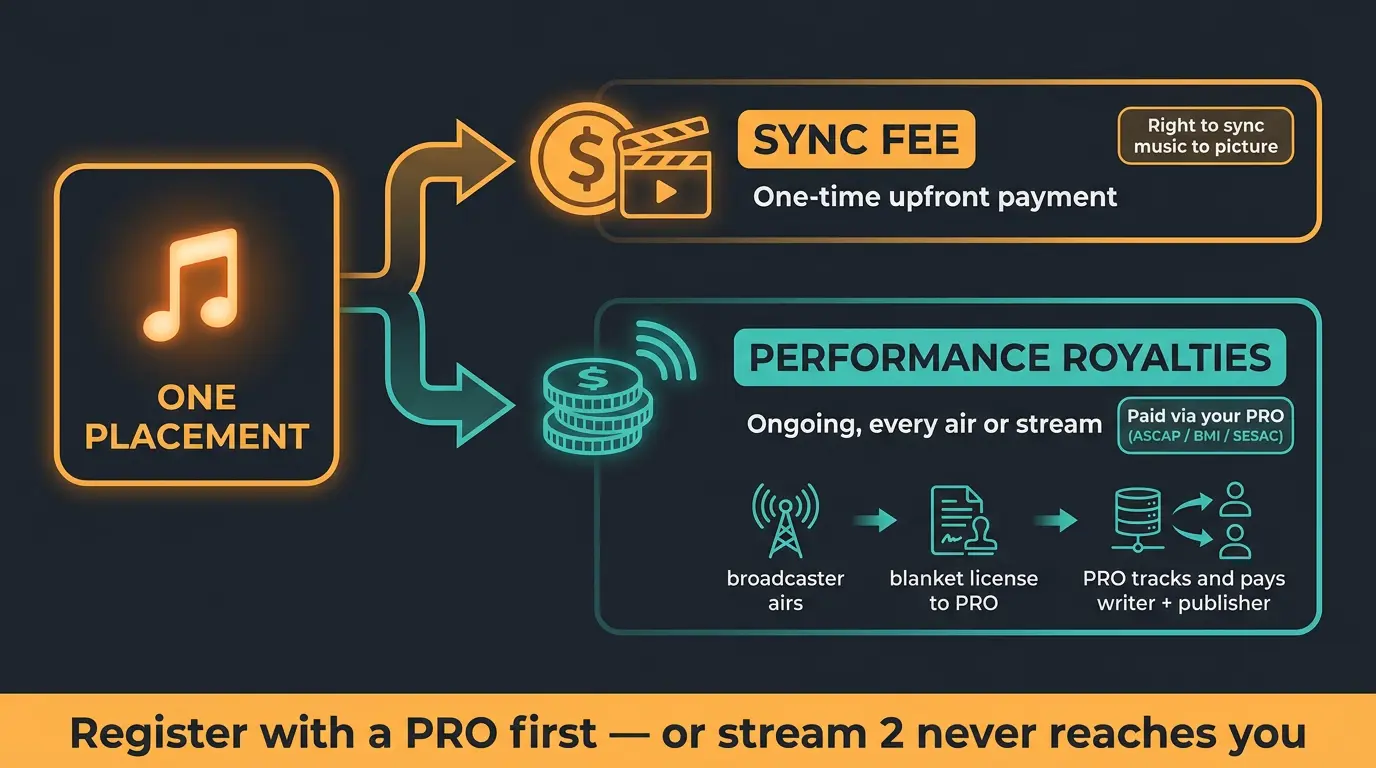
Here's the thing a lot of people miss: a placement doesn't pay once. It pays twice, through two completely different systems.
The first is the upfront synchronization fee — the one-time payment for the right to sync your music to picture. That's the number people talk about. The second is ongoing performance royalties, and they flow every single time the show, ad, or film airs or streams.
Your PRO handles that second stream, not the sync fee. When a broadcaster airs the placement, they pay a blanket performance license to ASCAP, BMI, or SESAC. The PRO tracks it and pays the writer and publisher their share. If you want to understand how performance collection works alongside your recording royalties, our breakdown of what SoundExchange is and why it matters is worth a read.
Make sure you're registered with a PRO before you ever chase a placement. If you're not, that second income stream just doesn't reach you.
Where sync placements actually happen now

TV, movies, and national commercials are still the mainstays. But if that's all you're thinking about, you're missing most of the market.
Placements now happen across streaming originals, YouTube creators, TikTok trends, video games, apps, movie trailers, and branded content. Micro-syncs are a real category now — short placements in creator content pay less per use, but they add up over time. Music libraries do a lot of the heavy lifting too; they power a large majority of placements today.
Short-form virality has sped everything up. A track that catches on can generate tens of millions of streams in days, and that demand loops right back into licensing.
Fees run across an enormous spread. An indie limited-time license might land low, while a top-tier national campaign for a well-known song can run into the hundreds of thousands. Where you fall depends entirely on the use. If you want the fundamentals, our full guide to making money from sync licensing covers it.
The exposure payoff is real
"Exposure" gets thrown around so much it stopped meaning anything. So let's anchor it to something concrete.
When Kate Bush's "Running Up That Hill" landed in Stranger Things, streams jumped over 9,000%. The song came out in 1985 and had originally peaked at No. 30. After the placement, it re-entered the charts and hit No. 1 on Hot Alternative Songs. The effect came back with the show's final season, and the track has since passed 1.5 billion streams on Spotify.
It's not a one-off. Orville Peck's "Dead of Night" surged 812% after Euphoria used it. Supervisors treat this as a repeatable play — they target shows with younger audiences and watch Shazam and TikTok to spot the next one.
Now the honest part. This is the ceiling, not the norm. Most placements won't relaunch your catalog. But it's proof the exposure can be worth as much as the check, when the stars line up.
What music supervisors want from you
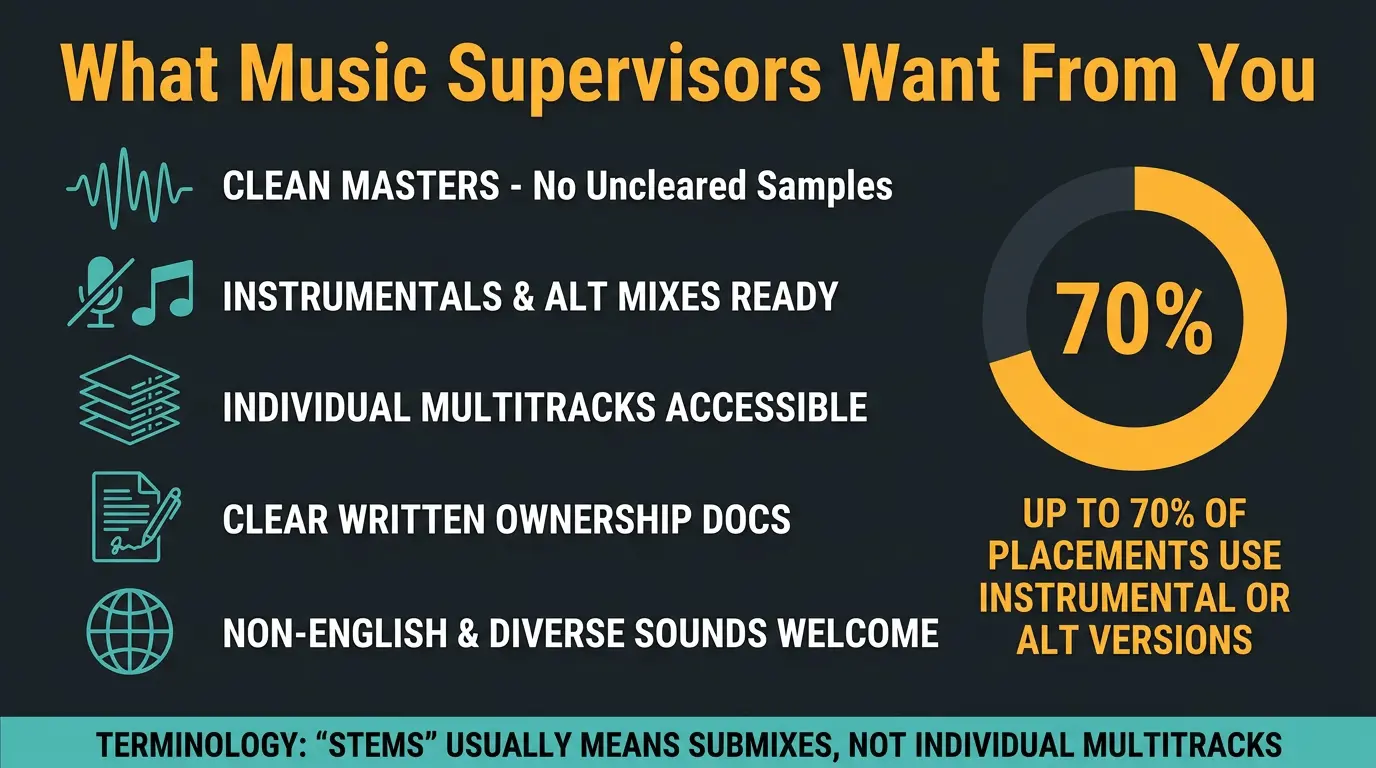
Supervisors get pitched thousands of songs a week and they move fast. The single biggest thing you can do is make your music easy to clear. Legal headaches get songs skipped, no matter how good they sound.
That means clean masters with no uncleared samples, instrumentals and alternate mixes ready to go, individual multitracks accessible, and clear written ownership docs. Quick terminology note, because it matters: the industry loves the word "stems," but most of the time people mean submixes, not the actual individual multitracks. What you call it matters less than handing everything over clean and organized — just know a supervisor asking for one might mean the other.
Up to 70% of placements use instrumental or alternate versions, so those aren't optional extras. And non-English lyrics and globally diverse sounds are mainstream demand now, not a niche.
One more warning. On fees, the buyer almost always knows the market better than you do, which is exactly why new writers leave money on the table. It's also part of why having an agent or publisher in your corner pays off. And before you pitch anything, make sure your ownership is buttoned up — here's how to copyright a song so you can prove what's yours.
Your sync-ready checklist
- Clean masters with no uncleared samples
- Instrumental and alternate versions available
- Multitracks and submixes accessible and organized
- Clear written documentation of who owns what
- Music registered with a PRO so you collect performance royalties
How AI is changing the sync market
This is the biggest shift in sync since we first wrote about it. Supervisors are adopting AI tools for music search, metadata, and rights compliance. That part's just workflow — it makes the searching faster.
The real change is at the low end. Routine functional music — reality-TV tension beds, corporate atmospheres, low-budget ad cues — is being consumed by AI generation at near-zero cost. That's reshaping the traditional library business in a serious way.
But there's strong resistance higher up. In a late-2025 survey of supervisors, filmmakers, and advertisers, the overwhelming majority demanded full transparency about whether music is AI-generated, and roughly half refuse to use it at all. Premium value is concentrating in human, emotive, recognizable music where the story behind the song actually matters. Berklee's look at where music and video are headed in 2026 digs into this shift if you want more.
And here's the caveat that really matters. Fully AI-generated content isn't copyrightable without sufficient human authorship. Music that can't be copyrighted can't be cleared, and music that can't be cleared can't be used. So if you're leaning on AI, keep enough human authorship in the work that you can actually protect it.
Frequently Asked Questions (FAQs)
How much does a sync agent take?
A sync agent typically takes 15% to 50% of the sync fee, with the artist-friendly end sitting around 15% to 25% and larger platforms running higher. There's no upfront cost — you only pay when they land a placement. Contracts usually run one to three years.
Do I need a sync agent or can I pitch myself?
You can pitch yourself, but a good agent has the relationships and knows the market better than you do. Supervisors get thousands of songs a week, so getting through the door is the hard part. Self-pitching works for some, but new writers routinely underprice deals on their own.
What's the difference between a sync fee and performance royalties?
The sync fee is a one-time upfront payment for the right to sync your music to picture. Performance royalties are ongoing payments collected by your PRO every time the show or ad airs or streams. One placement pays you through both, so make sure you're registered with a PRO.
Should I sign an exclusive or non-exclusive sync deal?
It depends on your goals. Exclusive means one agent gets dedicated attention and a real stake in your success, but you lose flexibility if they underperform. Non-exclusive lets you work with several agents at once. There's no single right answer — trust your read of the people involved.
Can I get AI-generated music placed for sync?
Fully AI-generated music generally can't be placed, because content without sufficient human authorship isn't copyrightable, and music that can't be copyrighted can't be cleared or used. AI-assisted work with real human authorship can qualify, but many supervisors demand transparency and some refuse AI outright.
Final Thoughts
Sync is one of the few corners of the music business that's actually growing, and a good agent earns their cut by opening doors you can't reach on your own. Just remember the placement isn't the whole story — the sync fee is the headline, but the performance royalties keep paying long after. Get registered with a PRO and keep your masters clean and clearable.
And don't sleep on the AI shift. The low end is getting automated, which means the human, emotive, well-crafted stuff is worth more, not less. That's a good spot to be if you're making real music. Less is more, but make sure the little you have is buttoned up and ready to pitch.
Some of the links within this article are affiliate links. These links are from various companies such as Amazon. This means if you click on any of these links and purchase the item or service, I will receive an affiliate commission. This is at no cost to you and the money gets invested back into Audio Sorcerer LLC.