C major has no sharps or flats, and its seven diatonic chords are C, Dm, Em, F, G, Am, and Bdim. That's the whole answer up top. Those are the chords you build everything in this key from.
This post covers all seven of them, why C is where most people start, and how to turn them into real progressions you already know from songs. We'll spell out every chord by name and notes, so you can play along as you read.
TABLE OF CONTENTS
The Seven Chords in the Key of C
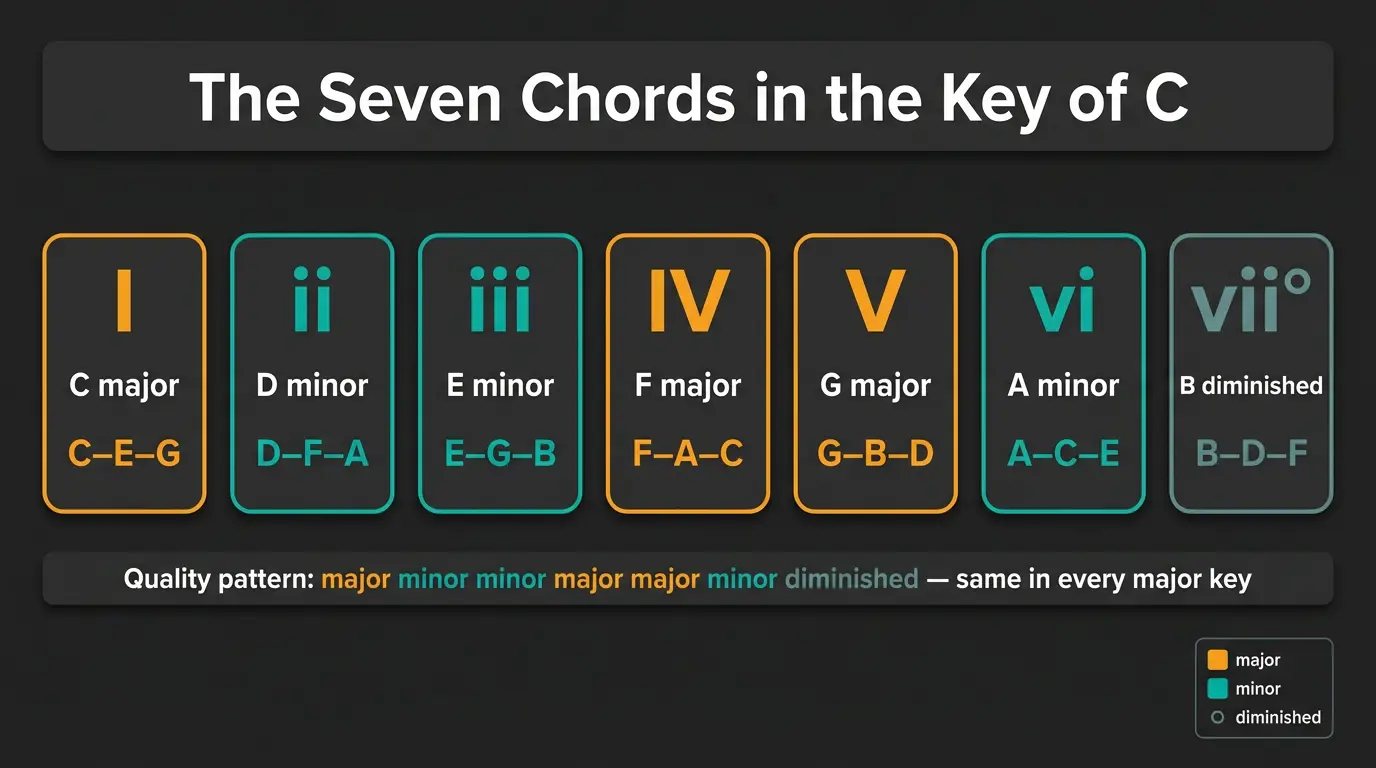
You build the chords by stacking thirds on each note of the C major scale — start on a scale note, skip one, grab the next, skip one, grab the next. Do that on all seven notes and you get the seven chords in the key.
Here they are, with their notes:
- C major — C–E–G
- D minor — D–F–A
- E minor — E–G–B
- F major — F–A–C
- G major — G–B–D
- A minor — A–C–E
- B diminished — B–D–F
We label these with Roman numerals: I, ii, iii, IV, V, vi, vii°. Uppercase means major, lowercase means minor, and the little circle means diminished.
Here's the part that pays off forever. The quality pattern — major, minor, minor, major, major, minor, diminished — is the same for every major key. Learn it once in C and you've got a template you can move anywhere. If you want to go deeper on the numbering, we've got a full write-up on music scale degrees.
The Quick Reference
- I — C major — C, E, G
- ii — D minor — D, F, A
- iii — E minor — E, G, B
- IV — F major — F, A, C
- V — G major — G, B, D
- vi — A minor — A, C, E
- vii° — B diminished — B, D, F
Why C Major Is the Beginner's Key

The big reason is the blank key signature. No sharps, no flats, nothing to track in your head. That's the real conceptual win, and it makes C a clean doorway into theory and sight-reading.
On piano, C major is all white keys, which is about as friendly as it gets. On guitar, the key is built from chords you probably already know — C, G, Am, F, Dm, and Em are all open chords that live right here.
Worth knowing: the relative minor of C major is A minor. Same exact notes, just a different home base, which is how you get a moodier feel out of the same toolbox. If sad and minor is your thing, we go further on that in our post on minor-key chord progressions.
With that being said, easy to think in isn't the same as easy to play. The open C shape on guitar is a bit of a stretch for new hands, so don't feel bad if your pinky isn't cooperating yet. C is the easiest key to understand — physical ease is a separate conversation.
What Each Chord Actually Does
Chords don't just sit there — they have jobs. Three of them carry most of the weight.
The tonic (I = C) is home. It's the resting point, the chord that makes your ears feel settled. The subdominant (IV = F) moves you away from home and creates a sense of motion. The dominant (V = G) builds tension and wants to fall back to C — that pull is the engine behind most resolutions you hear.
I, IV, and V are the workhorses you'll bump into most, with vi, ii, and iii not far behind. Get those three functions in your ear and the progressions coming up will make a lot more sense.
Progressions You Can Play Right Now
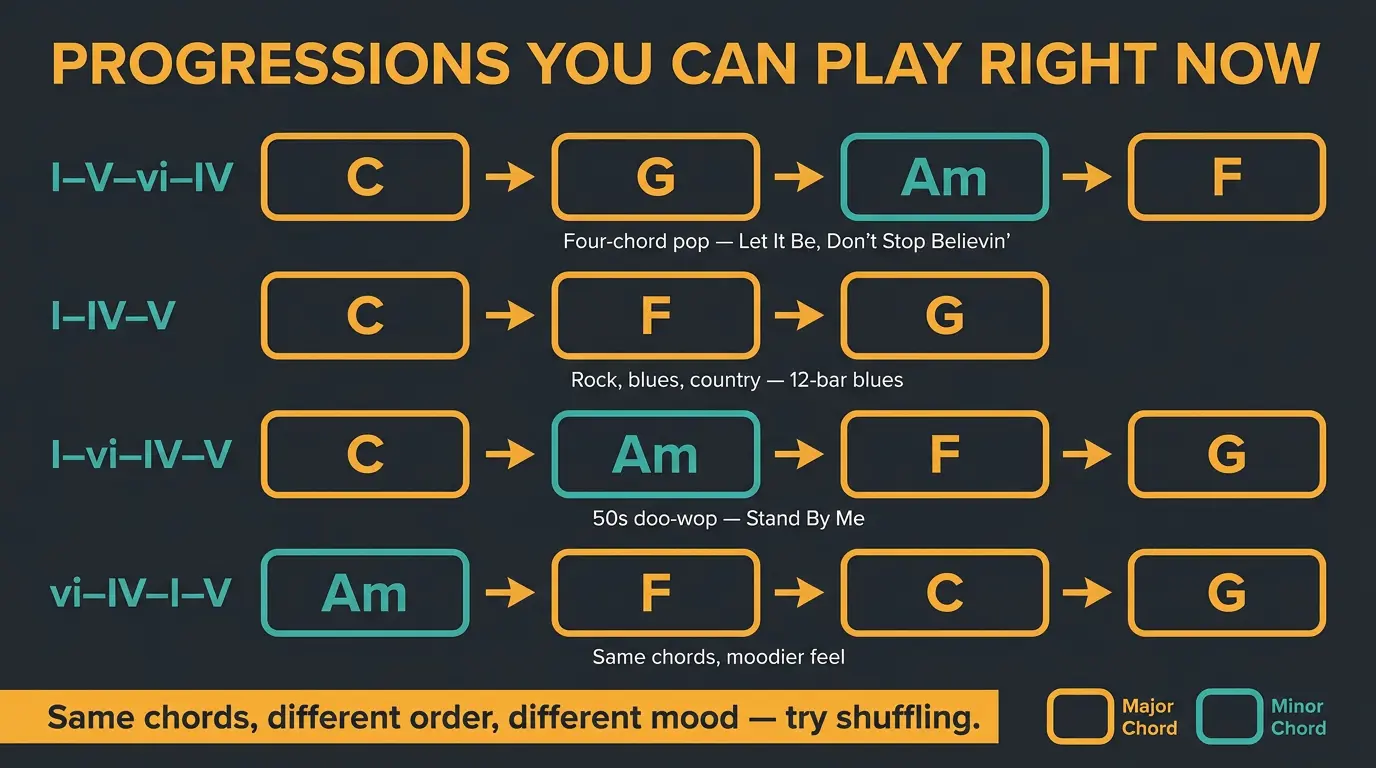
Here are four progressions spelled out in C, with songs you'll recognize.
- I–V–vi–IV (C–G–Am–F) — the four-chord pop progression. You've heard it in "Let It Be" and "Don't Stop Believin'." It balances resolution and tension into a loop you could ride all day. There's a great rundown of its history on the I–V–vi–IV progression Wikipedia page.
- I–IV–V (C–F–G) — the bedrock of rock, blues, and country, and the basis of the 12-bar blues.
- I–vi–IV–V (C–Am–F–G) — the 50s doo-wop sound, like "Stand By Me."
- vi–IV–I–V (Am–F–C–G) — the same four chords as the pop one, just reordered for a moodier feel.
Notice that last one. Same chords, different order, totally different mood. That's the lesson — think in groups of chords, not fixed sequences. Make sure you take any four chords you like and try shuffling the order before you decide a progression is done. For more of these, we collected the common progressions every songwriter should know.
Adding Seventh Chords
Once the triads feel comfortable, you stack one more third on top and get seventh chords. They're richer and a little jazzier. In C, the seven diatonic seventh chords are:
- Cmaj7, Dm7, Em7, Fmaj7, G7, Am7, Bm7♭5
The pattern, just like the triads, is fixed: maj7, m7, m7, maj7, 7, m7, m7♭5. Notice G7 is the only dominant seventh in the bunch. That extra tension is exactly what makes it pull hard back to C.
The classic place this lands is the ii–V–I, which in C is Dm7–G7–Cmaj7. It's the cornerstone of jazz, and it's worth getting under your fingers. We keep it light here — less is more — but if you want the full tour, start with our beginner's introduction to jazz chord progressions.
A Few Things People Get Wrong
A few spots trip people up, so let's clear them out.
Diatonic just means built from notes in the key. C major (C–E–G) is diatonic to C. C minor isn't, because the Eb isn't in the C major scale. That's the whole distinction — there's a fuller breakdown in our post on diatonic vs chromatic.
A chord can belong to more than one key. F major lives happily in both C major and F major. Chords aren't owned by a single key.
The vii° gets ignored, and that's mostly fine. B diminished sits out of a lot of pop, no harm done. But it's genuinely useful as a V substitute or a passing chord, and it shows up all the time in jazz, soundtracks, and classical. Don't write it off forever.
And the real point of Roman numerals isn't labeling for its own sake. It's that the template transposes. Learn I–V–vi–IV in C, and you instantly know it in every other key too.
Frequently Asked Questions (FAQs)
What are the chords in the key of C?
The seven chords in the key of C are C major, D minor, E minor, F major, G major, A minor, and B diminished. They're built by stacking thirds on each note of the C major scale, which has no sharps or flats.
What are the most common C major chords used in songs?
C, F, G, and A minor are the big four you'll run into most. That's the I, IV, V, and vi, and a huge number of songs are built from just those four. Learn them first and you can play along with a lot of music.
Is C major the easiest key?
Conceptually, yes — C major has no sharps or flats, so there's no key signature to track, and on piano it's all white keys. Physically it's a different story. The open C chord on guitar is a stretch for beginners, so easy to think in doesn't always mean easy to play.
What's the relative minor of C major?
The relative minor of C major is A minor. They share the exact same seven notes and the same blank key signature. The only difference is where home base sits, which is why A minor feels darker while using the very same chords.
What's the difference between chords in the key of C and C major chords generally?
Chords in the key of C are the diatonic chords built only from notes in the C major scale — C, Dm, Em, F, G, Am, and Bdim. C major chords generally can include non-diatonic chords, like a C minor or a borrowed chord, that use notes from outside the key.
Final Thoughts
The key of C is a small set of chords that opens up a huge amount of music. Seven chords, a fixed quality pattern, and a handful of progressions — that's the whole starter kit, and the pattern carries straight over to every other major key.
So learn these seven in C, mess with the order, and trust your ears over any rule. There isn't always a right answer in this stuff. Have fun with it.
Some of the links within this article are affiliate links. These links are from various companies such as Amazon. This means if you click on any of these links and purchase the item or service, I will receive an affiliate commission. This is at no cost to you and the money gets invested back into Audio Sorcerer LLC.