Yes, you can absolutely start a song from a chord progression. Most writers do, because having chords there as a guide feels a lot safer than staring at a blank melodic slate.
But here's the tradeoff, right up front: chords-first tends to produce a wandering, shapeless melody if you're not deliberate about it. The chords sound fine on their own, so it's easy to let the tune just drift along on top.
A progression is a foundation, not a finished song. So here's the workflow in order: loop the progression, build the melody, find the lyric, develop the sections. Four steps, and the melody step is where the real work lives.
TABLE OF CONTENTS
Why start with chords at all
A chord progression is just a sequence of chords that repeats to give a song its harmonic foundation and emotional color. It's the bed everything else lies on.
Most writers reach for chords first because starting from a melody feels scary. We're so used to having chords present as a musical guide that humming a tune into silence feels like it'll only produce garbage. That's a real feeling, and it's fine to lean on chords to beat it.
Just set expectations: chords give you harmony, not the whole song. And borrowing a known progression isn't cheating. Chord progressions aren't copyrightable, and the same four chords have built countless completely different songs. If you want a bigger menu to pull from, we've got a whole rundown of common chord progressions every songwriter should know.
Step 1: Pick and loop a progression
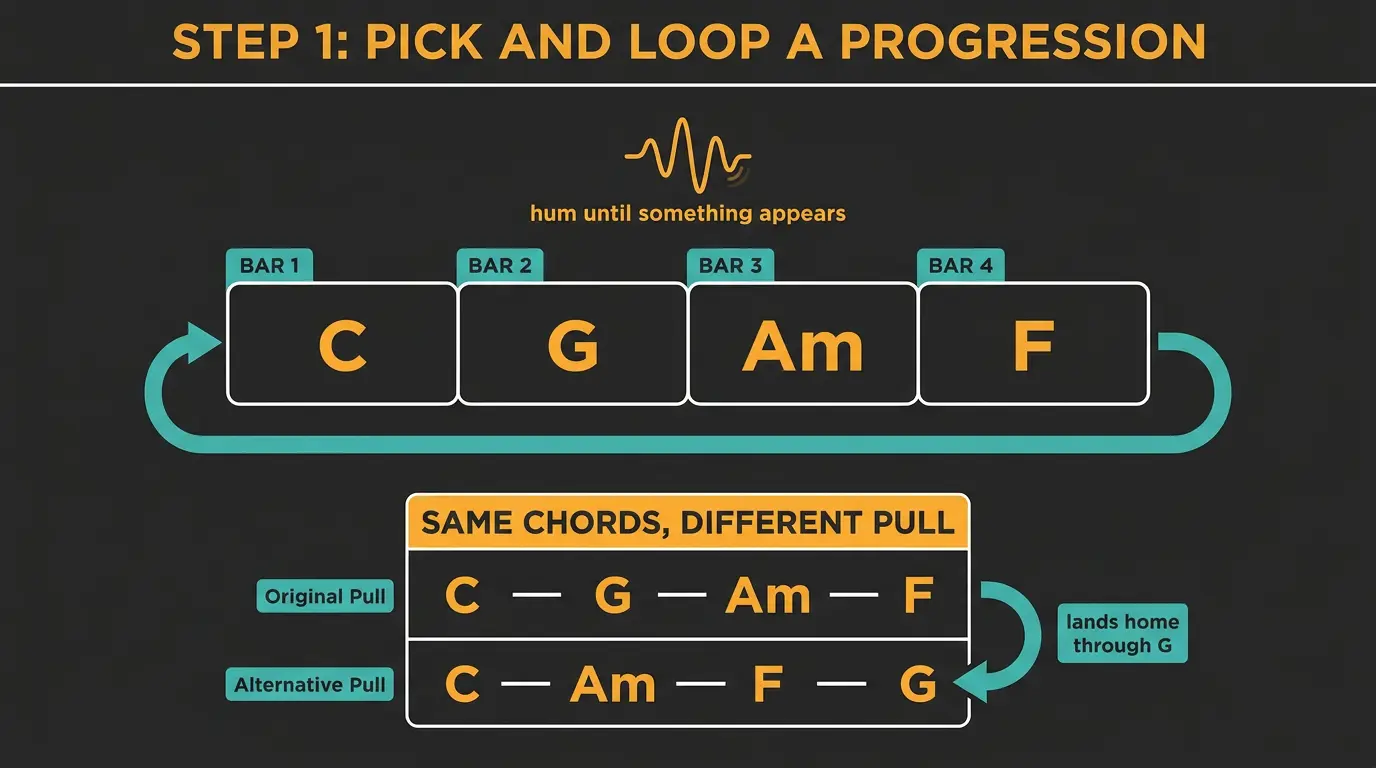
Play your progression as a four-bar loop, one chord per bar, and hum over it until something appears. That's the whole mechanic. Let it repeat long enough that your ear stops analyzing and starts suggesting.
Below are a handful of starting points in C major so you can transpose them to any key you like. These are examples to write with, not a ranked list. Reorder the same chords and the direction changes completely. C–G–Am–F and C–Am–F–G use the same four chords, but the second one lands back home through G, so the phrase pulls differently.
| Roman Numerals | Chords in C | Feel |
|---|---|---|
| I–V–vi–IV | C–G–Am–F | The modern four-chord loop. Uplifting but a little bittersweet, and it never fully resolves. |
| vi–IV–I–V | Am–F–C–G | Same chords started on the minor vi. Wistful and heartfelt. |
| I–vi–IV–V | C–Am–F–G | The doo-wop progression from 1950s pop. |
| I–IV–V | C–F–G | The most direct progression there is. Home, a lift to IV, tension on V, back home. |
Step 2: Build the melody over the progression
This is the heart of the whole thing, and it comes down to chord tones versus non-chord tones. A chord tone is a note that's in the chord playing right now. A non-chord tone is a note that's in the key but not in that chord.
Here's the part people get wrong: a non-chord tone is not an out-of-key note. Over a C major chord (C, E, G), an F is in the key of C, but it's outside the chord. So it's a non-chord tone. It's still a perfectly "legal" note, it just sits in tension instead of rest.
Chord tones feel stable and satisfying. Non-chord tones add tension and movement. A good melody balances both. Worth noting: in a 2021 study of Mozart and Beethoven themes, Hu and Arthur found roughly 81% of the notes in the plain themes were chord tones. So even in dense classical writing, the bulk of the melody sits on safe notes, with the tension sprinkled in.
Techniques for landing the melody right
A few concrete moves that keep a melody feeling intentional instead of random:
- Target a chord tone when the chord changes. The moment of the chord change is the most important spot in your melody. Land on a note from the new chord there and you get a smooth handoff between harmony and tune.
- Strong notes on strong beats. We like hearing chord tones on the strong beats. Weak beats can carry the non-chord tones and their tension, which usually wants to resolve quickly.
- Lean on guide tones. The 3rds and 7ths make strong anchors. The 3rd gives you color, the root gives you stability.
- Use passing tones to connect. Moving from C to E? Drop a D in between to bridge the gap. That D is a passing tone doing its job.
- Hold a common tone across a chord change. Keep the same melody note while the harmony shifts underneath it. Instant variety, zero effort.
None of these are rules, exactly. Trust your ears. There isn't always one right answer, and the "wrong" note is sometimes the one that makes the whole line interesting. For more on building lines from scratch, see how to write melodies on guitar.
The capture-by-improv method
- Play the loop over and over and hum different notes until something sticks.
- Record any short idea you like right away, before you talk yourself out of it.
- Take a phrase you've got and repeat it, but change the ending.
- Push a phrase higher and lower to find contrast between your sections. If you're a beginner, stay in the pentatonic scale (C, D, E, G, A) as a safe sandbox since it dodges the trickier 4th and 7th.
Step 3: Find the lyric
Set your chords-plus-melody loop at a low volume, grab a notebook, and free-write. No editing, no cuts, no deciding what's good yet. Just let the progression pull words out of you and see what shows up.
When it's time to shape those words, here's a rule that earns its keep: verse lyrics describe situations, people, and circumstances. Chorus lyrics describe emotions and reactions. The verse sets the scene; the chorus tells you how it feels.
The pitfall is when there's no real difference between the two. If your verse and chorus are saying the same kind of thing in the same way, the song goes flat. Make sure the chorus does a different job than the verse. For a deeper dive, we've covered how to write lyrics that actually connect.
Step 4: Develop your sections

A basic structure looks like intro, verse, chorus, verse, chorus, bridge, final chorus, outro. You don't need every one of those. A verse and a chorus alone can carry a short song just fine.
The big idea here is contrast without new chords. Same progression, different treatment. Play it differently per section, or change the harmonic rhythm by holding each chord for 2, 4, or 8 beats. You can also try a borrowed chord for a moment, like swapping an A major for an A minor, to add a little color where it counts.
Your chorus melody should sit higher than your verse melody. If both pull from the same four or five notes, it's too much of the same thing and the whole song gets boring. And even a wandering verse progression needs a tonic as an anchor, otherwise the ear has nothing to hold onto. More on this in our guide to song structure, and there's a solid outside read on richer harmony over at Berklee's Take Note.
The one trap of writing chords-first
Back to the trap from the top: the shapeless, wandering melody. When the chords sound good on their own, it's easy to leave the tune neglected and let it drift.
Starting from chords is fine, as long as you commit to shaping the melody on purpose. Target chord tones on the changes. Give the chorus its own contour. Anchor to a tonic. Do those three things and the "trap" stops being a trap. Less is more, but the melody still has to earn its keep.
Frequently Asked Questions (FAQs)
Is it better to start a song with chords or melody?
Neither is better, they just carry different risks. Starting with chords is easier because you have a guide, but it tends to produce a wandering melody if you're not careful. Starting with melody forces a strong tune but feels scarier. Use whichever gets you writing.
Is using someone else's chord progression legal?
Yes, using an existing chord progression is legal and it's not cheating. Chord progressions aren't copyrightable. The same four chords have built countless songs across every genre, so borrowing a progression you love and writing your own melody and lyrics over it is a totally standard tool.
What's the difference between a chord tone and a non-chord tone?
A chord tone is a note that's in the chord currently playing; a non-chord tone is a note that's in the key but not in that chord. A non-chord tone isn't out of key. Over a C chord, an F is a non-chord tone but still perfectly in key.
How many chords do you need to write a song?
You can write a full song with just three chords, like I–IV–V (C–F–G). Plenty of rock, folk, and country classics use exactly that. More chords give you more color, but the melody and lyrics do most of the heavy lifting, not the chord count.
Why does my melody sound shapeless when I start with chords?
Shapeless melodies usually mean the tune is drifting without landing on chord tones at the chord changes. Target a note from the new chord each time it switches, keep strong notes on strong beats, and give your chorus a higher, distinct contour. That alone fixes most of it.
Final Thoughts
Chords-first is a great way to work. It gets you moving fast and gives your ear something solid to write against. Just don't let the melody coast on top of a nice progression and call it done.
Loop the chords, shape the melody with intent, find the lyric, and build contrast between your sections. Do that and four chords can take you a long, long way.
Some of the links within this article are affiliate links. These links are from various companies such as Amazon. This means if you click on any of these links and purchase the item or service, I will receive an affiliate commission. This is at no cost to you and the money gets invested back into Audio Sorcerer LLC.