You don't need music theory to write a song. You don't need a trained voice, you don't need to read notation, and you definitely don't need to feel ready. Plenty of people talk themselves out of writing because they think they're missing some secret ingredient. They aren't.
Here's the only real rule: if you like what you've written, you've succeeded. That's it. Three chords, a simple structure, and the willingness to finish will get you a complete song from start to end in about an hour.
Let's write one.
TABLE OF CONTENTS
Do you need music theory to write a song?
No. Plainly, no.
Theory is useful. It helps later on, especially with arrangement and smarter harmony choices. But it's a tool you reach for once you've got songs under your belt, not a gate you have to pass through first. Plenty of beginners write real, usable songs with basic chords, a voice memo on their phone, and a clear idea of what they're trying to say.
The thing that actually stops most people isn't a lack of knowledge. It's waiting to feel ready. So let's reframe it: you need a clear starting point and the willingness to begin before you feel prepared. This is songwriting for absolute beginners, and that's a perfectly good place to be.
Start with three chords
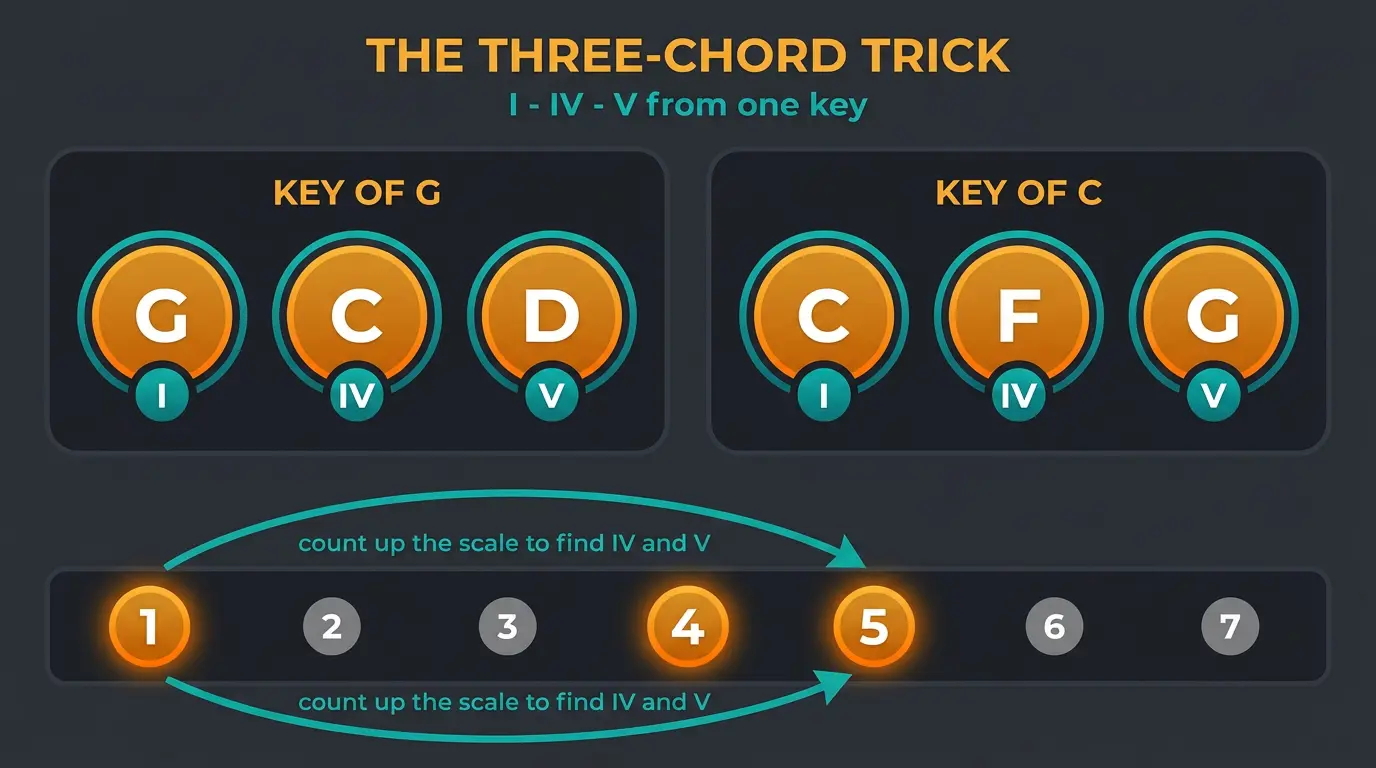
The oldest trick in the book is the three-chord trick, and it earned that reputation. It's three chords pulled from the same key, and it works across rock, folk, country, blues, and pop. The chords are the I, the IV, and the V of a key.
Here are two sets you can grab right now:
- Key of G: G, C, and D
- Key of C: C, F, and G
Finding the IV and V isn't mystical. Once you know your starting chord (the I), count up the scale to the fourth note and the fifth note, and play the major chords on those. In G, that's C and D. In C, that's F and G. Done.
The number of songs built on this handful of chords runs into the many thousands, so you're in good company. If you want further reading on just how deep this well goes, the three-chord song is its own well-documented thing. If you want to go deeper on how chords relate inside a key, we've got a full breakdown of the chords in the key of C.
Want one more chord? Try the four-chord pop progression
If three chords start to feel a little bare, add one. The famous four-chord pop progression is I-V-vi-IV, which in C is C-G-Am-F. The only new concept is that vi is a minor chord (Am), and it adds a little warmth and movement.
You've heard this one more times than you can count. "Let It Be," "Perfect," "Someone Like You," "Hey Soul Sister" — all riding the same four chords. Turns out a lot of famous songs share the same tiny handful of chords.
That said, three chords is still plenty for a first song. You don't need the fourth. It's there if you want it.
Use the simplest structure that works
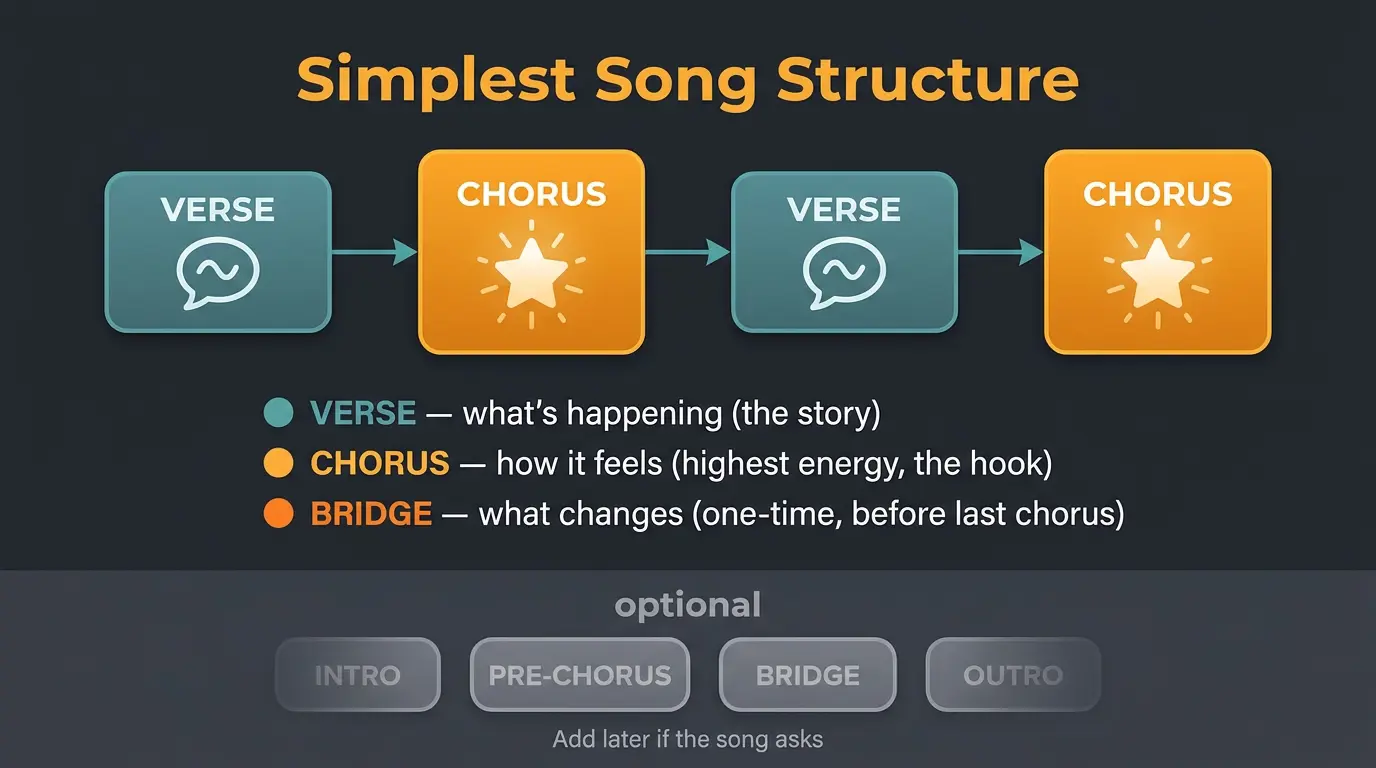
For your first song, use verse-chorus-verse-chorus. That's a complete song. Nothing missing.
Here's the whole framework in three lines:
- Verse — what's happening. This is the storytelling part.
- Chorus — how it feels. Highest energy, most repeated, holds the hook and usually the title.
- Bridge — what changes. A one-time section that breaks the pattern, usually before the last chorus.
There's a fuller form you'll see all over the place — verse-chorus-verse-chorus-bridge-chorus — plus optional intros, pre-choruses, and outros. None of those extra parts are mandatory. Add them later if the song asks for them. For a deeper dive, here's our full guide to song structure.
Write your first song in one sitting
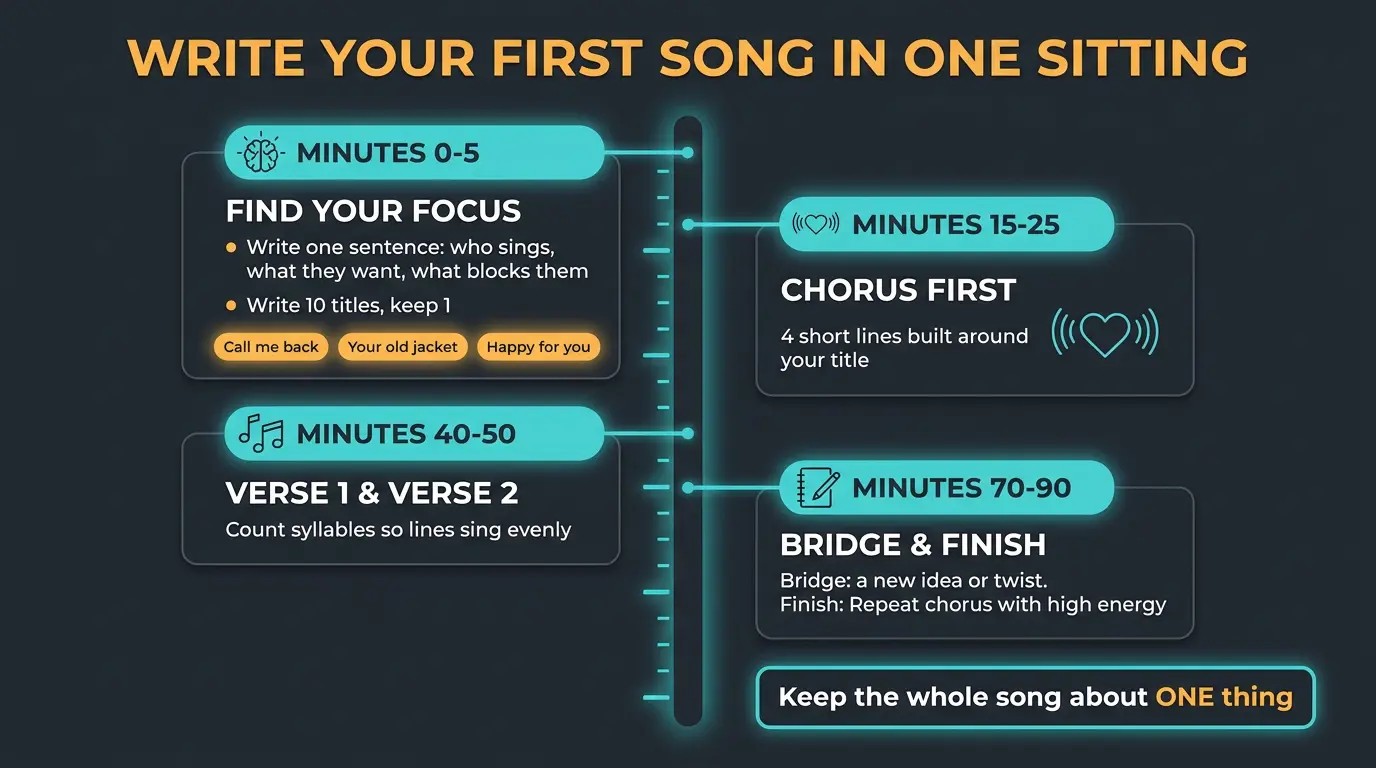
Here's a workflow you can run in about an hour. Make sure you keep the whole song about one thing — that single focus does most of the heavy lifting.
- Minutes 0–5: Write one sentence — who's singing, what they want, and what gets in the way. Then write ten quick titles and keep one. Good titles are things people actually say ("Call me back"), an object with a feeling attached ("Your old jacket"), or a contradiction ("Happy for you").
- Minutes 15–25: Write the chorus first. Four short lines built around your title.
- Minutes 40–50: Write verse one and verse two. Count the syllables so your lines sing evenly from one to the next.
Writing the chorus first feels backwards, but it works. The chorus is the heart of the thing, so build it early and let the verses lead into it.
Finding a melody without knowing a single scale
You don't need a scale. You need a loop and your voice.
Loop your chords and sing nonsense syllables over them until something sticks. Don't think — just make sounds and see what happens. Melodies you stumble into this way sound more natural than anything you'd engineer by overthinking theory. And they don't need a ton of notes to work.
Try this: loop each chord of I-V-vi-IV in C for four beats, and hum three different melodies with no lyrics at all. Keep the one that makes you want to sing it again. If you're writing on guitar, our guide on writing melodies on guitar takes this further.
Writing lyrics that sound like you
Write the way you talk. If a line sounds like something you'd never actually say out loud, rewrite it until it does.
Two rhyme schemes cover most of what you'll need. AABB is where the first two lines rhyme and the next two rhyme. ABAB is where line one rhymes with line three, and line two with line four. Pick one and stay consistent inside a section.
A couple of small things that make a big difference: specific images beat vague emotion labels every time — "your coat still on the chair" says more than "I'm sad." And keep your syllable counts roughly even line to line so everything sits comfortably when sung. When a fragment hits you mid-day, catch it in the Notes or Voice Memos app before it's gone. For more on this, here's how to write lyrics that actually connect.
Your first-song cheat sheet
- Three chords: G-C-D (key of G) or C-F-G (key of C)
- Structure: verse-chorus-verse-chorus is a full song
- Write the chorus first, built around your title
- Keep the whole song about one thing
Finish it before you perfect it

Make finishing the goal, not perfection. Get the song to exist from beginning to end — all the way through — then step away and come back later with fresh ears.
Early on, momentum matters more than mastery. Finishing a song teaches you things that endless tweaking never will, and writers who actually finish improve faster because they get more chances to learn. Ideas are easy. Crossing the finish line is the hard, rare part, and it's the part that separates people who talk about writing from people who write.
So here's your rule: every song you start, you finish. Not perfect. Just finished. Less is more — get it done, move on, and write the next one.
Frequently Asked Questions (FAQs)
Can I write a song if I can't play an instrument?
Yes. You can write a full song by humming melodies and lyrics into your phone's voice memo app, no instrument required. Plenty of songs start as a sung idea. An instrument helps you work out chords later, but it isn't the thing standing between you and a finished song.
How many chords do I actually need?
Three. A I-IV-V progression like G-C-D or C-F-G is enough for a complete song, and thousands of real songs use exactly that. If you want a little more color later, add one minor chord for the four-chord pop progression. But three is genuinely plenty to start.
Should I write lyrics or melody first?
There's no right answer, but for a first song, write the chorus lyric and melody together around your title. Loop your chords, hum until something sticks, then fit words to it. Some writers start with words, some with melody. Try both and keep whatever gets you moving.
How long should my first song be?
Aim for verse-chorus-verse-chorus, which usually lands around two to three minutes. That's a complete, satisfying song without demanding a bridge, pre-chorus, or extra parts. Keep it short for your first one. You can always expand later once finishing feels natural.
Is it okay if my first song isn't good?
Completely okay, and expected. Your first song's job is to exist from start to finish, not to be great. Finishing is the skill that makes the next song better. Every writer you admire has early songs they'd rather not play for anyone, and that's exactly how it's supposed to go.
Final Thoughts
You've got everything you need: three chords, a four-line structure, and permission to write something imperfect. The only step left is the one that actually matters, which is starting.
Pick a key, loop those chords, and hum until something feels like yours. Don't wait until you feel ready — nobody ever does. Write the song, finish the song, and let's give it a listen when it's done.
Some of the links within this article are affiliate links. These links are from various companies such as Amazon. This means if you click on any of these links and purchase the item or service, I will receive an affiliate commission. This is at no cost to you and the money gets invested back into Audio Sorcerer LLC.