A hook is a function, not a section. Most songwriting advice treats the hook and the chorus like they're the same thing, and they're not. A chorus is a part of your song's structure. A hook is the thing people can't stop humming — and it can live anywhere.
It might be in the chorus. But it might also be an intro riff, a vocal ad-lib, or a bass line. A piano riff can carry an entire song on its own. Listen to "Still D.R.E." — that piano loop runs the whole track and forms the foundation everything else sits on.
So let's talk about how to write a hook on piano that actually does that. We'll cover rhythm, voicings, space, and smart repetition. No filler.
TABLE OF CONTENTS
What a piano hook actually is
A hook is a short, repetitive, memorable phrase that grabs attention and sticks. It can be melodic or rhythmic, and it usually carries the main motif of the song. One definition I like: a musical or lyrical phrase that stands out and is easily remembered.
A riff is really just a contemporary version of an ostinato — a short, repeated figure that acts as a foundation. If you want to go deeper on the building block underneath all this, we've got a whole piece on what a motif is in music.
Here's why piano is a different beast than guitar for riffs. Guitar rewards open strings and strumming, which pulls you toward certain keys. Piano treats all twelve keys equally and rewards voicing and register instead. And because your two hands work independently, one piano can supply the bass, the harmony, and the hook all at once. That's a lot of power in one instrument.
Start with rhythm, not notes
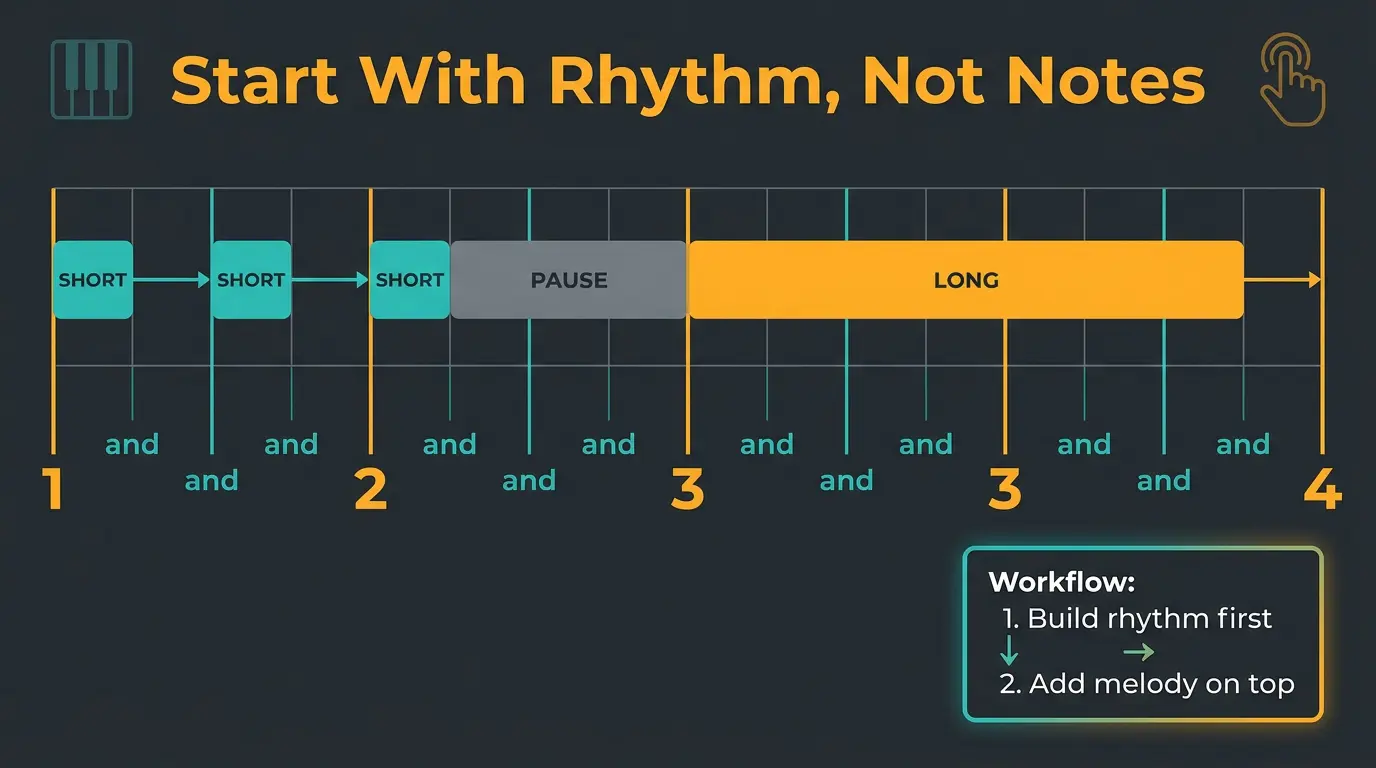
Rhythm is what makes a riff stick — and almost everyone obsesses over the notes instead. A great melody delivered with a boring, predictable rhythm falls flat every time. The rhythmic shape is probably the real reason a hook gets stuck in your head.
So try flipping your workflow. Build a rhythmic pattern first — just tap it out or play one note — then lay a melody on top of it. A strong rhythm gives your hook momentum and makes it easier to remember.
A scenario where this helps: you've got a chord progression you love but the top-line idea feels flat. Lock in a rhythm first and the notes tend to fall into place. Play with syncopation — notes on the "and" of the beat. In 4/4 you'd count "1 and 2 and 3 and 4 and," and placing notes on those "ands" pushes the feel forward.
The best hooks mix on-beat and off-beat placement, and they combine long and short note values. Think of the start of "Another One Bites The Dust" — three short hits, a pause, then a quick run. That short-short-short-long shape is doing a ton of work on basically one note.
The 3-3-2 pattern and why 'Clocks' works
Here's a rhythmic trick that punches way above its weight. Instead of grouping eighth notes evenly (2-2-2-2), you group them three, three, two. It's called tresillo, and it gives you a lopsided, propulsive feel.
Coldplay's "Clocks" is the cleanest example. People assume an uneven grouping like that needs an odd time signature, but it doesn't — "Clocks" stays in plain 4/4. Chris Martin just groups the eighth notes 3-3-2 within the bar, and that's where the restless, driving urgency comes from.
That rhythm has deep roots, too. It worked its way through ragtime and into the Charleston rhythm long before any of us were born. Let's give it a listen and feel that push — once you hear the 3-3-2, you'll start noticing it everywhere.
Use space like it's an instrument
Less is more. Rests and silence aren't empty gaps you failed to fill — they're active tools. A riff gets catchier when there's tension between the notes and the silence around them.
Try this: take a riff that feels flat and busy. Don't change a single note. Just pull some notes out, stretch a couple of them longer, and drop a rest where there wasn't one. Alternating long notes with rests or quiet ghost notes makes the same figure instantly more fun to hear.
On piano, space also means managing register so the riff doesn't turn to mud. If your left and right hands are both crowding the middle of the keyboard, everything smears together. Give the hook room — let the bass sit low, keep the hook's notes clear up top, and the silence will do its job.
Keep it short and simple
Remember what you're actually writing. It's a hook, not a full melody. Hooks tend to run anywhere from two to about twelve notes, averaging five to seven. And most pop hooks don't use more than three or four different pitches.
That's not a limitation — it's the whole point. The fewer pitches you use, the easier it is for someone to lock onto it and sing it back.
If you want a safe palette to start from, reach for the pentatonic scale. C major pentatonic is just C, D, E, G, A — five notes that sound good against almost anything in the key. Make sure you resist the urge to cram in extra notes to sound clever. The simple version is usually the one that sticks.
Repeat it, then twist it
Repetition is how a hook gets planted — but pure repetition turns into wallpaper, and variation with no repetition never plants at all. You need both. There's a good breakdown of this balance in this guide on using repetition and variation to create melodic hooks.
The practical move: state your hook two or three times to lock it in, then on the next pass change one thing. Shift a single note, extend the rhythm, or change how the phrase ends. That satisfies your brain's pattern recognition while keeping your ear awake.
Even better, keep the hook exactly the same and change what's around it. Swap the chord underneath it, add a production layer, shift the energy. Everything moves except the hook, which makes the hook feel fresh without you touching it.
"Clocks" does a clean version of this — right after the second chorus, the piano figure jumps up a third so the song develops without abandoning the idea. That's a melodic sequence: the same shape restarted from a new note. It stays coherent but never gets monotonous.
Voice it so it rolls
This is where piano earns its keep. Think of your two hands as having different jobs. The left hand anchors which chord is playing — if you're starting out, just play the root note, not an inversion. The right hand decides how to voice that chord, and that's where the hook lives.
Inversions are your friend here. A progression played in root position makes your hand jump all over the keyboard. Use inversions instead and you minimize movement, which keeps the top voice smooth — ideally moving just a tone or semitone between chords. If inversions are new to you, we break them down in chord inversions explained simply.
Broken chords are the classic piano-riff engine. Instead of hitting a chord all at once, you roll through its notes one at a time. "Clocks" is literally three broken chords — E-flat major, B-flat minor, and F minor. The magic is that a finger stays anchored on a shared note while the top note drops, and that small repeating motion is what gives the riff its rolling, hypnotic feel.
Meanwhile, think of your left hand as the drummer — bass notes on 1 and 3 like a kick drum, giving the whole thing a pulse. And one quick note on notation: if you see a chord written like G/D, that just means play a G chord with D as the bass note underneath. You'll run into those a lot.
Quick checklist for a piano hook that sticks
- Nail the rhythm before the notes — a strong rhythmic shape is what makes a hook memorable.
- Keep it short and simple — aim for three or four pitches, and start from a pentatonic scale.
- Use space and rests as real tools, and manage your register so the riff stays clear.
- Repeat the hook to plant it, then twist one element or change what surrounds it.
- Voice it with inversions and broken chords so the figure rolls smoothly instead of jumping around.
Frequently Asked Questions (FAQs)
What makes a piano hook memorable?
Rhythm makes a piano hook memorable more than the notes do. A distinctive rhythmic shape, a short and simple set of pitches, and space between the notes are what lock a hook in your head. Most people overthink the melody and ignore the rhythm driving it.
What's the difference between a hook and a chorus?
A hook is a function and a chorus is a structural section — they're not the same thing. A chorus is a part of the song; a hook is the memorable phrase that grabs you. Your hook often lives in the chorus, but it can just as easily be an intro riff or a bass line.
How many notes should a piano riff have?
A piano riff usually works best with around three to seven notes, and many pop hooks use only three or four pitches. Shorter is easier to remember and sing back. Start with a pentatonic scale, like C-D-E-G-A, and resist cramming in extra notes.
What is the 3-3-2 rhythm in 'Clocks'?
The 3-3-2 rhythm in "Clocks" groups eighth notes into sets of three, three, and two within a normal 4/4 bar. It's a form of tresillo, and the uneven grouping creates that lopsided, propulsive drive. You don't need an odd time signature to use it.
Do I need to know music theory to write a piano hook?
No, you don't need deep music theory to write a piano hook. A pentatonic scale and a strong rhythm will get you a long way by ear. That said, knowing a few things like inversions and basic chords makes it faster to voice your ideas and twist them.
Final Thoughts
A hook that carries a song isn't about fancy notes — it's about a sharp rhythm, a handful of pitches, and enough space to breathe. Get those right and repeat it with a little twist, and you've got something that sticks.
So go sit at the piano and tap out a rhythm before you play a single note. Trust your ears. There's no single right answer here, and the best way to find your hook is to keep writing until one of them won't leave you alone.
Some of the links within this article are affiliate links. These links are from various companies such as Amazon. This means if you click on any of these links and purchase the item or service, I will receive an affiliate commission. This is at no cost to you and the money gets invested back into Audio Sorcerer LLC.