The last few seconds of your song are the freshest thing in a listener's memory. That makes the ending worth as much thought as the hook — and yet it's the part most people wing.
A good ending should feel chosen, not accidental. The listener should sense you're wrapping up on purpose, not just running out of ideas and hitting stop.
There are really a handful of ways to end a song: the fade-out, the cold ending, the tag ending, and a few variations on each. This post walks through all of them, plus when to reach for which — because the right ending for a breakup ballad is the wrong one for a punk anthem.
TABLE OF CONTENTS
Outro, coda, fade-out: quick definitions
Let's clear up the words first, because they get mixed up constantly.
An outro is the section that ends a song. It's often instrumental, but it can carry vocals too. It's a part of the arrangement, the same way a verse or chorus is.
A fade-out is not a section — it's a production choice. It's a way of ending an outro by lowering the mix to silence. So you can have an outro that fades, or an outro that stops cold.
A coda is basically the same thing as an outro in casual use. The word comes from the Italian for "tail," as in the tail end of the song. If someone says coda, they mean the ending section. Don't overthink it.
The main types of song endings
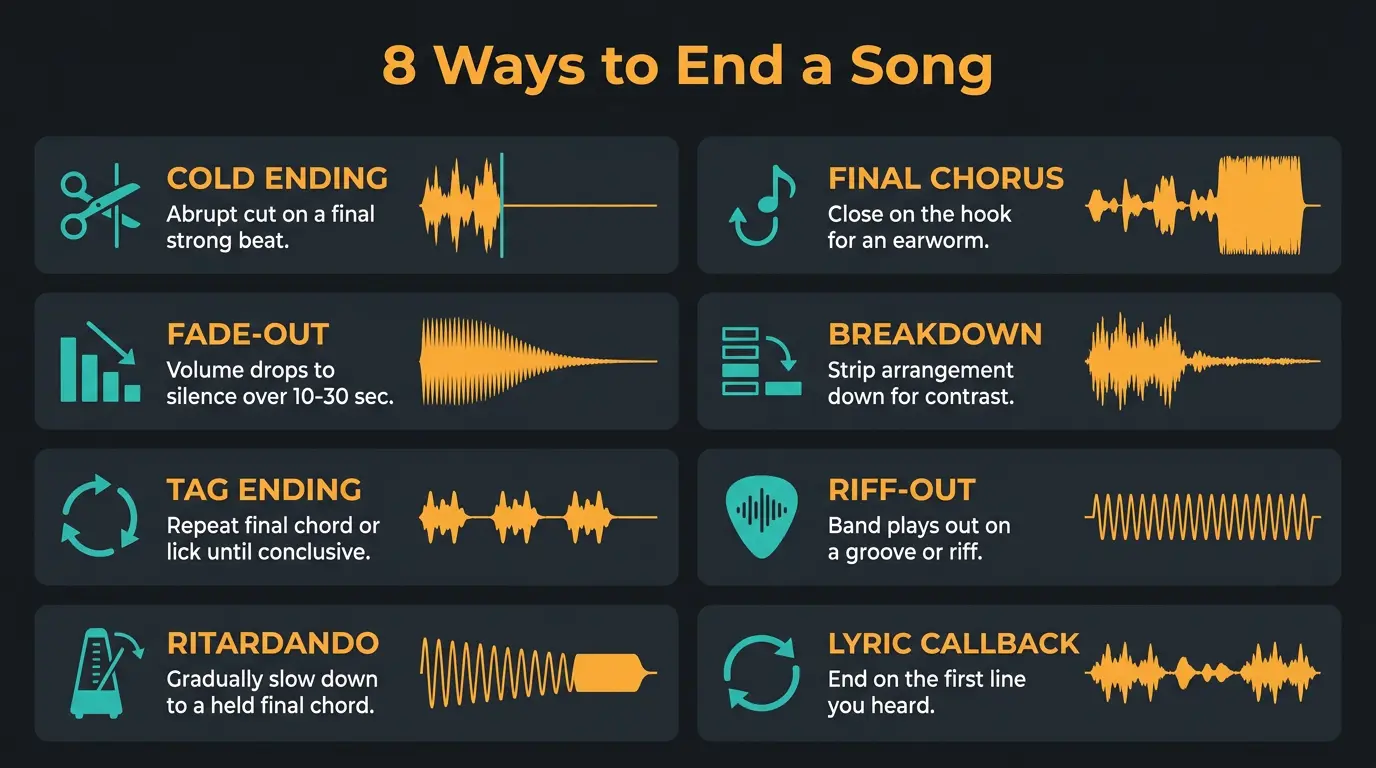
Here are the core ways to end a song. State what each does, hear it in a song you already know, move on. There's no single right answer here — trust your ears.
- Cold ending (hard stop): The music cuts out abruptly on a final strong beat. No fade, no decay — just sudden silence. It's bold and confident. Jack White ends "Seven Nation Army" exactly this way.
- Fade-out: The volume slowly drops to silence over roughly 10 to 30 seconds. It gives the feeling the song keeps going after you stop hearing it. Classic in nostalgic pop and smooth jazz.
- Tag ending: You repeat the final chord or a signature lick a few times, usually with changing dynamics, until it feels conclusive. Tons of classic rock songs land this way.
- Ritardando (slow-down): The ending phrase gradually slows down, ending on a held final chord at a much slower tempo. Queen does this gorgeously at the end of "Bohemian Rhapsody" before that soft "any way the wind blows."
- End on the final chorus: You close on the hook itself, hammering it into the listener's head one last time. If your chorus is catchy, this is how you build an earworm. More on that in why some choruses get stuck in your head.
- Instrument subtraction / breakdown: You strip the arrangement down at the end for contrast. Childish Gambino's "This Is America" drops to a detuned kick and a lone fading vocal line.
- Instrumental riff-out: You let the band play out on a groove or signature riff. "Hotel California" rides out on two harmonized guitars for about as long as the actual song.
- Lyric callback (full circle): The last thing you hear is the first thing you heard. Demi Lovato's "Give Your Heart a Break" opens and closes on "The day I first met you."
Variations worth stealing
These are flavor more than main course, but they're worth having in your pocket.
- Modulated chorus: Bump the final chorus up a key, or just a line or two of it. "Love Story" and "Perfect Illusion" both ride a key change up at the tail end.
- Hook variations and ad-libs: The vocalist keeps the final chorus alive with melodic variations and improvised runs. Whitney Houston does this on "I Wanna Dance With Somebody."
- A satisfying cadence: A chord sequence that resolves cleanly to the root is deeply pleasing to the ear, especially on a big, melodic piece. If you want to go deeper, here's a full breakdown of how cadences bring phrases to rest.
- Dissolution: If you've got strong improvisers, let the song come unglued — players drift from their parts, the structure dissolves. It's a blast live.
- False or trick endings: Fake the stop, wait for the reaction, then hit one more big chorus. Fun to tease an audience with, as long as you don't wear it out.
When each ending works
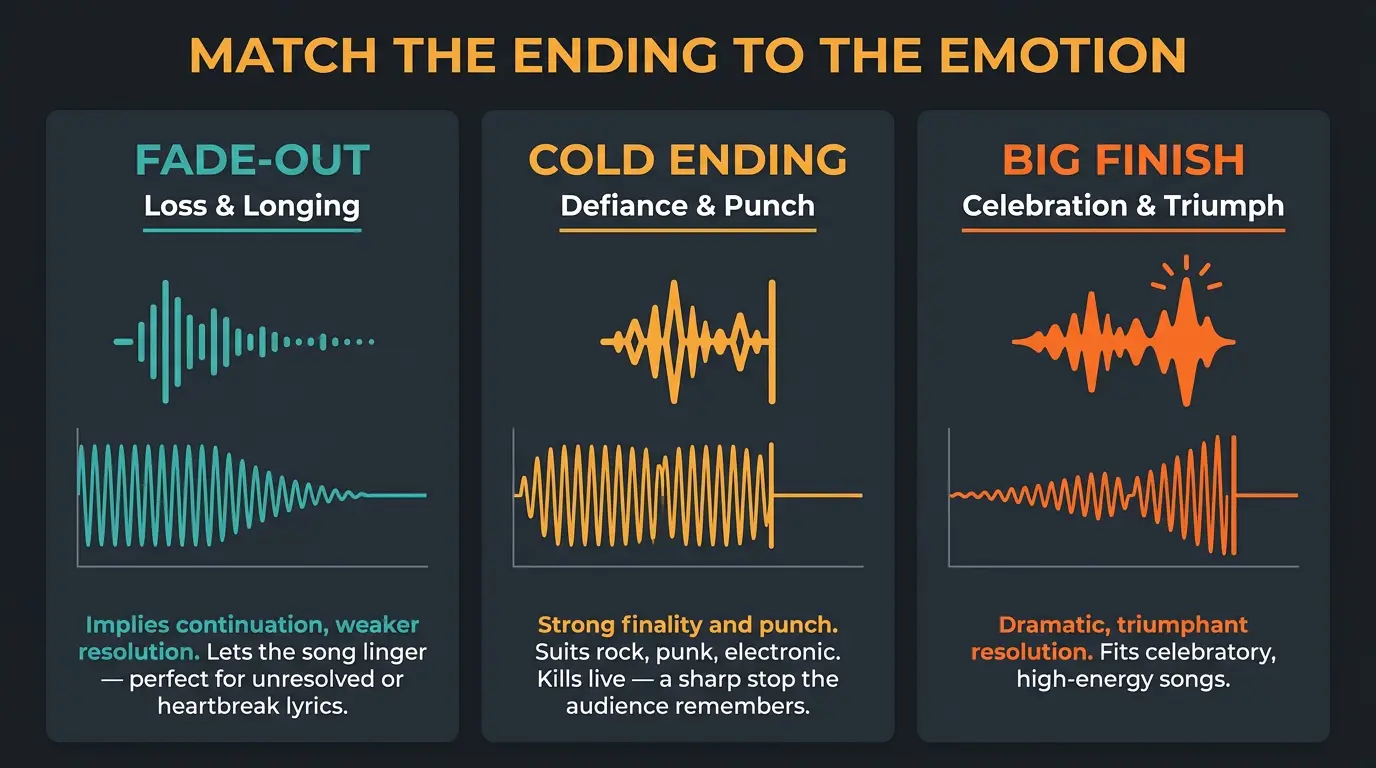
Here's the governing principle: match the ending to the song's emotion and story. That's it. A quiet trail-off for heartbreak, a big finish for celebration, a hard stop for defiance.
A fade-out implies continuation and gives a weaker sense of resolution — which is a feature, not a bug. If your lyric is about something unfinished or unresolved, the fade mirrors that perfectly. "Every Breath You Take" lands on "I'll be watching you," so a cold ending would fight the whole mood. The fade lets it linger like it's supposed to.
A cold ending gives you a stronger sense of resolution and more punch. That's why it suits rock, punk, and electronic music, and why it kills live — a sharp stop after an intense chorus is a moment an audience remembers. With a hard out, there's simply more finality than a fade can give you.
Big dramatic finishes fit celebration and triumph. Trailing fades fit loss and longing. For a deeper roundup of approaches, iZotope has a solid piece on 13 ways to end a song.
Does your song even need an outro?
Sometimes the best ending is just the final chorus, and tacking on an outro would only pad things out. If the hook lands and the song feels complete, stop there. Less is more.
But an outro earns its keep when the arrangement has been building and needs room to decompress. If your final chorus is the loudest, densest moment in the whole track, stopping dead right there can feel like a door slamming instead of a conclusion. An outro gives the listener a soft landing.
There's no universal rule here. Trust the song. If the energy needs somewhere to go after the peak, give it an outro. If the chorus already says everything, let it have the last word.
Common ending mistakes to avoid
- An ending that feels accidental rather than chosen — the listener can tell when you just ran out of song and stopped.
- Defaulting to a fade-out because you couldn't think of anything better. A fade is a real choice, not a place to hide a weak ending.
- An ending that fights the lyric or emotion, like a hard cold stop on a song about something unresolved.
- Overstaying your welcome by repeating the outro so many times the listener mentally checks out before the track does.
Frequently Asked Questions (FAQs)
What's the most common way to end a song?
The two most common endings are the fade-out and the cold ending. The fade slowly lowers the volume to silence; the cold ending stops abruptly on a final chord or beat. Ending on the final chorus is a close third, especially in pop, since it drives the hook home one last time.
Are fade-outs outdated in the streaming era?
Fade-outs are used less than they were in the radio era, but they're far from dead. They still fit nostalgic pop, smooth jazz, and any song whose lyric feels unresolved or ongoing. Use one because it suits the song, not because you couldn't think of a real ending.
What's the difference between a cold ending and a tag ending?
A cold ending stops abruptly on one final beat or chord — silence hits all at once. A tag ending repeats the final chord or a signature phrase a few times before it lands, usually with changing dynamics. Cold is a sudden door close; a tag eases you toward the exit.
How long should an outro be?
An outro should last only as long as it stays interesting — long enough to decompress after the peak, short enough that the listener doesn't tune out. Fade-outs commonly run 10 to 30 seconds. If you're repeating the same phrase past the point of payoff, trim it. Less is more.
Should the last chord be major or minor?
Either works — it depends on the feeling you're after. Pop often lands on a major chord for an uplifting, resolved sound, sometimes voiced in an interesting inversion. A minor final chord can leave things unsettled or melancholy on purpose. Let the song's emotion pick the chord, not a rule.
Final Thoughts
Your ending is the last impression you leave, so give it the same care you gave the hook. Pick a type that matches the song's emotion, make it feel deliberate, and don't overstay your welcome. That's most of the battle.
Try a couple of options on your next track and let's give it a listen with fresh ears. The cold ending, the fade, the full-circle callback — none of them are wrong. The only real mistake is letting the ending happen by accident.
Some of the links within this article are affiliate links. These links are from various companies such as Amazon. This means if you click on any of these links and purchase the item or service, I will receive an affiliate commission. This is at no cost to you and the money gets invested back into Audio Sorcerer LLC.