A cadence is how a musical phrase comes to rest. It's the audio equivalent of punctuation — a comma tells you to pause, a period tells you the thought is finished, and a cadence does the same job with chords.
There are four main types, and each one lands differently on the ear. This post covers all of them: the chords behind each cadence, the terminology that trips people up, and how each one actually feels. No filler, let's get into it.
TABLE OF CONTENTS
What is a cadence in music?
A cadence is a progression of two or more chords that concludes a phrase, section, or piece of music. The word comes from the Latin for "a falling," and that's a decent mental image — the music settling down after being in motion. Depending on the type, it can create a full sense of resolution or only a partial one.
Here's the part a lot of beginner explanations skip: a chord progression by itself isn't a cadence. There has to be a real sense of closure at the end of a phrase. Rhythm and melody play into that too, not just harmony — where the phrase breathes, how the melody rises and falls, all of it contributes.
Cadences are also one of the strongest signals of the tonic, the anchor point of a key. When you hear a phrase land, your ear is being told "this is home." That's a big part of why they matter so much.
The four types of cadences
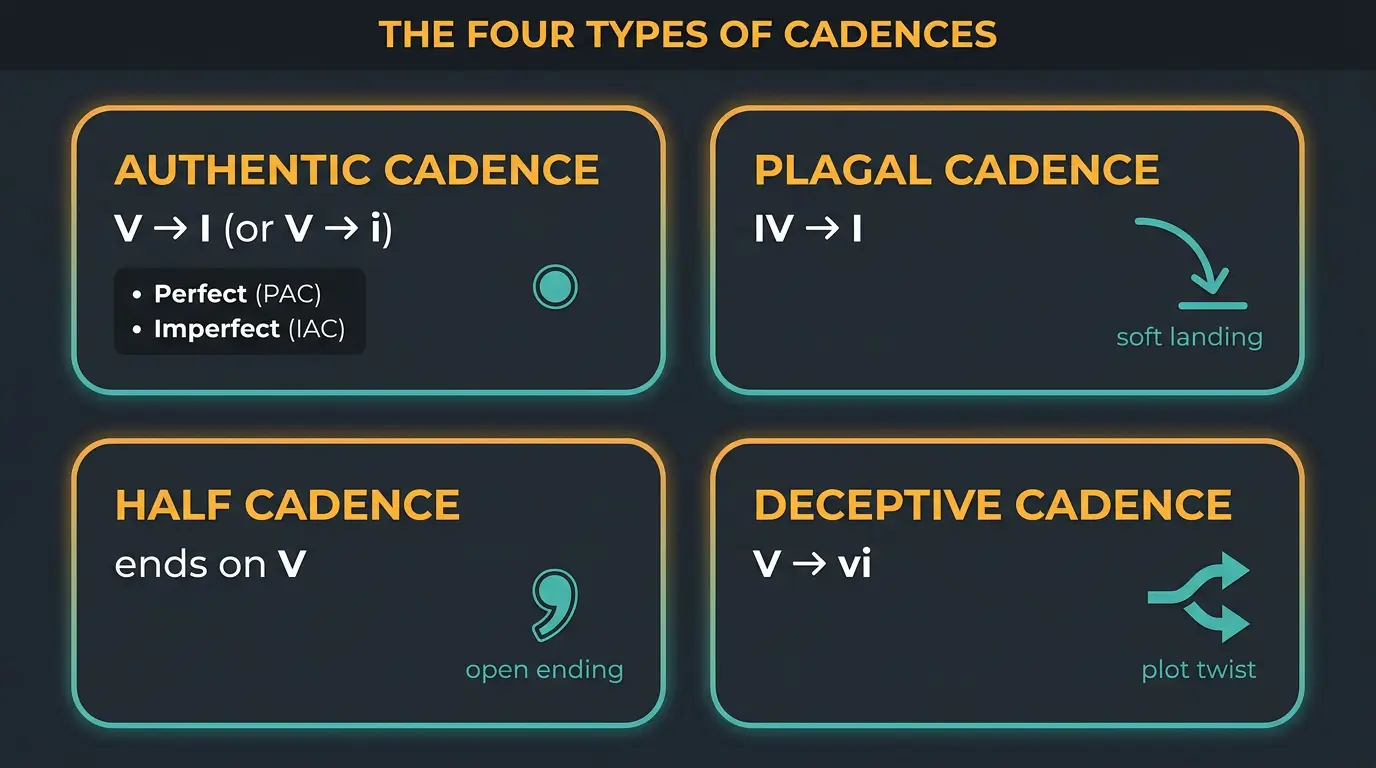
The standard framework from common-practice theory gives us four types of cadences: authentic (which splits into perfect and imperfect), plagal, half, and deceptive. Everything else in this post hangs off that framework, and the chart below is your quick reference.
If the punctuation analogy helps — and it usually does — map them like this. A perfect authentic cadence is a period. A half cadence is a comma. A deceptive cadence is a plot twist. And a plagal cadence is a soft landing. Same idea as writing: some endings close the door, others leave it open.
| Cadence | Chords (in C major) | How it feels |
|---|---|---|
| Perfect authentic | V–I (G to C) | Strong and final, like a period |
| Plagal | IV–I (F to C) | Soft and restful, the "Amen" ending |
| Half / imperfect | ends on V (ends on G) | Unfinished, like a comma |
| Deceptive / interrupted | V–vi (G to A minor) | A surprise, expectation denied |
Perfect and imperfect authentic cadences (V–I)
The authentic cadence is the strongest close in the book: V to I, or V7 to I. Dominant chord resolves to the tonic, and the ear reads it as a definite finish. This is the sound of a phrase truly landing.
Now the nuance most posts leave out. Authentic cadences come in two strengths — perfect and imperfect — and they're two versions of the same cadence, not two different types. A perfect authentic cadence (PAC) needs all three of these: the V chord in root position, the I chord in root position, and the melody landing on scale degree 1. Hit all three and you've got the strongest arrival there is. That's why you find PACs at big structural moments, like the end of a section or a whole piece.
An imperfect authentic cadence (IAC) is what you get when any one of those boxes goes unchecked — an inverted chord, the melody ending on scale degree 3 or 5, or a vii diminished chord subbing in for the V. Still resolves to the tonic, still feels like an ending, just a little less final. Think of PAC and IAC as the same cadence at two different volumes of certainty.
Plagal cadence (IV–I): the soft landing
The plagal cadence goes IV to I. You've heard it a thousand times as the "Amen" at the end of a hymn — that's literally its nickname, the Amen cadence. It feels gentle and calming, a softer resolution than the perfect cadence. That softness comes from starting on the subdominant rather than the dominant, so it doesn't have the same strong pull toward home.
Here's the myth worth busting: plagal motion is not just for sacred music. You hear IV–I all over pop, often tucked inside the classic I–V–vi–IV loop that runs half the radio. So don't file it away as a church-only sound.
There's also a minor plagal variant, iv–I, and a rarer combination, IV–iv–I, that moves from the major subdominant to the minor one before landing home. It doesn't show up often, but it's a genuinely pleasing sound worth keeping in your back pocket. If you're already comfortable with borrowed chords and modal interchange, that minor iv will feel right at home.
Half cadence (imperfect cadence): the unfinished feel
A half cadence ends on V and doesn't resolve. It leaves you hanging on purpose — that unresolved tension is the whole point, a comma that all but promises another phrase is coming. It can start on I, ii, or IV before landing on the dominant.
Quick terminology note, done plainly: US theory calls this a "half cadence," UK theory calls it an "imperfect cadence." Same thing.
With that being said, watch out for one genuine landmine. The imperfect cadence (UK, ends on V) is not the same as an imperfect authentic cadence (US, a weaker V–I that still resolves to the tonic). Both feel incomplete, but for opposite reasons — one never gets home, the other gets home a little quietly. Same word, two different ideas. For a real-world touchpoint, listen to the first two chords of the chorus of Adele's "Someone Like You" for that suspended, leaning-forward feel.
Deceptive cadence (interrupted cadence): the plot twist
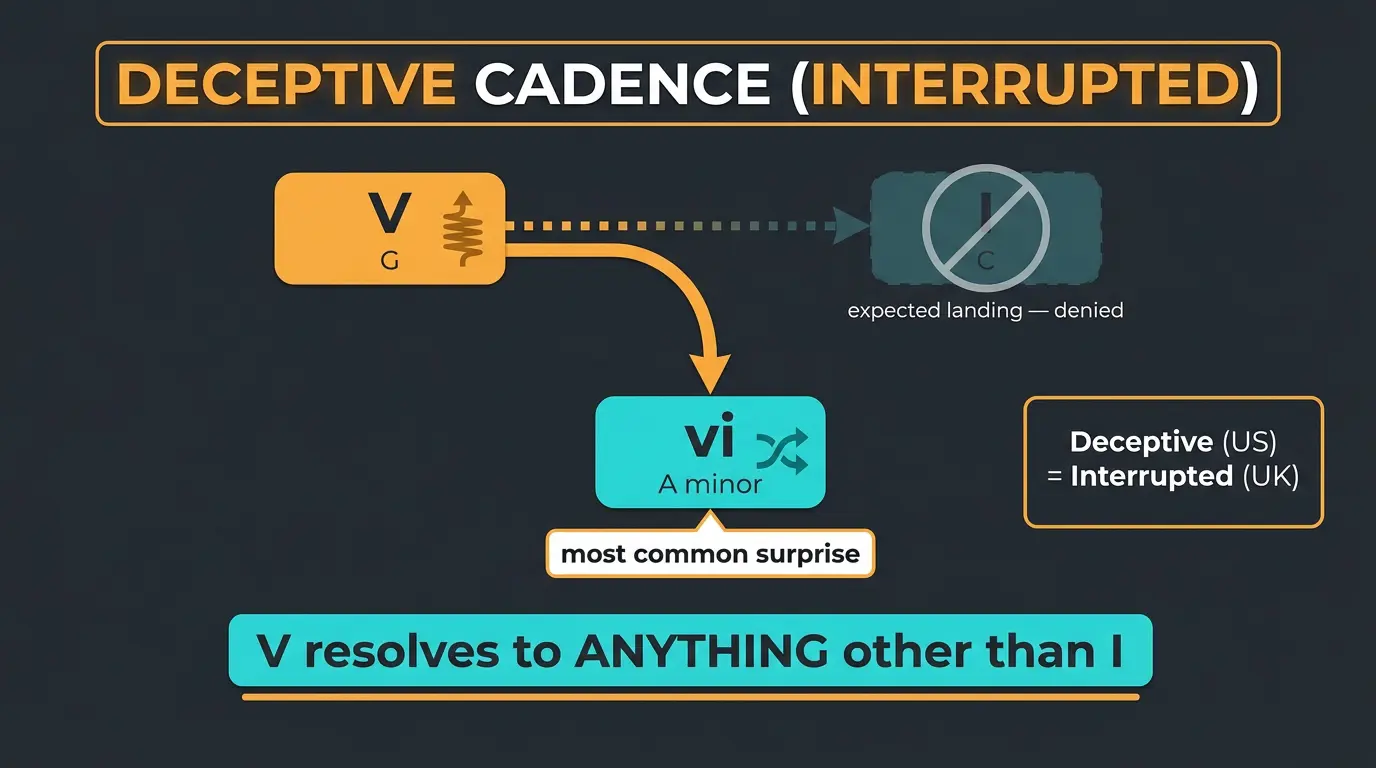
A deceptive cadence sets up the V chord, so your ear leans toward the tonic — and then it resolves somewhere else. Most often that somewhere is vi (or VI in a minor key). In C major, that's G moving to A minor instead of the C you were expecting. The surprise is the effect. You got teased with a landing and denied it.
Terminology again: deceptive (US) equals interrupted (UK). And here's the important part people miss — the defining trait isn't that V goes to vi. The defining trait is that V goes to anything other than I. The vi is just the most common landing spot, not a rule. Any dodge away from the tonic after a dominant chord counts.
Cadence misconceptions worth clearing up
- A chord progression on its own isn't a cadence. There has to be a genuine sense of closure at the end of a phrase — rhythm and melody count too, not just the chords.
- An imperfect cadence (UK, ends on V) and an imperfect authentic cadence (US, a weaker V–I) are two different things. Both feel incomplete, but for opposite reasons.
- Plagal cadences aren't only for church music. IV–I shows up all over pop, often inside the I–V–vi–IV loop.
- A deceptive cadence doesn't always mean V to vi. It just means V resolving to something other than I — vi is common, not required.
Cadences in minor keys
Perfect and imperfect authentic cadences work in minor keys too — V–i does the job. But there's one thing you have to do: raise scale degree 7 in the V chord. If you leave it as the natural minor seventh, the V loses its dominant pull and the cadence goes flat. That raised seventh is the leading tone, and it wants to resolve up a step into the tonic. That upward tug is what makes the landing feel like a landing.
One more trick worth knowing is the Picardy third — ending a minor-key piece on a major tonic instead of a minor one, so V–I with a major chord at the end. It shows up almost exclusively at final cadences and hardly ever mid-piece. Done right, it's a lovely way to close out something dark on a bright note. If you want more on how these chords are built, our guide to minor-key progressions pairs well with this.
Frequently Asked Questions (FAQs)
What is a cadence in music?
A cadence is a progression of two or more chords that ends a phrase, section, or piece and creates a sense of resolution. Think of it as musical punctuation — a comma or a period for sound. It also strongly signals the tonic, the home note of the key.
What are the four types of cadences?
The four main cadences are authentic (V–I), plagal (IV–I), half (ends on V), and deceptive (V to something other than I). Authentic feels final, plagal feels soft, half feels unfinished, and deceptive feels like a surprise. The authentic type also splits into perfect and imperfect strengths.
What's the difference between a perfect and imperfect cadence?
In US theory, a perfect authentic cadence has V and I both in root position with the melody on scale degree 1, while an imperfect authentic cadence is missing one of those, so it resolves less strongly. In UK theory, "imperfect cadence" means a half cadence ending on V — a different thing entirely. The terms overlap, so context matters.
Is a half cadence the same as a deceptive cadence?
No. A half cadence ends on the V chord and never resolves, leaving tension hanging. A deceptive cadence sets up the V but resolves to a chord other than I — usually vi. Both feel incomplete, but a half cadence stops on the dominant while a deceptive one moves past it to an unexpected place.
Do cadences only apply to classical music?
Not at all. Every style with functional harmony uses cadences — pop, rock, jazz, gospel, film scores, you name it. The plagal cadence lives inside countless pop loops, and deceptive cadences show up any time a songwriter wants to dodge the obvious ending.
Final Thoughts
Once you can hear cadences, you can't un-hear them — you'll catch that plot-twist deceptive move in a chorus or feel the comma of a half cadence before the next line kicks in. That's the fun part. Terminology aside, it all comes down to how a phrase decides to rest.
Make sure you spend some time listening for these in songs you already know before you try writing with them. Your ear learns faster than any chart can teach. If you want to keep going, the Wikipedia entry on cadence digs deeper into the historical variants.
Some of the links within this article are affiliate links. These links are from various companies such as Amazon. This means if you click on any of these links and purchase the item or service, I will receive an affiliate commission. This is at no cost to you and the money gets invested back into Audio Sorcerer LLC.