A good love song doesn't win by saying "I love you" louder. It wins on specifics and honesty. Anyone can rhyme "heart" with "apart" and call it a day, but that's not what makes someone hit repeat.
The enemy here is cliché. Every worn-out phrase you reach for tells the listener you couldn't be bothered to find your own words. So we're going to cover the whole thing: picking a theme, writing lyrics that don't make people cringe, choosing chords that actually feel romantic, and writing a melody people can sing back to you.
TABLE OF CONTENTS
Start with your love, not love in general

Here's the mistake most people make right out of the gate: they try to write about love. Not their love. Love. The big abstract concept everyone's already written a thousand songs about.
Love is universal, but each love is singular. Your job is to tell your story with accuracy, not to tell a perfect story. Make sure there's a real reason for the song to exist — something only you could say.
Some angles that stay fresh because people underuse them:
- The "please love me back" song. Laying your heart out with no guarantee it comes back is about as vulnerable as it gets, and vulnerability connects.
- Disillusioned, modern love. The kind that doesn't text back, gets confusing, and isn't the fairy tale you were sold.
- Unusual vantage points. A parent's love for a grown kid. Someone in recovery. Someone learning how to love late in life.
And don't be afraid to let doubt, humor, or even boredom into the song. Pure wall-to-wall devotion reads fake. A little compromise and imperfection reads true.
Trade clichés for details
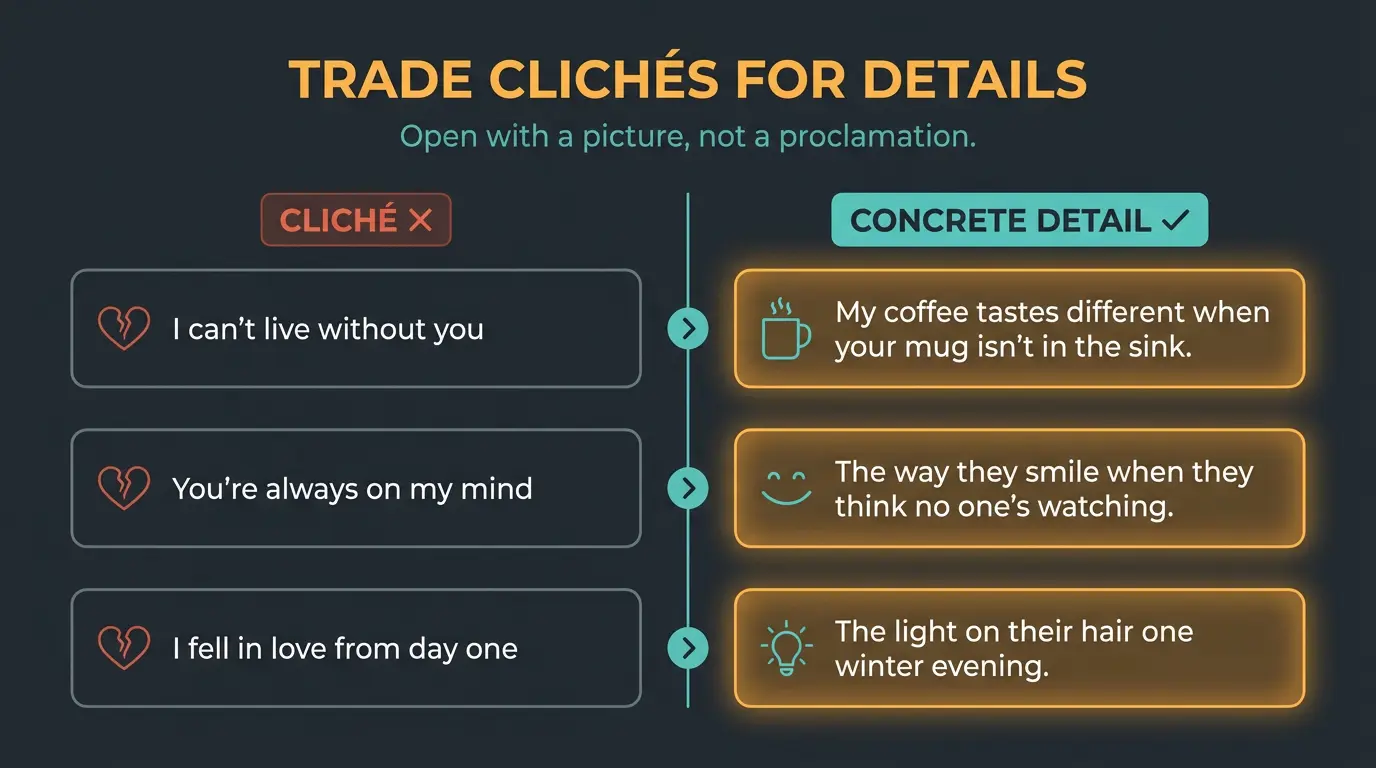
There's a fine line between universal and cliché, and it's worth understanding where it is. A cliché promises much and delivers little. It sounds like feeling without actually containing any. "You complete me" tells me nothing about the two of you.
The fix is concrete, slightly messy detail. It's the small stuff that carries the texture and the truth. Watch what happens when you swap the statement for the scene:
- Instead of "I can't live without you" — try "my coffee tastes different when your mug isn't in the sink."
- Instead of "you're always on my mind" — show the way they smile when they think no one's watching.
- Instead of "I fell in love from day one" — open on the scene: the light on their hair one winter evening.
Open with a picture, not a proclamation. If you want to go deeper on this, we've got a whole piece on how to write lyrics that actually connect. There's also a good discussion on making a love song that isn't cliché worth reading if you want more angles.
The sincerity test
Songwriter Marty Dodson has a method I keep coming back to, and it's dead simple. Keep everything conversational except for one or two lines that really stand out — and make sure those standout lines don't tip over into cheesy or unbelievable.
His gut check is even better: "How would my wife respond if I said this to her? Would she ask what I'd been drinking, or would she melt into my arms?" Say your line out loud to a real person in your head. If it earns an eye-roll, cut it.
His advice is to write it so simple and honest that all your training screams "this can't be interesting." Then go back and see if there's a line or two you can swap for something unique but still believable. Less is more, and it usually is here.
Chords and mood: how to make it sound romantic
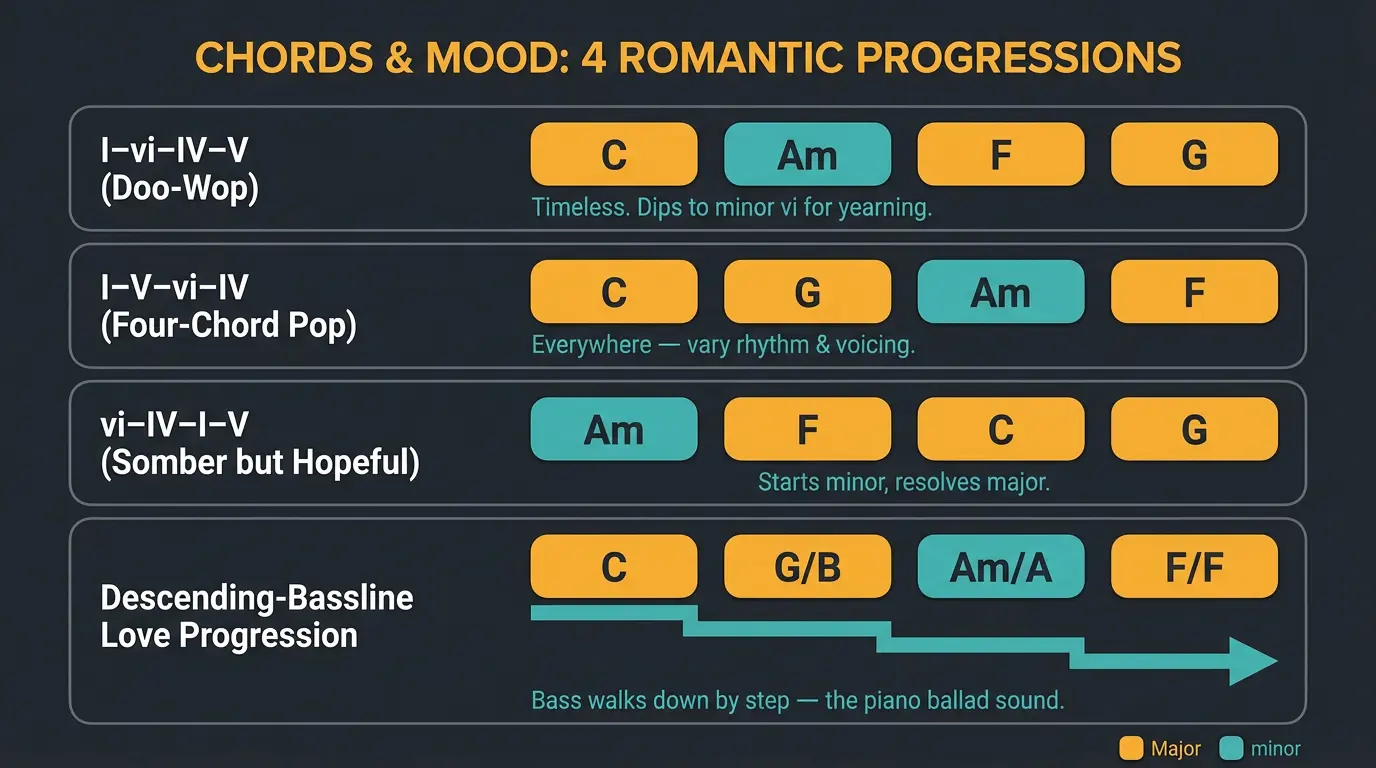
Quick misconception to clear up: "romantic" isn't a genre. It's a mood, and you can build it in pop, hip-hop, folk, whatever. It comes from how you use major and minor chords together, not from a style label. Major keys are more common in love songs, but there aren't any hard rules.
Here are the go-to progressions and why each one works. Let's give it a listen to a few in your head as you read.
- I–vi–IV–V (the doo-wop): C–Am–F–G. The timeless one. It opens major, dips to the minor vi for a touch of yearning, then resolves home. Linger on that vi chord before moving to IV and you really lean into the longing.
- I–V–vi–IV: C–G–Am–F. The famous four-chord pop progression. It's great, but it's everywhere, so it can read as cliché on its own. Change the rhythm, the voicing, or the instrumentation to give it some character.
- vi–IV–I–V: starts in a minor mood and resolves major. Somber but hopeful. Perfect for ballad verses and bridges that build into an uplifting chorus. If minor keys pull you in, this guide to sad chord progressions pairs well with it.
- The descending-bassline "love progression": the bass walks down the scale by step under your chords, usually with inversions. That downward stepwise motion carries a specific emotional weight we tie to deep feeling. It's the piano ballad sound.
Add color with extensions and voicing
Basic triads get the job done, but a little harmonic color goes a long way. A plain C major becomes Cmaj7 and suddenly it's warmer and more open. Add 9ths and 11ths and you drift into soul and R&B territory.
Inversions add subtle flavor without changing the chord — just shift a note and you get a gentle dissonance that keeps things interesting. And octave shifts on the melody or the chords are a classic move for building emotion as the song rises.
Mixing in a minor chord or two adds passion against the majors, though be honest with yourself — most love songs still live in major keys, so treat this as a technique, not a rule. And don't stack every extension you know onto every chord. Less is more. Pick one or two spots that need the color and leave the rest alone.
Write a melody people can actually sing
The melodies that stick are simple. Five or six notes, short phrases, something you could whistle walking out the door. "Can't Help Falling in Love" is the model — nobody's showing off, and everybody can sing it.
Stepwise motion is the love-song default. Move between nearby notes, up or down a step, and it stays smooth and singable. "Your Song" and "How Deep Is Your Love" live in that conversational, airy space. When you want drama instead, that's when you reach for a big leap — think "Somebody to Love" pushing into grand, unfiltered emotion.
Here's the shortcut most people skip: let the lyrics lead. Well-paced words already hum their own tune. Say the line naturally and you'll hear the rhythm and shape hiding in it. Write the smooth version first, then drop in a leap or two later for surprise.
The quick checklist
- Write about your specific love, not love in general — give the song a real reason to exist.
- Swap clichés for concrete, slightly messy detail. Open with a scene, not a statement.
- Pick a chord progression for the mood you want, and change the voicing if it feels too familiar.
- Keep the melody simple and singable — stepwise motion, short phrases, one or two leaps for surprise.
Frequently Asked Questions (FAQs)
What chord progression should I use for a love song?
The I–vi–IV–V (like C–Am–F–G) is the classic romantic go-to — it dips into a minor chord for yearning, then resolves home. For somber-but-hopeful ballads, try vi–IV–I–V. And the descending-bassline "love progression" gives you that piano-ballad warmth. Match the progression to the mood, not the other way around.
How do I avoid clichés in love song lyrics?
Trade the big statement for a small, specific detail. "I can't live without you" is a cliché; "my coffee tastes different when your mug isn't in the sink" is a scene only you could write. Clichés promise a lot and deliver nothing. Concrete, slightly messy detail carries the real feeling.
Do love songs have to be in a major key?
No, love songs don't have to be in a major key, though major keys are the most common because they feel warm and open. Minor chords add yearning, tension, and passion, and mixing the two often reads truer than pure major. Follow the mood you're after, not a rule.
What's a good structure for a love song?
Verse–chorus–bridge is the tried-and-true backbone for love songs and most ballads. Verses set the scene and detail, the chorus lands the emotional core, and the bridge shifts perspective before the final payoff. It's common because it works — build your emotional arc around it.
Can a love song be about heartbreak or unrequited love?
Absolutely — some of the best love songs are about heartbreak or love that isn't returned. The "please love me back" song is one of the most vulnerable and fertile angles you can write from. Doubt, longing, and imperfection often connect harder than perfect devotion ever could.
Final Thoughts
Writing a love song isn't about grand declarations. It's about being specific enough that one person feels seen, and honest enough that a stranger recognizes their own life in it. The craft is in the small details and the restraint.
So write about your love, not love itself. Trust your ears on the chords and your gut on the lyrics. If a line makes you wince when you say it out loud, that's your answer — go find a better one.
Some of the links within this article are affiliate links. These links are from various companies such as Amazon. This means if you click on any of these links and purchase the item or service, I will receive an affiliate commission. This is at no cost to you and the money gets invested back into Audio Sorcerer LLC.