A song is really just two things — a harmonic framework, which is your chord progression, and a melody that rides over it. That melody can be your voice or another instrument. That's it. Everything else is decoration.
There's no single correct way to write one. Some people start with lyrics and add chords. Others start with the chords and find a melody. On guitar, you've got three natural starting points, and none of them require years of theory.
This post covers all three: writing from chords, building a riff, and using a capo to find new sounds and better keys for your voice. You only need a handful of open chords and a couple of techniques to get going. Let's get to it.
TABLE OF CONTENTS
Start with chords
Strumming chords and humming a melody over them is the most common on-ramp for songwriting on guitar. It's also the easiest, because you can lean on shapes you already know.
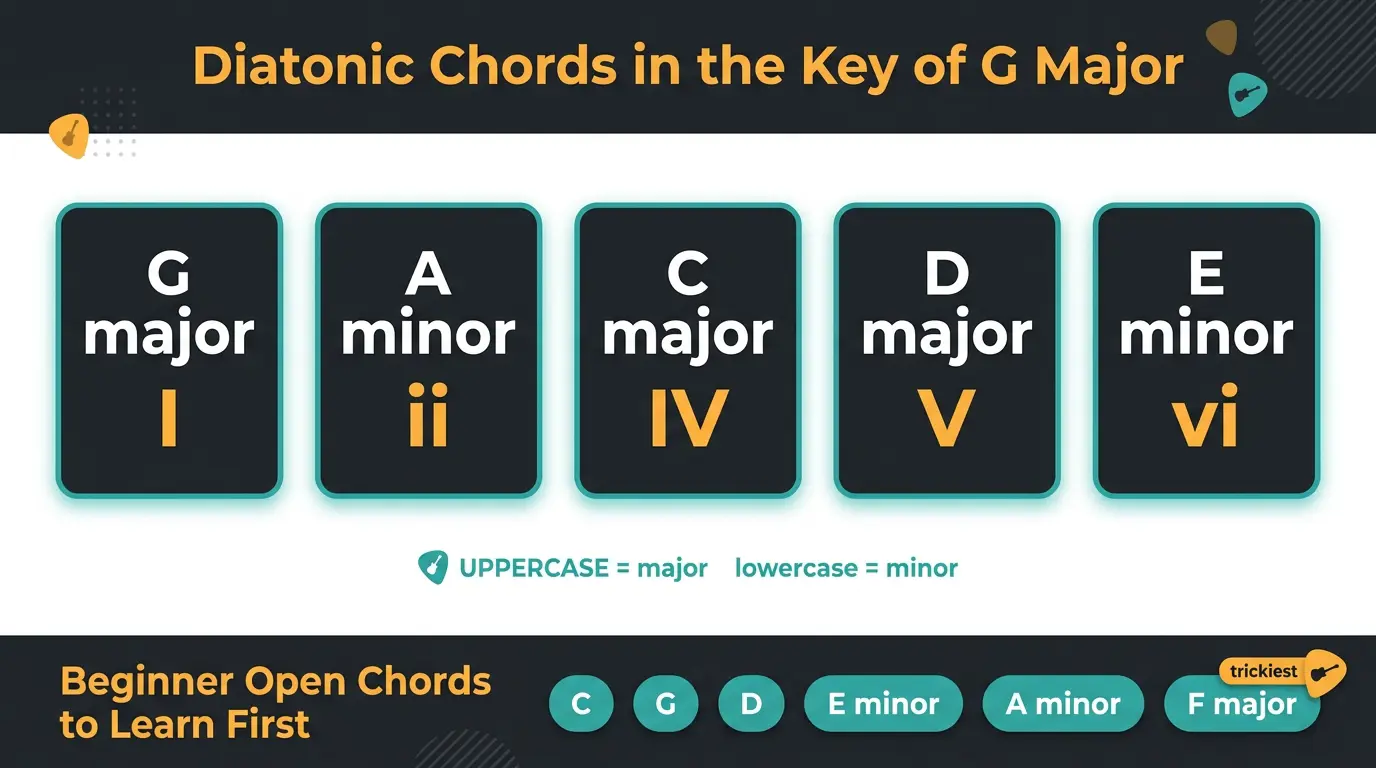
If you're just starting out, learn these open chords first: C, G, D, E minor, A minor, and F major. They use a few fingers on nearby frets, so they're friendly to new hands. F is the trickiest of the bunch, so don't sweat it if it takes a while.
Here's the part that unlocks everything. Chords that come from the same key sound good together — those are called diatonic chords. Take the key of G major. The chords that live in that key are G major, A minor, C major, D major, and E minor. Grab any of those, play them in any order, and they'll fit.
You'll also see chords written as Roman numerals — I, IV, V, vi, and so on. Uppercase means a major chord, lowercase means minor. In the key of G, G is the I, C is the IV, D is the V, and E minor is the vi. Keep that in the back of your head, because it makes the next section click.
Common open-chord progressions you can use today
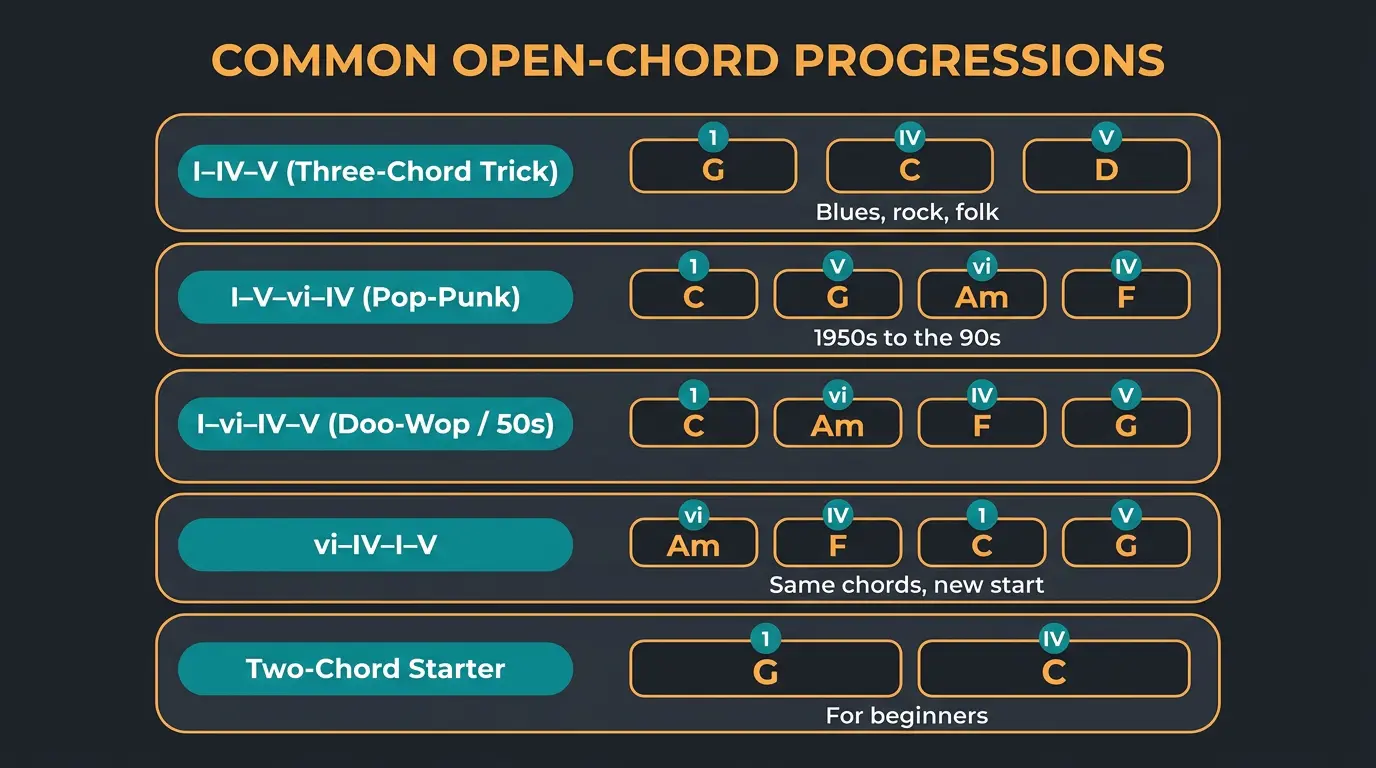
Here are a few recipes you can play right now, in guitar-friendly keys with easy shapes. Try each one and see what melody your voice wants to do over it.
- I–IV–V (the three-chord trick): In G, that's G, C, D. This one's everywhere — "La Bamba," the chorus of "Like a Rolling Stone," "Walking on Sunshine." Nail it and you can play thousands of songs across blues, rock, and folk.
- I–V–vi–IV (the pop-punk progression): In C, that's C, G, Am, F. It's been around since the '50s and blew up in the '90s. "Let It Be" leans on it, and "With or Without You" is this same shape in D.
- I–vi–IV–V (the '50s / doo-wop one): C, Am, F, G. You couldn't turn on the radio in the 1950s without hearing it, but it's still around — Hoobastank's "The Reason" is this progression in E.
- vi–IV–I–V: Same four chords, different starting point. Think "Africa" by Toto, "All Too Well" by Taylor Swift, "21 Guns" by Green Day.
- The two-chord starter: If you're brand new, just pair I and IV — in G, that's G and C. IV back to I is a strong resolution, and plenty of songs live on two chords.
Now, the worry I hear all the time: "Am I just copying?" No. Common progressions are common because they sound good — songwriters kept using them for a reason. Using the same four chords as another song isn't copying. Borrowing the progression plus the rhythm and the melody is where you'd get into trouble, but the chords themselves are fair game. If you want to see how far a single progression can stretch, this breakdown from Berklee on common progressions is worth a read.
Once these feel comfortable, the 12-bar blues is a great next step. It looks harder than it is, and if you've got the I–IV–V down, you're most of the way there. For more on building sections out of these, take a look at how to write a chorus that sticks.
Start with a riff
A riff is a short repeating phrase — a motif that comes back around. It can be single notes, a rhythmic chord move, or a mix of both. Think of the little hook that repeats under a song and makes it recognizable in two seconds.
A scenario where starting with a riff makes sense is when you're on electric and you've got a mood before you've got chords. Here's a method that works. Pick a scale — A minor pentatonic is a great one. Then give yourself constraints: stick to a single string, set a five-minute timer, and hum along as you play. If you can sing it back, you've got the start of a riff.
The biggest thing beginners miss is that rhythm matters more than the notes. The timing and order of notes carry the weight. Try clapping the rhythm of "Smoke on the Water" — people will name it without a single pitch. So find a rhythm that grabs you first, then worry about which notes.
Want the riff to feel intentional instead of random? Target chord tones. Say your progression is C to A minor. Over the C, lean on C, E, and G. Over the A minor, lean on A, C, and E. Move a small phrase between those notes and it'll sound like it belongs. You can also take a two- or three-note lick and slide it to different spots on the neck — that repetition ties it together.
If theory isn't your thing yet, power chords are a low-effort way in. A G5 is just the root note with the fifth stacked on top, and it slides anywhere on the neck. Plenty of famous riffs are nothing but power chords. Keep it short — one or two bars is plenty. Trust your ears here; there's no wrong answer.
Capo tricks for songwriting
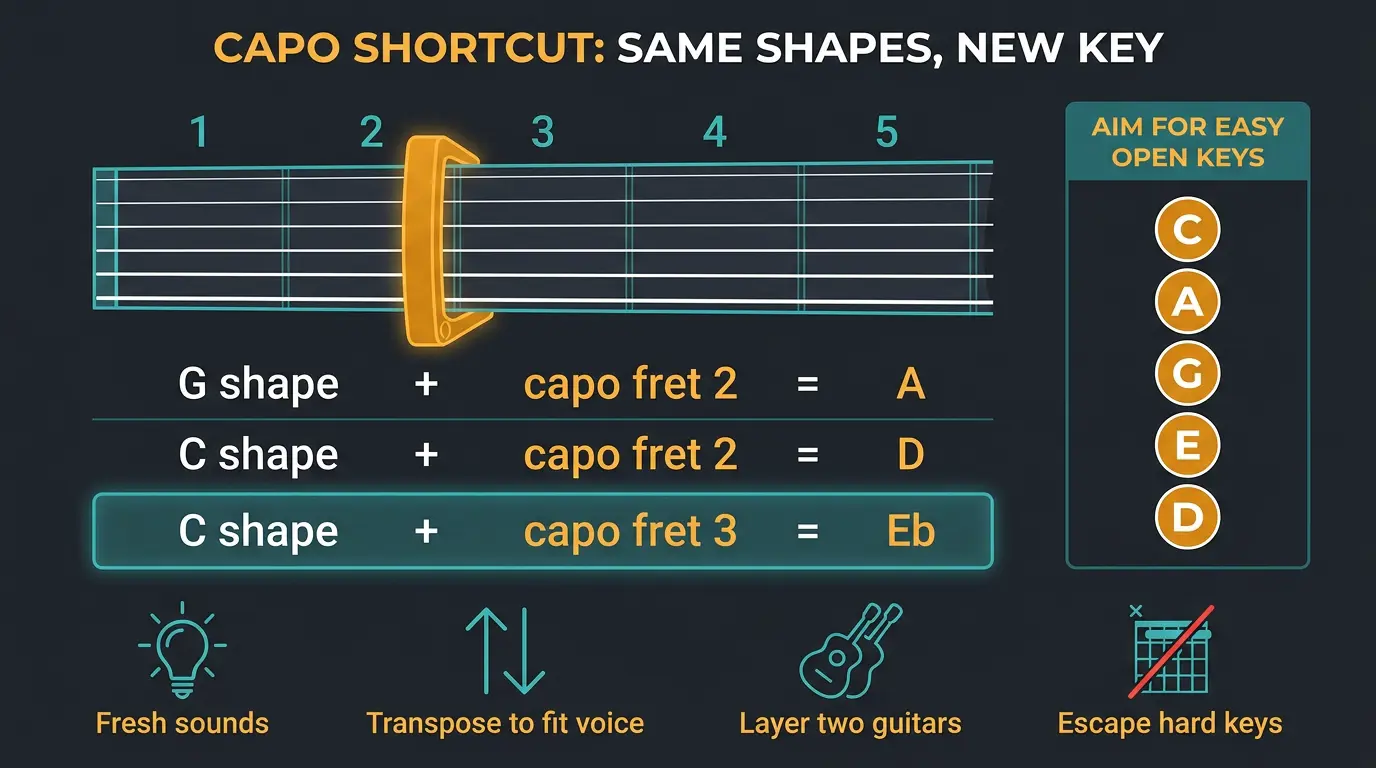
A capo is a clamp you attach to the neck. It shortens the strings and raises their pitch, so think of it as a movable nut. The magic for songwriting is that your chord shapes don't change — you play the same easy open chords, but they sound higher.
Here's where it earns its keep:
- Fresh sounds from familiar shapes. The same three chords in a new spot on the neck can spark a progression you'd never have found otherwise.
- Transposing on the fly. If the key feels too high or low for your voice, slide the capo around until the singing feels comfortable. Make sure you actually sing the melody while you do this — your voice will tell you where it's happy.
- Layering with another guitar. One player capoed, one not, both playing different voicings of the same chords. That's how you get that lush, two-guitar texture.
- Escaping brutal keys. Songs in F, Bb, or Eb are barre-chord city. Nobody wants to play in Bb unless they have to. A capo lets you use open shapes instead.
The mechanics are simple. An open G shape with the capo on the 2nd fret sounds like an A. A C shape with the capo on the 2nd fret becomes a D. So if your song is written in C but your singer needs it in Eb, put the capo on the 3rd fret and keep playing your C shapes — done.
When you're figuring out where to put it, aim for keys that have easy open shapes: C, A, G, E, and D. Count down the fretboard from your target key until you land on one of those. Less fighting with barre chords, more actual songwriting.
Quick songwriting starters
- Pick a key and stick to its chords — in G, that's G, Am, C, D, and Em. They'll all fit together no matter the order.
- Steal a common progression with zero guilt. I–V–vi–IV and I–IV–V are common because they work, and using one isn't copying.
- Writing a riff? Nail the rhythm first, notes second. If people can clap it and recognize it, the rhythm is doing the heavy lifting.
- Use a capo to fit your voice. Slide it up or down until the melody sits comfortably, and keep playing the shapes you already know.
Frequently Asked Questions (FAQs)
What's the easiest way to start writing a song on guitar?
Pick a key, grab three or four chords from it, and hum a melody over them. In G, try G, C, and D. Play them in a loop and sing whatever comes out. That chord-plus-melody combo is already a song — everything after is just refining it.
Do I need to know music theory to write a song?
No, you don't need theory to write a song on guitar. A little bit helps you understand why certain chords sound good together, but you can write plenty using your ears alone. Learn a handful of chords, trust what sounds right, and pick up theory later if you want it.
Is using a common chord progression copying?
No, using a common chord progression isn't copying. Progressions like I–IV–V and I–V–vi–IV appear in thousands of songs precisely because they work, and no one owns them. You'd only run into trouble if you borrowed the progression, the rhythm, and the melody all at once.
What chords should a beginner learn first?
Start with C, G, D, E minor, A minor, and F major. These open chords use a few fingers on nearby frets and cover a huge range of songs. Once those feel natural, you can play most common progressions in guitar-friendly keys without much trouble.
How does a capo help with songwriting?
A capo raises your guitar's pitch without changing your chord shapes, so you can keep playing easy open chords in a higher key. It's great for matching a singer's range, finding fresh-sounding progressions, and escaping barre-chord keys like F or Bb. Just move it up or down until it fits.
Final Thoughts
Writing a song on guitar comes down to a few chords, a melody, and a willingness to trust what your ears are telling you. Start from chords, start from a riff, or throw a capo on and see what shakes loose. There's no wrong door.
The only real mistake is waiting until you "know enough" to begin. You know enough right now. Pick a progression, sing something over it, and go make a mess — that's where the good stuff lives. If you want to keep going, dig into writing lyrics that connect next.
Some of the links within this article are affiliate links. These links are from various companies such as Amazon. This means if you click on any of these links and purchase the item or service, I will receive an affiliate commission. This is at no cost to you and the money gets invested back into Audio Sorcerer LLC.