A catchy chorus comes down to three things: contrast with the verse, a clear hook, and smart repetition. That's most of the game right there. The chorus is the part people remember, hum, and sing in the car — so it has to earn that attention.
Berry Gordy, who built Motown, put it best: "Don't bore us, get to the chorus." That's the job in one line. But there's no magic formula here. This is craft, not magic. It's a handful of things that reliably work, and once you understand why they work, you can bend them to fit your song.
TABLE OF CONTENTS
What a chorus is actually for
The chorus is the emotional peak of the song and the big idea distilled down — the takeaway your verses have been hinting at the whole time. When the listener gets there, you want them to think, "Ah, there it is."
There's a clear division of labor between the verse and the chorus. The verse carries the details: the story, the characters, the sequence of events. The chorus delivers the universal feeling — love, loss, hope, joy — in simple, direct language. That's why the verse lyrics change throughout the song while the chorus repeats the same lines. The verse moves the story forward; the chorus is the heart of it, said the same way every time.
Funny enough, the word "chorus" goes back to ancient Greek theater, where a group of performers would sing or speak in unison to summarize the play so the audience could keep up. Different art form, same job.
Contrast is the engine
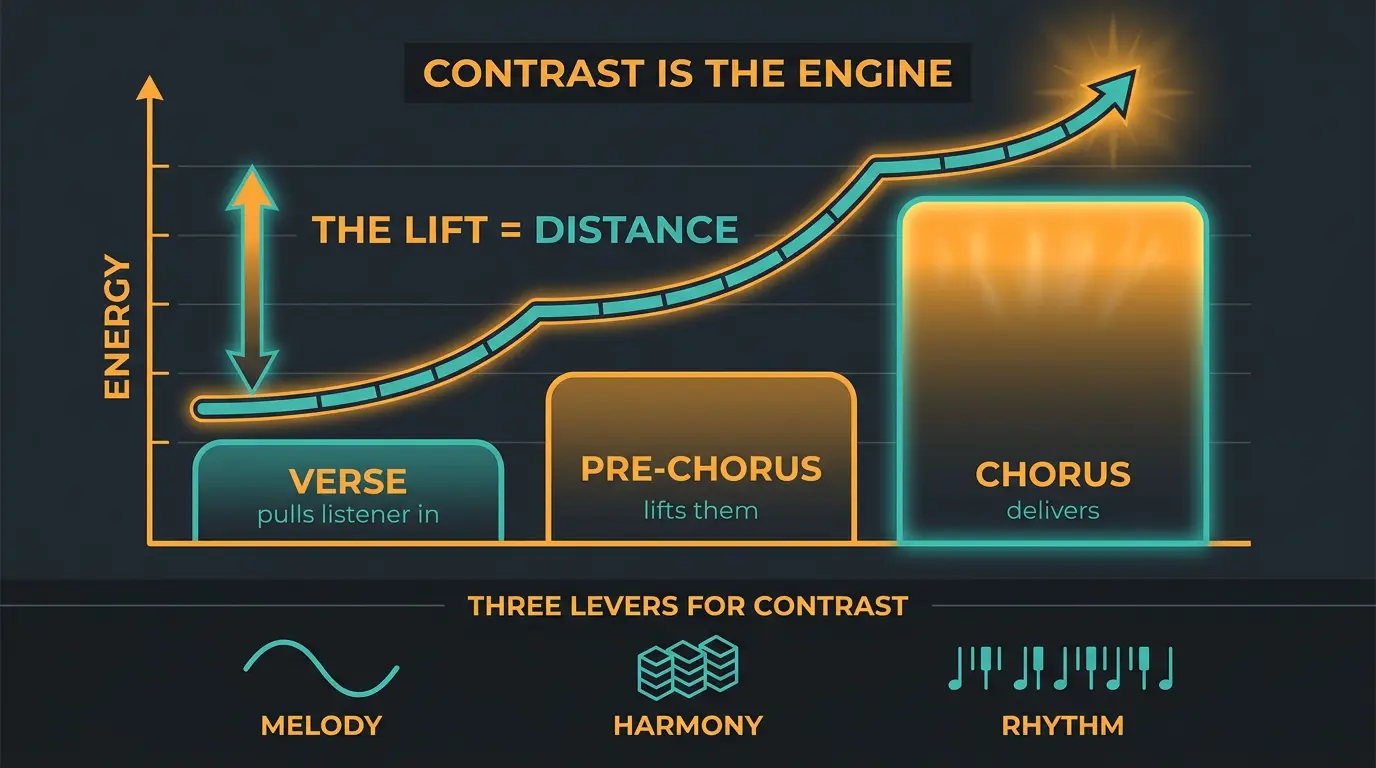
Here's the thing most people miss: a chorus only feels big if the verse sets it up. A loud chorus means nothing if the verse is just as loud. The lift you feel when a great chorus hits isn't really about the chorus — it's about the distance between the chorus and everything before it.
Think of it as an energy arc. The verse pulls the listener in. The pre-chorus lifts them. The chorus delivers. Each section needs to occupy a different space — in melody, energy, volume, or density — or they all blur together. If you've ever written a song where you couldn't quite tell where the chorus started, this is almost always why.
Music has three building blocks — melody, harmony, and rhythm — which means you've got three levers to pull when you want contrast.
Three ways to build contrast
- Melodic. Verses tend to sit in a smaller range with repetitive, stepwise patterns. Choruses open up with broader leaps and bigger phrasing. Make sure the highest note of the whole song lands somewhere in the chorus — that one move alone does a lot of heavy lifting.
- Harmonic. If the verse and chorus share the same chord progression, there's a good chance they'll sound too alike. Pick a different progression for each. The easiest fix is to start each section on a different chord. If you want ideas for how chord choices shape a mood, our breakdown of sad chord progressions and the power of minor keys is a good place to dig in.
- Rhythmic. Keep the verse rhythm basic, then open the chorus up. A classic pop move is going from a straight beat in the verse to a four-on-the-floor feel in the chorus.
You don't need all three. Even one strong contrast can mark the chorus clearly. With that being said, stacking two of them usually feels more satisfying.
The production side of contrast
Contrast isn't only a songwriting thing — production and mixing serve the exact same goal. A common approach is a sparse, subdued verse that opens into a fuller chorus: new instruments come in, the volume and density bump up, and background harmonies spread out across the stereo field.
This is where "less is more" earns its keep. If you fill the verse wall-to-wall, the chorus has nowhere to go. Hold things back early — strip the verse down, leave space — so when the chorus arrives, the contrast does the work for you. Songwriting, production, and mixing are all pulling on the same rope: build anticipation, then pay it off.
The pre-chorus, or lift
A pre-chorus is a short transitional section between the verse and the chorus, usually 4 to 8 bars, built to create tension so the chorus hits harder. You'll also hear it called a "lift" or a "channel," which honestly describes the job better than "pre-chorus" does.
The trick is to make it sit between the verse and the chorus in both range and intensity. Use ascending melodic lines, a little rhythmic acceleration, or some harmonic tension to build forward momentum. A favorite move is starting the pre-chorus on a chord that destabilizes the tonic — it creates a sense of suspension that the chorus then resolves. That resolution is the satisfying part.
One thing to be clear about: the pre-chorus is completely optional. Plenty of great songs go straight from verse to chorus. It's a tool, not a rule.
Repetition and the hook
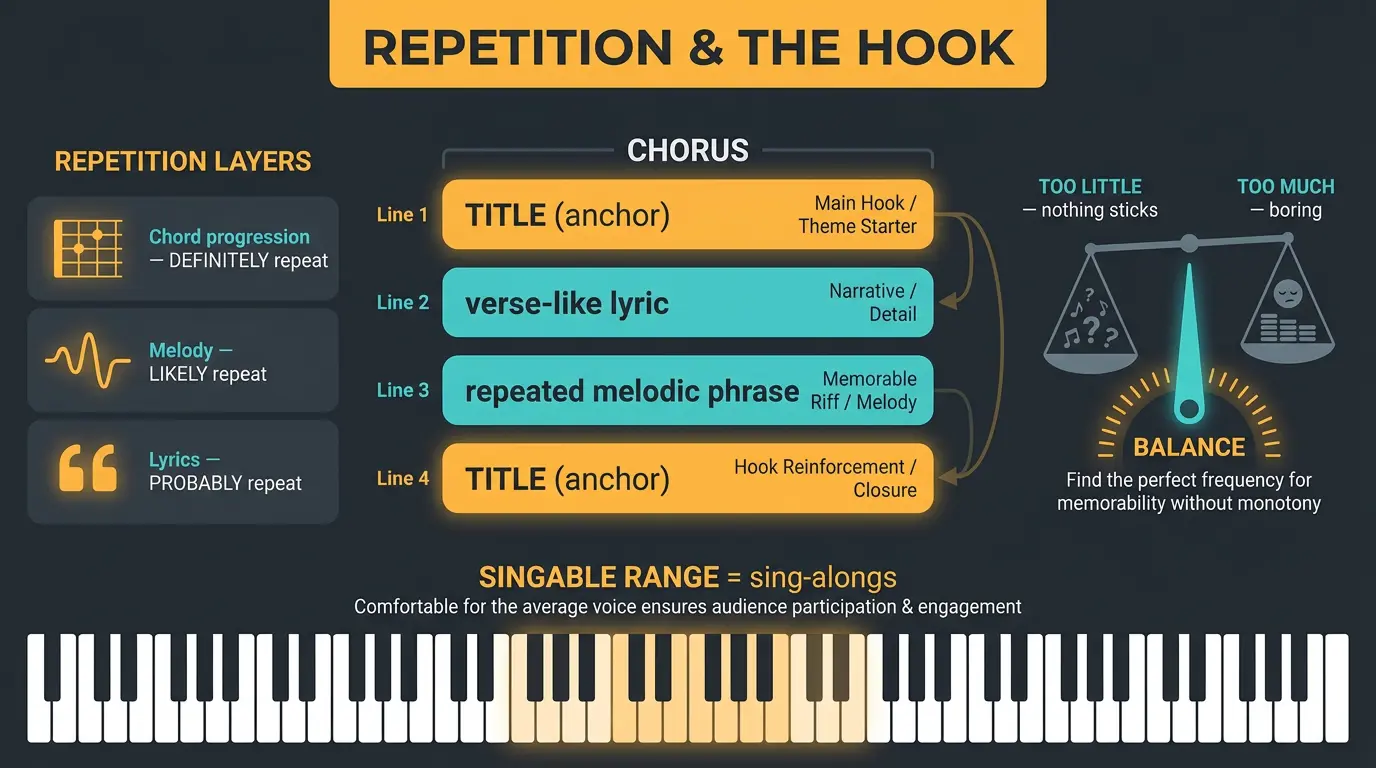
A hook is anything that lodges in memory and won't leave — lyrical, melodic, or rhythmic. It's the bit that gets under the skin and refuses to budge. Every catchy chorus has at least one.
Repetition is how you get there, and it's structural, not lazy. If your chorus has four completely different melodies, none of them will stick. You need repetition somewhere — definitely in the chord progression, most likely in the melody, and probably in the lyrics. That repetition is what tells the listener's brain, "This is the part that matters."
The title is your best anchor. Putting it as the first and last line of the chorus is a strong, reliable move — but it's worth experimenting with placement. Try it up front, at the back, or both, and see what feels right. And make sure you keep the melody in a range most people can actually sing. Comfortable range invites sing-alongs, and sing-alongs are how a chorus spreads.
The catch: too much repetition gets boring. There's a balance, and your ears will tell you when you've crossed it.
What makes a chorus stick in your head
There's actual research on this. A study by Jakubowski and colleagues, published by the American Psychological Association in 2016, found that earworms tend to share a couple of traits: a fairly fast tempo and an easy-to-remember melody. Repetition is the engine behind it — repeating a melody helps the brain recognize the pattern and store it in long-term memory. That's exactly why the chorus, the part that repeats most, is usually the most memorable part of a song.
There's also the sing-along angle. One theory is that earworms come from an unconscious urge to sing along, where an easy-to-sing fragment gets stuck on a loop in your head. Simple, singable phrases get stuck the most. If you're curious how deep this goes, this piece on earworms and musical memory from UC Santa Cruz is worth a read.
Here's the key tension, though: the best choruses are familiar and surprising. Sections feel right when they're distinct enough to register as their own thing, but related enough to feel like the same song. Repetition builds familiarity; a little variation keeps you paying attention. Managing that push and pull is most of what writing a good chorus actually is.
Quick chorus checklist
- Make the chorus contrast clearly with the verse in melody, rhythm, energy, or density.
- Put the highest note of the whole song somewhere in the chorus.
- Anchor the chorus with the song title, often as the first and last line.
- Keep the melody simple and in a singable range so people can sing along.
- Repeat a motif to make it stick — but don't repeat so much that it gets boring.
Common chorus mistakes
A few traps come up over and over. None of them mean you're a bad writer — they're just easy to fall into.
- The chorus sounds too much like the verse. This is the big one. If the chorus and verse share melody, range, and energy, the contrast disappears and the song goes flat.
- Over-complicating it. Too many words, too many ideas, and the chorus loses its punch. When in doubt, cut it out. A simpler chorus almost always lands harder.
- Treating the chorus like a modified verse. The chorus isn't the verse with different words. It's the peak of the song — the place the central idea lives.
- Repetition with no ceiling. Repetition is your friend, right up until it isn't. Past a certain point, it just bores people.
And here's the honest part: there's no magic formula. Writing a great chorus is about capturing a moment or a feeling in a way that feels fresh and true. The techniques above stack the odds in your favor — but in the end, trust your ears. If you want to zoom out and see how the chorus fits the bigger picture, our step-by-step guide to writing a song covers the whole structure.
Frequently Asked Questions (FAQs)
What makes a chorus catchy?
A catchy chorus comes from contrast with the verse, a clear hook, and smart repetition. The hook — a melodic, lyrical, or rhythmic idea — gives the listener something to grab onto, and repetition helps the brain store it in long-term memory. Keep it simple and singable, and it sticks.
Should the chorus be higher than the verse?
Usually, yes. Lifting the chorus into a higher register is one of the most reliable ways to make it feel like the song's peak. A good rule of thumb is to put the highest note of the whole song somewhere in the chorus. It's not mandatory, but it works.
Do I need a pre-chorus?
No, a pre-chorus is completely optional. Plenty of great songs go straight from verse to chorus. A pre-chorus, or "lift," builds tension over 4 to 8 bars so the chorus hits harder — use it when your chorus needs more runway, skip it when the song already flows.
How many times should I repeat the title in a chorus?
There's no fixed number, but using the title as the first and last line of the chorus is a strong, common move. It anchors the central idea without overdoing it. Experiment with placement — front, back, or both — and trust your ears on when repetition starts to feel like too much.
Why does my chorus sound too much like my verse?
It usually means they share too much — same melody range, same chord progression, same rhythm, or same energy level. Change at least one clearly: lift the melody higher, start the chorus on a different chord, or open up the rhythm. Contrast is what tells the listener the chorus has arrived.
Final Thoughts
None of this is about following a checklist to the letter. Contrast, a hook, and the right amount of repetition give you a strong foundation — but the magic, if you want to call it that, is in the writing itself. Capture a real moment and say it simply.
So write the chorus, then play it back and ask yourself honestly: does it feel bigger than the verse, and would you sing along? If the answer's yes, you're most of the way there. If it's not quite landing, you usually don't need more — you need more contrast. Trust your ears and keep at it.
Some of the links within this article are affiliate links. These links are from various companies such as Amazon. This means if you click on any of these links and purchase the item or service, I will receive an affiliate commission. This is at no cost to you and the money gets invested back into Audio Sorcerer LLC.