Relative major and minor are two keys that share the exact same key signature but center on different home notes. The classic example: C major and A minor. Both have no sharps and no flats, so they're built from the same seven notes — they just don't sound the same, because the tonal center is different.
This post covers what that relationship actually is, how to find one key from the other in a couple seconds, and why songwriters lean on it to shift mood without a jarring key change. There's also one mix-up that trips almost everyone up, so stick around for that.
TABLE OF CONTENTS
What relative major and minor actually means
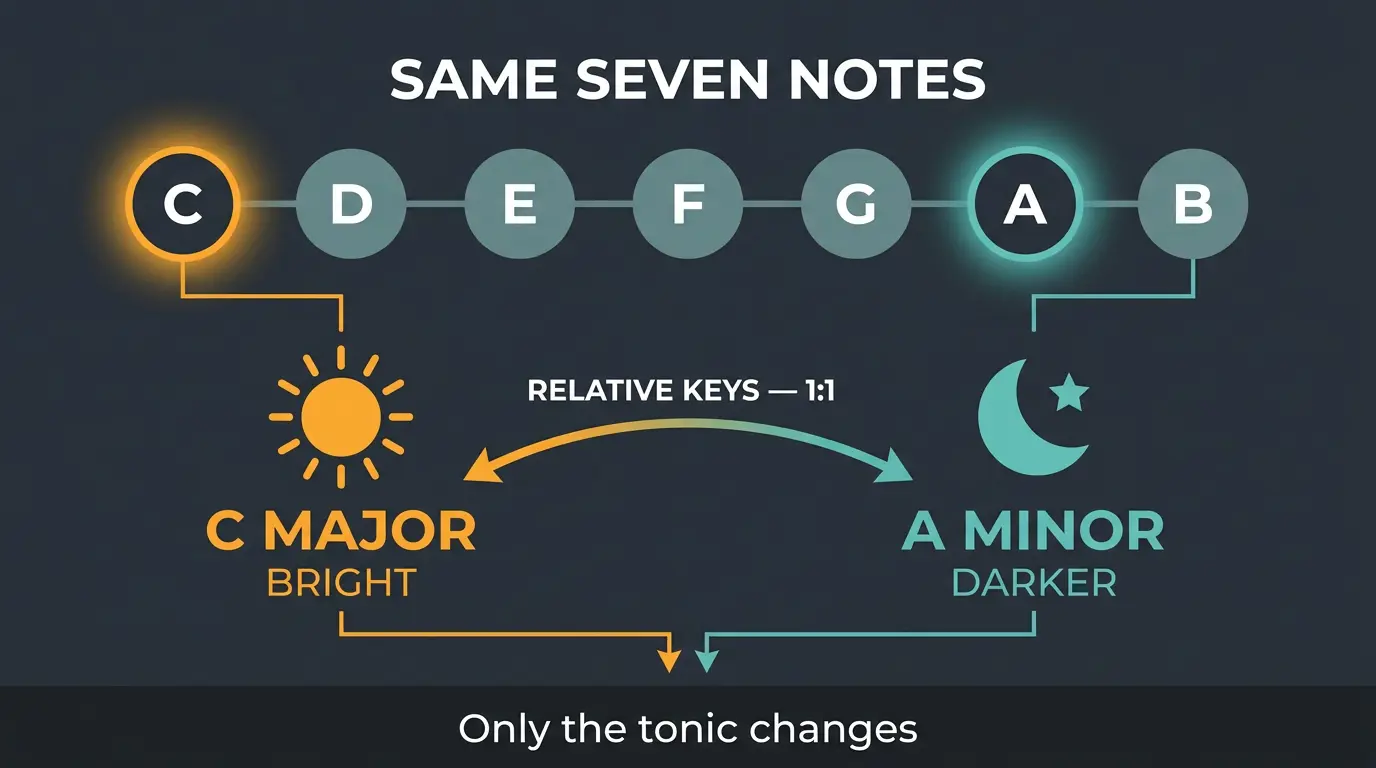
A relative major and minor are two keys — one major, one minor — that share the same set of sharps or flats. Same seven notes. The only thing that changes is the tonic, which is the note that feels like home.
Take C major. No sharps, no flats. Its relative minor is A minor, which also has no sharps and no flats. Same pitches, start to finish. Every major key has exactly one relative minor, and every minor key has exactly one relative major. It's a one-to-one relationship.
Here's the part that matters most: the notes don't change the mood, the tonal center does. Play those seven notes and land on C, and it feels bright. Play the same seven notes and land on A, and it leans darker. Same ingredients, different center of gravity.
How to find the relative minor from a major key
There are two ways to do this, and they get you to the same place.
- Count down a minor third. That's three semitones down from the major tonic.
- Go to the 6th degree of the major scale. Whatever note sits on the sixth is your relative minor.
Make sure you go down a minor third, not up. Direction matters here — go the wrong way and you'll land on the wrong key.
Watch out for letter names too. From C down to A is two letter names, not three. Trust the interval, not the alphabet. Here are a few worked examples:
- C major → A minor (no accidentals)
- G major → E minor (one sharp: F#)
- F major → D minor (one flat: Bb)
If you know your scale degrees, the 6th-degree method is usually the fastest way to get there.
How to find the relative major from a minor key
Just flip it. Go up a minor third from the minor tonic, or find the note on the 3rd degree of the natural minor scale — that's your relative major.
So from A minor, up three semitones gets you to C major. Same pair, approached from the other side.
Relative vs. parallel keys (don't mix these up)
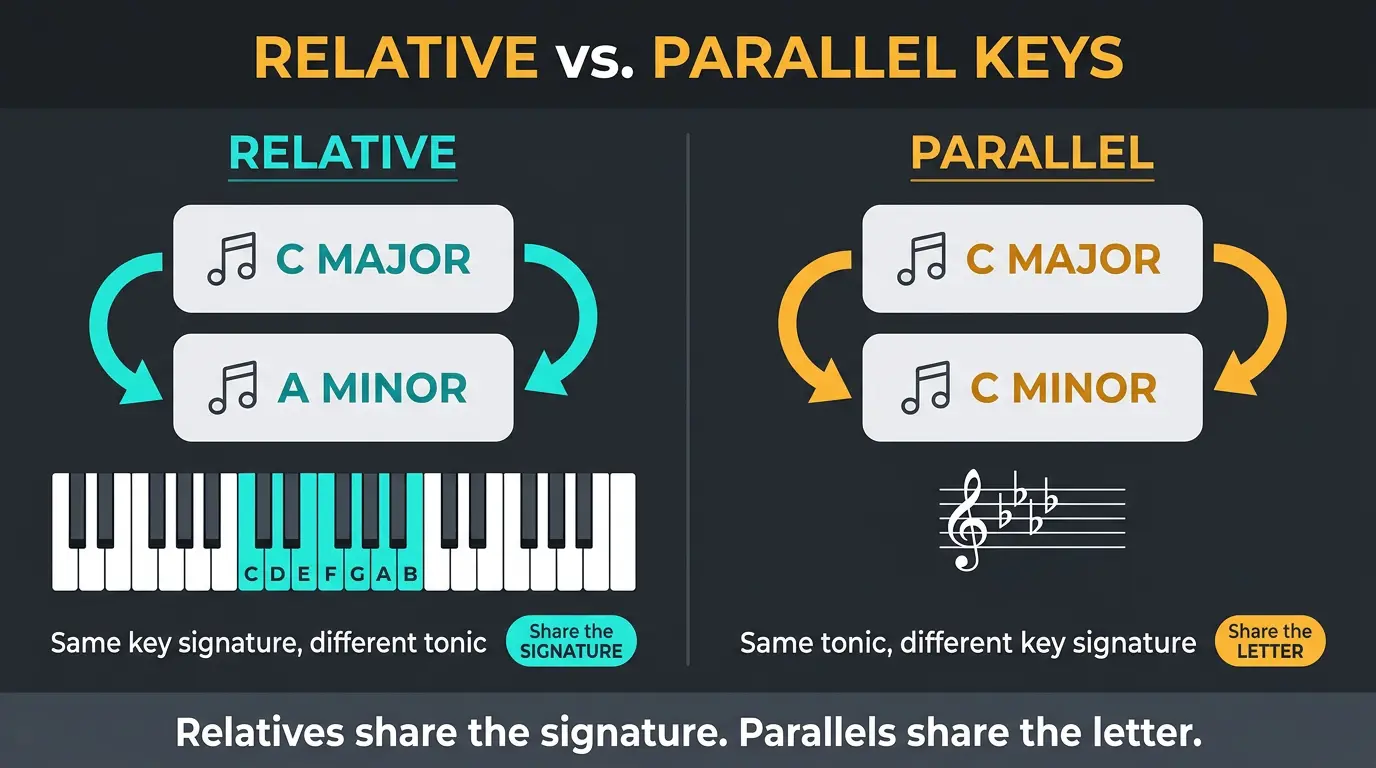
This is where a lot of people get tangled, and the terminology genuinely matters here.
Relative keys share a key signature but have different tonics. C major and A minor — same seven notes, different home note.
Parallel keys share the tonic but have different key signatures. C major and C minor — same home note, but C minor has three flats.
People conflate them because both involve a major and a minor key that feel connected. The clean way to remember it: relatives share the signature, parallels share the letter. If the letter name stays the same (C to C), it's parallel. If the sharps and flats stay the same (C major to A minor), it's relative.
Common mistakes to avoid
- Relative keys don't sound the same. They share every note, but the tonal center is different, so the mood is different.
- It's down a minor third from major to minor, not up. Go the wrong direction and you'll land on the wrong key.
- It's a minor third, not a major third. The wrong interval puts you a whole step off.
- The raised 7th in harmonic minor is an accidental, not part of the key signature, so it doesn't break the shared-signature rule.
| Key Signature | Major Key | Relative Minor |
|---|---|---|
| No sharps/flats | C major | A minor |
| 1 sharp | G major | E minor |
| 2 sharps | D major | B minor |
| 3 sharps | A major | F# minor |
| 4 sharps | E major | C# minor |
| 5 sharps | B major | G# minor |
| 6 sharps | F# major | D# minor |
| 7 sharps | C# major | A# minor |
| 1 flat | F major | D minor |
| 2 flats | Bb major | G minor |
| 3 flats | Eb major | C minor |
| 4 flats | Ab major | F minor |
| 5 flats | Db major | Bb minor |
| 6 flats | Gb major | Eb minor |
| 7 flats | Cb major | Ab minor |
How songwriters use relative keys

Because relatives share a key signature, moving between them is smooth. No new accidentals show up, so a shift from one to the other doesn't sound like a hard turn. That's what makes this useful in practice.
A few ways it shows up in writing:
- Verse and chorus contrast. Write the verse leaning on the minor tonic and the chorus leaning on the relative major (or the other way around) for a lift or a drop without a jarring change.
- The vi chord is the door. The vi chord of a major key is the tonic of its relative minor. In C major, that's A minor — so you're already sitting on the pivot point.
- One note pool for soloing. Since both keys share the same notes, a single scale works over sections that alternate between them. Handy for improvisation.
- Recolor a chord loop. Take a familiar progression and treat a different chord as home. Vamping on Am instead of C repaints the same notes in a darker light.
One honest caveat: the whole "major is happy, minor is sad" thing is a generalization. It's a starting point, not a law. If you want to go deeper on how minor keys color a progression, we broke that down in minor key chord progressions and the moods they create. Trust your ears over the rulebook.
Where the circle of fifths fits in
The circle of fifths already maps this relationship out for you. Each position shows the major key on the outer ring and its relative minor on the inner ring, so it doubles as a fast lookup — glance at the circle and both keys are right there together.
If you want the full walkthrough of how the circle works, we covered it in our practical guide to the circle of fifths. For relative pairs, just remember: outer ring major, inner ring minor.
Frequently Asked Questions (FAQs)
What is the relative minor of C major?
The relative minor of C major is A minor. Both keys share the same key signature — no sharps and no flats — and use the exact same seven notes. The difference is the tonic: C is home in C major, A is home in A minor.
How do you find the relative minor of any key?
To find the relative minor, count down a minor third (three semitones) from the major tonic, or go to the 6th degree of the major scale. Both land on the same note. Just make sure you go down, not up, or you'll get the wrong key.
What's the difference between relative and parallel keys?
Relative keys share the same key signature but have different tonics, like C major and A minor. Parallel keys share the same tonic but have different key signatures, like C major and C minor. Relatives share the sharps and flats; parallels share the letter name.
Do relative major and minor sound the same?
No, relative major and minor don't sound the same. They contain the identical seven notes, but each key centers on a different tonic, which changes the mood. Major tends to sound brighter and minor darker, though that's a generalization more than a hard rule.
Why do relative keys share the same notes but feel different?
Relative keys feel different because the tonal center changes, even though the notes don't. Your ear latches onto whichever note functions as home, and that reference point reshapes how every other note sounds around it. Same ingredients, different center of gravity.
Final Thoughts
Relative keys come down to one simple idea: same notes, different home. Once that clicks, finding one from the other takes a couple seconds, and you've got a built-in way to shift mood in a song without wrestling in a bunch of new accidentals.
Learn the C major and A minor pair cold, keep the down-a-minor-third rule in your back pocket, and don't confuse relative with parallel. Everything else is just applying the same idea across the other fourteen pairs.
Some of the links within this article are affiliate links. These links are from various companies such as Amazon. This means if you click on any of these links and purchase the item or service, I will receive an affiliate commission. This is at no cost to you and the money gets invested back into Audio Sorcerer LLC.