There's a royalty stream a lot of artists never collect, and it's not because they did anything wrong. It's because nobody signs them up for it. That stream is SoundExchange.
SoundExchange is a non-profit, established in 2003, and it's already distributed more than $13 billion to over 800,000 music creators. That's real money going to real people. And a chunk of the folks who are owed some of it don't even know it exists.
Here's the practical stakes. If your music has played on Pandora or SiriusXM, you may be owed money you're not getting. Let's walk through what SoundExchange does, what it covers, and why you have to be the one to raise your hand.
TABLE OF CONTENTS
What SoundExchange actually does
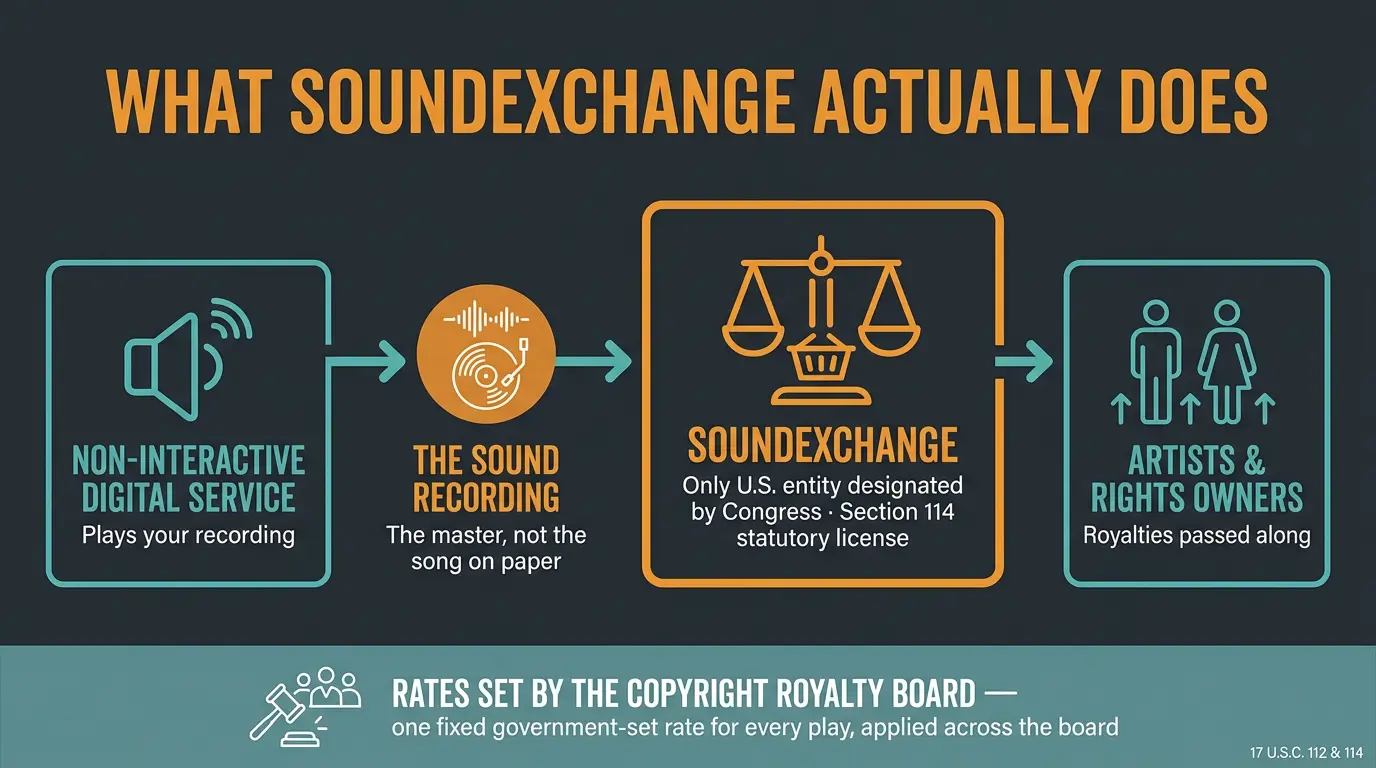
SoundExchange is the only U.S. entity Congress designated to administer the Section 114 sound-recording license. That's the statutory license under 17 U.S.C. §§112 and 114 that lets certain digital services stream recordings while paying a fixed, government-set rate for every play.
What it collects is digital performance royalties for the sound recording — the actual master, the recording being played. Not the song on paper. The recording. When a non-interactive digital service spins your track, that play owes a royalty, and SoundExchange is the one collecting and passing it along to the artists and rights owners it's due to.
The rates aren't negotiated track by track, which is a nice change of pace in the music business. They're set by the Copyright Royalty Board, a three-judge panel. One rate structure, applied across the board.
Which services it covers

The key word here is non-interactive. That means the listener doesn't pick the specific track. They pick a station, a channel, or a genre, and the platform decides what plays next.
Real examples of what that covers:
- SiriusXM
- Pandora's radio mode
- iHeartRadio
- Internet and webcast radio
- Digital-cable music services like Music Choice
Now contrast that with on-demand services. Spotify's on-demand catalog, Apple Music — those let you pick the exact song, so they're licensed differently and don't run through SoundExchange. If you searched for the track and hit play yourself, that's not a SoundExchange play.
One more thing worth knowing: SoundExchange also pulls in international performance royalties through a global partnership network. So it's not just a domestic story.
Where SoundExchange fits in the royalty picture
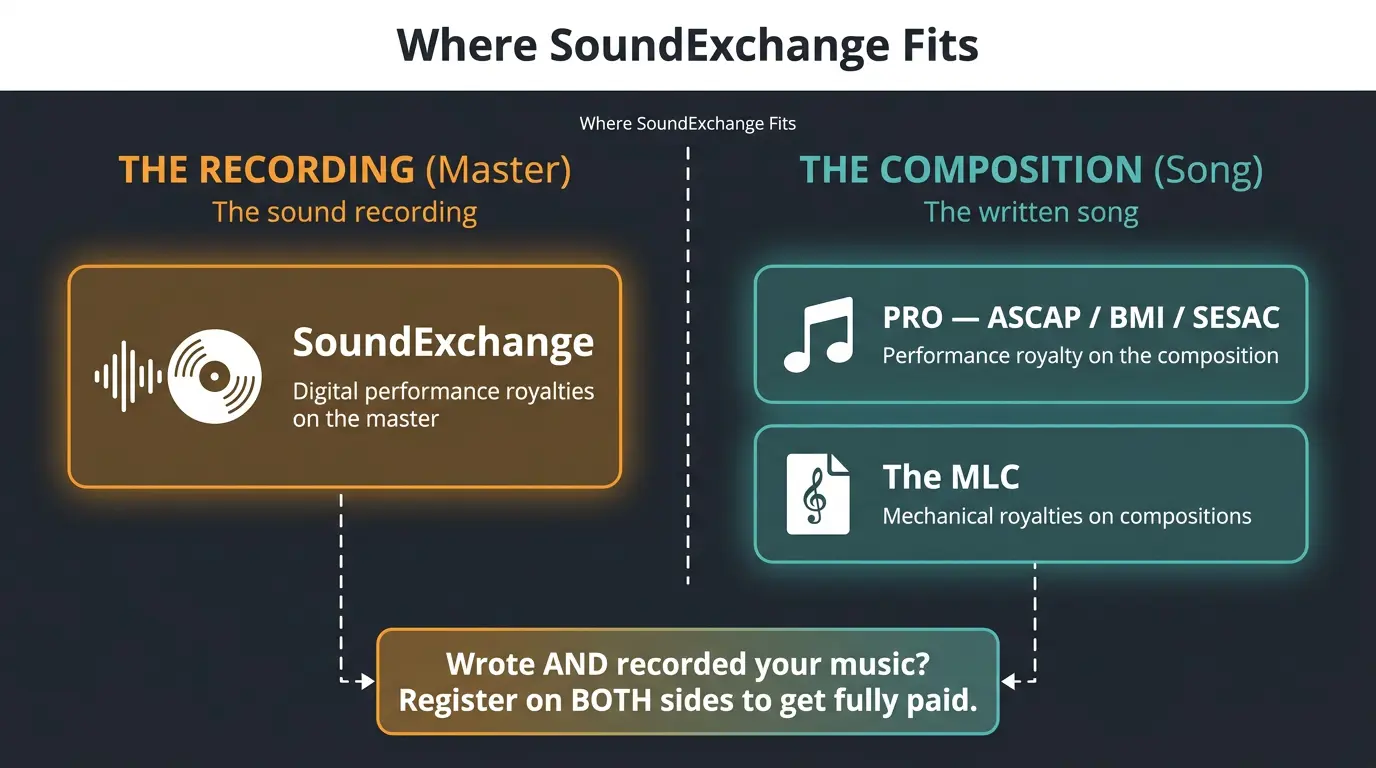
Here's a myth worth killing: SoundExchange does not collect everything. It handles one lane — the sound-recording side, the master. That's it.
The song itself, the composition, is a whole separate right with its own collectors. A PRO — that's ASCAP, BMI, or SESAC — collects the performance royalty on the composition for the songwriter and publisher. The MLC (Mechanical Licensing Collective) collects mechanical royalties on compositions. Different organizations, different rights, different money.
This is the part that actually matters for you. If you wrote and recorded your own music, you may need to register in more than one place to get paid on both sides. Getting your sound-recording royalties from SoundExchange doesn't mean your composition royalties are handled. If you want to go deeper on the composition side, our guide to public performance licensing lays out how those pieces work.
Your distributor does not sign you up for this
This is the most useful thing in the whole post, so I'll say it plainly. DistroKid, TuneCore, and the rest of them do not register you with SoundExchange. Not automatically, not as part of your plan, not tucked away in some checkbox you missed.
You sign up yourself, directly, and you keep 100% of what SoundExchange pays you. No cut going to a distributor. It's your money, in full.
Make sure you go check whether you're actually registered. If your music has been out for a while and you've never set up a SoundExchange account, that's money sitting on the table waiting for you. It doesn't pile up forever, either — go grab it.
The quick version
- SoundExchange collects digital performance royalties on the sound recording — the master, not the composition.
- It covers non-interactive services like SiriusXM, Pandora's radio mode, iHeartRadio, and webcast radio.
- It's separate from PROs (ASCAP, BMI, SESAC) and the MLC, which handle the composition side.
- You have to register yourself, because distributors like DistroKid and TuneCore won't do it for you.
How the royalties get paid — and how the rates work
First, what's a "performance"? It's every time one listener hears one song. So if a station has 10 listeners in an hour and each of them hears 10 songs, that's 100 performances. Simple math, but it adds up fast across millions of listeners.
For webcasting and simulcasting, the Copyright Royalty Board sets a rate per performance, and it steps up over time. The current framework runs 2026 through 2030 and came out of an agreement with the National Association of Broadcasters. The per-performance rate climbs a little each year across that window. You can see the scale of what gets paid out in SoundExchange's Q2 2025 distribution report — $241 million in a single quarter.
SiriusXM works differently. Being satellite, it's licensed as a percentage of revenue rather than per performance. Same collector, different math.
The stories worth watching

Two things are in motion right now that are worth keeping an eye on. Both are developing, so treat them as snapshots, not final answers.
SoundExchange vs. SiriusXM. SoundExchange sued SiriusXM alleging underpayment, an amount now estimated at over $400 million, tied to how SiriusXM allegedly shifted revenue from satellite to streaming. In August 2025, a federal court dismissed the case — not on the money, but on standing. The judge ruled SoundExchange has no private right of action to sue. Congress gave that power to the MLC, but chose not to hand it to SoundExchange. SoundExchange appealed to the Second Circuit, and it's still pending. If the dismissal holds, SoundExchange may be limited to audits and arbitration to chase down what it's owed.
The American Music Fairness Act. Here's a gap that surprises people: traditional AM/FM radio in the U.S. doesn't pay performers at all. Internet radio pays, satellite pays, cable pays — terrestrial radio doesn't. This bill (H.R. 861 / S. 326) would finally require it to. It's got bipartisan support and keeps gaining co-sponsors, but it's not law yet. That gap doesn't just cost domestic dollars, either — it costs U.S. artists over $200 million a year in overseas royalties, because most other countries won't pay U.S. artists when we don't offer them the same right in return.
Frequently Asked Questions (FAQs)
Do I have to pay SoundExchange to sign up?
No. Registering with SoundExchange is free, and you keep 100% of what they pay you with no cut going to a distributor. Anyone charging you to register is selling you something you can do yourself in a few minutes.
Does DistroKid or TuneCore register me with SoundExchange?
No. Neither DistroKid nor TuneCore registers you with SoundExchange — you have to sign up directly, yourself. This trips up a lot of artists who assume their distributor handles everything. It doesn't cover this stream.
Is SoundExchange the same as a PRO like ASCAP or BMI?
No. A PRO like ASCAP or BMI collects performance royalties on the composition for songwriters and publishers, while SoundExchange collects performance royalties on the sound recording — the master. They're separate organizations covering separate rights, and you may need both.
Does SoundExchange cover Spotify and Apple Music streams?
No. SoundExchange only covers non-interactive services where the listener doesn't pick the exact track. On-demand platforms like Spotify's main catalog and Apple Music let you choose the song, so they're licensed differently and don't run through SoundExchange.
Who can register with SoundExchange — artists, labels, or both?
Both. Featured artists and rights owners like labels can each register with SoundExchange, because the royalties are split between the two sides. If you're an independent artist who owns your own masters, you'd register on both sides to collect the full amount.
Final Thoughts
SoundExchange isn't complicated once you see where it fits. It collects digital performance royalties on your recordings from non-interactive services, it's separate from the composition side, and nobody's going to sign you up but you. That last part is the whole ballgame.
If you've got music out and you've never checked, go check today. It's free to register, and there could be money waiting on you. While you're squaring away the business side, it's worth making sure your releases carry proper ISRC codes too, since that's how these plays get tracked back to you in the first place.
Some of the links within this article are affiliate links. These links are from various companies such as Amazon. This means if you click on any of these links and purchase the item or service, I will receive an affiliate commission. This is at no cost to you and the money gets invested back into Audio Sorcerer LLC.