An augmented chord is a major triad with a raised fifth. Take C major (C–E–G), sharp the G to G♯, and you've got C augmented. That's the whole change — one note moves up a half step.
It's the fourth member of the triad family, sitting alongside major, minor, and diminished. And unlike the other three, it sounds tense and unsettled on purpose. That's not a bug. That's the entire reason songwriters reach for it.
TABLE OF CONTENTS
What an augmented chord actually is
An augmented triad has three notes: the root, a major third, and an augmented (raised) fifth. In C, that's C–E–G♯. Compare it to plain C major (C–E–G) and you'll see the raised fifth is the only difference. Nothing else moves.
Here's the tidy part. It's a stack of two major thirds. C to E is a major third, and E to G♯ is another major third. In semitones the chord is {0, 4, 8} — every note sits two whole steps above the one below it.
You'll see it written a couple of ways. The symbol is either a plus sign (C+) or "aug" (Caug). Same aug chord, different shorthand. And a quick heads-up on that raised fifth: the sharp is just how we spell it in this key. It doesn't mean the note is literally always a sharp — it means the fifth is raised a half step from wherever it naturally sits.
How it completes the triad family
There are four triad qualities: major, minor, diminished, and augmented. Once you understand the augmented chord, you've got the full set.
The naming logic is worth getting straight. Major and minor triads are named for their third — a major third gives you major, a minor third gives you minor, and both keep a perfect fifth. Diminished and augmented are named for their fifth. A diminished triad lowers the fifth; an augmented triad raises it.
So if you've already worked through how major and minor chords shape the sound of music and gotten comfortable with diminished chords, augmented is the last corner of the room. Two chords named for their third, two named for their fifth. Clean.
Why it sounds so unmoored: symmetry
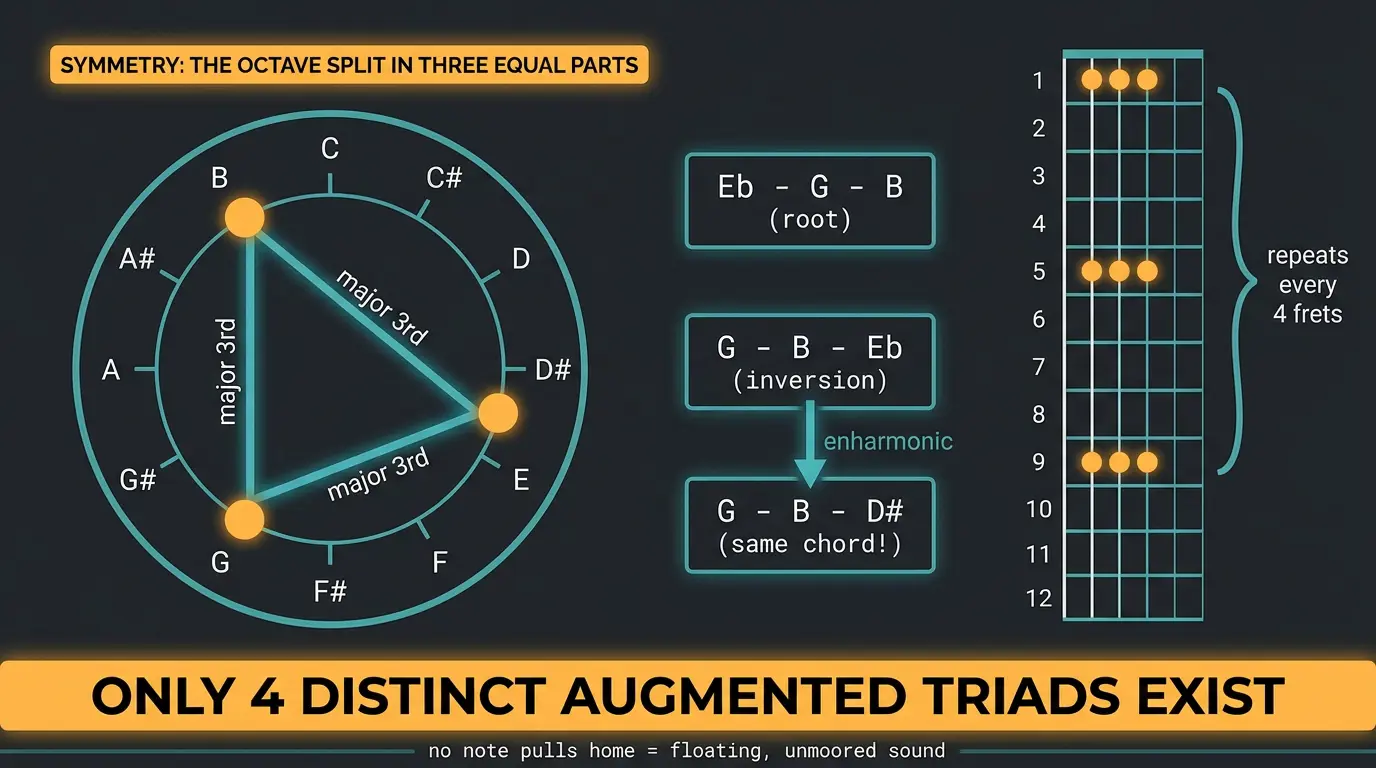
Because the augmented triad is two equal major thirds, it splits the octave into three even pieces. It's perfectly symmetrical, and that symmetry has some strange consequences.
Flip it around and the inversions come out as new augmented triads. Take E♭–G–B. Invert it to G–B–E♭, and that's enharmonically the same as G–B–D♯ — a G augmented triad in root position. So an augmented chord and its inversions are all, in effect, the same chord viewed from different roots.
That's also why there are only four distinct augmented triads across all 12 keys. And for guitarists, it's a gift: one shape repeats every four frets up the neck. If you've been working through chord inversions on other chord types, this is the one where the rules bend.
The deeper point is the emotional one. Because the chord divides the octave evenly, no note pulls harder than the others. It doesn't point to a home key. That rootless, floating quality is exactly where the unease comes from.
The whole-tone connection
Stack two augmented triads a whole step apart and you get a whole-tone scale. C augmented (C–E–G♯) plus D augmented (D–F♯–A♯) gives you C–D–E–F♯–G♯–A♯ — the C whole-tone scale.
The reason it sounds dreamy and blurred is the same reason the augmented chord sounds unmoored. Every note is the exact same distance from its neighbors, so nothing stands out and nothing feels like home. Debussy leaned on this all over his writing to get that hazy, weightless color.
Jazz players use it too. Run a whole-tone scale over a dominant #5 chord — a G whole-tone over G7♯5, for instance — and you get that shimmering, unresolved tension right where you want it.
Where it comes from harmonically
Quick myth to bust: the augmented triad is not diatonic to any major key. Build triads on the major scale all day and you'll never get one. It's always a chromatic chord, because it needs at least one note from outside the key.
Its one natural home is harmonic minor, where it shows up as III+. That's the only spot in the standard major/minor system where an augmented triad appears without borrowing a note. If you want to dig into that outside-the-key idea further, our piece on diatonic vs chromatic lays out the groundwork.
The other everyday use is as a chromatic passing chord between V and I. That's where most songwriters actually meet it, so let's get practical.
How songwriters use it for lift and tension
The whole trick lives in that raised fifth. The G♯ in a C+ chord wants to keep climbing a half step to A. Your ear hears it and leans forward, waiting for the resolution. That's the engine.
Try it yourself. Play C (C–E–G), then sharp the G to make C augmented (C–E–G♯), then move to F (F–A–C). Hear how the G♯ telegraphs the A that's coming? That's the augmented chord working as a dominant substitute and a swell at the same time.
The classic move is I → I+ → IV, walking that inner voice up chromatically. The Beatles loved this. In "From Me to You," a G barre chord slides into Gaug at the end of the bridge, creating a little swell before it moves on. "Oh! Darling" opens on Eaug in the key of A, and that longing pull makes the arrival on A feel earned. George Harrison had a nickname for it — he called it the "naughty chord."
The Beach Boys' "The Warmth of the Sun" goes from G7 to G+ to pull back up to C, and it lands like a sigh. That's augmented chord music at its best: a plain seventh would've done the job, but the augmented version aches a little more. With that being said, the takeaway is restraint. One well-placed augmented chord does more than five of them. Less is more.
Quick ways to use augmented chords
- Place an augmented chord right before your resolution chord, often one a half step above its root, to build a pull into the next moment.
- Use the I to I+ to IV swell to add a chromatic lift without changing the destination of your progression.
- Substitute an augmented chord for the dominant V — the raised fifth acts as a leading tone into the third of your tonic.
- Use it sparingly. The tension only lands when it's rare, so one per section usually beats one per bar.
Frequently Asked Questions (FAQs)
What is an augmented chord?
An augmented chord is a three-note triad made of a root, a major third, and a raised (augmented) fifth. It's a major chord with its fifth pushed up a half step. That raised fifth gives it a tense, unsettled sound, which is why songwriters use it to build tension before a resolution.
What notes are in a C augmented chord?
A C augmented chord contains C, E, and G♯. It's a C major chord (C–E–G) with the fifth raised a half step from G to G♯. You'll see it written as C+ or Caug, and it's built from two stacked major thirds — C to E, then E to G♯.
What's the difference between augmented and diminished chords?
An augmented chord raises the fifth of a major triad, while a diminished chord lowers the fifth of a minor triad. So augmented stacks two major thirds and sounds bright but unstable; diminished stacks two minor thirds and sounds dark and tense. Both are named for their altered fifth, not their third.
Are augmented chords major or minor?
Augmented chords are neither strictly major nor minor — they're their own quality, built on a major third and a raised fifth. They start from a major triad, so they have a major third at the bottom, but the raised fifth removes any sense of a stable key, which is why they sound so floating and unresolved.
When should you use an augmented chord in a song?
Use an augmented chord when you want to build tension right before a resolution, especially heading into a chord a half step above its root. It works well as a swell (I to I+ to IV) or as a substitute for the dominant. Use it sparingly so the tension actually lands.
Final Thoughts
The augmented chord isn't the one you'll reach for every day, and that's the point. Its whole personality is tension, so it works best as a spice, not a main ingredient. Drop one in before a resolution, let that raised fifth pull upward, and you've got a moment that grabs the ear.
Play around with the I to I+ to IV move and the G7 to G+ trick from "The Warmth of the Sun." Trust your ears — there's no single right spot for it. If you want to read more on the theory side, the augmented triad entry on Wikipedia goes deep on the classical and jazz history.
Some of the links within this article are affiliate links. These links are from various companies such as Amazon. This means if you click on any of these links and purchase the item or service, I will receive an affiliate commission. This is at no cost to you and the money gets invested back into Audio Sorcerer LLC.