A diminished chord is a stack of minor thirds that sounds tense and unresolved, like it's leaning toward something it hasn't reached yet. Its two main jobs are simple: a passing chord that connects two others smoothly, and a stand-in for a dominant seventh that pulls toward resolution.
That tense, restless quality is exactly what makes it useful. Here's how diminished triads and seventh chords are built, why they sound the way they do, and a handful of real progressions you can drop into your own music today.
TABLE OF CONTENTS
How diminished chords are built
A diminished triad is a minor triad with the fifth lowered a half step. In formula terms, that's 1, ♭3, ♭5. Another way to see it: two minor thirds stacked on top of each other.
Take C as the root. A minor third up gets you E♭. Another minor third up from E♭ gets you G♭. So C diminished is C, E♭, G♭.
The name comes from that flat fifth. C up to G♭ is a diminished fifth — six semitones — which is the same distance as a tritone. That interval is the whole reason these chords sound the way they do.
Diminished 7th vs half-diminished
Once you add a seventh, you get two flavors, and the only thing separating them is that top note.
A fully diminished seventh (dim7 or °7) keeps stacking minor thirds: 1, ♭3, ♭5, ♭♭7. So Cdim7 is C, E♭, G♭, A. Every note sits a minor third from the last.
A half-diminished seventh (m7♭5 or ø7) is 1, ♭3, ♭5, ♭7. That's literally a minor 7 chord with a flat five. Both chords sit on top of the same diminished triad — the seventh is the only difference. This is the same seventh-building logic covered in our guide to seventh chords and how to use them.
A quick word on notation
Here's where charts trip people up. "Cdim" or "Co" usually means the three-note triad. But some jazz charts use those same symbols to mean the four-note dim7. Terminology matters, so when a chart isn't clear, confirm from context — look at what's around it and what the voicing needs.
Quick reference for the symbols you'll actually see:
- Diminished triad: dim, °, or m♭5
- Fully diminished 7th: dim7 or °7
- Half-diminished 7th: m7♭5, ø7, or ø
Why diminished chords sound so tense
The tension isn't magic. It's the tritone doing its thing. That flat fifth has been considered dissonant for centuries, and it wants to move.
The dim7 goes a step further. Because it stacks equal minor thirds, it splits the octave into four equal parts, so no single note feels like home. That's why it sounds so suspended and unsettled — and why film, jazz, and classical composers lean on it whenever they want suspense.
So the "mysterious" quality people talk about is just intervals doing their job. Nothing mystical about it.
The symmetry trick that makes them easy
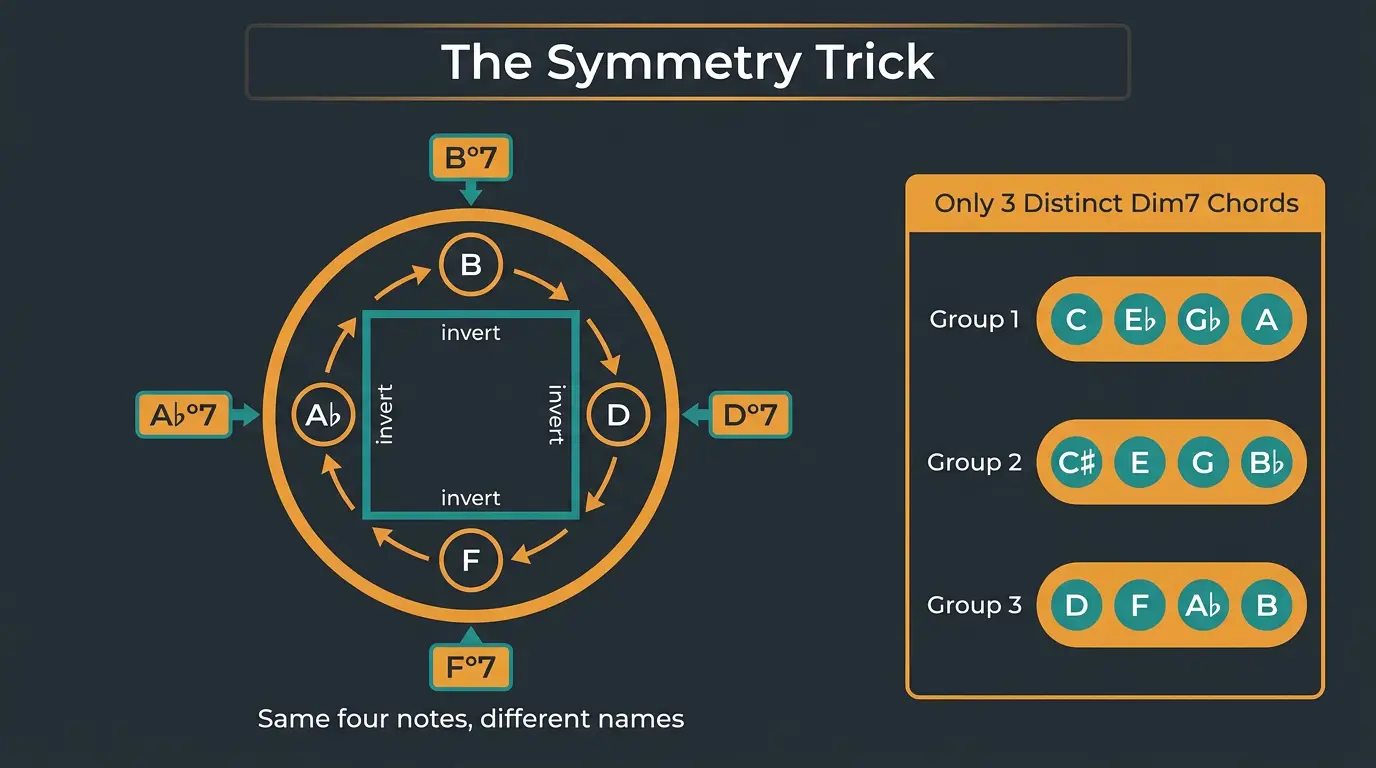
This is the one thing that makes diminished chords click. Because a dim7 is perfectly symmetrical, every inversion of it is also a dim7 — with the exact same notes.
Take Bo7. Invert it and you get Do7. Invert again for Fo7, again for A♭o7. Same four notes every time. They're the same chord wearing different name tags.
Follow that all the way through and you land on something great: there are only three distinct dim7 chords in existence. That's it. Once you point it out, you can hear it — and it means you can grab one of these chords from almost anywhere on your instrument. If inversions are new to you, our post on chord inversions explained simply is a good primer.
Using diminished chords as passing chords
This is the most common use, and it's the easiest to try. A diminished chord slides between two chords that have a stronger relationship to the key, adding a little tension on the way through.
The move is simple: drop a diminished chord in, then resolve it up a half step. A scenario where this might be useful is when a progression feels a bit static and you want a smoother, more melodic climb between two chords.
Try this: C – C#dim – Dm. The C#dim acts as a chromatic bridge, walking you up from C major into D minor. Play it once with the diminished chord and once without, and trust your ears. There isn't a right or wrong answer here — you're deciding whether that little bit of tension earns its place.
Using diminished chords as a dominant substitute
Here's the insight that unlocks a lot of jazz and pop harmony: a dim7 is basically a dominant chord in disguise.
Look at C#dim7 — C#, E, G, B♭. Now look at A7 — A, C#, E, G. They share three notes. In fact, C#dim7 is pretty much an A7 without the root. So a dim7 can stand in for a dominant seventh and pull toward resolution the same way.
This comes from the leading-tone chord. In C major, Bo7 lives on the seventh degree and wants to resolve up to C, and the fully diminished version shows up naturally in harmonic minor with the same dominant pull. You don't need to memorize the theory to use it — just know that a dim7 built a half step below your target chord will tug you home.
Common progressions to try
- ii-V-I with a dim7 for the V. In C major, play Dm7 – Bo7 – Cmaj7. The Bo7 stands in for the dominant and pulls straight into Cmaj7.
- Jazz blues #IVo7. In bar 6 of a jazz blues, turn the IV chord into a #IV diminished chord for a classic chromatic lift back toward the I.
- Pop I-V-vi-IV swap. Replace the V chord with a dim7 or an m7♭5 to add tension and color to an otherwise familiar loop.
- Common-tone diminished. Instead of resolving, use it to embellish and stretch out a chord you're already sitting on. It shares a note with the chords on either side, so it decorates rather than moves.
Frequently Asked Questions (FAQs)
What is a diminished chord?
A diminished chord is a stack of minor thirds built as 1, ♭3, ♭5, giving it a tense, unresolved sound. The triad has three notes; add another minor third and you get a fully diminished seventh. Its main jobs are as a passing chord and a dominant substitute.
What's the difference between diminished and half-diminished?
The only difference is the seventh. A fully diminished seventh (dim7) uses a double-flat seventh — 1, ♭3, ♭5, ♭♭7 — stacking four equal minor thirds. A half-diminished seventh (m7♭5) uses a regular flat seventh — 1, ♭3, ♭5, ♭7 — which is just a minor 7 chord with a flat five.
How many diminished chords are there?
There are only three distinct fully diminished seventh chords. Because a dim7 is symmetrical, its four inversions all share the same notes, so many chords that look different are actually the same one. That symmetry is what makes dim7 chords so easy to grab anywhere.
When should you use a diminished chord?
Use a diminished chord when you want to connect two chords smoothly or add tension that resolves. The two go-to uses are as a passing chord between stronger chords, and as a stand-in for a dominant seventh that pulls toward the next chord. Try it and let your ears decide.
What scale do you play over a dim7 chord?
The whole-half diminished scale is the go-to choice over a dim7 chord. It's an eight-note scale that repeats a pattern of whole steps and half steps, and like the chord itself, it's symmetrical — so the same shape works over the whole dim7 family.
Final Thoughts
Diminished chords look intimidating on paper and turn out to be one of the friendlier tools once you understand the symmetry. Learn the shape, remember there are only three of them, and you've got a chord you can slide in almost anywhere. If you want to dig deeper into the theory behind that flat fifth, the diminished triad reference is worth a read.
Make sure you actually play these into your own progressions rather than just reading about them. Drop a dim7 between two chords, resolve it a half step up, and see how it feels. Less is more — one well-placed diminished chord does more than five of them crammed together.
Some of the links within this article are affiliate links. These links are from various companies such as Amazon. This means if you click on any of these links and purchase the item or service, I will receive an affiliate commission. This is at no cost to you and the money gets invested back into Audio Sorcerer LLC.